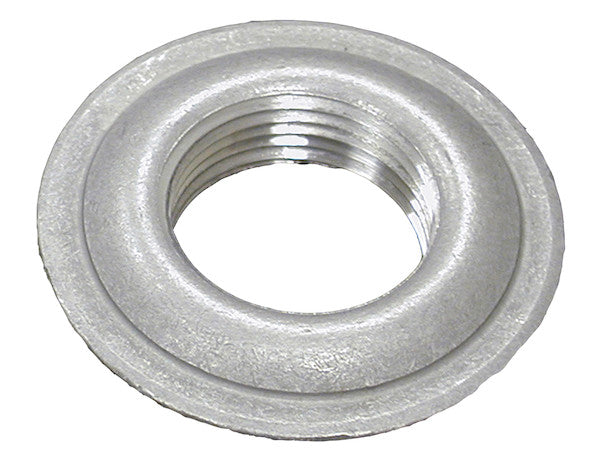
The Stamped Welding Flange from Buyers Products comes in aluminum, steel, and stainless steel in a variety of sizes to meet your reservoir installation needs. Use the flanges when fabricating your own hydraulic reservoir, or adding a port to an existing reservoir. Choose from a wide range of sizes, materials, ODs, and thicknesses to match your requirements.
Specifications
| Construction | Stamped |
|---|---|
| Finish | Smooth |
| Material | Aluminum |
| Outer Diameter | 2.890 |
| Pilot | 1.722 |
| Size | 1.550 |
| Thickness | .240 |
Technical Overview: 1-1/4 Inch NPTF Aluminum Stamped Welding Flange
The 1-1/4 Inch NPTF Aluminum Stamped Welding Flange from Buyers Products is a precision-engineered component critical for fluid conveyance systems, particularly those demanding robust, leak-proof connections within aluminum structures. Designed to facilitate the integration of 1-1/4 inch NPTF (National Pipe Taper Fuel) threaded connections into custom-fabricated or modified reservoirs and tanks, its construction from high-quality aluminum, combined with a meticulous stamping manufacturing process, ensures optimal performance, material compatibility, and ease of installation through welding. This detailed description will explore the technical specifications, material advantages, application methodologies, and the intricate considerations for deploying this essential component in various industrial, automotive, and marine environments.
Precision Engineering and Design Specifications
The core utility of this welding flange lies in its adherence to precise dimensional and material specifications, ensuring seamless integration and reliable operation. With a nominal pipe size of 1-1/4 inches, this flange is engineered for compatibility with standard 1-1/4 inch NPTF threaded fittings, hoses, and instrumentation. The "F" in NPTF signifies its dryseal characteristic, a critical feature for pressure and vacuum systems where thread sealants are minimized or eliminated, relying instead on the metal-to-metal interference fit for sealing integrity. This makes it particularly suitable for hydraulic fluid, fuel, and pneumatic applications where preventing leakage is paramount and often regulated by stringent safety and environmental standards.
Key dimensions define the physical attributes and integration profile of this flange. It features an Outer Diameter (OD) of 2.890 inches (approximately 73.41 mm), providing a substantial surface area for secure welding to a tank wall or other structural components. The flange's Thickness is specified at .240 inches (approximately 6.10 mm), offering ample material for a strong, structurally sound weld bead while maintaining a relatively low profile. A critical dimension for alignment and fitment is the Pilot, measuring 1.722 inches (approximately 43.74 mm). This pilot diameter is designed to mate with a corresponding bore in the reservoir wall, ensuring concentricity and facilitating precise positioning prior to welding. The "Size" of 1.550 inches (approximately 39.37 mm) typically refers to an internal diameter or a specific bore dimension relevant to the overall system design, complementing the 1-1/4 inch NPTF thread which dictates the functional connection size.
The "Stamped" construction method is a significant aspect of this product's engineering. Stamping involves placing flat sheet metal, in this case, aluminum, into a press where a tool and die form it into the desired shape. This process offers several advantages: high-volume production with excellent repeatability, ensuring dimensional consistency across all units. Stamping can achieve complex geometries with high precision and typically results in a smooth finish, as specified, beneficial for welding preparation and reducing potential stress concentrators. Cold working during stamping can also enhance the material's strength, contributing to the flange's overall durability.
Material Selection: Advantages of Aluminum
The choice of aluminum for this welding flange is strategic, offering a suite of material properties highly advantageous for its intended applications. Aluminum, specifically alloys commonly used in stamping and welding (e.g., 5052, 6061), provides an exceptional strength-to-weight ratio, making the component lightweight without compromising structural integrity. This is particularly valuable in applications where overall system weight is a critical factor, such as in mobile hydraulic equipment, automotive fuel systems, and aerospace fluid management. Aluminum flanges are significantly lighter than their steel or stainless steel counterparts, reducing manufacturing and operational burdens.
Corrosion resistance is another paramount benefit of aluminum. When exposed to air, aluminum naturally forms a thin, protective oxide layer on its surface, which is highly resistant to further oxidation and many corrosive agents. This passive layer makes aluminum flanges ideal for use in environments with moisture, mild chemicals, or fluctuating temperatures, significantly extending component lifespan and fluid system integrity. This is especially pertinent for hydraulic reservoirs that might contain various fluid types, or for marine applications where saltwater corrosion is a constant threat. While not universally resistant to all aggressive chemicals, its performance in many common hydraulic and fuel environments is superior to unprotected steel.
Aluminum's thermal properties are also noteworthy. It exhibits excellent thermal conductivity, beneficial for dissipating heat within the fluid system or ensuring rapid temperature equilibration. Its relatively low coefficient of thermal expansion, while higher than steel, is manageable within typical operating temperature ranges for hydraulic and fuel systems, reducing the risk of differential expansion issues that could compromise seal integrity or structural connections.
Economically, aluminum often presents a cost-effective solution. While initial material costs can vary, the ease of fabrication (including welding), reduced shipping weights, and long-term durability often result in a lower total cost of ownership compared to alternatives requiring more intensive processing or more frequent replacement due to corrosion or wear.
Understanding the NPTF Dryseal Thread Standard
The specification of a 1-1/4 Inch NPTF thread is fundamental to the functionality and reliability of this welding flange. NPTF, or National Pipe Taper Fuel, is a standard designed to create a pressure-tight joint without absolute reliance on external sealants. The "taper" in NPTF signifies that the threads on both the male and female fittings are tapered (1:16 taper), allowing them to wedge together as they are tightened, forming a mechanical seal.
The "F" for "Fuel" or "Dryseal" is the critical distinction from standard NPT (National Pipe Taper) threads. NPT threads inherently have small spiral leakage paths at the crest and root, necessitating thread sealants. NPTF threads, however, are designed with slightly altered crests and roots to ensure metal-to-metal contact at these points before the flanks (sides of the threads) fully engage. This controlled interference deformation crushes the threads together, filling potential leakage paths and creating a robust, leak-free seal. Various classes of NPTF threads exist (e.g., Class 1, Class 2), with Class 1 being common for general industrial applications due to its excellent dryseal capability. The 1-1/4 inch nominal size refers to the internal diameter of the pipe the thread is designed for, not the actual measured thread diameter.
NPTF threads are particularly beneficial in hydraulic reservoirs and fuel systems. Firstly, they reduce reliance on external sealants, which can degrade, be improperly applied, or contaminate the fluid system. Secondly, in high-pressure hydraulic systems, the inherent sealing mechanism of NPTF provides a more reliable and durable connection against fluid escape. Thirdly, for systems handling volatile or flammable fluids like fuels, the enhanced leak prevention is a critical safety feature, minimizing spill or fire risks. When properly torqued, an NPTF connection offers superior long-term reliability and resistance to vibration and thermal cycling compared to non-dryseal tapered threads.
Versatile Applications in Fluid Systems
The 1-1/4 Inch NPTF Aluminum Stamped Welding Flange is engineered for a diverse range of applications focused on fluid containment and transfer where welding aluminum is feasible and desirable. Its most prominent use is in the fabrication or modification of hydraulic reservoirs. Here, the flange allows system designers and fabricators to precisely position ports for fluid lines (suction, return, auxiliary), sensors, and drain plugs, ensuring optimal flow dynamics and accessibility for maintenance. Custom reservoir fabrication is common in specialized heavy equipment, industrial machinery, and agricultural vehicles where standard solutions may not meet specific space or volume requirements.
Beyond hydraulic systems, this aluminum welding flange finds utility in several other critical areas:
- Fuel Tanks and Systems: For custom fuel tanks in performance vehicles, marine vessels, or generators, the NPTF thread's dryseal capability is essential for preventing fuel leaks, while aluminum construction contributes to lighter weight and corrosion resistance against various fuel types.
- Chemical and Process Tanks: In industries handling non-corrosive or mildly corrosive chemicals compatible with aluminum, these flanges can be integrated into process tanks, sumps, or mixing vessels to connect instrumentation, drainage lines, or transfer pipes.
- Marine Applications: Given aluminum's excellent resistance to saltwater corrosion, these flanges are ideal for marine environments, used in boat fuel tanks, water tanks, or hydraulic systems for steering and auxiliary equipment.
- Aerospace Ground Support Equipment: For ground support vehicles and equipment that utilize hydraulic or fuel systems, lightweight and durable aluminum components are often preferred.
- Custom Fabrication and Prototyping: Fabricators and engineers developing custom machinery or prototypes can leverage these flanges to create robust, weld-in ports for a wide array of fluid management challenges.
The adaptability of this flange ensures that whether the project involves a new build or an upgrade, a reliable and permanent threaded connection can be integrated into an aluminum structure, providing flexibility and robust performance across a spectrum of demanding applications.
Advanced Welding Considerations for Aluminum
Welding aluminum requires specific expertise and careful execution to ensure joint integrity and flange performance. Unlike steel, aluminum has a lower melting point, higher thermal conductivity, and forms a tenacious oxide layer that melts at a much higher temperature than the base metal. These characteristics necessitate specialized welding techniques.
Pre-Welding Preparation:
- Cleaning: Meticulous cleaning is paramount. The flange and mating tank surface must be free from dirt, oil, grease, paint, and especially the invisible aluminum oxide layer. This typically involves mechanical cleaning (e.g., stainless steel wire brushing, sanding) followed by chemical cleaning (e.g., acetone or specialized aluminum cleaner). Contaminants can lead to porosity, lack of fusion, or weakened welds.
- Fit-up: The pilot diameter (1.722 inches) of the flange should snugly fit into the prepared hole in the reservoir wall. Proper fit-up is crucial for maintaining alignment and minimizing distortion during welding. Tack welding should be used to hold the flange in place before the main weld pass.
- Joint Design: A common joint design for welding flanges to flat plate is a fillet weld, often accompanied by a partial or full penetration groove weld if access allows, maximizing strength. The flange's thickness (.240 inches) provides sufficient material for a strong weld.
Welding Process Selection:
- Gas Tungsten Arc Welding (GTAW / TIG): TIG welding is generally preferred for aluminum flanges due to its precise heat control, ability to produce high-quality, aesthetically pleasing welds, and effective oxide cleaning action with AC current. AC TIG welding uses the alternating current to break up the oxide layer and then penetrate the base metal. Argon is the most common shielding gas.
- Gas Metal Arc Welding (GMAW / MIG): MIG welding can be used for thicker aluminum sections and faster speeds but offers less control than TIG and may be more prone to porosity if proper settings are not maintained. Specific aluminum MIG wire (e.g., 4043 or 5356 series) and 100% argon shielding gas are required. Pulse MIG is often favored for improved control and reduced heat input.
Filler Material and Parameters:
- Filler Metal: The choice of aluminum filler wire is crucial and depends on the base aluminum alloy of the flange and the tank. Common choices include 4043 (good for general purpose, lower cracking susceptibility) or 5356 (higher strength, better ductility). Matching the filler to the base metal ensures metallurgical compatibility and optimal mechanical properties.
- Heat Input: Aluminum dissipates heat rapidly, requiring higher amperage than steel of similar thickness. However, excessive heat can lead to distortion, burn-through, and reduced corrosion resistance in the heat-affected zone. Preheating the workpiece can help for thicker sections but must be carefully controlled.
Professional welding by certified personnel experienced in aluminum fabrication is strongly recommended to ensure the highest quality, leak-proof, and structurally sound installation of this flange.
Installation and System Integration Best Practices
Proper installation of the 1-1/4 Inch NPTF Aluminum Stamped Welding Flange is paramount for the long-term reliability and performance of the fluid system. The process involves meticulous planning and execution to ensure dimensional accuracy, structural integrity, and leak-proof operation.
Design and Positioning:
- Location Planning: Carefully determine the optimal location for the flange, considering fluid levels, potential for cavitation, accessibility for connecting fittings, and clearance for other components. Ensure the flange location allows for full thread engagement and proper wrenching of mating NPTF fittings.
- Hole Preparation: The hole in the tank wall for the flange's pilot (1.722 inches) should be accurately cut, typically by plasma, laser, waterjet, or a hole saw, followed by deburring and cleaning. Precision in this step is vital for a tight fit-up and subsequent welding.
Assembly and Welding:
- Alignment: Insert the flange's pilot into the prepared hole. Ensure the flange is flush against the tank wall and correctly oriented. Use clamps or tack welds to temporarily secure the flange in position, checking for squareness and alignment before proceeding with the main weld.
- Welding Sequence: For circular components like flanges, a balanced welding sequence (e.g., welding opposite sides alternately) is recommended to minimize distortion and residual stresses. A continuous, full penetration fillet weld around the entire circumference is typically applied for maximum strength and sealing.
- Inspection: After welding, visually inspect the weld bead for consistency, lack of porosity, complete fusion, and absence of cracks. For critical applications, non-destructive testing (NDT) methods such as dye penetrant inspection or ultrasonic testing may be employed to verify weld integrity.
Post-Installation Procedures:
- System Cleaning: Post-welding, thoroughly clean the internal surfaces of the reservoir to remove any welding spatter, slag, or debris that could contaminate the fluid system. This often involves flushing and potentially pickling/passivating if appropriate for the system and fluid.
- Leak Testing: Before filling with operational fluids, the entire system, including the welded flange connection, should undergo rigorous leak testing. This can involve pressure testing with air or inert gas while submerged in water, or applying a leak detection solution to the weld seams. For NPTF connections, ensure mating fittings are correctly torqued for dryseal performance.
Adhering to these best practices will contribute significantly to the longevity, safety, and operational efficiency of the fluid system utilizing this high-quality aluminum welding flange.
Benefits, Quality Assurance, and Longevity
The 1-1/4 Inch NPTF Aluminum Stamped Welding Flange embodies engineering excellence, material science, and manufacturing precision designed to deliver significant benefits to system integrators and end-users. Its stamped construction ensures dimensional consistency and cost-effectiveness, while the aluminum material provides inherent advantages in terms of weight reduction, corrosion resistance, and thermal performance, crucial for demanding fluid handling applications.
The integration of the NPTF dryseal thread standard is a cornerstone of this flange's value proposition, guaranteeing a robust, leak-proof connection without absolute reliance on external sealants. This is critical for maintaining system integrity, preventing fluid loss, and ensuring compliance with environmental and safety regulations, particularly in hydraulic and fuel systems where integrity is paramount. The meticulous specifications—Outer Diameter of 2.890 inches, Pilot of 1.722 inches, and Thickness of .240 inches—are testament to its design for precise fitment and reliable weldability.
Buyers Products adheres to stringent quality assurance protocols, ensuring each stamped welding flange meets specified tolerances and material compositions, thereby contributing to the overall reliability and safety of the assembled system. Choosing such a high-quality component minimizes the risk of costly rework, fluid contamination, and potential system failures in the field.
For optimal longevity and sustained performance, appropriate system design, professional welding practices, and adherence to proper installation procedures are essential. Regular inspection of welded joints and threaded connections, especially in vibratory or high-stress environments, can further extend the service life of the component and the entire fluid system. The inherent durability of aluminum, coupled with proper maintenance, ensures that this flange will continue to provide a dependable fluid connection for many years.
In conclusion, the 1-1/4 Inch NPTF Aluminum Stamped Welding Flange is a critical enabler for reliable, high-performance fluid systems. Its thoughtful design, material selection, and adherence to established engineering standards make it an indispensable choice for professionals seeking uncompromised quality and functionality in their hydraulic, fuel, and industrial applications.