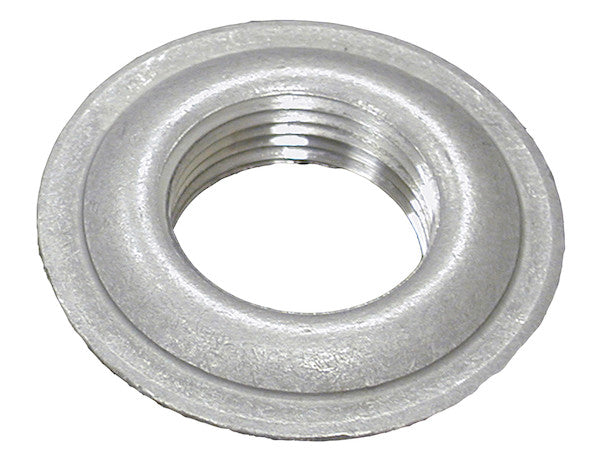
The Stamped Welding Flange from Buyers Products comes in aluminum, steel, and stainless steel in a variety of sizes to meet your reservoir installation needs. Use the flanges when fabricating your own hydraulic reservoir, or adding a port to an existing reservoir. Choose from a wide range of sizes, materials, ODs, and thicknesses to match your requirements.
Specifications
| Construction | Stamped |
|---|---|
| Finish | Plain |
| Material | Carbon Steel |
| Outer Diameter | 1.780 |
| Pilot | 0.930 |
| Size | .50 |
| Thickness | 0.134 |
The 1/2 Inch NPTF Steel Stamped Welding Flange represents a critical component in the fabrication and modification of hydraulic fluid reservoirs, offering a robust and reliable connection point for fluid lines and ancillary equipment. Engineered by Buyers Products, this specific flange, characterized by its carbon steel construction and NPTF threading, is designed to meet rigorous industrial demands, ensuring secure and leak-proof integration into hydraulic systems. Its stamped manufacturing process underscores an approach focused on efficiency, consistency, and material optimization, yielding a product that delivers exceptional performance without compromising on cost-effectiveness for high-volume applications.
At the core of this component’s design is the "Stamped" construction method. Stamping is a cold-forming process where sheet metal is precisely shaped by pressing it between a die and punch. This method offers several distinct advantages in manufacturing components like welding flanges. Firstly, it allows for high-volume production with excellent repeatability, ensuring that each flange meets precise dimensional tolerances. This consistency is paramount for critical applications where fit and function are non-negotiable. Secondly, stamping optimizes material utilization, reducing waste and contributing to a more economically viable product. Unlike machining, which removes material to achieve the desired shape, stamping reshapes the material, often resulting in less scrap. Thirdly, the cold-working nature of the stamping process can enhance the mechanical properties of the steel, such as its tensile strength and hardness, in certain areas of the component due to work hardening. This can contribute to the overall durability and resistance to deformation under operational stresses. For a welding flange, the uniformity of material thickness and the precision of the port opening achieved through stamping are vital for ensuring proper weld penetration and maintaining the integrity of the hydraulic reservoir. The absence of internal stresses often associated with casting, and the fine grain structure resulting from cold forming, typically contribute to a more stable and reliable component ready for demanding environments.
The material choice for this flange is Carbon Steel, a widely utilized alloy in industrial applications due to its excellent balance of strength, ductility, and cost-effectiveness. Specifically, this product likely employs a low to medium carbon steel, which exhibits superior weldability characteristics, a crucial attribute for a component designated as a "Welding Flange." Carbon steel provides a high tensile strength, allowing the flange to withstand significant internal and external pressures commonly encountered in hydraulic systems. Its inherent toughness ensures resistance to impact and vibrational fatigue, thereby enhancing the longevity and reliability of the reservoir assembly. While carbon steel is susceptible to corrosion, especially in moist or chemically active environments, its "Plain" finish implies that post-installation protective measures, such as painting, coating, or cathodic protection, can be applied to suit the specific operational environment. This allows end-users the flexibility to choose a corrosion protection strategy that is most appropriate for their application, rather than being limited by a factory-applied finish. The robust nature of carbon steel also ensures that the flange maintains its structural integrity under thermal cycling and mechanical stresses, contributing to a secure and leak-free hydraulic system over an extended service life.
The specified "1/2 Inch NPTF" threading is a critical technical detail, denoting National Pipe Taper Fuel. NPTF threads are a specialized variation of the National Pipe Taper (NPT) standard, designed specifically to achieve a pressure-tight seal without the aid of sealing compounds, although sealant is often used for added security in critical applications. The key distinction of NPTF, often referred to as "Dryseal," lies in its controlled crest and root truncations. Unlike standard NPT threads, which require a thread sealant to fill the helical leak path created by the clearance between the crest and root, NPTF threads are designed to create an interference fit between the crest of the male thread and the root of the female thread, and between the flanks of the mating threads. This mechanical deformation of the threads during tightening essentially forms a metal-to-metal seal, preventing leakage of hydraulic fluid, even under high pressure. The 1/2-inch nominal pipe size indicates the internal diameter of the pipe or fitting it is designed to connect to, adhering to industry standards for hydraulic fluid lines. The tapered nature of the thread (1:16 taper on diameter) means that as the male and female threads are tightened, they wedge together, creating a progressively tighter seal. This design is paramount in hydraulic reservoirs where maintaining system integrity and preventing fluid loss are essential for operational efficiency and safety. Proper torque application during assembly is vital to achieve the intended dryseal without over-stressing the threads or the flange itself.
The application of this flange predominantly lies in the fabrication or modification of hydraulic reservoirs. Hydraulic reservoirs are fundamental components of any hydraulic system, serving not only as a storage vessel for hydraulic fluid but also facilitating heat dissipation, air separation, and contaminant settling. The ability to add or modify ports is crucial for accommodating various system requirements, such as integrating additional pumps, return lines, suction lines, or auxiliary equipment like filters and heat exchangers. A welding flange provides a secure and permanent method for creating these access points. By welding the flange to the reservoir wall, a highly durable and leak-proof connection is formed, capable of withstanding the dynamic pressures and vibrations inherent in hydraulic operations. The 1/2-inch NPTF port size is versatile, allowing for connection to a wide range of standard hydraulic fittings, hoses, and tubes, facilitating system expansion or repair. This modularity reduces downtime for maintenance or upgrades and enhances the overall adaptability of the hydraulic system to evolving operational needs. The precision of the stamped flange ensures that mating components will align correctly, minimizing installation complexities and reducing the potential for misalignment-induced stress or leakage.
The successful installation of this 1/2 Inch NPTF Steel Stamped Welding Flange relies heavily on proper welding techniques. Given its carbon steel composition, common welding processes such as Gas Metal Arc Welding (GMAW/MIG), Shielded Metal Arc Welding (SMAW/Stick), or Gas Tungsten Arc Welding (GTAW/TIG) can be employed. Prior to welding, the flange and the reservoir surface must be thoroughly cleaned to remove any oils, grease, rust, or mill scale. This surface preparation is critical for achieving a sound, defect-free weld that ensures maximum strength and leak integrity. A slight bevel on the reservoir opening edge and/or the flange contact surface can facilitate better weld penetration and fusion. During welding, controlling heat input is essential to prevent excessive distortion of the flange or the reservoir wall, which could compromise the NPTF thread geometry or the overall structural integrity. For thinner reservoir walls (such as the flange's 0.134" thickness), a lower heat input or pulsed welding techniques might be beneficial. Post-weld inspection, including visual examination for defects like porosity, cracks, or inadequate fusion, is highly recommended. For critical applications, non-destructive testing methods like dye penetrant inspection or magnetic particle inspection may be employed to confirm the absence of microscopic flaws. Proper cool-down procedures should also be followed to prevent residual stresses that could lead to cracking. The expertise of a certified welder is paramount in ensuring that the flange is securely and reliably integrated into the hydraulic reservoir, thereby contributing to the safety and efficiency of the entire hydraulic system.
The provided specifications for this flange, including an Outer Diameter (OD) of 1.780 inches, a Pilot of 0.930 inches, and a Thickness of 0.134 inches, are crucial for its proper fit and function. The Outer Diameter dictates the overall footprint of the flange on the reservoir surface, influencing the required clearance and the area available for welding. A larger OD generally provides a more stable base and a longer weld path, potentially enhancing strength. The "Pilot" dimension, at 0.930 inches, refers to the raised circular section designed to fit snugly into a pre-cut hole in the reservoir wall. This pilot serves multiple critical functions: it accurately centers the flange, ensuring concentricity with the reservoir opening; it provides a tight fit that minimizes gaps for welding, thereby reducing the amount of filler material needed and improving weld quality; and it acts as a locating feature, simplifying installation and ensuring proper alignment. This precise piloting mechanism is especially valuable in high-production environments or when working with automated welding processes. The flange's Thickness of 0.134 inches (approximately 1/8 inch or 3.4mm) is indicative of a robust yet manageable gauge for welding. This thickness ensures sufficient material to withstand the mechanical stresses of the NPTF connection and the hydraulic pressure, while remaining thin enough to be readily welded to typical reservoir wall materials without requiring excessive heat or specialized welding techniques. These precise dimensions contribute to the ease of fabrication, structural integrity, and long-term reliability of the hydraulic connection.
The benefits of utilizing this 1/2 Inch NPTF Steel Stamped Welding Flange extend beyond its individual technical specifications. Its primary advantage lies in facilitating the creation of a structurally sound and leak-proof hydraulic connection. The combination of carbon steel strength, NPTF dryseal threading, and precise stamped construction results in a flange that is exceptionally reliable for critical fluid power applications. Its design simplifies reservoir fabrication and modification, enabling engineers and technicians to quickly and effectively integrate new components or repair existing ones. The cost-effectiveness of stamped manufacturing, coupled with the durability of carbon steel, offers an excellent return on investment, reducing the total cost of ownership for hydraulic systems. Furthermore, the standardization of the 1/2-inch NPTF thread ensures broad compatibility with a vast array of hydraulic fittings and components, providing flexibility in system design and procurement. This flange is an integral part of maintaining the operational efficiency and safety of hydraulic machinery in various sectors, from mobile equipment to industrial automation.
For long-term performance and optimal longevity, even with a "Plain" finish, certain considerations are prudent. As carbon steel is prone to corrosion, particularly in environments exposed to moisture or corrosive agents, applying a suitable protective coating post-welding is highly recommended. This could include painting, powder coating, or specialized anti-corrosion treatments, depending on the operational environment and regulatory requirements. Regular inspection of the welded joint for any signs of fatigue cracking, corrosion, or loosening of threaded connections will ensure the continued integrity of the hydraulic reservoir. Although NPTF connections are designed to be self-sealing, periodic checks for weepage or leaks around the port are good maintenance practice, especially under conditions of significant vibration or pressure cycling. By proactively addressing potential issues, the service life of both the flange and the entire hydraulic system can be significantly extended, minimizing unexpected downtime and repair costs.
Integrating this specific flange into a hydraulic system demands careful consideration of overall system compatibility. The 1/2-inch NPTF port size must align with the flow requirements and pressure ratings of the connecting hoses, tubing, and fittings. Ensuring that the internal diameter of the connecting components does not create undue restriction or turbulence at the port entry is crucial for maintaining efficient fluid flow and minimizing pressure drop. The material compatibility between the flange (carbon steel) and the hydraulic fluid, as well as any other components in the fluid path, should be verified to prevent galvanic corrosion or material degradation over time. By selecting this standardized and robust welding flange, system designers can confidently build hydraulic reservoirs that offer high performance, reliability, and ease of maintenance, supporting the seamless operation of diverse hydraulic applications. Buyers Products' commitment to providing a range of such components underscores their understanding of the varied and exacting demands of the hydraulic industry, offering solutions that consistently meet or exceed technical expectations.