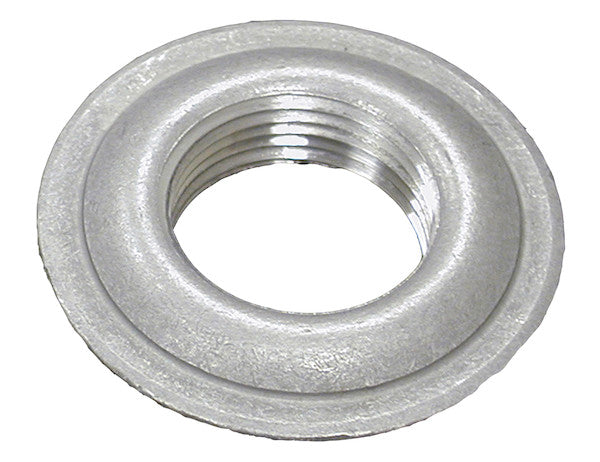
The Stamped Welding Flange from Buyers Products comes in aluminum, steel, and stainless steel in a variety of sizes to meet your reservoir installation needs. Use the flanges when fabricating your own hydraulic reservoir, or adding a port to an existing reservoir. Choose from a wide range of sizes, materials, ODs, and thicknesses to match your requirements.
Specifications
| Construction | Stamped |
|---|---|
| Finish | Plain |
| Material | Stainless Steel |
| Outer Diameter | 2.355 |
| Pilot | 1.110 |
| Size | .75 |
| Thickness | 0.134 |
Advanced Technical Overview: 3/4 Inch NPTF Stainless Steel Stamped Welding Flange
The 3/4 Inch NPTF Stainless Steel Stamped Welding Flange represents a critical component in the fabrication and modification of fluid containment and transfer systems, particularly hydraulic reservoirs. Engineered for superior performance and longevity, this specific flange combines the robust characteristics of stainless steel with the efficiency of stamped manufacturing and the reliability of an NPTF dryseal thread connection. Its precise design facilitates secure, leak-free integration into various industrial and mobile hydraulic applications, ensuring operational integrity under demanding conditions.
Material Science: The Advantages of Stainless Steel
The selection of stainless steel as the primary material for this welding flange is a deliberate choice driven by its unparalleled material properties critical for industrial applications. Stainless steel, fundamentally an iron alloy with a minimum of 10.5% chromium content, gains its renowned corrosion resistance from a passive oxide layer that forms on its surface. This self-repairing layer provides exceptional protection against rust, oxidation, and degradation in aggressive environments where standard carbon steel would quickly succumb. For the 3/4 Inch NPTF Stainless Steel Stamped Welding Flange, this translates into a significantly extended service life and reduced maintenance requirements.
Specifically, the stainless steel utilized in this flange typically falls into the AISI 300 series, with 304 or 316 grades being common choices due to their excellent balance of mechanical properties and corrosion resistance. AISI 304 stainless steel, often referred to as 18/8 stainless due to its approximate 18% chromium and 8% nickel content, offers good formability, weldability, and resistance to a wide range of atmospheric and chemical environments. It is a cost-effective choice for general industrial applications. AISI 316 stainless steel, on the other hand, includes molybdenum in its composition (typically 2-3%), which significantly enhances its resistance to pitting and crevice corrosion, particularly in chloride-rich or acidic environments. While the specification for this particular flange notes "Stainless Steel," it inherently implies a material chosen for its superior resilience.
Beyond corrosion resistance, stainless steel exhibits excellent strength-to-weight ratio and maintains its mechanical properties across a broad temperature range, from cryogenic conditions to elevated temperatures. This thermal stability is crucial in hydraulic systems where fluid temperatures can fluctuate considerably. Furthermore, stainless steel is a hygienic material, easy to clean and sanitize, making it suitable for applications that may involve sensitive fluids or require strict cleanliness standards, although its primary application here is hydraulic fluids. The material's inherent ductility also plays a role in the stamping process, allowing for precise formation without excessive material stress, and contributes to the overall weldability of the flange. The plain finish indicated in the specifications further highlights the intrinsic corrosion resistance of the material, obviating the need for external coatings which could degrade or chip over time, compromising protection.
Manufacturing Precision: The Stamped Production Process
The designation "Stamped" for this welding flange signifies a manufacturing methodology centered on high-volume production, dimensional consistency, and optimized material utilization. Stamping is a cold-forming process where sheet metal is precisely cut and formed into desired shapes using dies and presses. Unlike machined or forged components, stamped parts begin as sheet stock, which is then subjected to a series of operations including blanking, piercing, bending, and forming.
One of the primary advantages of the stamping process for components like the 3/4 Inch NPTF Stainless Steel Stamped Welding Flange is its cost-effectiveness in mass production. Once the tooling is developed, each subsequent part can be produced rapidly and consistently, leading to lower unit costs compared to machining from solid bar stock or forging which typically involves more material and energy input per part. This efficiency doesn't come at the expense of quality; modern stamping techniques allow for extremely tight tolerances, ensuring that each flange meets the specified Outer Diameter (2.355 inches), Pilot Diameter (1.110 inches), and Thickness (0.134 inches) with high precision.
The stamping process also imparts specific mechanical properties to the stainless steel. Cold working during stamping can increase the material's yield strength and tensile strength through work hardening, enhancing the flange's durability and resistance to deformation under operational stress. The smooth, consistent surface finish achieved through stamping minimizes stress concentrators, which is beneficial for fatigue resistance and overall structural integrity. Furthermore, the stamping process is highly repeatable, ensuring that every flange produced will have identical characteristics, which is crucial for predictable performance in critical applications. This consistency simplifies installation and guarantees interoperability with standard pipe fittings, reinforcing the reliability of the overall hydraulic system.
Thread Standard Excellence: The NPTF Dryseal Connection
The specification "NPTF" (National Pipe Taper Fuel) for the 3/4 Inch thread size is a critical detail that underscores the advanced design of this welding flange for fluid power applications. NPTF threads are a variant of the standard NPT (National Pipe Taper) threads, specifically engineered to provide a mechanical seal without the need for additional sealants. This "dryseal" capability is achieved through a controlled interference fit between the crests of the male thread and the roots of the female thread, coupled with a deformation of the thread flanks, creating a metal-to-metal seal.
The 3/4 Inch nominal pipe size refers to the approximate inside diameter of the pipe or fitting it’s designed to connect. The taper of NPTF threads, typically 1/16 inch per inch of diameter (or 0.75 degrees from the center axis), ensures that as the male and female threads are tightened, they wedge together, creating a progressively tighter seal. For a 3/4 Inch NPTF connection, this taper is meticulously maintained to achieve the desired dryseal effect. While NPTF threads are designed for dryseal, in practical applications, particularly in hydraulic systems where high pressures and vibration are common, the use of appropriate thread sealants (like PTFE tape or liquid pipe dope) is often recommended or required. This acts as a secondary sealing mechanism and also functions as an anti-galling agent, facilitating assembly and future disassembly without damaging the threads.
The superiority of NPTF over standard NPT lies in its enhanced sealing performance. Standard NPT threads rely solely on the deformation of thread flanks and often require significant amounts of sealant to prevent leaks, especially in higher pressure applications. NPTF, with its precise crest and root control, offers a more robust and reliable seal, minimizing the risk of fluid loss, which is paramount in hydraulic systems where pressure integrity and system cleanliness are vital. A leak in a hydraulic system can lead to efficiency losses, environmental contamination, and potential safety hazards. The 3/4 Inch NPTF designation thus highlights a commitment to high-performance, leak-resistant connections that contribute directly to the operational safety and efficiency of the overall system.
Integrated Design for Welding and System Integration
As a "Welding Flange," this component is specifically engineered for permanent, high-integrity attachment to a primary structure, such as a hydraulic reservoir. The design considerations for a welding flange are paramount, encompassing factors that ensure both ease of welding and the long-term structural integrity of the joined components. The specified dimensions – Outer Diameter (2.355 inches), Pilot (1.110 inches), and Thickness (0.134 inches) – are not arbitrary; they are optimized for effective welding and robust mechanical performance.
The Outer Diameter (OD) provides sufficient surface area for a strong perimeter weld, distributing stress effectively across the joint. The Pilot diameter (1.110 inches) serves a crucial function in ensuring precise alignment. This internal shoulder or protrusion helps center the flange within a pre-cut opening on the reservoir or tank, simplifying the welding preparation and ensuring that the NPTF port is correctly oriented and positioned. Accurate piloting is essential for maintaining dimensional consistency and preventing misalignment that could lead to welding defects or structural weaknesses. The Thickness (0.134 inches) is optimized to provide sufficient material for a strong weld without requiring excessive heat input, which could distort thinner materials. This thickness also contributes to the overall strength of the flange, allowing it to withstand the operational pressures and stresses inherent in hydraulic systems.
For successful integration, welding procedures must adhere to best practices for stainless steel. This typically involves using appropriate welding techniques (e.g., TIG, MIG) and filler materials compatible with stainless steel, ensuring a strong metallurgical bond. Proper joint preparation, including cleaning and potentially beveling depending on the application and desired weld strength, is crucial. Post-weld inspection, such as visual inspection, dye penetrant testing, or even radiographic inspection for critical applications, is often performed to verify weld integrity and detect any discontinuities that could compromise the seal or structural strength. The welding flange’s design facilitates these processes, ensuring a robust, permanent connection capable of withstanding the dynamic loads, pressure pulsations, and thermal cycling characteristic of hydraulic operations.
Diverse Applications and Industry Versatility
The 3/4 Inch NPTF Stainless Steel Stamped Welding Flange finds its primary utility in the construction and modification of hydraulic reservoirs, yet its robust design and material properties extend its applicability across a broad spectrum of industries. In hydraulic systems, these flanges are indispensable for creating connection points (ports) for suction lines, return lines, gauge ports, drain ports, and auxiliary component mounting. The ability to weld this flange directly onto a reservoir offers a permanent and reliable interface for system plumbing.
**Construction and Heavy Equipment:** This sector heavily relies on hydraulic power. Flanges are used in excavators, bulldozers, cranes, and other machinery to ensure reliable fluid transfer in their hydraulic systems, which operate in harsh, often corrosive, outdoor environments. The stainless steel construction ensures resistance to elements like moisture, road salt, and various contaminants.
**Agriculture:** Agricultural machinery, from tractors to harvesters, utilizes hydraulics for various functions. Flanges provide durable connections for hydraulic lines on equipment exposed to fertilizers, pesticides, and varying weather conditions.
**Marine Applications:** In marine environments, exposure to saltwater necessitates corrosion-resistant materials. Stainless steel flanges are ideal for hydraulic systems on boats, ships, and offshore platforms, where they withstand constant exposure to corrosive elements.
**Manufacturing and Industrial Automation:** Hydraulic presses, power units, and automated machinery in factories require robust and leak-free fluid connections. The NPTF dryseal capability is particularly valued in these settings where fluid leaks can lead to production downtime, safety hazards, and environmental concerns.
**Waste Management:** Hydraulic systems are integral to refuse trucks, compactors, and other waste processing equipment. The durability of stainless steel flanges ensures longevity in applications that are subjected to demanding operational cycles and potentially corrosive waste materials.
**Transportation:** Beyond heavy equipment, hydraulic systems are found in braking systems, steering mechanisms, and suspension systems of commercial vehicles. The reliability offered by a stainless steel NPTF welding flange is crucial for vehicle safety and performance.
The flange's adaptability, combined with its resistance to corrosion, extreme temperatures, and mechanical stress, positions it as a preferred component for engineers and fabricators demanding high reliability and longevity in their fluid power systems. Its seamless integration into existing or newly fabricated reservoirs makes it a versatile solution for repair, upgrade, or original equipment manufacturing.
Key Benefits and Value Proposition
The 3/4 Inch NPTF Stainless Steel Stamped Welding Flange offers a compelling value proposition rooted in its engineering and material science. Its primary benefits include:
- **Exceptional Corrosion Resistance:** The stainless steel construction provides superior protection against rust, oxidation, and chemical degradation, extending the lifespan of the hydraulic system, especially in aggressive environments.
- **Leak-Free Performance:** The NPTF dryseal thread design, combined with the option for secondary sealants, minimizes the risk of hydraulic fluid leaks, ensuring system efficiency, environmental protection, and operational safety.
- **High Structural Integrity:** Stamped manufacturing, coupled with the inherent strength of stainless steel and precise dimensions for welding, results in a durable component capable of withstanding high pressures, vibrations, and thermal cycling.
- **Dimensional Accuracy and Consistency:** The stamping process guarantees precise and repeatable dimensions (OD, Pilot, Thickness), facilitating straightforward installation and reliable fit with standard piping components.
- **Versatile Application:** Ideal for fabricating new hydraulic reservoirs or adding ports to existing ones across diverse industries including construction, agriculture, marine, and industrial manufacturing.
- **Cost-Effectiveness and Longevity:** While the initial investment in stainless steel may be higher than carbon steel, the extended service life, reduced maintenance, and avoidance of costly fluid leaks translate into significant long-term savings and a lower total cost of ownership.
- **Ease of Integration:** Designed specifically for welding, the flange’s pilot feature and optimized thickness simplify the welding process, ensuring a secure and permanent connection.
Conclusion
The 3/4 Inch NPTF Stainless Steel Stamped Welding Flange is more than just a component; it is a critical enabling technology for robust and reliable hydraulic systems. By integrating advanced material science (stainless steel), efficient manufacturing (stamping), and a superior connection standard (NPTF), this flange delivers an unparalleled combination of corrosion resistance, leak prevention, and structural integrity. For engineers, fabricators, and maintenance professionals seeking to build or repair hydraulic reservoirs with uncompromising quality and long-term performance, this welding flange provides a technically sound and economically advantageous solution, ensuring the sustained operation and efficiency of vital fluid power infrastructure.