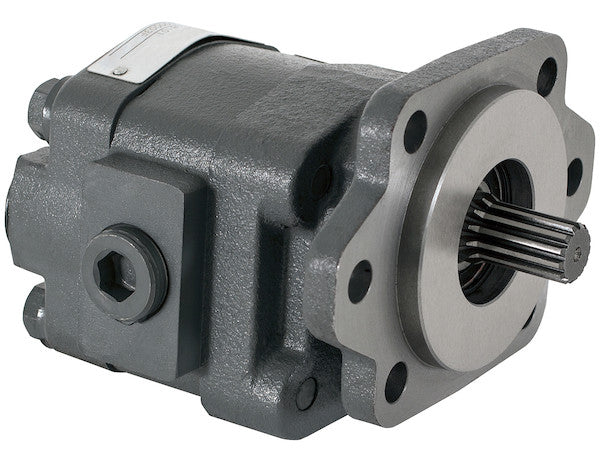
The H21 Series Hydraulic Gear Pump with Spline Shaft from Buyers Products is a sturdy, durable bi-rotational pump that can be 2- or 4-bolt mounted in an SAE B mount. The pump is built tough of cast iron with teflon-coated bronze thrust plates. Four internal dowels work to protect its structural integrity. Choose from a range of models with flow rates from 6.8 to 15.3 at 1000 RPM. The pumps are capable of higher pressures, taking up to 2500 or 3000 PSI. All of the models feature a 7/8 in. by 13 spline shaft.
Specifications
| Direct Mount/Remote Mount | 2/4 Bolt SAE B |
|---|---|
| Direct or Remote Mount | Direct Mount |
| Displacement | 2 |
| Flow | 8 |
| Flow at 1000 RPM | 8.7 |
| Flow at 1200 RPM | 10.44 |
| Flow at 1500 RPM | 13.05 |
| Flow at 1800 RPM | 15.66 |
| Flow at 2100 RPM | 18.27 |
| Flow at 600 RPM | 5.22 |
| Flow at 900 RPM | 7.83 |
| Gear Size | 1.25 |
| Gear Width | 1.250 |
| Inlet Port Size | 1 NPT |
| Input Mount Type | Integral Bracket |
| Material | Cast Iron |
| Maximum Pressure | 3000 |
| Maximum Rotations Per Minute (RPM) | 2000 |
| Mount Type | SAE B 2/4 Bolt |
| Outlet Port Size | 1 NPT |
| Pilot Diameter | 4.00 |
| Ports (rear/side) | Rear/Side |
| Rear Port Size | 1 NPT |
| Rotation | Bi-Directional |
| Shaft Size | 7/8-13 |
| Shaft Type | Splined |
| Suction Port Size | 1 NPT |
The Hydraulic Gear Pump with a 7/8-13 Spline Shaft and 1-1/4 Inch Diameter Gear represents a pinnacle of hydraulic power transmission technology, engineered to meet the rigorous demands of industrial and mobile hydraulic systems. This detailed description delves into the technical specifications, design principles, performance characteristics, and application suitability of this robust component, aiming to provide a comprehensive understanding for engineers, system integrators, and technical purchasers.
Advanced Design and Construction for Uncompromised Durability
At the core of this hydraulic gear pump's exceptional performance and longevity is its meticulously engineered design and material selection. The H21 Series, particularly this model featuring a 1-1/4 inch diameter gear and 7/8-13 spline shaft, is constructed with an unwavering commitment to durability and operational reliability under strenuous conditions.
Robust Cast Iron Housing
The primary structural component, the pump housing, is precision-machined from high-grade cast iron. Cast iron is selected for its superior mechanical properties, including high tensile strength, excellent rigidity, and remarkable vibration dampening capabilities. This material choice ensures that the pump can withstand the significant internal pressures generated during operation (up to 3000 PSI) without deformation or fatigue. Furthermore, cast iron possesses inherent thermal stability, effectively dissipating heat generated by fluid friction and mechanical losses, thereby maintaining optimal operating temperatures and extending the life of internal components and hydraulic fluid. The robust housing acts as a protective shield for the critical internal elements, contributing to a longer service life even in challenging environmental conditions.
Precision-Engineered Gearing System
The heart of any gear pump lies in its gearing mechanism. This particular model features a 1-1/4 inch diameter gear, directly impacting its displacement and flow rate capabilities. The gears are manufactured from hardened steel, typically through processes like carburizing or nitriding, to achieve a high surface hardness while maintaining a tough core. This treatment provides exceptional wear resistance against abrasive particles within the hydraulic fluid and withstands the high contact stresses encountered during power transmission. The precision of the gear teeth profiles is paramount; they are meticulously machined to minimize backlash, ensure smooth meshing, and reduce pulsation, thereby optimizing volumetric efficiency and acoustic performance. The 1.250-inch gear width, specified in the technical data, plays a critical role in defining the pump's displacement. Specifically, the displacement of 2 cubic inches per revolution is a direct function of the gear geometry, including its diameter, width, and tooth count. This optimized gear set ensures efficient fluid transfer and robust performance across the operational RPM range.
Enhanced Internal Integrity with Thrust Plates and Dowels
The internal architecture of this pump is further strengthened by several key design elements. Teflon-coated bronze thrust plates are strategically integrated to manage axial loads and minimize internal leakage paths between the gear faces and the housing. Bronze, an inherently low-friction material, is further enhanced with a PTFE (Teflon) coating. This coating significantly reduces friction between the rotating gear faces and stationary plates, thereby improving mechanical efficiency and reducing heat generation. The thrust plates also serve a critical function in accommodating thermal expansion and maintaining tight tolerances throughout the pump's operational temperature spectrum, crucial for consistent performance and volumetric efficiency. Their wear-resistant properties contribute directly to the pump's extended operational life.
Crucially, four internal dowels are employed to ensure the precise alignment of the pump's internal components. These dowels prevent relative movement between the end covers, the gear section, and the main housing. Maintaining exact alignment is vital for minimizing wear on the gears and bearings, preventing internal leakage, and preserving the overall structural integrity of the pump, especially under high-pressure cycling and mechanical stress.
Advanced Power Transmission: The 7/8-13 Spline Shaft
A defining characteristic of this hydraulic gear pump is its 7/8-13 spline shaft. The selection of a spline shaft over a traditional keyed shaft is a deliberate engineering choice, offering significant advantages in applications requiring high torque transmission and precise alignment. A spline shaft features multiple keys (splines) machined directly into the shaft that mate with corresponding grooves in the mating component (e.g., a PTO or drive coupling).
- Dimensions: The "7/8 inch" refers to the major diameter of the spline, and "13" indicates the number of teeth or splines. This specific configuration adheres to industry standards, ensuring compatibility with a wide range of power take-off (PTO) units and hydraulic drive systems.
- Superior Torque Transmission: Splines distribute the transmitted torque over a much larger surface area compared to a single keyway. This reduces stress concentrations, minimizing the risk of shaft failure, shearing, or fretting corrosion, especially in applications subject to frequent starts, stops, or shock loads.
- Enhanced Alignment and Reduced Wear: The multiple points of contact in a spline connection inherently provide superior concentricity and alignment between the pump shaft and the drive mechanism. This reduces radial loads on the pump's bearings and seals, extending their lifespan and minimizing energy losses due to misalignment.
- Durability: The spline shaft is typically manufactured from high-strength alloy steel, often subjected to induction hardening or similar heat treatment processes. This fortifies the splines against wear and deformation, ensuring reliable power transfer over countless operational cycles.
The integral bracket input mount type further simplifies installation, providing a direct and secure connection to the power source, minimizing potential alignment issues and reducing the overall footprint of the hydraulic power unit.
Performance Characteristics and Fluid Dynamics
Understanding the hydraulic performance of this gear pump is critical for proper system design and application matching. The specifications detail a precise set of operational parameters that define its capabilities.
Displacement and Flow Rate Precision
With a nominal displacement of 2 cubic inches per revolution, this pump is designed for consistent and predictable fluid delivery. Displacement is the theoretical volume of hydraulic fluid moved by the pump in one complete revolution of its gears. The listed flow rates, provided at various RPMs, demonstrate the pump's volumetric efficiency. For instance, at 1000 RPM, the pump delivers 8.7 gallons per minute (GPM). This linear relationship between RPM and flow is a hallmark of positive displacement pumps, indicating highly efficient conversion of mechanical energy into hydraulic power. The detailed flow rates at 600, 900, 1200, 1500, 1800, and 2100 RPM provide a comprehensive performance curve, allowing engineers to precisely match pump output to system requirements.
High Pressure Capability
The pump boasts an impressive maximum pressure rating of 3000 PSI. This high-pressure capability is a testament to its robust internal construction, precision manufacturing, and material integrity. Operating at such pressures necessitates meticulously designed seals, tight internal clearances, and materials capable of withstanding extreme forces without compromise. High-pressure capacity is crucial for demanding applications where significant force multiplication is required, such as operating large hydraulic cylinders in heavy machinery, providing sufficient torque for hydraulic motors in complex drives, or maintaining pressure in advanced hydraulic circuits.
Bi-Directional Rotation
The bi-directional rotation feature significantly enhances the versatility of this pump. Unlike unidirectional pumps, a bi-directional pump can be driven in either clockwise or counter-clockwise rotation, adapting seamlessly to various engine or power take-off (PTO) configurations. This reduces inventory requirements for system builders and offers greater flexibility in system design and layout, simplifying field installations and repairs. The internal construction, including the symmetrical design of the gears and the robust thrust plate system, is specifically engineered to handle fluid flow and pressure generation irrespective of the rotation direction.
Optimized Porting for System Integration
The pump features 1 NPT (National Pipe Taper) inlet and outlet ports. NPT connections are widely recognized and utilized in hydraulic systems for their robust sealing capability under pressure, achieved by the tapered threads. The 1-inch size of both suction and discharge ports is carefully selected to optimize fluid velocity and minimize pressure drop and cavitation. Proper port sizing is critical for maintaining volumetric efficiency and preventing damage to the pump. The availability of both rear and side ports provides exceptional flexibility for plumbing and installation, allowing the pump to be integrated into diverse system layouts with minimal space constraints or complex hose routing.
Mounting Standards and System Compatibility
Adherence to industry mounting standards is crucial for interchangeability and ease of integration. This H21 Series pump is designed with an SAE B 2/4 bolt mount type, signifying compliance with Society of Automotive Engineers (SAE) standards for hydraulic pump mounting flanges.
- SAE B Standard: The SAE B standard defines specific dimensions for mounting flanges, including the bolt pattern and pilot diameter. The specified 4.00-inch pilot diameter is a critical dimension for ensuring precise concentric alignment between the pump and its drive source. This precise alignment is paramount for reducing vibration, minimizing wear on the input shaft and bearings, and ensuring smooth operation.
- 2-Bolt or 4-Bolt Mounting: The option for either a 2-bolt or 4-bolt SAE B mount offers versatility. While 2-bolt mounts are common for lighter-duty applications, the 4-bolt configuration provides enhanced rigidity and stability, particularly in high-vibration environments or applications involving significant shock loads. This flexibility allows system designers to select the most appropriate mounting configuration based on the specific demands of their application.
- Direct Mount Configuration: The pump is designed for direct mounting, meaning it can be directly coupled to a power source, such as an engine flywheel housing or a PTO unit. This eliminates the need for complex intermediate couplings or remote mounting arrangements, reducing overall system complexity, cost, and potential points of failure.
Applications Across Industries
The specific technical characteristics of this Hydraulic Gear Pump – high pressure capability, robust cast iron construction, durable spline shaft, and versatile bi-directional operation – make it exceptionally well-suited for a wide array of demanding applications across various industries.
- Mobile Hydraulics: This pump is ideal for heavy-duty mobile equipment such as dump trucks, refuse vehicles, snowplows, salt spreaders, and utility vehicles. Its ability to operate at high pressures and withstand harsh environmental conditions ensures reliable performance in these applications, where powerful and consistent hydraulic output is essential for lifting, tilting, and operating various implements.
- Agricultural Machinery: In agriculture, this pump can power hydraulic systems on tractors, combines, and other farm implements, providing the necessary force for steering, lifting cultivators, operating loaders, and driving auxiliary equipment. The spline shaft is particularly beneficial for connecting to tractor PTOs or other engine-driven interfaces.
- Construction Equipment: Compact construction equipment, such as mini-excavators, skid-steer loaders, and trenchers, can benefit from this pump's compact yet powerful design. It can provide hydraulic power for boom movements, bucket actuation, and attachment drives.
- Material Handling: Forklifts, lift gates, and other material handling systems that require precise and powerful hydraulic movements can utilize this pump for efficient operation.
- Industrial Power Units: Beyond mobile applications, this pump can be integrated into stationary hydraulic power units for manufacturing processes, presses, and other industrial machinery where a reliable and high-pressure hydraulic fluid source is needed.
Maintenance and Longevity Considerations
While engineered for durability, the longevity and optimal performance of any hydraulic pump are significantly influenced by proper system design and maintenance practices. Key considerations include:
- Hydraulic Fluid Quality: Using the correct type and viscosity of hydraulic fluid, maintained at appropriate cleanliness levels (e.g., ISO cleanliness codes), is paramount. Contaminants are the leading cause of wear and premature failure in hydraulic pumps.
- Filtration: Implementing effective filtration throughout the hydraulic circuit (suction, pressure, return, and off-line filtration) is crucial to protect the pump and other components from particulate contamination.
- Operating Parameters: Ensuring the pump operates within its specified maximum pressure (3000 PSI) and maximum RPM (2000 RPM) limits will prevent undue stress and extend its service life. Cavitation, often caused by restricted suction lines or inadequate reservoir sizing, must be avoided as it can severely damage pump internals.
- Seal Integrity: While not explicitly detailed in the original description, high-quality seals (e.g., Buna-N, Viton, depending on fluid type and temperature) are integral to maintaining pressure and preventing external leakage. Regular inspection of seals and fittings can prevent system performance degradation.
Conclusion
The Hydraulic Gear Pump with a 7/8-13 Spline Shaft and 1-1/4 Inch Diameter Gear from the H21 Series by Buyers Products is a testament to precision engineering and robust manufacturing. Its cast iron construction, advanced Teflon-coated bronze thrust plates, and meticulously designed gearing system ensure exceptional durability and performance under high-pressure conditions. The incorporation of a 7/8-13 spline shaft provides superior torque transmission and alignment, making it a reliable choice for demanding applications. With bi-directional rotation, versatile SAE B mounting options, and optimized NPT porting, this pump offers unparalleled flexibility for system integrators. Delivering consistent flow rates up to 18.27 GPM at 2100 RPM and capable of sustaining pressures up to 3000 PSI, this pump is an ideal solution for a broad spectrum of heavy-duty mobile and industrial hydraulic systems where reliability, efficiency, and longevity are non-negotiable requirements.