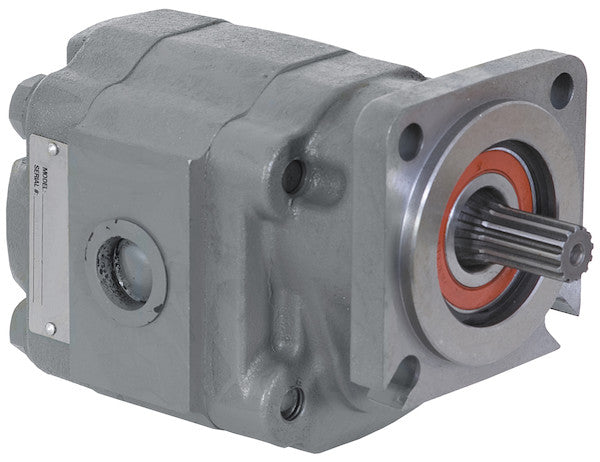
The heavy duty Live Floor Hydraulic Pump from Buyers Products is built tough to handle continuous, high-pressure operations such as a live floor. It features counter clockwise rotation. The pump is constructed of cast iron with Teflon-coated bronze thrust plates and heavy duty roller bearings. Eight internal dowels protect the structural integrity of the pump. Two models both handle a maximum 3000 PSI while delivering a flow of either 18 GPM or 24.2 GPM at 1000 RPM. The pump is designed to be 4-bolt mounted into an SAE B mount.
Specifications
| Direct Mount/Remote Mount | 4 Bolt SAE B |
|---|---|
| Direct or Remote Mount | Direct Mount |
| Displacement | 3 |
| Flow | 18 |
| Flow at 1000 RPM | 18 |
| Flow at 1200 RPM | 21.60 |
| Flow at 1500 RPM | 27.00 |
| Flow at 1800 RPM | 32.4 |
| Flow at 2100 RPM | 37.8 |
| Flow at 600 RPM | 10.80 |
| Flow at 900 RPM | 16.2 |
| Gear Size | 1.75 |
| Gear Width | 1.750 |
| Inlet Port Size | 1 1/4 NPT |
| Input Mount Type | Integral Bracket |
| Material | Cast Iron |
| Maximum Pressure | 3000 |
| Maximum Rotations Per Minute (RPM) | - |
| Mount Type | SAE B 4 Bolt |
| Outlet Port Size | 1 1/4 NPT |
| Pilot Diameter | 4.00 |
| Ports (rear/side) | Side |
| Rear Port Size | - |
| Rotation | Counterclockwise |
| Shaft Size | 7/8-13 |
| Shaft Type | Splined |
Advanced Technical Overview: The Buyers Products Live Floor Hydraulic Pump with 1-3/4 Inch Diameter Gear
The Buyers Products Live Floor Hydraulic Pump, featuring a robust 1-3/4 inch diameter gear, represents a pinnacle of hydraulic engineering designed for the most demanding mobile equipment applications. This heavy-duty positive displacement gear pump is specifically engineered to meet the rigorous and continuous operational requirements inherent in live floor systems, providing exceptional reliability, efficiency, and longevity. Its design principles and material selection prioritize performance under high-pressure, cyclical loading, and extreme environmental conditions, making it an indispensable component for waste management, agricultural, forestry, and bulk material transport industries.
Understanding the Live Floor Application
Live floor systems are specialized hydraulic mechanisms integrated into trailers and truck bodies, facilitating the automated loading and unloading of bulk materials such as refuse, wood chips, agricultural products, and aggregates. Unlike traditional dump trailers, live floor systems utilize a series of reciprocating slats or planks that move in a coordinated sequence to push material out of the trailer or pull it in. This process demands a hydraulic pump capable of delivering consistent, high-pressure fluid flow over extended periods. The operational cycle often involves high starting loads, rapid reversals, and continuous pressure maintenance, which can be particularly taxing on hydraulic components. The Live Floor Hydraulic Pump from Buyers Products is precisely calibrated and constructed to withstand these intense conditions, ensuring uninterrupted and efficient material handling.
Core Engineering and Material Science: The Cast Iron Advantage
The primary construction material of this hydraulic pump is high-grade cast iron. The selection of cast iron is a deliberate engineering choice that underscores the pump's heavy-duty classification and suitability for severe-duty applications. Cast iron offers several critical advantages over lighter materials like aluminum alloys in this context:
- Superior Strength and Rigidity: Cast iron possesses inherent strength and high compressive yield strength, allowing the pump casing to withstand internal pressures up to 3000 PSI without deformation. This rigidity is crucial for maintaining the precise internal clearances required for optimal pump efficiency and preventing cavitation under pressure.
- Excellent Wear Resistance: The metallurgical structure of cast iron provides superior wear resistance, particularly beneficial in environments where hydraulic fluid might be contaminated with fine particulate matter, which can accelerate wear in less robust materials.
- Vibration Damping Characteristics: Cast iron exhibits excellent vibration damping properties. In dynamic hydraulic systems, pumps generate pulsations and vibrations. Cast iron construction effectively absorbs these mechanical stresses, reducing noise levels, minimizing fatigue on surrounding components, and contributing to smoother overall system operation.
- Thermal Stability: Heavy-duty applications often involve significant heat generation. Cast iron provides superior thermal stability and dissipation compared to aluminum, helping to manage operating temperatures and prevent thermal expansion issues that could compromise internal tolerances and performance.
This robust cast iron housing forms the foundation for the pump's long-term durability and performance reliability, establishing it as a dependable workhorse in challenging industrial settings.
Precision Internal Components for Enhanced Performance and Durability
Beyond the robust external casing, the internal architecture of the Buyers Products Live Floor Hydraulic Pump is meticulously engineered with advanced components to ensure peak performance and extended operational life.
Teflon-Coated Bronze Thrust Plates
Within the pump, Teflon-coated bronze thrust plates play a pivotal role in managing internal forces and maintaining hydraulic efficiency. These plates are situated adjacent to the rotating gears and serve multiple critical functions:
- Friction Reduction: The Teflon coating significantly reduces friction between the rotating gears and the stationary thrust plates. Lower friction translates directly to higher mechanical efficiency, reduced heat generation, and less power consumption from the prime mover.
- Wear Resistance: Bronze, known for its excellent bearing properties, combined with the low-friction Teflon, provides exceptional wear resistance. This prolongs the life of the thrust plates and maintains the critical axial clearances necessary for volumetric efficiency.
- Axial Thrust Management: As fluid pressure builds within the pump, it exerts axial forces on the gears. The thrust plates are designed to absorb and distribute these forces, preventing direct wear on the pump housing and maintaining the precise alignment of the gears.
- Sealing Integrity: These plates also contribute to internal sealing, minimizing leakage paths around the gear tips and sides, which is essential for maximizing volumetric efficiency and ensuring that the generated flow is effectively delivered to the hydraulic system.
Heavy Duty Roller Bearings
The integration of heavy-duty roller bearings is another critical feature contributing to the pump's longevity and performance under continuous high-pressure operations. Roller bearings are inherently designed to handle significant radial and axial loads, making them ideal for gear pump applications where torque transmission and pressure differentials create substantial forces on the gear shafts.
- Load Capacity: Roller bearings distribute loads over a larger contact area compared to ball bearings, enabling them to withstand greater static and dynamic loads without premature fatigue. This is paramount in live floor systems where loads can be highly variable and demanding.
- Reduced Friction: While designed for heavy loads, modern roller bearings are engineered to minimize rotational friction, contributing to the overall mechanical efficiency of the pump.
- Extended Service Life: By supporting the gear shafts robustly, these bearings prevent shaft deflection and wear, ensuring the gears maintain optimal meshing and clearances throughout the pump's operational lifespan, thereby reducing the need for frequent maintenance.
Eight Internal Dowels for Structural Integrity
The mention of "eight internal dowels" highlights a sophisticated design element crucial for the pump's structural integrity and consistent performance. Dowel pins are precision-machined cylindrical fasteners used to precisely align components and resist shear forces. In a hydraulic pump, these dowels:
- Maintain Component Alignment: They ensure the precise alignment of the pump's internal sections, including the gear housing, wear plates, and end covers. This accurate alignment is vital for maintaining tight internal clearances and preventing internal leakage, which directly impacts volumetric efficiency.
- Enhance Rigidity: By securely pinning the internal components, the dowels reinforce the pump's structural rigidity, particularly important when the pump is subjected to the high internal pressures and mechanical stresses characteristic of live floor operations.
- Prevent Cavitation and Wear: Misalignment can lead to uneven wear, localized pressure drops, and increased susceptibility to cavitation. The dowels prevent such issues, contributing to smoother fluid flow and extending component life.
This attention to detail in the internal construction ensures that the pump maintains its high efficiency and durability even under the most arduous operating conditions.
Gear Design and Hydraulic Displacement
The product title specifically references a "1-3/4 Inch Diameter Gear," which is central to the pump's volumetric displacement and flow characteristics. In a gear pump, fluid is carried between the teeth of two meshing gears and forced out as the gears rotate. The displacement, in cubic inches per revolution (CIR), is a direct function of the gear's dimensions, primarily its diameter and width. The specification table indicates a displacement of 3 CIR.
- Gear Dimensions: With a gear size of 1.75 inches and a gear width of 1.750 inches, these dimensions are optimized to achieve the specified 3 CIR displacement. This balance ensures efficient fluid transfer and robust gear tooth strength for high-pressure operation.
- Volumetric Flow Rates: The pump offers two primary models, delivering either 18 GPM or 24.2 GPM at a reference speed of 1000 RPM, both maintaining a maximum pressure capability of 3000 PSI. This provides flexibility for system designers to choose the appropriate flow rate based on the speed requirements of their live floor system or other hydraulic actuators.
- Flow Linearity: The provided flow rates at various RPMs (e.g., 10.80 GPM at 600 RPM, 37.8 GPM at 2100 RPM for the 18 GPM model) demonstrate the linear relationship between pump speed and volumetric output in a positive displacement pump. This predictability is crucial for precise system control and sizing of the prime mover (e.g., engine PTO) to achieve desired operational speeds. The 3 CIR displacement, when converted, yields approximately 0.013 gallons per revolution, which at 1000 RPM aligns closely with the 18 GPM specification, accounting for volumetric efficiency.
Operational Characteristics: Pressure, Rotation, and Porting
Maximum Pressure Rating
With a maximum pressure rating of 3000 PSI, this pump is equipped to handle demanding hydraulic tasks. Live floor systems, especially when moving dense or sticky materials, often encounter high resistive forces that require significant hydraulic pressure to overcome. The 3000 PSI capability ensures that the pump can generate sufficient force to operate the live floor slats efficiently, even under challenging conditions, and also provides a safety margin for peak loads.
Counterclockwise Rotation
The specified counterclockwise rotation (viewed from the shaft end) is a critical parameter for proper system integration. Hydraulic pumps are unidirectional devices, meaning they are designed to rotate in a specific direction to ensure correct internal fluid flow and lubrication. Matching the pump's rotation to the power take-off (PTO) or other drive source's rotational direction is essential for proper installation and operation. The counterclockwise rotation makes this pump compatible with a wide array of standard mobile equipment drive systems.
Porting Configuration
The pump features side ports for both the inlet and outlet, with a size of 1 1/4 NPT. This configuration provides flexibility for plumbing and mounting within the vehicle chassis. NPT (National Pipe Taper) threads are a widely used standard in hydraulic systems, known for creating robust, leak-resistant connections. The 1 1/4 inch port size is appropriately dimensioned to minimize pressure drop at the inlet, which is crucial for preventing cavitation, and to efficiently transfer the high flow rates generated by the pump at the outlet, ensuring adequate fluid supply to the system's actuators.
Mounting Standards and Integration
The pump is designed for a 4-bolt SAE B direct mount, featuring a 4.00-inch pilot diameter. These specifications adhere to the Society of Automotive Engineers (SAE) industry standards, ensuring broad compatibility with a variety of mobile hydraulic power take-offs (PTOs) and other drive interfaces. Direct mounting offers several advantages:
- Compactness: Eliminates the need for intermediate drive shafts or couplings, resulting in a more compact system footprint.
- Reduced Alignment Issues: Direct mounting inherently minimizes potential misalignment problems between the pump and the power source, which can lead to premature wear of bearings and seals.
- Simplified Installation: Standardized mounting patterns and pilot diameters simplify the installation process and reduce assembly time.
The "Integral Bracket" for input mount type further emphasizes that the pump itself is designed with the necessary mounting features, ready for direct integration into the hydraulic system without additional adapter plates or brackets.
Shaft Design for Power Transmission
The pump is equipped with a 7/8-13 splined shaft. A splined shaft features a series of ridges (splines) machined along its length that mate with corresponding grooves in a hub or coupling. This design offers distinct advantages for power transmission in hydraulic applications:
- High Torque Transmission: Splined shafts are highly effective at transmitting significant torque without slippage, which is critical for driving a hydraulic pump under high-pressure loads.
- Even Load Distribution: The multiple contact points of the splines distribute the transmitted load evenly, reducing stress concentrations and extending the life of both the shaft and the mating hub.
- Standardization: The 7/8-13 specification refers to a standardized splined shaft size and number of teeth (13 splines on a 7/8-inch diameter shaft), ensuring compatibility with commonly available PTOs and hydraulic pump drive adapters.
System Integration and Maintenance Considerations
While the Live Floor Hydraulic Pump is engineered for maximum durability, its optimal performance and longevity are also contingent on proper system integration and diligent maintenance practices.
- Hydraulic Fluid Selection: The choice of hydraulic fluid is paramount. It must meet the manufacturer's specifications for viscosity, temperature range, and anti-wear properties to ensure adequate lubrication and heat transfer.
- Filtration: Maintaining clean hydraulic fluid through robust filtration is critical. Contaminants are a leading cause of hydraulic component wear and failure. A properly sized and maintained filtration system will protect the pump and the entire hydraulic circuit.
- Reservoir Design: An adequately sized hydraulic reservoir with proper baffling and fluid conditioning (breathers, strainers) is essential for effective heat dissipation and fluid de-aeration, ensuring a continuous supply of cool, clean, and air-free fluid to the pump.
- Preventive Maintenance: Regular inspection of hydraulic lines, fittings, and seals for leaks, checking fluid levels, and monitoring operating temperatures are vital to identify and address potential issues before they escalate.
By adhering to these best practices, operators can maximize the service life and efficiency of their Buyers Products Live Floor Hydraulic Pump.
Conclusion
The Buyers Products Live Floor Hydraulic Pump with a 1-3/4 inch diameter gear stands as a testament to robust engineering and application-specific design. Its heavy-duty cast iron construction, augmented by Teflon-coated bronze thrust plates, heavy-duty roller bearings, and eight precision internal dowels, ensures unparalleled durability and structural integrity under continuous, high-pressure operations. With flexible flow rate options (18 GPM or 24.2 GPM at 1000 RPM) and a formidable 3000 PSI maximum pressure, it provides the hydraulic power essential for efficient live floor system performance. The standardized SAE B 4-bolt direct mount, 1 1/4 NPT side ports, and 7/8-13 splined shaft facilitate seamless integration into a wide range of mobile hydraulic systems. This pump is not merely a component; it is a critical investment in the reliability, efficiency, and productivity of heavy-duty material handling operations, embodying Buyers Products' commitment to delivering high-performance solutions for the most demanding industries.