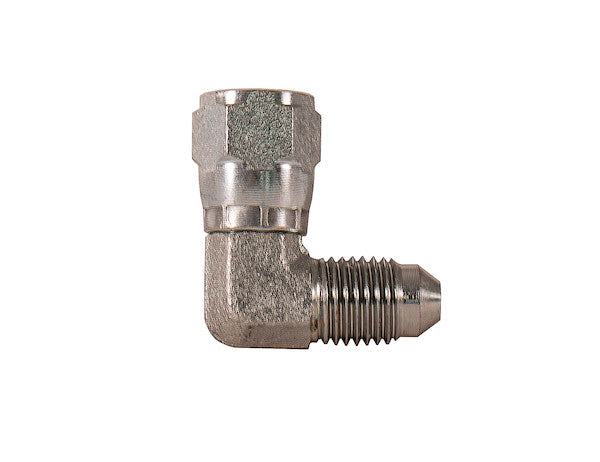
H5506X4 - Swivel Nut 90?? Elbow 1/4 Inch Tube O.D.
H5506X4 - Swivel Nut 90?? Elbow 1/4 Inch Tube O.D.
We currently do not ship to Alaska or Hawaii.
Couldn't load pickup availability
Share
The Swivel Nut 90?? Elbow is part of the Buyers Products line of JIC 37 degree flare tube fittings. The fittings feature tough carbon steel construction, 3 piece flare sealing for a tight, secure connection, and a corrosion-resistant zinc finish. Fitting conforms to JIC and SAE specifications. Buyers Products tube fittings are used with copper, brass, steel, aluminum, and other tubing that can be flared. They are rated at up to 10,000 PSI depending on tube size.
Specifications
| Finish | Zinc Plated |
|---|---|
| Material | Carbon Steel |
| Shape | 90?? Elbow |
| Side 1 | 1/4 JIC (-4) |
| Side 2 | 1/4 JIC (-4) |
| Style | MF |
Technical Overview: Swivel Nut 90° Elbow JIC 37° Flare Tube Fitting for 1/4 Inch O.D. Tubing
The Swivel Nut 90° Elbow, specifically engineered for 1/4 inch tube O.D. applications, represents a critical component within hydraulic and fluid transfer systems. As part of the distinguished Buyers Products line of JIC 37-degree flare tube fittings, this product is meticulously designed to facilitate reliable, high-pressure, and leak-free connections in demanding industrial environments. Its robust construction, adherence to stringent industry standards, and innovative design features make it an indispensable choice for system integrators and maintenance professionals.
Understanding JIC 37° Flare Fittings
JIC (Joint Industry Council) fittings are a widely adopted standard for fluid power connections, particularly in hydraulic systems. The defining characteristic of a JIC fitting is its 37-degree flare seating surface, which forms a metal-to-metal seal when compressed against a corresponding flared tube end by a threaded nut. This design offers several significant advantages over other connection types:
- High-Pressure Capability: The metal-to-metal seal, combined with the robust threads, allows JIC fittings to withstand extremely high operating pressures, often exceeding those of pipe thread or O-ring face seal connections in certain applications.
- Vibration Resistance: While not entirely impervious, the rigid, high-integrity seal of a JIC fitting offers good resistance to vibration and shock, which are common in mobile and heavy industrial equipment.
- Reusability: JIC fittings are designed for repeated assembly and disassembly without compromising the integrity of the seal, provided the sealing surfaces and threads remain undamaged. This characteristic is invaluable for maintenance, inspection, and system modifications.
- Ease of Assembly: Compared to welded connections, JIC fittings offer relatively quick and straightforward assembly, requiring only standard flaring tools and wrenches.
- Interchangeability: Adherence to JIC and SAE standards ensures broad interchangeability among components from different manufacturers, simplifying procurement and reducing downtime.
The 37-degree flare angle itself is a critical design parameter. It provides an optimal balance between sealing effectiveness and resistance to tube deformation, ensuring that the flared tube end forms a secure and durable seal against the fitting body. This angular precision, combined with the material hardness of both the fitting and the tube, creates a reliable barrier against fluid leakage, even under dynamic pressure fluctuations.
Detailed Component Analysis: Swivel Nut 90° Elbow
This specific fitting integrates several key features: a swivel nut, a 90-degree elbow configuration, and compatibility with 1/4 inch O.D. tubing. Each element contributes significantly to its functionality and utility within fluid transfer systems.
The Swivel Nut Feature
The inclusion of a swivel nut is a crucial design advantage, particularly for installation and maintenance. A swivel nut is a freely rotating nut that allows the fitting body to remain stationary while the nut is tightened onto a mating threaded component. For this 90° elbow, it typically implies that one end of the elbow features a female swivel nut, designed to connect to a male JIC flare adapter or directly to a male JIC component. The benefits of this design are manifold:
- Simplified Assembly: The swivel action eliminates the need to rotate the entire tube or fitting body during tightening, greatly simplifying installation in confined spaces or complex routing configurations. This reduces mechanical stress on the tubing and other connected components.
- Alignment Compensation: It provides a degree of flexibility in aligning tubes, allowing for minor angular misalignments without inducing undue stress on the connection points.
- Reduced Torsion on Tubing: By allowing the nut to rotate independently, the swivel nut prevents torsional stress from being applied to the attached tubing during tightening, which could otherwise weaken the tube or compromise the integrity of the flare.
- Rapid Disconnection/Reconnection: Systems requiring frequent disconnection for servicing or component replacement benefit significantly from the ease of operation offered by swivel nuts.
The 90° Elbow Configuration
The 90-degree elbow shape is fundamental for altering the direction of fluid flow within a system. In complex hydraulic layouts, rigid tubing often needs to navigate around obstructions or change planes. A precisely engineered 90-degree elbow facilitates these directional changes efficiently and effectively. Key considerations for elbow design include:
- Space Optimization: Elbows are essential for creating compact and organized plumbing runs, allowing systems to fit within constrained envelopes.
- Flow Dynamics: While any directional change introduces some pressure drop and turbulence, well-designed elbows minimize these effects. The internal geometry of quality fittings is optimized to promote smooth fluid flow, preserving system efficiency.
- Structural Integrity: The elbow form must maintain its structural integrity under system pressure and external forces. The casting or forging process for such a fitting is crucial in ensuring uniform wall thickness and material strength throughout the bend.
1/4 Inch Tube O.D. Compatibility
This fitting is specifically designed for 1/4 inch (approximately 6.35 mm) outside diameter (O.D.) tubing. This dimension is a standard size in many hydraulic, pneumatic, and general fluid transfer applications, particularly where precise flow rates and moderate volumes are required. The compatibility ensures a precise fit, which is paramount for forming a secure and leak-tight flare connection. The dash size designation (-4) corresponds to 4/16ths of an inch, confirming the 1/4-inch tube O.D. specification.
Material and Construction: Carbon Steel with Zinc Finish
The material selection and surface treatment of the Swivel Nut 90° Elbow are critical determinants of its performance and longevity in industrial environments.
High-Strength Carbon Steel Construction
The fitting's construction from tough carbon steel provides an exceptional combination of mechanical properties essential for high-pressure fluid power applications. Carbon steel offers:
- Superior Strength: It possesses high tensile strength and yield strength, enabling the fitting to withstand significant internal pressures and external mechanical stresses without deformation or failure. This strength is crucial for maintaining the integrity of the flare seal.
- Durability and Wear Resistance: Carbon steel is inherently durable and resistant to wear, ensuring a long service life even in systems with high-frequency pressure cycles or abrasive environments.
- Temperature Stability: It maintains its mechanical properties across a wide range of operating temperatures common in hydraulic systems, from sub-zero conditions to elevated temperatures.
- Cost-Effectiveness: Compared to exotic alloys, carbon steel offers a favorable balance of performance and cost, making it a practical choice for a broad spectrum of industrial applications.
The manufacturing process for such fittings often involves precision forging or machining from solid bar stock. Forging enhances the grain structure of the steel, resulting in superior strength and fatigue resistance compared to cast alternatives. Subsequent machining ensures precise dimensional accuracy of the flare seat, threads, and overall geometry, which is vital for a reliable seal.
Corrosion-Resistant Zinc Finish
To protect the carbon steel from environmental degradation, the fitting features a corrosion-resistant zinc finish. Zinc plating (often electroplated) serves as a sacrificial coating, meaning the zinc corrodes preferentially to the underlying steel, thereby extending the life of the fitting. The benefits of zinc plating include:
- Sacrificial Protection: If the coating is scratched or compromised, the surrounding zinc will still protect the exposed steel through galvanic action.
- Barrier Protection: The zinc layer acts as a physical barrier, preventing moisture, oxygen, and other corrosive agents from reaching the carbon steel substrate.
- Enhanced Appearance: Zinc plating provides a clean, bright finish that can improve the aesthetic appeal of the component.
- Environmental Resistance: It offers good resistance to common industrial environments, including exposure to humidity, mild chemicals, and various atmospheric conditions. For more aggressive environments, specialized zinc-nickel or chromate conversion coatings may be applied over the zinc for enhanced performance.
The 3-Piece Flare Sealing Mechanism
The description mentions "3 piece flare sealing for a tight, secure connection." While typical JIC connections are often considered 2-piece (body and nut interacting with a flared tube), this specific reference highlights the robust nature of the seal. It likely refers to the interaction between the fitting body's 37° cone, the swivel nut, and the precisely flared tube end. The critical elements that form this metal-to-metal seal are:
- The Flared Tube: The end of the 1/4 inch O.D. tube is precisely flared to a 37-degree angle, creating a smooth, conical sealing surface.
- The Fitting Body's Cone: The male end of the fitting (the cone on the elbow itself) presents a matching 37-degree seating surface.
- The Swivel Nut: This component threads onto the external threads of the fitting body. As it tightens, it draws the flared tube end firmly against the fitting body's cone, compressing the metal surfaces together to form a leak-proof seal.
This metal-to-metal sealing principle is highly effective for high-pressure applications, offering excellent resistance to leakage across a wide temperature range. It negates the need for elastomeric O-rings or gaskets at the primary seal interface, which can be susceptible to degradation from aggressive fluids, extreme temperatures, or wear. The precision of the 37-degree angle and the surface finish of both the tube flare and the fitting cone are paramount for achieving a reliable seal. Proper flaring technique and appropriate tightening torque are essential during installation to prevent under-tightening (leading to leaks) or over-tightening (which can damage the flare or fitting threads).
Adherence to JIC and SAE Specifications
The conformity of this fitting to JIC and SAE specifications is a testament to its quality, reliability, and interchangeability. These standards are developed by industry experts to ensure consistent performance and compatibility across various manufacturers.
- JIC (Joint Industry Council): JIC standards dictate the design and dimensions of the 37-degree flare fittings, ensuring that a JIC fitting from one manufacturer will reliably mate with a JIC-flared tube or another JIC component from any other compliant manufacturer.
- SAE (Society of Automotive Engineers): SAE J514 is the primary standard governing hydraulic tube fittings, including 37-degree flare fittings. It specifies critical dimensions, material requirements, pressure ratings, and testing procedures. Adherence to SAE J514 guarantees that the fitting meets rigorous engineering criteria for performance, durability, and safety in hydraulic systems.
Compliance with these standards means that users can confidently integrate this Swivel Nut 90° Elbow into existing systems or design new ones, knowing that it will function as expected and be compatible with other standard JIC components. This standardization reduces complexity, minimizes errors, and streamlines procurement and inventory management.
Versatile Compatibility and Broad Applications
Buyers Products tube fittings are renowned for their versatility, capable of being used with a wide array of tubing materials. This particular Swivel Nut 90° Elbow is suitable for:
- Copper Tubing: Often used in lower pressure applications, instrumentation, and refrigeration where its malleability is beneficial.
- Brass Tubing: Similar to copper, brass is suitable for moderate pressures and non-corrosive fluids, offering good machinability.
- Steel Tubing: Including carbon steel and stainless steel, this is the most common and robust option for high-pressure hydraulic and pneumatic systems due to its strength and durability.
- Aluminum Tubing: Favored for applications where weight is a critical factor, such as in aerospace or certain mobile equipment, provided pressure and vibration limits are respected.
The ability to work with various materials, provided they can be properly flared, makes this fitting exceptionally adaptable. Its primary applications span across numerous industrial sectors:
- Hydraulic Systems: Indispensable in construction equipment, agricultural machinery, material handling systems, industrial presses, and power units for routing high-pressure hydraulic lines.
- Pneumatic Systems: Used in industrial automation, robotics, and air brake systems where compressed air or inert gases are conveyed.
- Fuel and Oil Lines: Reliable for transferring fuels, lubricants, and other industrial fluids in engines, transmission systems, and lubrication circuits.
- Instrumentation: Employed in process control and monitoring systems for connecting sensor lines and gauges.
- Transportation: Found in heavy-duty trucks, trailers, and specialized vehicles for hydraulic, braking, and steering systems.
The 90-degree elbow configuration is particularly useful for routing lines neatly along chassis, within equipment enclosures, or around fixed components, ensuring a professional and secure installation.
Exceptional Pressure Rating: Up to 10,000 PSI
The stated pressure rating of "up to 10,000 PSI depending on tube size" underscores the high-performance capability of this fitting. For the 1/4 inch tube O.D. variant, it indicates suitability for extremely demanding high-pressure applications. The actual maximum operating pressure for any given assembly is not solely determined by the fitting but by the weakest component in the system, which includes:
- Tube Material and Wall Thickness: The burst pressure of the tubing itself is a primary limiting factor. Thicker-walled, higher-strength tubing (e.g., cold-drawn seamless steel) will support higher pressures than thinner-walled or softer materials.
- Temperature: Elevated temperatures can reduce the strength of both the fitting and the tubing, thereby lowering the maximum safe operating pressure.
- Application Dynamics: Systems with significant pressure spikes, hydraulic shock, or high-frequency pressure cycling may require derating of the static pressure rating to ensure long-term fatigue life.
- Safety Factors: Engineering practice dictates the application of safety factors to the burst pressure to determine the maximum allowable working pressure. A typical safety factor might be 4:1 (meaning working pressure is 1/4 of burst pressure).
The high-pressure rating of this JIC fitting confirms its engineering for robust performance in critical hydraulic circuits where system integrity under extreme conditions is non-negotiable. It is imperative that all components within a pressure system – including the tubing, fittings, hoses, valves, and pumps – are selected with compatible pressure ratings that meet or exceed the maximum anticipated system pressure, factoring in dynamic loads and safety margins.
Installation and Maintenance Best Practices
Proper installation is paramount to achieving the full performance potential and longevity of the Swivel Nut 90° Elbow:
- Tube Preparation: Ensure the tube end is cut squarely, deburred internally and externally, and precisely flared to a 37-degree angle using a high-quality flaring tool. The flare surface must be smooth and free from nicks or scratches.
- Cleanliness: All components (fitting, nut, tube) must be clean and free from debris, metal chips, or contaminants that could compromise the seal or introduce foreign matter into the fluid system.
- Lubrication: A light coating of hydraulic fluid or a compatible lubricant on the threads and the back of the flare can facilitate assembly and ensure proper torque transmission, preventing galling.
- Torque Specifications: Adhere strictly to manufacturer-recommended torque specifications. Over-tightening can deform the flare or fitting, while under-tightening will lead to leaks. Use a calibrated torque wrench for critical applications.
- Inspection: After initial operation, visually inspect connections for leaks and retighten if necessary (often referred to as "re-torquing"). Regular preventative maintenance should include periodic inspection of all fittings.
The inherent reusability of JIC fittings simplifies maintenance. Provided the flare surfaces and threads are undamaged, fittings can be disconnected and reconnected multiple times, which is a significant advantage for systems requiring routine servicing or component replacement.
Conclusion
The Swivel Nut 90° Elbow for 1/4 Inch Tube O.D. from Buyers Products stands as a meticulously engineered solution for high-integrity fluid power connections. Its carbon steel construction, zinc plating, JIC 37-degree flare design, and conformity to SAE standards collectively ensure exceptional strength, corrosion resistance, and reliable sealing up to 10,000 PSI. The swivel nut feature enhances installation flexibility, while the 90-degree elbow shape optimizes fluid routing in confined spaces. This fitting is an essential component for professionals demanding superior performance and dependability in their hydraulic, pneumatic, and fluid transfer systems.