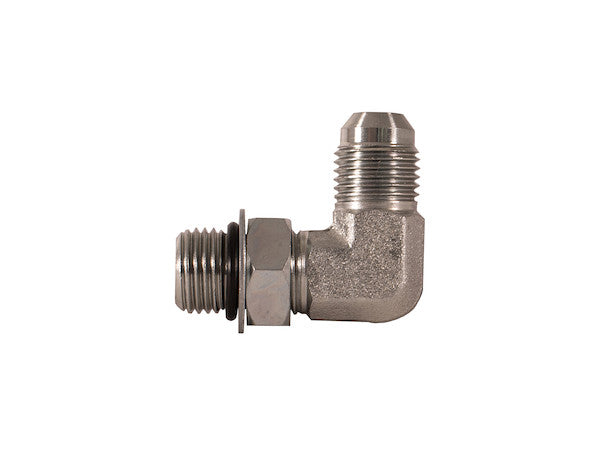
The Straight Thread O-Ring 90?? Elbow is part of the Buyers Products line of JIC 37 degree flare tube fittings. The fittings feature tough carbon steel construction, 3 piece flare sealing for a tight, secure connection, and a corrosion-resistant zinc finish. Fitting conforms to JIC and SAE specifications. Buyers Products tube fittings are used with copper, brass, steel, aluminum, and other tubing that can be flared. They are rated at up to 10,000 PSI depending on tube size.
Specifications
| Finish | Zinc Plated |
|---|---|
| Material | Carbon Steel |
| Shape | 90?? Elbow |
| Side 1 | 1/2 JIC (-8) |
| Side 2 | 1/2 SAE ORB (-8) |
| Style | MM |
Technical Overview: Straight Thread O-Ring 90° Elbow for High-Performance Fluid Systems
The Straight Thread O-Ring 90° Elbow, meticulously engineered by Buyers Products, represents a critical component in the design and execution of robust hydraulic and fluid transfer systems. This specific fitting is designed to facilitate a precise 90-degree directional change in tubing runs while simultaneously providing a secure, leak-resistant connection between a 1/2 inch outer diameter (O.D.) JIC (Joint Industry Council) 37-degree flared tube and a 1/2 inch SAE O-Ring Boss (ORB) straight thread port. Its construction from high-grade carbon steel, complemented by a resilient zinc plating, ensures superior performance, longevity, and adherence to stringent industry standards, making it an indispensable choice for demanding industrial and mobile applications.
The Significance of JIC 37-Degree Flare Connections
The JIC 37-degree flare standard (conforming to SAE J514) is a cornerstone in hydraulic tubing connections, renowned for its reliability and widespread interchangeability across various manufacturers. This standard specifies a metal-to-metal sealing mechanism achieved by flaring the end of a tube to a 37-degree angle, which then mates with a corresponding 37-degree conical seat within the fitting body. The connection is secured by a threaded nut that compresses the flared tube end against the fitting body, creating a robust, pressure-tight seal.
The design inherently offers several distinct advantages:
- Reliable Sealing: The metal-to-metal contact, when properly torqued, provides an excellent seal capable of withstanding high pressures and vibrations common in hydraulic systems.
- Vibration Resistance: Unlike some other connection types, the JIC flare fitting maintains its integrity under dynamic loads and system vibrations, crucial for mobile equipment and heavy machinery.
- Ease of Assembly and Disassembly: JIC fittings are designed for repeated assembly and disassembly without compromising seal integrity, facilitating maintenance, troubleshooting, and system modifications. This characteristic significantly reduces downtime and labor costs in the field.
- Field Serviceability: With proper flaring tools, tubes can be cut and flared in the field, allowing for quick repairs or custom installations, enhancing operational flexibility.
- Three-Piece Construction: The Buyers Products JIC fittings typically feature a three-piece design comprising a nut, a sleeve, and the body. The sleeve (or flare nut) slides over the tube and compresses the flare against the body's conical seat when the nut is tightened. This arrangement helps distribute the compressive force evenly, reducing stress concentrations on the flared tube and improving overall seal integrity and fatigue life. The inclusion of a sleeve further aids in preventing the tube from twisting during assembly and provides additional support to the flared section, enhancing vibration resistance and mechanical stability.
Compatibility with various tubing materials such as copper, brass, steel, and aluminum is a testament to the JIC standard's versatility, provided the tubing possesses the necessary malleability for proper flaring without cracking or weakening.
Understanding the SAE O-Ring Boss (ORB) Straight Thread Connection
The SAE O-Ring Boss (ORB) connection, conforming to SAE J1926 and ISO 11926 standards, represents a superior sealing technology, particularly favored in high-pressure hydraulic applications where absolute leak prevention is paramount. Unlike tapered pipe threads (e.g., NPT) which rely on deformation of threads and thread sealant for sealing, the ORB system employs a straight thread to create a mechanical connection and an elastomeric O-ring to achieve the static seal.
Key features and advantages of the ORB design include:
- Positive O-Ring Seal: The primary seal is established by compressing an elastomeric O-ring within a precisely machined chamfer or groove on the male fitting against a flat surface on the female port. This face-seal mechanism provides an exceptionally reliable and leak-free connection, even under significant pressure fluctuations, temperature variations, and vibration.
- Straight Threads: The use of straight threads eliminates the risk of overtightening and cracking that can occur with tapered threads, ensuring consistent sealing performance and preventing structural damage to components. Straight threads also facilitate easier assembly and disassembly, as less torque is required to achieve a secure connection.
- Reduced Assembly Torque: Since the seal is performed by the O-ring and not by thread deformation, ORB connections typically require lower torque values for assembly compared to NPT connections. This reduces stress on components and simplifies installation procedures.
- Reusability: ORB fittings can be reused multiple times simply by replacing the O-ring, making them a cost-effective and environmentally friendly solution for systems requiring frequent maintenance or component replacement.
- Elimination of Sealants: The O-ring provides a self-contained sealing element, removing the need for thread sealants, tapes, or compounds, which can potentially contaminate hydraulic fluid or become dislodged.
For this specific fitting, the 1/2 inch SAE ORB connection corresponds to the -8 dash size, indicating its compatibility with ports designed for optimal flow and pressure characteristics in 1/2 inch nominal systems. The O-ring material is typically chosen for compatibility with the hydraulic fluid being used and the operating temperature range, ensuring long-term sealing performance.
The Robustness of Carbon Steel Construction
The foundation of this elbow's exceptional performance lies in its carbon steel construction. Carbon steel is the material of choice for high-pressure hydraulic fittings due to its superior mechanical properties, including:
- High Tensile Strength: Carbon steel exhibits excellent resistance to pulling forces, ensuring that the fitting can withstand internal system pressures without material deformation or failure.
- Exceptional Yield Strength: This property signifies the material's ability to resist permanent deformation under stress, vital for maintaining the fitting's structural integrity in dynamic hydraulic environments.
- Fatigue Resistance: Hydraulic systems often experience pressure cycling, which can induce fatigue in components. Carbon steel's inherent fatigue resistance contributes to the extended service life of the fitting.
- Impact Resistance: In industrial and mobile applications, fittings may be subjected to external impacts or shock loads. Carbon steel provides the necessary toughness to absorb such forces without catastrophic failure.
The manufacturing process for these carbon steel fittings involves precision machining to achieve the exact dimensions and surface finishes required for optimal sealing and connection integrity. Rigorous quality control measures are applied throughout the production cycle to ensure that each fitting meets stringent material and dimensional specifications.
Enhanced Durability with Zinc Plated Finish
To augment the intrinsic strength of carbon steel and protect it from environmental degradation, the Straight Thread O-Ring 90° Elbow is finished with a high-quality zinc plating. This surface treatment is not merely aesthetic; it serves a crucial functional role in extending the fitting's operational lifespan and maintaining system reliability. The benefits of zinc plating include:
- Corrosion Resistance: Zinc acts as a sacrificial coating, corroding preferentially to the underlying carbon steel when exposed to moisture, chemicals, or other corrosive agents. This galvanic protection significantly delays the onset of rust and preserves the structural integrity of the fitting.
- Abrasion Resistance: The plating provides a hard outer layer that helps resist surface wear and tear from handling, installation, and operation.
- Environmental Durability: In harsh operating environments typical of construction, agricultural, and transport machinery, the zinc plating ensures the fitting can withstand exposure to road salts, industrial fluids, and varying weather conditions.
- Reduced Friction: Zinc plating can also contribute to lower friction during assembly, aiding in achieving correct torque values without galling of threads.
The zinc plating process adheres to industry standards, guaranteeing a uniform coating thickness and consistent performance across all fittings.
The Functional Design of the 90° Elbow
The 90-degree elbow configuration is a fundamental element in fluid power system design, offering unparalleled flexibility in routing hydraulic lines. Its primary function is to redirect fluid flow by precisely 90 degrees, enabling compact system layouts and efficient space utilization. In complex machinery, where space is often at a premium, a 90-degree elbow can simplify hose and tube routing, minimize bending radii (which can restrict flow or damage hoses), and reduce the overall footprint of the hydraulic circuit.
Design considerations for elbow fittings include:
- Optimized Flow Path: The internal geometry of the elbow is carefully designed to minimize turbulence and pressure drop, ensuring efficient fluid transfer and preserving system energy.
- Stress Distribution: The robust construction and material selection ensure that the elbow can withstand the hydraulic forces generated by directional changes without undue stress concentration, which could lead to fatigue failure.
- System Layout: The 90-degree angle is strategically important for connecting components that are perpendicularly oriented, such as pumps to valves, or cylinders to manifolds, allowing for neat and professional installation.
Performance Parameters: Pressure Rating and System Compatibility
The Straight Thread O-Ring 90° Elbow is rated for exceptional pressure capabilities, "up to 10,000 PSI depending on tube size." This high-pressure rating underscores its suitability for demanding hydraulic applications. The exact maximum operating pressure for a given system is influenced by several factors:
- Tube Wall Thickness and Material: The pressure rating is fundamentally constrained by the weakest link in the system. While the fitting itself is rated high, the actual working pressure must consider the burst pressure and working pressure of the connected tubing. Thicker walled tubes of appropriate material (e.g., seamless cold-drawn steel tubing) will support higher pressures.
- Temperature: Elevated operating temperatures can reduce the strength of materials and affect the performance of O-rings, thereby reducing the effective pressure rating.
- Fluid Type: The type of hydraulic fluid can influence O-ring compatibility and system pressure, particularly with synthetic or aggressive fluids.
- Dynamic vs. Static Pressure: The rating often refers to maximum static pressure; dynamic pressures (pressure spikes or pulsations) may require a larger safety factor.
Adherence to safety factors is paramount in hydraulic design, typically employing a 4:1 safety factor for working pressure to burst pressure, ensuring a substantial margin against failure. This fitting's high intrinsic pressure capability provides engineers with the necessary confidence to integrate it into medium to high-pressure hydraulic circuits with reliability.
Furthermore, the fitting's compatibility with a range of tubing materials—copper, brass, steel, and aluminum—highlights its versatility. Each material has specific properties that make it suitable for flaring: copper and brass for their malleability, steel for strength, and aluminum for lightweight applications. Proper flaring techniques are essential to ensure the integrity of the 37-degree flare connection for all compatible tubing types.
Adherence to Industry Standards: JIC and SAE
The explicit conformation to JIC and SAE specifications is a critical assurance of quality and interoperability. Adherence to these established industry standards provides numerous benefits:
- Interchangeability: Ensures that fittings from different manufacturers conforming to the same standard can be reliably interconnected, simplifying procurement and field repairs.
- Safety: Components manufactured to recognized standards have undergone rigorous design and testing protocols, enhancing the safety of the fluid power system.
- Performance Assurance: Standards define dimensional tolerances, material requirements, and performance criteria, guaranteeing consistent and predictable operation.
- Global Acceptance: JIC and SAE standards are widely recognized and accepted globally, facilitating international trade and application.
Detailed Technical Specifications and Sizing (-8 Dash Size)
The product title and specifications delineate specific sizing:
- 1/2 Inch Tube O.D. To 1/2 Inch Port Size: This indicates the nominal sizes of the connections.
- Side 1: 1/2 JIC (-8): This refers to the male JIC 37-degree flared end designed to mate with a 1/2 inch O.D. flared tube. The "-8" dash size is a common industry shorthand, where each unit typically represents 1/16 of an inch. Thus, -8 signifies 8/16, or 1/2 inch. This convention simplifies component selection and ensures compatibility within a system.
- Side 2: 1/2 SAE ORB (-8): This specifies the male SAE O-Ring Boss straight thread end, also corresponding to the -8 dash size. This end is designed to screw into a female ORB port on a hydraulic component such as a pump, valve, or cylinder, providing the secure O-ring seal.
- Style: MM (Male-Male): This indicates that both ends of the fitting are male connections, meaning they are designed to screw into female ports or connect to female tube ends (in the case of the JIC side, the flared tube itself is effectively the male component).
The precise machining of these dimensions is vital. Incorrect dimensions, even by small tolerances, can lead to poor sealing, premature wear, or catastrophic failure under pressure. Buyers Products ensures strict adherence to these dimensional standards through advanced manufacturing techniques and rigorous inspection.
Installation, Maintenance, and System Integrity
Optimal performance and longevity of the Straight Thread O-Ring 90° Elbow depend significantly on proper installation and maintenance practices:
- Correct Flaring: For the JIC connection, a high-quality flaring tool must be used to create a clean, uniform 37-degree flare on the tube end. The flare must be free of cracks, nicks, or uneven surfaces to ensure a perfect metal-to-metal seal.
- Cleanliness: All components, including the fitting, tube ends, and mating ports, must be thoroughly cleaned of any debris, contaminants, or machining oils prior to assembly. Contamination is a leading cause of hydraulic system malfunction and premature wear.
- Proper Torque: Adhering to manufacturer-recommended torque specifications for both the JIC nut and the ORB connection is crucial. Overtightening can damage threads, deform components, or crush the O-ring, while undertightening can lead to leaks.
- O-Ring Inspection and Replacement: Before installing the ORB connection, the O-ring should be inspected for any cuts, nicks, or signs of degradation. It is good practice to replace the O-ring during maintenance or reassembly to ensure optimal sealing, especially in critical applications. Lubricating the O-ring with a compatible fluid or O-ring lubricant before installation can prevent twisting and pinching.
- System Compatibility: Ensure that the materials of the fitting, O-ring, and tubing are chemically compatible with the hydraulic fluid used in the system to prevent material degradation.
Applications and Industry Relevance
The technical specifications and robust design of this 90° elbow make it exceptionally well-suited for a broad spectrum of demanding applications across various industries:
- Construction Equipment: Excavators, bulldozers, loaders, and cranes rely on robust hydraulic systems for power transmission, where high pressures, vibrations, and harsh environmental conditions are standard.
- Agricultural Machinery: Tractors, harvesters, and irrigation systems often utilize hydraulic power, necessitating reliable fittings that can withstand continuous operation and outdoor exposure.
- Industrial Hydraulic Power Units: Manufacturing plants, automation systems, and heavy presses use complex hydraulic circuits where precise fluid routing and leak-free connections are critical for efficiency and safety.
- Material Handling: Forklifts, conveyors, and lifting platforms depend on responsive and reliable hydraulics.
- Transportation and Trucking: Hydraulic systems in trucks (e.g., dump trucks, refuse vehicles) and specialized transport equipment require durable fittings for braking, steering, and auxiliary functions.
In these applications, the cost of hydraulic fluid leakage extends beyond environmental concerns to include reduced operational efficiency, increased maintenance costs, potential safety hazards, and system downtime. The design and features of this Straight Thread O-Ring 90° Elbow directly address these challenges by providing a secure, high-integrity connection.
Buyers Products Commitment to Quality
Buyers Products is renowned for its commitment to engineering excellence and manufacturing high-quality components for the work truck and industrial equipment markets. This 90° elbow fitting is a testament to that dedication. Each product undergoes stringent quality control procedures, from raw material inspection to final product verification. This includes dimensional checks, material composition analysis, and pressure testing to ensure that every fitting delivered meets or exceeds the industry's most demanding performance criteria. By choosing Buyers Products, users invest in reliability, safety, and long-term operational efficiency, backed by a brand synonymous with durability and precision in fluid power solutions.
In summary, the Straight Thread O-Ring 90° Elbow with 1/2 Inch Tube O.D. to 1/2 Inch Port Size is a technically superior component designed for critical hydraulic applications. Its dual-standard connectivity (JIC 37° flare and SAE ORB), robust carbon steel construction with zinc plating, high-pressure rating, and precision engineering ensure unparalleled reliability, leak prevention, and longevity in the most challenging operational environments.