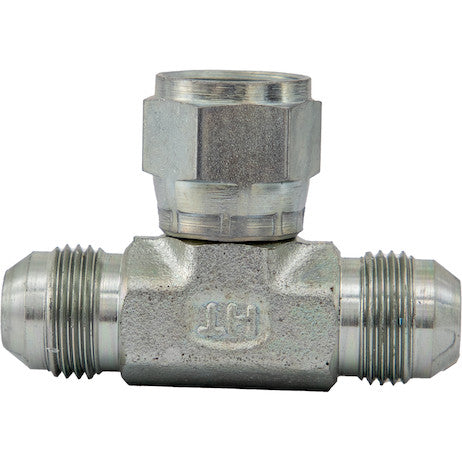
The Swivel Nut Branch Tee is part of the Buyers Products line of JIC 37 degree flare tube fittings. The fittings feature tough carbon steel construction, 3 piece flare sealing for a tight, secure connection, and a corrosion-resistant zinc finish. Fitting conforms to JIC and SAE specifications. Buyers Products tube fittings are used with copper, brass, steel, aluminum, and other tubing that can be flared. They are rated at up to 10,000 PSI depending on tube size.
Specifications
| Finish | Zinc Plated |
|---|---|
| Material | Carbon Steel |
| Shape | Branch Tee |
| Side 1 | 1/2 JIC (-8) |
| Side 2 | 1/2 JIC (-8) |
| Style | MF |
The Swivel Nut Branch Tee, with its 1/2 Inch Tube O.D. specification, represents a cornerstone component in high-performance fluid transfer systems, particularly within hydraulic and pneumatic applications. Manufactured as part of the esteemed Buyers Products line, this fitting is engineered to meet the stringent demands of industrial and mobile equipment, offering a robust and reliable solution for creating branching pathways in tubing systems. Its design adheres to the widely recognized JIC 37-degree flare standard, ensuring compatibility, interchangeability, and consistent performance across a broad spectrum of applications.
Engineering Principles of JIC 37-Degree Flare Fittings
The JIC (Joint Industry Council) 37-degree flare fitting standard (also known as SAE J514 in North America, or ISO 8434-2 internationally) is a globally accepted design for fluid power connections, renowned for its exceptional reliability under high pressures and resistance to vibration. The fundamental principle of a flare fitting involves the mechanical deformation of a tube end into a conical shape, typically at a 37-degree angle. This flared tube then mates precisely with a corresponding 37-degree conical seat machined into the fitting body. A swivel nut, which slides over the tube before flaring, is then tightened onto the fitting body, compressing the flared tube end against the fitting's seat to create a metal-to-metal seal. This sealing mechanism is inherently robust, offering superior leak integrity compared to many other fitting types, especially in dynamic environments.
Key advantages of the JIC 37-degree flare system include its high working pressure capabilities, ease of assembly and disassembly for maintenance or system modifications, and the ability to reuse components provided they are undamaged. The swivel nut design is critical for these benefits, allowing the nut to be tightened without rotating the tube or the fitting body, thus preventing torsional stress on the tubing and simplifying installation in complex layouts. This eliminates the need for precise alignment of the tube and fitting body before tightening, a common challenge with fixed-nut designs.
The Swivel Nut Branch Tee: Functionality and Design
A "Branch Tee" fitting serves the essential function of splitting or combining fluid flow within a tubing system, creating a T-shaped junction. This particular Swivel Nut Branch Tee features three ports, typically with two ports aligned on a straight run and a third port branching off at a 90-degree angle. The designation "Swivel Nut" confirms that at least one, and most commonly two (the run ends), of these ports are designed for connection via a swivel nut, which engages with a flared tube end. The third port, often the branch, may also be a swivel nut type or a male flare end, depending on the specific configuration. For this particular product, with "Side 1: 1/2 JIC (-8)" and "Side 2: 1/2 JIC (-8)" and a "Style: MF", it indicates that two ports are 1/2 JIC swivel nut connections, and the third port, likely the branch, is a 1/2 JIC male flare connection. This configuration is highly versatile, allowing for direct connection to another female JIC port or a hose assembly.
The 1/2 Inch Tube O.D. specification is crucial as it defines the size of the tubing with which this fitting is intended to connect. In the JIC system, "1/2 JIC (-8)" signifies a nominal tube outside diameter of 1/2 inch (approximately 12.7 mm). This common size is prevalent in medium-flow and medium-to-high pressure hydraulic circuits, offering an optimal balance between flow capacity and system compactness. The precision engineering of the 37-degree flare and seat ensures a consistent and reliable seal for this tube size, even under fluctuating pressure and temperature conditions.
Material Excellence: Carbon Steel Construction
The selection of carbon steel as the primary construction material for Buyers Products JIC fittings is a deliberate choice driven by its superior mechanical properties essential for demanding fluid power applications. Carbon steel offers an exceptional combination of high tensile strength, excellent fatigue resistance, and good ductility. These properties are critical for fittings exposed to high internal pressures, external stresses, and potential vibration. The material's inherent strength ensures that the fitting can withstand significant operational loads without yielding or fracturing, thereby maintaining system integrity and preventing catastrophic failures. Furthermore, carbon steel exhibits good machinability, allowing for the precise manufacturing of the intricate 37-degree flare seats and threads required for optimal sealing and connection.
Typically, low to medium carbon steel grades (e.g., AISI 1018, 1020, or similar) are utilized due to their advantageous balance of strength, formability, and weldability. The robust nature of carbon steel ensures a long service life for the fitting, even in challenging industrial environments. Its structural integrity provides a reliable foundation for the hydraulic system, safeguarding against leaks and operational downtime. The durability of carbon steel also contributes to the reusability of the fittings, which is a significant economic and practical advantage in maintenance and repair scenarios.
Corrosion Protection: The Zinc Plated Finish
While carbon steel provides excellent structural integrity, its susceptibility to corrosion in humid or chemically aggressive environments necessitates a protective coating. The Swivel Nut Branch Tee features a corrosion-resistant zinc finish, applied through an electroplating process. Zinc plating serves as a sacrificial layer, meaning it corrodes preferentially to the underlying steel, thereby protecting the base metal from rust and degradation. This galvanic protection is highly effective, significantly extending the lifespan of the fitting and maintaining its aesthetic appearance. Modern zinc plating typically utilizes a clear trivalent chromium passivation layer (often referred to as clear zinc or zinc clear) which provides enhanced corrosion resistance and meets environmental regulations such as RoHS (Restriction of Hazardous Substances).
The zinc plating process ensures a uniform coating thickness across all surfaces of the fitting, including complex geometries and thread roots. This comprehensive protection prevents the formation of red rust, which can not only degrade the fitting but also contaminate the hydraulic fluid, leading to premature wear of pumps, valves, and cylinders. A high-quality zinc finish also contributes to easier identification and handling of fittings, as well as providing a cleaner, more professional appearance within the equipment assembly. This attention to surface treatment underscores Buyers Products' commitment to delivering components that perform reliably and maintain their integrity over time.
The Precision of 3-Piece Flare Sealing
The description highlights "3 piece flare sealing for a tight, secure connection." In the context of JIC 37-degree flare fittings, this typically refers to the collaborative interaction of three primary components that form the seal: the fitting body with its precisely machined 37-degree conical seat, the flared end of the tube, and the swivel nut. The fitting body provides the stationary sealing surface. The tube end is carefully flared to match the 37-degree angle, forming the dynamic sealing surface. The swivel nut, when tightened, applies axial force, drawing the flared tube end firmly into contact with the fitting body's seat. This metal-to-metal contact, under appropriate torque, creates an extremely robust and leak-proof seal. The integrity of this seal is paramount in high-pressure fluid power systems, where even minor leakage can lead to system inefficiencies, environmental contamination, and safety hazards.
The exact geometry of the 37-degree angle is not arbitrary; it is an optimized design that balances sealing effectiveness with resistance to mechanical stresses. A properly flared tube will have a smooth, burr-free surface, free of imperfections that could compromise the seal. The design allows for minor variations in tube wall thickness and material properties to be accommodated, provided the flaring process is performed correctly using appropriate tools. The specified torque values for tightening the swivel nut are critical to achieving the optimal compression for the seal without over-stressing the tube flare or the fitting threads. This controlled compression ensures the longevity of the connection and its ability to withstand operational pulsations and vibrations without loosening.
Adherence to JIC and SAE Specifications
The statement that the fitting "conforms to JIC and SAE specifications" is a crucial indicator of its quality, interchangeability, and performance reliability. JIC (Joint Industry Council) standards originated in the United States to standardize hydraulic components for heavy industrial machinery, ensuring interchangeability and predictable performance across different manufacturers. SAE (Society of Automotive Engineers) J514 specifically defines the dimensional and performance criteria for hydraulic 37-degree flared tube fittings. This includes material specifications, dimensional tolerances for threads and flare angles, pressure ratings, and test methods.
Adherence to these internationally recognized standards provides several profound benefits:
- Interchangeability: Fittings from different manufacturers conforming to JIC/SAE J514 can be confidently used together, simplifying procurement, inventory management, and maintenance.
- Reliability: The standardized design has undergone extensive testing and field validation, ensuring a high level of performance and durability in demanding applications.
- Safety: Conformance to these specifications implies that the fitting has been designed and tested to withstand specified pressures and conditions, contributing to the overall safety of fluid power systems.
- Global Acceptance: As a widely adopted standard, JIC fittings are recognized and used worldwide, facilitating international commerce and repair.
Tubing Compatibility and Pressure Performance
The versatility of this fitting is highlighted by its compatibility with a range of tubing materials, including "copper, brass, steel, aluminum, and other tubing that can be flared." This broad compatibility is a significant advantage, allowing engineers and technicians to select the optimal tubing material based on application-specific requirements such as fluid compatibility, temperature, pressure, and cost. Each material possesses distinct properties:
- Steel Tubing: Preferred for high-pressure hydraulic applications due to its superior strength and fatigue resistance. Both seamless and welded steel tubing can be flared, with seamless offering higher pressure capabilities.
- Copper Tubing: Excellent corrosion resistance, good thermal conductivity, and ease of flaring, making it suitable for low to medium pressure lines, particularly in refrigeration or instrumentation.
- Brass Tubing: Offers good corrosion resistance and is relatively easy to flare, often used in pneumatic systems, fuel lines, and some lower-pressure hydraulic applications.
- Aluminum Tubing: Lightweight with good corrosion resistance, ideal for applications where weight is a critical factor, such as in aerospace or certain mobile equipment.
The stated pressure rating of "up to 10,000 PSI depending on tube size" underscores the high-performance capability of these fittings. This maximum pressure is not a universal constant but is influenced by several critical factors:
- Tube Material and Wall Thickness: Thicker-walled, higher-strength tubing (e.g., seamless cold-drawn steel) will support significantly higher pressures than thin-walled or softer materials. The fitting itself is often capable of withstanding more pressure than the tubing it connects.
- Operating Temperature: Higher temperatures can reduce the mechanical strength of both the fitting and the tubing, thereby lowering the maximum safe operating pressure.
- Fluid Type: While JIC fittings are generally compatible with various hydraulic fluids, aggressive fluids can potentially affect long-term material integrity.
- Dynamic vs. Static Pressure: Systems with constant pressure fluctuations (pressure surges) will require a more conservative working pressure to account for fatigue.
- Safety Factor: Engineering design typically incorporates a safety factor (e.g., 4:1) where the burst pressure is significantly higher than the maximum recommended working pressure.
Broad Range of Applications
The Swivel Nut Branch Tee is an indispensable component across a multitude of industries and applications where reliable, high-pressure, and versatile fluid connections are paramount:
- Mobile Hydraulics: Essential in construction equipment (excavators, loaders), agricultural machinery (tractors, harvesters), material handling equipment (forklifts), and municipal vehicles. They facilitate the routing of hydraulic power to various actuators and control valves.
- Industrial Hydraulics: Found in manufacturing plants, heavy presses, injection molding machines, machine tools, and robotics, where precise and powerful fluid control is critical.
- Pneumatic Systems: Although designed for hydraulic pressures, these fittings are also well-suited for high-pressure pneumatic applications due to their robust sealing capability, preventing air leaks.
- Lubrication Systems: Used for distributing lubricants under pressure to critical machinery components, ensuring smooth operation and reducing wear.
- Fuel and Oil Lines: In certain non-automotive, heavy-duty applications, JIC fittings provide secure connections for fuel and oil transfer lines, especially where vibration is a concern.
- Process Control and Instrumentation: For systems requiring reliable connections for sensing and control lines carrying various fluids or gases.
Installation, Maintenance, and Value Proposition
Proper installation is key to maximizing the performance and longevity of the Swivel Nut Branch Tee. This involves using a high-quality flaring tool to create a perfectly formed, smooth, and crack-free 37-degree flare on the tube end. The tube should be cut squarely, deburred thoroughly, and cleaned of any debris or contaminants that could interfere with the seal. The swivel nut should be threaded onto the fitting body by hand until snug, then tightened with a wrench to the manufacturer's specified torque. Over-tightening can deform the flare or damage the threads, while under-tightening can lead to leaks. The swivel nut design allows for alignment corrections after the initial hand-tightening, facilitating easier and faster assembly.
Maintenance typically involves periodic inspection for leaks, signs of corrosion, or damage. The reusability of JIC fittings, provided the flare seat and threads are undamaged, makes them an economical choice. If a connection requires disassembly, careful inspection of the tube flare and fitting seat is essential before reassembly to ensure the integrity of the metal-to-metal seal.
In summary, the Buyers Products Swivel Nut Branch Tee for 1/2 Inch Tube O.D. offers an unparalleled combination of robust construction, technical precision, and operational versatility. Its carbon steel composition, corrosion-resistant zinc finish, adherence to JIC/SAE standards, and proven 37-degree flare sealing mechanism collectively ensure a highly dependable component for critical fluid power systems. Capable of handling pressures up to 10,000 PSI and compatible with a wide array of tubing materials, this fitting provides engineers and system integrators with a high-confidence solution for creating durable, leak-free branching connections. Choosing Buyers Products means investing in expertly engineered components that deliver superior performance, longevity, and peace of mind in the most demanding industrial and mobile applications.