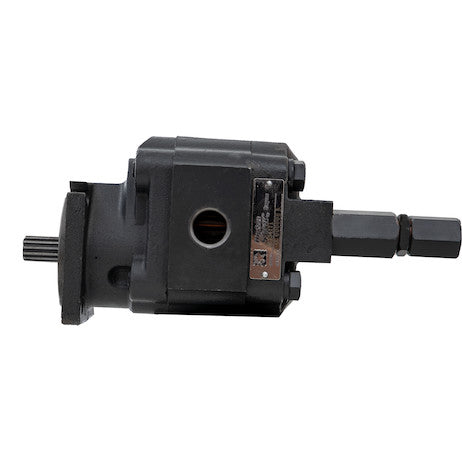
The heavy duty Live Floor Hydraulic Pump with Relief Port from Buyers Products is built tough to handle continuous, high-pressure operations such as a live floor. It features counter clockwise rotation. The 1 in. relief port on the rear protects the pump's operation from spikes in pressure that could damage it and other parts of your hydraulic system. The pump is constructed of cast iron with Teflon-coated bronze thrust plates and heavy duty roller bearings. Eight internal dowels protect the structural integrity of the pump. Two models both handle a maximum 3000 PSI while delivering a flow of either 18 GPM or 24.2 GPM at 1000 RPM. The pump is designed to be 4-bolt mounted into an SAE B mount.
Specifications
| Direct Mount/Remote Mount | 4 Bolt SAE B |
|---|---|
| Direct or Remote Mount | Direct Mount |
| Displacement | 3 |
| Flow | 18 |
| Flow at 1000 RPM | 18 |
| Flow at 1200 RPM | 21.80 |
| Flow at 1500 RPM | 27.00 |
| Flow at 1800 RPM | 43.56 |
| Flow at 2100 RPM | 50.82 |
| Flow at 600 RPM | 14.52 |
| Flow at 900 RPM | 21.78 |
| Gear Size | 2.50 |
| Gear Width | 1.750 |
| Inlet Port Size | 1 1/2 NPT |
| Input Mount Type | Integral Bracket |
| Material | Cast Iron |
| Maximum Pressure | 3000 |
| Maximum Rotations Per Minute (RPM) | - |
| Mount Type | SAE B 4 Bolt |
| Outlet Port Size | 1 1/4 NPT |
| Pilot Diameter | 4.00 |
| Ports (rear/side) | Side |
| Rear Port Size | - |
| Rotation | Counterclockwise |
| Shaft Size | 7/8-13 |
| Shaft Type | Splined |
Advanced Engineering for Demanding Hydraulic Applications: The Live Floor Hydraulic Pump
The Buyers Products Live Floor Hydraulic Pump with Relief Port and 1-3/4 Inch Diameter Gear represents a pinnacle of hydraulic engineering, specifically designed for the most strenuous continuous, high-pressure operations inherent in live floor systems and other heavy-duty applications. This detailed exposition will delve into the technical intricacies, material science, and operational benefits that establish this pump as a superior choice for professional-grade hydraulic power.
Foundational Design Principles for Unrivaled Durability
At the core of this hydraulic pump's robust performance is its meticulously engineered construction, beginning with its foundational material: cast iron. The selection of cast iron is a deliberate engineering decision, providing exceptional tensile strength, rigidity, and resistance to thermal distortion. Unlike lighter materials, cast iron offers superior vibration damping characteristics, which are crucial for reducing noise and wear in high-speed, high-pressure environments. Its inherent density also contributes to efficient heat dissipation, preventing overheating during prolonged operational cycles, thereby extending the lifespan of both the pump and the hydraulic fluid. This robust housing acts as a protective shell, ensuring the precise alignment of internal components even under extreme operational loads.
Further enhancing the pump's durability and efficiency are the Teflon-coated bronze thrust plates. These critical components are positioned to manage axial thrust loads generated by the meshing gears. Bronze, known for its excellent bearing properties and resistance to wear, is further augmented by a Teflon coating. Polytetrafluoroethylene (Teflon) dramatically reduces the coefficient of friction between the rotating gears and the stationary plates. This reduction in friction translates directly into several operational advantages: significantly less heat generation within the pump, improved volumetric and mechanical efficiency, and extended service intervals by minimizing wear on critical surfaces. The design ensures that even under maximum pressure, the thrust loads are effectively distributed and absorbed, maintaining optimal internal clearances and preventing premature component failure.
The integration of heavy-duty roller bearings is another testament to the pump's design for continuous, high-pressure operations. Roller bearings, as opposed to plain bearings, are engineered to handle both radial and axial loads with superior efficiency and load-carrying capacity. Their rolling element design minimizes friction and heat generation, which is paramount for high-RPM applications where sustained performance is required. These bearings ensure precise shaft rotation, reducing shaft deflection and maintaining optimal gear alignment under varying load conditions. This contributes significantly to the pump's overall mechanical efficiency, longevity, and consistent hydraulic output.
The structural integrity of the pump is further reinforced by eight internal dowels. These precisely machined dowels serve a critical function in aligning and securing the various sections of the pump housing and internal components. They resist shear forces and prevent relative movement between pump sections, which is vital for maintaining the tight tolerances required for efficient gear pump operation. In high-pressure systems, the internal forces can be substantial; these dowels ensure that the pump's structure remains sound and leak-free throughout its operational life, preventing internal bypass and maintaining consistent performance parameters.
Integrated Safety and Performance: The Relief Port
A distinctive and essential feature of this Live Floor Hydraulic Pump is its integrated 1-inch relief port, strategically located on the rear of the unit. This component is not merely an accessory but a fundamental safety and operational integrity mechanism. The relief port is designed to house a pressure relief valve (not explicitly stated as included but implied by "relief port"), which acts as a hydraulic fuse, preventing over-pressurization of the pump and the entire hydraulic system. In applications like live floors, where dynamic loads can fluctuate rapidly and potentially cause sudden pressure spikes, an effective relief mechanism is indispensable.
When system pressure exceeds a pre-set maximum (in this case, up to the 3000 PSI maximum pressure rating, the relief valve would typically be set below this to allow for a safety margin), the relief valve within the port opens, diverting excess hydraulic fluid back to the reservoir. This instantaneous pressure modulation protects not only the pump itself from potential internal damage (such as seal failure, gear distortion, or housing stress fractures) but also safeguards other expensive components within the hydraulic circuit, including hoses, valves, cylinders, and motors. Without such a mechanism, pressure surges could lead to catastrophic equipment failure, costly downtime, and significant safety hazards. The 1-inch size of the port ensures sufficient flow capacity for rapid pressure relief, maintaining system stability and operational safety.
Precision Power Delivery: The Gear Mechanism and Performance Metrics
The heart of this positive displacement pump lies in its gear mechanism. The title specifies a "1-3/4 Inch Diameter Gear," while the specifications table provides a "Gear Width" of 1.750 inches and a "Gear Size" of 2.50. This interplay of dimensions is critical for defining the pump's volumetric displacement and, consequently, its flow rate capabilities. Gear pumps operate on the principle of volumetric displacement, where a fixed amount of fluid is trapped between the teeth of meshing gears and carried from the inlet to the outlet port with each revolution. The precision of the gear machining, coupled with the robust support provided by the heavy-duty roller bearings, ensures minimal internal leakage and high volumetric efficiency.
The pump is engineered to deliver substantial hydraulic power, demonstrated by its impressive performance specifications. It is rated for a maximum pressure of 3000 PSI. This high-pressure capability is crucial for live floor systems, which often require significant force to move heavy and cohesive bulk materials, especially when overcoming initial inertia or dealing with sticky loads. Achieving and sustaining 3000 PSI under continuous operation underscores the inherent strength and design integrity of the pump's components.
In terms of flow, the product description highlights two models offering either 18 GPM or 24.2 GPM at 1000 RPM. The provided specifications table details the performance for the 18 GPM model:
- Flow at 600 RPM: 14.52 GPM
- Flow at 900 RPM: 21.78 GPM
- Flow at 1000 RPM: 18 GPM (This discrepancy with the general "18 GPM" vs. calculated flow rate from 3 cu.in. displacement implies that "Displacement: 3" might refer to a nominal series or a specific internal dimension, not directly cubic inches per revolution, or that the pump's volumetric efficiency is factored into the 18 GPM at 1000 RPM figure, which is a common practice for real-world performance ratings.)
- Flow at 1200 RPM: 21.80 GPM
- Flow at 1500 RPM: 27.00 GPM
- Flow at 1800 RPM: 43.56 GPM
- Flow at 2100 RPM: 50.82 GPM
System Integration and Operational Considerations
The Live Floor Hydraulic Pump is designed for seamless integration into existing and new hydraulic systems. Its counter-clockwise rotation is a critical specification for ensuring compatibility with the power take-off (PTO) units and drive mechanisms typically found in heavy-duty trucks and equipment. Incorrect rotation can lead to severe damage and operational failure, making this an essential consideration during installation.
Mounting is facilitated by an SAE B 4-bolt standard, ensuring a robust and industry-standard connection. The direct mount configuration, with a 4.00-inch pilot diameter, provides excellent alignment with the power source (typically a PTO), minimizing vibrational stress and ensuring efficient power transfer. The "Integral Bracket" input mount type further simplifies installation and enhances stability.
Port sizing is crucial for hydraulic system efficiency. This pump features a 1 1/2 NPT inlet port and a 1 1/4 NPT outlet port, both designed to facilitate optimal fluid flow and minimize pressure drop. The generous inlet port size helps prevent cavitation, a phenomenon where air bubbles form and collapse within the pump, causing damage and reducing efficiency. The National Pipe Taper (NPT) threading ensures secure, leak-free connections when properly installed. The side port configuration offers flexibility in plumbing and routing of hydraulic lines.
Power transmission to the pump's internal gears is handled by a 7/8-13 splined shaft. A splined shaft is inherently superior to a keyed shaft for high-torque applications due to its ability to distribute torque over multiple teeth, significantly reducing stress concentrations and minimizing the risk of shaft or coupling failure. The 13 splines provide a robust and precise engagement with the PTO drive, ensuring efficient and reliable power transfer from the engine to the hydraulic system under the demanding loads associated with live floor operation.
Applications Beyond Live Floors
While specifically engineered for live floor systems, the robust design principles and high-performance characteristics of this hydraulic pump make it suitable for a wide array of other demanding mobile and industrial hydraulic applications. Its ability to sustain high pressures and deliver consistent flow rates makes it ideal for:
- Refuse Compactors and Collection Vehicles: Where continuous, high-pressure operation is required for compaction cycles.
- Heavy-Duty Tippers and Dump Trailers: Requiring significant force for lifting and precise control for lowering.
- Agricultural Machinery: For powering implements that demand consistent hydraulic flow and pressure.
- Construction Equipment: In applications such as augers, cranes, or specialty attachments that necessitate robust hydraulic power.
- Industrial Power Units: Where a reliable and durable hydraulic power source is critical for automated processes or heavy lifting.
Maintenance and System Longevity
To maximize the lifespan and maintain the peak performance of this high-quality hydraulic pump, adherence to best practices for hydraulic system maintenance is essential. This includes:
- Fluid Cleanliness: Regular inspection and filtration of hydraulic fluid are paramount. Contaminants are the leading cause of hydraulic component wear.
- Proper Fluid Type: Using the recommended hydraulic fluid with the correct viscosity and additive package for the operating temperature range.
- System Cooling: Ensuring adequate heat dissipation from the hydraulic system to prevent fluid degradation and component damage.
- Scheduled Inspections: Regularly checking for leaks, unusual noises, or vibrations that could indicate impending issues.
- Pressure Settings: Verifying that the relief valve is set correctly within safe operating parameters to prevent over-pressurization.
By integrating these maintenance practices, operators can ensure that the Live Floor Hydraulic Pump continues to deliver its designed performance for an extended operational life, minimizing downtime and reducing total cost of ownership.
Conclusion
The Buyers Products Live Floor Hydraulic Pump with Relief Port and 1-3/4 Inch Diameter Gear is a testament to sophisticated engineering focused on reliability, performance, and safety in heavy-duty hydraulic applications. From its robust cast iron construction, friction-reducing Teflon-coated thrust plates, and durable roller bearings to its crucial integrated relief port and high-capacity gear design, every aspect of this pump is optimized for the rigorous demands of continuous, high-pressure operation. Its adherence to SAE B mounting standards and precise flow delivery at various RPMs ensure seamless integration and efficient power transfer. Choosing this pump signifies an investment in a component designed to deliver consistent, powerful, and safe hydraulic performance, ultimately contributing to enhanced productivity and reduced operational expenditures in the most challenging work environments.