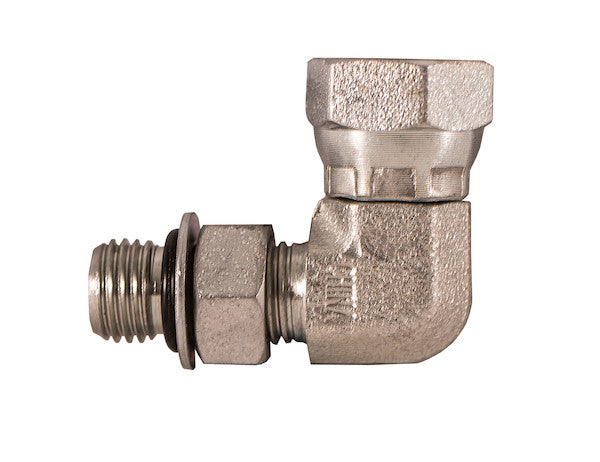
The Male Straight Thread to Female Pipe Swivel 90?? Elbow adapter is part of the Buyers Products line of swivel adapters. These adapters make a metal-to-metal seal to a male pipe. They feature tough carbon steel construction, a tight, secure connection, and a corrosion-resistant zinc finish. They are rated at up to 10,000 PSI depending on pipe size.
Specifications
| Finish | Zinc Plated |
|---|---|
| Material | Carbon Steel |
| Shape | 90?? Elbow |
| Side 1 | 3/8 SAE ORB (-6) |
| Side 2 | 3/8 NPSM |
| Style | MF |
Technical Overview: 9/16-18 Inch Male Straight Thread 3/8-18 Inch NPSM Female Pipe Swivel 90° Elbow
This detailed exposition provides a comprehensive technical overview of the 9/16-18 Inch Male Straight Thread to 3/8-18 Inch NPSM Female Pipe Swivel 90° Elbow, a critical component within Buyers Products' extensive range of hydraulic and pneumatic connectivity solutions. Engineered for demanding industrial and mobile applications, this adapter epitomizes precision manufacturing, robust material science, and intelligent design principles aimed at optimizing system performance, reliability, and longevity.
Precision Engineering: The 9/16-18 Inch Male Straight Thread (SAE ORB -6)
The first interface of this versatile elbow adapter features a 9/16-18 Inch Male Straight Thread. This specification precisely defines the thread's major diameter as 9/16 inches (0.5625 inches) and its thread pitch as 18 threads per inch (TPI). Crucially, this is a straight thread, meaning its diameter remains constant along its length, distinguishing it from tapered threads like NPT. In the context of hydraulic fittings, a 9/16-18 straight thread is overwhelmingly associated with the Society of Automotive Engineers (SAE) O-Ring Boss (ORB) standard, specifically designated as the -6 size. The SAE J1926/1 standard (which superseded SAE J514 and J1453 for these types of fittings) dictates the geometry and performance requirements for this connection.
The SAE ORB connection methodology is renowned for its superior sealing capability in high-pressure hydraulic systems. Unlike pipe threads that rely on thread deformation and sealants for pressure retention, the ORB system employs a robust O-ring for the primary seal. The male ORB thread (as present on this fitting) screws into a female ORB port, and as it tightens, the O-ring, seated in a groove on the male fitting's shoulder, is compressed against the flat face of the female port. This compression creates an elastomeric seal that is highly resistant to leakage, even under extreme pressure fluctuations and vibration. The metal-to-metal contact between the shoulder of the male fitting and the face of the female port provides a positive stop and mechanical strength, preventing over-compression of the O-ring while ensuring structural integrity. The specification indicating "metal-to-metal seal" in the initial description refers to this robust mechanical engagement, complemented by the O-ring's sealing efficacy at the ORB interface itself when connecting to an appropriate female ORB port, providing unparalleled leak resistance and stability.
Key advantages of the SAE ORB connection include:
- Exceptional Leak Resistance: The O-ring seal provides a highly effective barrier against fluid egress, making it ideal for critical hydraulic applications where zero leakage is paramount.
- High Pressure Rating: ORB connections are inherently capable of sustaining very high operating pressures due to their robust design and consistent sealing mechanism.
- Reduced Overtightening Risk: The positive stop provided by the metal-to-metal shoulder contact prevents excessive torque from damaging the O-ring or threads, simplifying installation and improving reliability.
- Vibration Resistance: The O-ring acts as a damper, making the connection less susceptible to loosening under dynamic loads and vibrations common in heavy machinery.
- Reusability: Unlike tapered pipe threads that can be damaged with repeated assembly, ORB fittings can be disconnected and reconnected multiple times, usually requiring only a new O-ring for renewed sealing performance.
This 9/16-18 Male Straight Thread, therefore, positions this elbow as a premium component for integration into sophisticated hydraulic circuits, offering a secure, high-integrity connection point.
Dynamic Connectivity: The 3/8-18 Inch NPSM Female Pipe Swivel
The opposing end of this fitting features a 3/8-18 Inch NPSM Female Pipe Swivel. This designation refers to a National Pipe Straight Mechanical thread with a nominal pipe size of 3/8 inch and a pitch of 18 threads per inch. Understanding NPSM requires differentiating it from its common relatives, NPT (National Pipe Taper) and NPSF (National Pipe Straight Fuel).
- NPSM (National Pipe Straight Mechanical): Characterized by parallel (straight) threads, NPSM connections are primarily designed for mechanical fastening and do not create a fluid-tight seal solely through thread engagement. Instead, they typically rely on a seating surface, a gasket, or an O-ring for sealing. In the context of a female swivel, an NPSM thread usually features an internal 30-degree cone seat, which mates with an external 30-degree cone on a corresponding male NPT or NPSM fitting. When tightened, this metal-to-metal conical seat creates the seal. The initial description's emphasis on a "metal-to-metal seal" strongly suggests this conical sealing mechanism for the NPSM swivel end, which is common for hydraulic swivel connections.
- NPT (National Pipe Taper): These threads are tapered, meaning their diameter gradually decreases along the thread's length. NPT connections create a seal by interference fit as the male and female tapered threads are tightened, deforming slightly and requiring thread sealant for a leak-proof connection.
- NPSF (National Pipe Straight Fuel): While also straight, NPSF threads are designed for dryseal applications in low-pressure fuel and gas lines and are typically used in conjunction with NPTF (National Pipe Taper Fuel) male threads for direct thread sealing without sealant.
The "Female Pipe" aspect signifies that this is an internal thread designed to accept a male pipe or fitting. The "Swivel" capability is a critically important functional attribute. A swivel fitting comprises multiple parts that allow one section to rotate freely relative to another, even when the connection is under pressure or torque. In this 90° elbow, the female NPSM end is housed within a collar that can rotate 360 degrees around the fitting's axis, independent of the male ORB end. This dynamic capability offers several significant advantages:
- Simplified Installation: Swivel fittings eliminate the need to precisely align rigid pipe or hose ends before tightening. The female swivel can be rotated to easily engage the male thread, and then the entire fitting can be positioned correctly without twisting the hose or pipe.
- Stress Reduction: In applications involving flexible hoses, the swivel feature prevents torsional stress from building up in the hose during installation or operation. Torsional stress can significantly shorten the life of a hydraulic hose, leading to premature failure.
- Improved Routing: Swivels allow for greater flexibility in routing hoses and pipes, enabling tighter bends and more efficient use of space, especially in confined machinery compartments.
- Dynamic Movement Accommodation: For systems where connected components move relative to each other (e.g., articulated machinery, rotating platforms), swivel fittings absorb and accommodate these movements, preventing damage to the fixed connections.
- Maintenance Accessibility: The ability to rotate components can greatly facilitate access for inspection, repair, or replacement of system elements without requiring complete disassembly of adjacent lines.
The combination of a precise 3/8-18 NPSM straight thread with a metal-to-metal swivel seal provides a robust and adaptable connection, perfectly suited for applications where ease of assembly, flexibility, and long-term reliability are paramount.
Robust Construction: Carbon Steel and Zinc Plating
The choice of materials and surface treatments is fundamental to the performance and longevity of hydraulic fittings. This elbow adapter is constructed from high-quality carbon steel and features a durable zinc-plated finish.
Carbon Steel: The Foundation of Strength
Carbon steel is the material of choice for the vast majority of high-pressure hydraulic fittings due to its exceptional mechanical properties. It is an iron-carbon alloy, with carbon content typically ranging from 0.05% to 2.0% by weight. The specific grade of carbon steel used in hydraulic fittings, such as 1018, 1045, or similar alloys, is selected for a balance of strength, machinability, and weldability. Key attributes of carbon steel include:
- High Tensile Strength: Carbon steel can withstand significant pulling forces before yielding or fracturing, which is essential for components operating under high internal pressures and external mechanical stresses.
- Excellent Hardness: The material resists indentation and abrasion, crucial for thread integrity and sealing surfaces that undergo repeated connection/disconnection cycles.
- Durability and Fatigue Resistance: Fittings are constantly subjected to pressure pulsations, vibrations, and thermal cycling. Carbon steel maintains its structural integrity over extended periods, resisting fatigue failure.
- Cost-Effectiveness: Compared to exotic alloys, carbon steel offers a superior strength-to-cost ratio, making it an economically viable choice for mass-produced industrial components without compromising performance.
The inherent toughness of carbon steel ensures that this 90° elbow can withstand the rigorous demands of heavy-duty applications, providing a reliable conduit for fluid transfer.
Zinc Plating: Enhanced Corrosion Resistance
While carbon steel provides structural strength, it is susceptible to corrosion, particularly in humid or outdoor environments. To mitigate this, the fitting undergoes a zinc plating process. Zinc plating, also known as galvanization when applied to larger structures, involves electrochemically depositing a thin layer of zinc onto the steel surface. This coating serves multiple protective functions:
- Sacrificial Protection (Galvanic Corrosion): Zinc is more electrochemically active than steel. If the coating is scratched or compromised, the zinc will corrode preferentially, protecting the underlying steel from rust.
- Barrier Protection: The zinc layer acts as a physical barrier, preventing moisture, oxygen, and other corrosive agents from reaching the steel substrate.
- Improved Aesthetics: Zinc plating provides a bright, clean, and uniform finish, which is important for product presentation and identification.
- Enhanced Wear Resistance: The zinc layer, especially when combined with chromate passivation (which is typical for these finishes), can offer improved surface hardness and abrasion resistance.
Modern zinc plating often includes a chromate conversion coating, which further enhances corrosion resistance and can impart different colors (e.g., clear, yellow, black) based on the chromate type. For hydraulic fittings, clear or yellow chromate is common, offering excellent protection against red rust in salt spray tests for hundreds of hours. This meticulous surface treatment ensures that the fitting maintains its structural and aesthetic integrity even in harsh operating conditions, extending its service life and reducing maintenance requirements.
Performance Capabilities: Pressure Rating and Connection Integrity
A fundamental characteristic of any hydraulic fitting is its pressure rating. This 90° elbow is rated for an impressive operational capability of up to 10,000 PSI, contingent upon the specific pipe size and overall system design. This high-pressure tolerance underscores its suitability for the most demanding hydraulic circuits found in heavy machinery, industrial presses, and high-force actuation systems.
Several engineering factors contribute to this exceptional pressure rating:
- Material Strength: As discussed, high-grade carbon steel provides the requisite tensile and yield strength to contain fluids under extreme pressure without deformation or failure.
- Thread Design: Both the SAE ORB straight thread and the NPSM straight swivel thread are designed for robust mechanical engagement. The ORB system, with its O-ring and metal-to-metal stop, is inherently superior for pressure containment compared to many other thread forms. The NPSM swivel, utilizing a conical metal-to-metal seat, similarly offers a high-integrity seal.
- Fitting Geometry: The overall design of the 90° elbow, including wall thickness, bend radius, and internal flow path, is optimized to distribute stress evenly and minimize areas of stress concentration under pressure. Finite Element Analysis (FEA) is often employed during the design phase to validate these characteristics.
- Manufacturing Precision: Tight tolerances in machining ensure proper thread engagement and effective sealing. Any deviations can create stress points or leak paths, compromising the pressure integrity.
The "tight, secure connection" mentioned in the product description is a direct consequence of these design and manufacturing principles. The precise machining of threads, the robust metal-to-metal seating surfaces, and the material strength work in concert to create a connection that resists loosening under vibration, thermal expansion/contraction, and dynamic pressure loads. This security is paramount in preventing catastrophic failures, fluid leaks, and subsequent environmental contamination or system downtime.
Ergonomic and Functional Design: The 90° Elbow Configuration
The 90° elbow configuration of this adapter is not merely an aesthetic choice but a critical functional element that addresses common challenges in fluid power system design and installation. The right-angle bend allows for a change in the direction of flow by 90 degrees, offering significant benefits:
- Space Optimization: In confined spaces, a 90° elbow can dramatically reduce the footprint required for hose or pipe routing, enabling more compact machinery designs.
- Hose/Pipe Protection: Bending hoses or pipes too sharply can lead to kinking, flow restriction, and accelerated material fatigue. An elbow fitting provides a smooth, controlled change in direction, protecting the integrity of the connected lines and preserving optimal flow characteristics.
- Installation Flexibility: The fixed 90° angle, combined with the swivel feature on one end, offers unparalleled flexibility during assembly. It allows engineers and technicians to navigate around obstructions, align components that are not directly in line with each other, and achieve a neat, professional installation.
- Reduced Pressure Drop: While any bend introduces some pressure drop, a well-designed elbow like this ensures a gradual change in flow direction, minimizing turbulence and energy loss compared to forced, tight bends in a hose.
The deliberate integration of the 90° bend with the swivel capability enhances the adapter's utility, making it an indispensable component for complex and space-constrained hydraulic and pneumatic layouts.
Broad Spectrum of Applications
Given its technical specifications and robust construction, this 9/16-18 Inch Male Straight Thread to 3/8-18 Inch NPSM Female Pipe Swivel 90° Elbow finds extensive application across a multitude of industrial, mobile, and commercial sectors. Its ability to provide both a secure, high-pressure connection (SAE ORB) and a flexible, orientable pipe connection (NPSM swivel) in a compact elbow form factor makes it uniquely valuable.
Primary application areas include:
- Heavy Construction Equipment: Excavators, bulldozers, cranes, and backhoes rely on sophisticated hydraulic systems. This fitting is ideal for routing hydraulic lines in tight engine compartments or boom structures where hoses need to change direction and accommodate movement without twisting.
- Agricultural Machinery: Tractors, harvesters, and implements often feature complex hydraulic circuits for actuation, lifting, and steering. The elbow facilitates efficient and durable hose routing, particularly where vibration and exposure to outdoor elements are prevalent.
- Industrial Manufacturing: In factories, hydraulic presses, injection molding machines, and automated assembly lines utilize high-pressure fluid power. The fitting ensures leak-free connections in critical power transmission lines and robotic systems.
- Material Handling: Forklifts, conveyors, and lift tables benefit from robust hydraulic connections that can withstand repetitive cycles and harsh operating environments.
- Mining and Forestry: Machinery in these sectors operates under extreme conditions, demanding fittings that can endure high pressures, abrasions, and corrosive environments.
- Transportation: Hydraulic systems in commercial trucks, buses, and railway equipment (e.g., braking systems, power steering, suspension) require reliable and vibration-resistant connections.
- Marine Applications: Though zinc plating is helpful, in direct saltwater environments, more specialized coatings or materials might be considered, but for protected marine hydraulic systems, this fitting remains a strong candidate.
The versatility of this adapter lies in its capacity to address both the static integrity of a primary hydraulic connection and the dynamic flexibility required for operational functionality or ease of installation, making it a cornerstone component for system designers and maintenance professionals alike.
Quality Assurance and Compliance
As part of the Buyers Products line, this swivel adapter is manufactured to stringent quality standards, reflecting a commitment to engineering excellence and product reliability. Compliance with relevant industry specifications is paramount to ensure interoperability, safety, and performance. For the SAE ORB end, adherence to SAE J1926/1 (and historically J514/J1453) ensures that the thread form, dimensions, and O-ring groove specifications meet internationally recognized benchmarks for hydraulic tube fittings. For the NPSM end, compliance with ANSI B1.20.1 standards for National Pipe Threads ensures dimensional accuracy and proper mating with corresponding components.
Buyers Products' manufacturing processes typically involve:
- Precision Machining: Utilizing advanced CNC (Computer Numerical Control) machinery to achieve exact thread forms, critical dimensions, and surface finishes.
- Material Traceability: Ensuring that raw materials meet specified metallurgical compositions and properties.
- Rigorous Testing: Including pressure testing, leak testing, and dimensional inspection to verify performance against design specifications.
- Quality Control: Implementing comprehensive quality management systems (e.g., ISO 9001 certified) throughout the production lifecycle.
This dedication to quality ensures that each 9/16-18 Inch Male Straight Thread 3/8-18 Inch NPSM Female Pipe Swivel 90° Elbow not only meets but often exceeds the expectations for durability and performance in its intended applications.
Installation Best Practices and Maintenance Considerations
Proper installation is crucial to maximizing the performance and longevity of any hydraulic fitting. For this particular swivel elbow, key considerations include:
- Thread Compatibility: Always verify that the mating threads are compatible. The 9/16-18 Male Straight Thread (SAE ORB) should connect to a female SAE ORB port, and the 3/8-18 NPSM Female Pipe Swivel should connect to a male NPT or NPSM pipe/fitting, ensuring the conical seat makes proper contact.
- O-Ring Inspection: For the SAE ORB connection, ensure the O-ring is correctly seated, free from nicks or cuts, and made of a material compatible with the system's fluid and temperature.
- Proper Torque: Apply the manufacturer-recommended torque values. For ORB connections, tighten until the shoulder makes metal-to-metal contact, then apply additional torque as specified. For the NPSM swivel, ensure the swivel nut is tightened sufficiently to compress the conical seal without overtightening, which can damage the seating surfaces.
- Avoid Cross-Threading: Always start threads by hand to ensure proper alignment before using tools.
- System Cleanliness: Maintain a clean work environment and ensure that no contaminants enter the hydraulic system during installation.
Regular maintenance involves periodic inspection for leaks, signs of corrosion, or damage. While the zinc plating offers excellent protection, extreme environments might still necessitate occasional cleaning or re-application of protective coatings if the surface is compromised. The swivel mechanism should remain free-moving but without excessive play, indicating potential wear that might require attention. Adhering to these practices will ensure optimal functionality and extend the service life of both the fitting and the overall hydraulic system.
Conclusion
The 9/16-18 Inch Male Straight Thread 3/8-18 Inch NPSM Female Pipe Swivel 90° Elbow from Buyers Products represents a high-performance, meticulously engineered solution for complex fluid power routing. Its combination of a robust SAE ORB male connection, a versatile NPSM female swivel, and a durable 90° elbow form factor, all fabricated from tough carbon steel with corrosion-resistant zinc plating, makes it an indispensable component in a wide array of demanding applications. With an impressive pressure rating of up to 10,000 PSI and a design focused on secure, leak-free, and adaptable connectivity, this fitting stands as a testament to advanced hydraulic engineering, providing reliability and operational efficiency where it matters most.