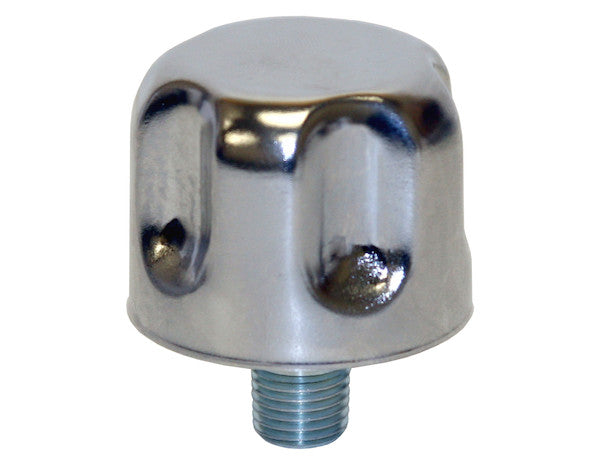
The Breather Cap from Buyers Products acts as a ventilator to provide a free flow of clean air into your reservoir. It features oil-resistant filter elements that keep out dirt and dust particles as small as 40 microns. Breather cap sizing ranges from 1/8 in. NPT to 1 in. NPT.
Specifications
| Cap Type | Threaded |
|---|---|
| Color | Chrome |
| Thread Size | 1/2 NPT |
In the realm of hydraulic systems, the seemingly simple breather cap plays an unequivocally critical role in safeguarding the longevity and operational integrity of expensive components and the fluid medium itself. The 1/2 Inch NPT Breather Cap from Buyers Products is engineered to perform this vital function with precision and reliability, serving as a meticulously designed ventilator that ensures a continuous, filtered ingress and egress of air into and from the hydraulic reservoir. This dynamic interaction of air with the reservoir is essential for maintaining proper system pressure equalization and preventing damaging conditions that can arise from vacuum formation or excessive pressure build-up during fluid level fluctuations.
Hydraulic systems are inherently susceptible to contamination, and a primary pathway for particulate matter and moisture is through the reservoir's air vent. Without adequate filtration, ambient air carrying microscopic dust, dirt, and other environmental debris is drawn directly into the reservoir, compromising the hydraulic fluid's pristine condition. This particular breather cap addresses this vulnerability head-on by incorporating advanced oil-resistant filter elements. These specialized elements are designed to capture and retain dirt and dust particles with an impressive efficiency, down to a size of 40 microns. To put this into perspective, a human hair typically ranges from 50 to 100 microns in diameter, illustrating the fine level of particulate matter that this breather cap effectively blocks. Such precision filtration is paramount for mitigating abrasive wear on critical hydraulic components like pumps, valves, and cylinders, thereby extending their operational lifespan and reducing unscheduled downtime.
The specification of a 1/2 Inch NPT (National Pipe Taper) thread size denotes a standard of connection widely recognized and utilized across industrial and mobile hydraulic applications. NPT threads are designed with a taper, which, when properly torqued and sealed, creates an interference fit that enhances seal integrity and resistance to leakage under varying pressure conditions. This universal standard ensures compatibility with a vast array of hydraulic reservoirs and simplifies installation and replacement procedures. The 1/2 NPT size is particularly versatile, striking an optimal balance between airflow capacity and compact footprint, making it suitable for a diverse range of hydraulic power units, auxiliary fluid tanks, and gearboxes where clean air ingress is non-negotiable.
Beyond its primary filtration and ventilation functions, the construction and material science of the breather cap contribute significantly to its overall performance and durability. The "Threaded" cap type ensures a secure and robust connection to the reservoir, resisting vibration and potential dislodgement in demanding operational environments. Furthermore, the "Chrome" color specification is indicative of a chrome-plated finish. Chrome plating is not merely an aesthetic choice; it imparts several crucial engineering benefits. Chromium is a hard, corrosion-resistant metal that provides an excellent barrier against environmental factors such as moisture, chemicals, and abrasive particles. This protective layer ensures the external integrity of the breather cap, preventing degradation over time, maintaining its visual appearance, and, more importantly, ensuring that the cap itself does not become a source of contamination through material breakdown. Its smooth surface also resists dirt accumulation and is easy to clean, contributing to the overall cleanliness of the hydraulic system environment.
The integrity of hydraulic fluid is directly proportional to the lifespan and efficiency of the entire hydraulic system. Contamination, whether solid particulate or moisture, is the leading cause of hydraulic component failure. Airborne contaminants, often minute enough to be invisible to the naked eye, act as abrasive agents within the fluid, leading to wear on precision-machined surfaces, enlarging clearances, and compromising the sealing capabilities of components. This abrasive wear can accelerate internal leakage, reduce volumetric efficiency of pumps, cause erratic valve operation, and ultimately lead to catastrophic component failure. The 40-micron filtration capability of this breather cap effectively intercepts the majority of these harmful particles before they can enter the reservoir, thereby maintaining the fluid's cleanliness level and preserving the hydrodynamic lubrication film crucial for preventing metal-to-metal contact.
Moreover, the breathing function of the cap is indispensable for preventing pressure imbalances within the reservoir. As hydraulic cylinders extend and retract, or as fluid levels fluctuate due to thermal expansion and contraction, air must freely enter or exit the reservoir. If this exchange is impeded by a clogged or inadequate breather, a vacuum can form during fluid withdrawal, leading to pump cavitation – a destructive phenomenon where air bubbles form and collapse, causing significant damage to pump components and generating excessive noise. Conversely, excessive pressure can build up during fluid return or thermal expansion, potentially stressing seals, gaskets, and even the reservoir walls. The 1/2 Inch NPT Breather Cap provides an unimpeded pathway for this air exchange, ensuring that the reservoir pressure remains balanced relative to the ambient atmosphere, thereby protecting system components from the adverse effects of pressure differentials.
The oil-resistant filter elements are a critical design feature, underscoring the product's suitability for hydraulic applications. Hydraulic fluids, often petroleum-based or synthetic, contain additives and possess properties that can degrade non-oil-resistant materials over time. Using oil-resistant elements ensures that the filter medium itself remains stable and effective, preventing chemical breakdown, shedding of filter fibers into the fluid, or compromise of its filtration efficiency due to exposure to hydraulic oil vapors or splashes. This robust material selection guarantees long-term performance and contributes to the overall reliability of the hydraulic system's fluid management strategy.
The broad applicability of this breather cap, with sizes ranging from 1/8 in. NPT to 1 in. NPT, highlights its versatility. While this particular product focuses on the 1/2 NPT size, the underlying design principles and quality extend across the range, catering to different reservoir capacities and airflow requirements. The choice of thread size is often dictated by the volume of air exchange required, which is, in turn, dependent on the maximum flow rate of the pump and the volume of the reservoir. A properly sized breather cap ensures that the system can "breathe" without restriction during peak operational demands, preventing pressure fluctuations that could induce cavitation or reduce system responsiveness.
Integrating this 1/2 Inch NPT Breather Cap into a hydraulic system offers tangible economic benefits. By preventing the ingress of damaging contaminants, it directly contributes to an extended service life for expensive hydraulic pumps, motors, valves, and cylinders. This reduction in premature wear translates into significantly lower maintenance costs, fewer component replacements, and a reduction in unscheduled downtime. For businesses reliant on hydraulic machinery, such as those in construction, agriculture, manufacturing, or transportation, these savings can be substantial, improving operational efficiency and profitability. Furthermore, maintaining a high level of fluid cleanliness can lead to improved energy efficiency, as clean fluid reduces friction and allows components to operate at their designed performance parameters.
Installation of the 1/2 Inch NPT Breather Cap is straightforward, yet proper procedure is crucial. The NPT thread design requires a suitable thread sealant, such as PTFE tape or a liquid threadlocker, to ensure a leak-free and secure connection. Over-tightening should be avoided to prevent damage to the threads or the reservoir port, while insufficient torque can lead to leaks or potential loosening due to vibration. Positioning the breather cap correctly, typically in a location less exposed to direct spray or heavy dust, can further enhance its lifespan and effectiveness. Regular inspection of the breather cap is also a key aspect of preventive maintenance. Over time, the filter elements can become clogged with accumulated dust and debris, reducing airflow and compromising its efficacy. Signs of a clogged breather include sluggish hydraulic operation, unusual noises (e.g., pump cavitation), or visible accumulation of dirt on the filter media. Periodic cleaning or replacement of the breather cap, as part of a scheduled maintenance program, is essential to ensure continuous optimal performance of the hydraulic system.
In conclusion, the 1/2 Inch NPT Breather Cap from Buyers Products is far more than a simple accessory; it is a fundamental component in any well-designed and maintained hydraulic system. Its technical specifications—the 40-micron particulate filtration, oil-resistant filter elements, robust threaded chrome construction, and industry-standard 1/2 NPT connection—collectively embody a commitment to hydraulic system longevity, efficiency, and reliability. By diligently preventing contamination and enabling proper pressure equalization, this breather cap safeguards the investment in hydraulic machinery, minimizes operational costs, and contributes significantly to uninterrupted productivity. It stands as a testament to the principle that meticulous attention to seemingly small components can yield monumental benefits in complex engineering systems.