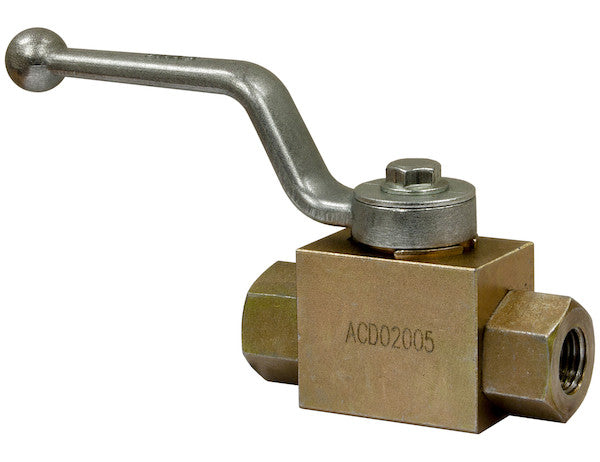
The 2 Port High Pressure Ball Valve from Buyers Products reliably controls the flow of fluids in your truck's hydraulic system. It's made to withstand very high pressures without failing. The valve has a stem that will not blow out in the event of excessive pressure. It also features Buna seals, made of a highly effective sealing compound, which protect the valve from leakage and failure. Choose from a range of thread sizes and maximum working pressure ratings to fit your needs. Note: The valve is not suitable for steam or potable water applications.
Specifications
| Ball Material | Hardened Steel |
|---|---|
| Body Finish | Zinc Plated Clear |
| Body Material | Carbon Steel |
| Body Style | Ball |
| Handle Material_1 | Carbon Steel |
| Maximum Pressure (Water, Oil, Gas) | 7250 |
| Maximum Working Pressure | 7250 |
| Pipe Size | 0.250 |
| Seat Material | Teflon |
| Thread Size | 1/4 NPT |
Advanced Technical Overview: 1/4 Inch NPTF 2-Port High Pressure Ball Valve for Demanding Hydraulic Systems
The 1/4 Inch NPTF 2-Port High Pressure Ball Valve represents a critical component in the design and maintenance of robust hydraulic systems, particularly those operating under extreme pressure conditions. Engineered to deliver exceptional reliability and safety, this valve is specifically optimized for applications demanding precise control over fluid flow within environments such as mobile hydraulics, industrial machinery, and heavy-duty vehicles. Its design embodies a comprehensive understanding of hydraulic system dynamics, material science, and safety engineering, ensuring consistent performance and prolonged service life even in the most challenging operational scenarios. The integration of high-grade materials and advanced manufacturing processes makes this valve an indispensable asset for engineers and system integrators seeking to maximize efficiency and minimize downtime.
Precision Engineering and Material Selection for Extreme Environments
The core of this valve's superior performance lies in its meticulous engineering and the strategic selection of materials. Each component has been chosen for its specific properties that contribute to the valve's overall integrity and functionality under high pressure. The body of the valve is constructed from robust carbon steel, a material renowned for its excellent tensile strength, yield strength, and fatigue resistance. This inherent strength is crucial for containing fluid at pressures up to 7250 PSI, mitigating the risk of catastrophic failure that could lead to system damage or operator injury. Carbon steel's ability to withstand significant mechanical stress and pressure pulsations makes it an ideal choice for the structural integrity of the valve body in demanding hydraulic applications.
Advanced Corrosion Protection: Zinc Plated Clear Finish
To enhance the durability and longevity of the carbon steel body, the valve undergoes a sophisticated zinc plating process with a clear passivation. This surface treatment provides a sacrificial layer that protects the underlying carbon steel from rust and corrosion, which are prevalent concerns in environments exposed to moisture, chemicals, and varying temperatures. The zinc plating acts as a barrier, preventing direct contact between the steel and corrosive elements, while the clear passivation layer further seals the zinc, offering enhanced resistance to white rust and improving aesthetic appeal. This protective finish is not merely cosmetic; it significantly extends the valve's operational life, reducing maintenance requirements and ensuring reliable performance over time in harsh industrial and outdoor settings.
Hardened Steel Ball: The Heart of Flow Control
The pivotal element controlling fluid flow within the valve is the hardened steel ball. The choice of hardened steel is paramount for several reasons. Hardening significantly increases the material's wear resistance, ensuring that the ball retains its spherical integrity and smooth surface finish despite constant rotation and the abrasive effects of high-velocity fluid flow and particulate matter that may be present in hydraulic oil. This resistance to wear is critical for maintaining a tight seal against the valve seats, thereby preventing internal leakage and ensuring precise flow isolation. Furthermore, hardened steel possesses superior compressive strength, allowing it to withstand the immense pressure exerted by the fluid without deforming, which is essential for consistent shut-off performance and operational safety.
Optimized Sealing with Teflon (PTFE) Seats and Buna (NBR) Seals
Effective sealing is a non-negotiable requirement for high-pressure hydraulic valves, and this product leverages a dual-material sealing strategy to achieve exceptional leak integrity. The valve seats are fabricated from Teflon, technically Polytetrafluoroethylene (PTFE). PTFE is highly regarded in fluid power applications for its exceptionally low coefficient of friction, chemical inertness, and wide operating temperature range. These properties ensure smooth, low-torque operation of the ball, reducing wear on both the ball and the seats. PTFE's remarkable chemical resistance means it will not degrade or react with a vast array of hydraulic fluids, oils, and gases, preserving its sealing capabilities over time. Its inherent flexibility allows it to conform effectively to the ball's surface, creating a robust seal even under fluctuating pressure conditions. However, it's also important to note that PTFE's cold flow characteristics are carefully managed in the valve's design to maintain sealing integrity over extended periods.
Complementing the PTFE seats are Buna-N (Nitrile Butadiene Rubber) seals, specified as Buna seals. Buna-N is a highly effective elastomer widely chosen for hydraulic applications due to its excellent resistance to petroleum-based oils, fuels, water, and various hydraulic fluids. It exhibits superior tensile strength and abrasion resistance, making it suitable for dynamic and static sealing applications in high-pressure environments. The elastic memory of Buna-N allows the seals to maintain constant pressure against mating surfaces, compensating for minor dimensional changes due to temperature fluctuations and ensuring a consistently tight seal against potential leakage paths. This combination of PTFE seats and Buna seals provides a synergistic sealing solution, offering comprehensive protection against fluid escape and ensuring the long-term reliability of the valve.
Enhanced Safety: The Blow-Out Proof Stem Design
A critical safety feature integrated into this valve is its blow-out proof stem design. In high-pressure applications, the stem, which connects the handle to the ball, is a potential point of failure if not properly secured. A standard stem could potentially be ejected from the valve body under extreme internal pressure, leading to a dangerous release of high-pressure fluid. The blow-out proof stem design incorporates a specific internal retention mechanism, often a shoulder on the stem that is larger than the bore through which it is inserted, preventing it from being pushed out by internal pressure. This design significantly enhances operational safety, protecting personnel and surrounding equipment from hazardous fluid discharge, making the valve suitable for safety-critical applications.
Durable Control: Carbon Steel Handle
The control handle is also constructed from carbon steel, mirroring the robust material choice of the valve body. This ensures that the handle can withstand the forces required for actuation, resist deformation, and endure the rigors of frequent operation in industrial environments without failing. Its solid construction contributes to the overall durability and reliability of the valve assembly, providing a reliable interface for manual operation.
Performance Metrics: Sustained Operation at 7250 PSI
Rated for a maximum working pressure of 7250 PSI (pounds per square inch) for water, oil, and gas, this valve is engineered for the most demanding hydraulic circuits. This exceptionally high-pressure rating is a testament to the robust design, material strength, and precision manufacturing techniques employed. Operating at such pressures requires not only strong materials but also meticulous attention to thread engagement, sealing integrity, and structural geometry to prevent stress concentrations and fatigue failures. The valve's ability to reliably perform at this pressure ensures that it can be integrated into systems where high force generation, rapid actuation, or heavy loads are commonplace, such as hydraulic presses, heavy construction equipment, and specialized industrial machinery.
Flow Characteristics and 2-Port Configuration
As a 2-port ball valve, its primary function is on-off fluid isolation. The design facilitates a straightforward, quarter-turn operation for full flow or complete shut-off. While the specific bore characteristic (full or reduced) is not explicitly detailed, high-pressure ball valves often feature a bore optimized for pressure containment rather than maximum flow, balancing flow capacity with structural integrity. For a 1/4 inch pipe size, flow rates are typically moderate, but the focus remains on reliable positive shut-off. This configuration makes it ideal for isolating sections of a hydraulic circuit for maintenance, diverting flow, or controlling the activation of hydraulic actuators.
Temperature Range Considerations
While a specific operating temperature range is not provided, the selected materials (Carbon Steel, Hardened Steel, PTFE, Buna) typically allow for a broad operational spectrum. Carbon steel generally maintains its structural integrity across a wide range, from cryogenic temperatures up to several hundred degrees Celsius, though practical limits are imposed by seals. PTFE seats generally perform well from approximately -70°C to +200°C (-94°F to +392°F), offering excellent performance in both hot and cold hydraulic conditions. Buna-N seals are typically effective from around -30°C to +100°C (-22°F to +212°F), which covers the vast majority of hydraulic system operating temperatures. The combined properties of these materials ensure that the valve maintains its sealing and structural integrity across diverse thermal conditions encountered in industrial and mobile applications.
Fluid Compatibility and Exclusions
The valve is explicitly designed for compatibility with water, oil, and gas, making it suitable for a broad spectrum of hydraulic fluids, including mineral oils, synthetic hydraulic fluids, and some water-glycol mixtures. The Buna seals and PTFE seats exhibit excellent resistance to these common media, preventing degradation and ensuring long-term sealing performance. It is crucial to adhere to the stated exclusion: the valve is not suitable for steam or potable water applications. Steam requires specific high-temperature resistant materials and designs to prevent flashing and material degradation, which are beyond the scope of this valve's intended design. For potable water, valves must meet stringent health and safety standards and be constructed from materials certified safe for drinking water contact, which are typically lead-free brass or specific stainless steel alloys, and FDA-approved sealing compounds, none of which are typically associated with this heavy-duty industrial hydraulic valve.
Precision Threading: 1/4 Inch NPTF
The specification of a 1/4 Inch NPTF thread is fundamental to the valve's high-pressure capability and ease of integration into hydraulic systems. NPTF, or National Pipe Taper Fuel, is a variant of the NPT (National Pipe Taper) standard specifically designed for dryseal applications. Unlike standard NPT threads, which rely on thread sealant (like PTFE tape or pipe dope) to prevent leaks, NPTF threads are designed to achieve a mechanical seal without sealant, by deformation of the crests and roots of the threads. This "dryseal" characteristic is achieved through slightly different thread forms that allow for metal-to-metal contact and deformation during tightening, creating an interference fit that effectively prevents spiral leakage paths. This feature is particularly critical in high-pressure hydraulic systems where sealants can be susceptible to washout, extrusion, or degradation, potentially leading to catastrophic leaks. The 1/4 inch nominal size indicates a small but highly robust connection point, suitable for manifold integration, pilot lines, or auxiliary hydraulic circuits where precise control and high-pressure integrity are paramount.
Versatile Applications Across Industries
The robust construction and high-pressure rating of this 2-port ball valve make it exceptionally versatile across a multitude of industrial and mobile hydraulic applications. It is ideally suited for:
- Mobile Hydraulics: Integral to dump trucks, refuse collection vehicles, snowplows, excavators, and other construction and agricultural machinery where hydraulic cylinders and motors require reliable isolation or diversion.
- Industrial Machinery: Used in hydraulic power units, presses, clamping systems, and automation equipment requiring precise control of high-pressure fluid lines.
- Oil & Gas Exploration: Suitable for certain non-corrosive fluid lines in equipment used for upstream and midstream operations, where high-pressure integrity is critical.
- Heavy-Duty Equipment: Any application involving heavy loads, high forces, and continuous operation in demanding environmental conditions will benefit from the valve's durability.
- Maintenance and Safety: Essential for isolating sections of hydraulic circuits for maintenance, repair, or emergency shut-off, enhancing operational safety and streamlining servicing procedures.
Installation and Maintenance Best Practices
Proper installation is paramount to ensuring the long-term reliability and safety of this high-pressure ball valve. When installing, it is crucial to apply appropriate torque to the NPTF threads to achieve the dryseal without over-tightening, which could damage the threads or the valve body. While NPTF threads are designed for drysealing, a small amount of liquid sealant or PTFE tape specifically rated for hydraulic applications can be used as an added precaution, applied sparingly to the male threads only. The system should be thoroughly flushed prior to valve installation to remove any contaminants that could damage the internal components, particularly the seats and ball. During operation, routine inspection for external leakage, smooth handle operation, and visible signs of wear or corrosion is recommended. Although the valve is designed for durability, proactive maintenance ensures peak performance and extends its service life within a high-pressure hydraulic system.
Conclusion: Uncompromising Reliability for High-Pressure Hydraulic Control
In summary, the 1/4 Inch NPTF 2-Port High Pressure Ball Valve is a meticulously engineered component designed to meet the rigorous demands of modern hydraulic systems. Its construction from carbon steel with a zinc-plated finish, hardened steel ball, robust PTFE seats, and reliable Buna seals collectively ensures exceptional pressure containment, leak integrity, and chemical compatibility. The critical blow-out proof stem design underscores a commitment to safety, while the NPTF threading guarantees a secure, dryseal connection. For applications ranging from heavy machinery to complex industrial hydraulic circuits, this valve delivers an uncompromising combination of performance, durability, and safety, making it an essential choice for professionals who cannot afford downtime or compromise on fluid control integrity.