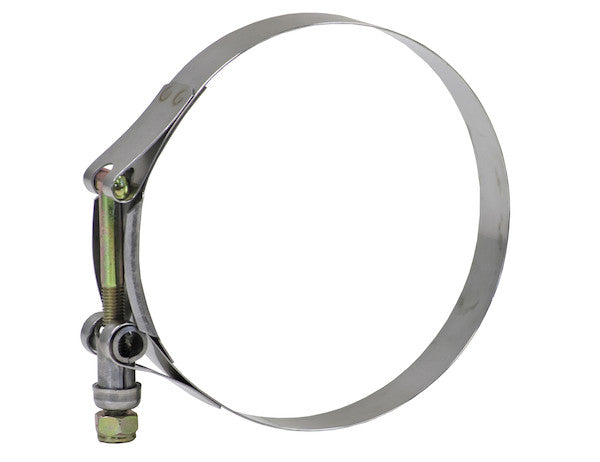
The T-Bolt Hose Clamp from Buyers Products has a smooth inner band that will not cut the hose or cause it to bulge, while allowing greater torquing capability. It will assure equal 360?? clamping force around the hose for a tight connection. The T-bolt is made out of heat-treated plated steel with a plated steel locknut for durability and wear-resistance.
Specifications
| Color | Silver |
|---|---|
| Finish | Plain |
| Material | 304 Stainless Steel |
| Maximum Diameter | 3.47 |
| Minimum Diameter | 3.16 |
| Nominal Diameter | 3.38 |
| T-Bolt Thread Size | 1/4-28 |
Technical Overview: T-Bolt Hose Clamp (3-3/8 Inch Nominal Diameter)
The T-Bolt Hose Clamp, with a nominal diameter of 3-3/8 inches (3.38 inches), represents a robust and precisely engineered solution for securing critical fluid or air transfer lines in demanding industrial, automotive, and heavy-duty applications. Designed for unparalleled reliability and sealing integrity, this component addresses the rigorous requirements of systems operating under high pressure, temperature fluctuations, and significant vibrational stress. Its core design principle centers on achieving a uniformly distributed clamping force around the hose circumference, mitigating potential leak paths and ensuring the long-term operational integrity of the connection. This technical overview will delve into the specific design features, material science, performance characteristics, and application considerations that elevate the T-Bolt Hose Clamp above conventional fastening mechanisms.
Engineering Design and Operational Mechanics
The fundamental advantage of the T-Bolt Hose Clamp lies in its superior engineering design, particularly the smooth inner band and the robust T-bolt fastening mechanism. Unlike traditional worm gear clamps that can create localized pressure points and extrude softer hose materials due to their perforated bands and screw-thread mechanism, the T-Bolt design incorporates a solid, smooth inner band. This critical feature ensures that the clamping force is applied evenly across the entire contact area of the hose, preventing damage such as cutting, abrasion, or the formation of bulges and cold flow regions. The absence of perforations also eliminates potential stress concentrators that could compromise hose integrity under dynamic loads or pressure surges.
The T-bolt mechanism itself is central to the clamp's enhanced performance. Comprising a T-bolt and a corresponding locknut, this system allows for significantly greater torquing capability compared to conventional screw-driven clamps. The larger cross-sectional area of the T-bolt, coupled with its fine thread pitch (specified as 1/4-28), enables the application of substantial clamping loads with precise control. This high clamping force is crucial for maintaining a hermetic seal against internal pressure and for resisting axial pull-off forces, particularly in applications involving flexible hoses or those subjected to internal pressure cycling. The design ensures that the force exerted by the bolt is efficiently translated into radial compression, creating an equal 360-degree clamping force around the hose. This uniform pressure distribution is paramount for preventing leakage, especially with elastomeric hose materials that may exhibit anisotropic deformation under uneven stress. The mechanical advantage provided by the T-bolt and nut system allows for controlled, high-tension clamping, leading to a secure and reliable connection even in environments characterized by significant thermal expansion and contraction cycles.
Material Science and Durability
The selection of materials for the T-Bolt Hose Clamp is a critical factor in its longevity, resistance to environmental degradation, and overall performance. The clamp band and housing are constructed from 304 Stainless Steel, while the T-bolt and locknut are fabricated from heat-treated plated steel. This strategic combination leverages the distinct advantages of each material for its specific role within the assembly.
304 Stainless Steel (Band and Housing)
Type 304 Stainless Steel is an austenitic chromium-nickel stainless steel, recognized for its excellent corrosion resistance, high ductility, and good formability. Its composition typically includes 18-20% chromium and 8-10.5% nickel, along with minor amounts of carbon, manganese, silicon, phosphorus, and sulfur. The high chromium content contributes to the formation of a passive oxide layer on the surface, which is self-healing and provides exceptional resistance to oxidation and a wide range of corrosive media, including fresh water, atmospheric conditions, and various chemicals found in automotive and industrial fluids (e.g., coolants, exhaust gases, some oils).
The mechanical properties of 304 Stainless Steel are well-suited for a hose clamp band. It exhibits a typical tensile strength ranging from 515-620 MPa (75,000-90,000 psi) and a yield strength of 205-310 MPa (30,000-45,000 psi). This ensures that the band can withstand the high clamping forces without deforming plastically, maintaining its structural integrity and sealing pressure over time. Its high ductility allows for the complex forming processes required to create the smooth inner band and housing without material failure. Furthermore, 304 SS maintains mechanical properties across a broad temperature range, making it suitable for applications experiencing significant thermal cycling, from cryogenic temperatures up to approximately 870°C (1600°F) for intermittent service and 925°C (1697°F) for continuous service. While long-term exposure to temperatures between 425°C and 860°C (800°F and 1580°F) can reduce intergranular corrosion resistance due to carbide precipitation, 304 SS offers exceptional thermal stability for typical hose clamp operating environments.
The choice of 304 SS provides robust protection against common modes of failure such as general corrosion, pitting corrosion (in environments with low chloride concentrations), and crevice corrosion (where the passive layer is disrupted). This inherent corrosion resistance significantly extends the service life of the clamp, reducing the frequency of maintenance and replacement, which is a crucial consideration in heavy-duty and critical applications.
Heat-Treated Plated Steel (T-Bolt and Locknut)
While 304 Stainless Steel offers excellent corrosion resistance, it generally has lower tensile strength and hardness compared to certain heat-treated alloy steels. For the T-bolt and locknut, the primary requirement is exceptional tensile strength and resistance to galling under high torque. Therefore, these components are manufactured from heat-treated plated steel.
Heat treatment processes, such as hardening and tempering, are applied to carbon or alloy steels to enhance their mechanical properties significantly. Hardening involves heating the steel to a high temperature and rapidly cooling it (quenching) to form a hard, brittle martensitic microstructure. Tempering then reheats the hardened steel to a lower temperature, reducing brittleness, increasing toughness, and adjusting final hardness and strength to desired levels. The resulting heat-treated steel T-bolt possesses superior tensile strength and fatigue resistance, critical for withstanding the high torquing forces applied during installation and the sustained tension during operation without stretching, fracturing, or experiencing thread deformation.
To provide corrosion resistance to this high-strength steel, a plating process is applied. Common platings include zinc, zinc-nickel, or cadmium, often with a chromate conversion coating. Zinc plating provides sacrificial corrosion protection, meaning the zinc corrodes preferentially to the steel substrate. The chromate conversion coating further enhances this protection and can provide various aesthetic finishes. This combination of heat treatment for strength and plating for corrosion resistance ensures that the T-bolt and locknut can perform reliably in challenging environments, preventing seizing due to rust and maintaining the integrity of the threaded connection over time. The threaded design, specifically 1/4-28, indicates a fine thread, which offers superior resistance to loosening from vibration and allows for precise torque application, translating efficiently into clamping force. The locknut, often incorporating a nylon insert or prevailing torque features, further enhances vibration resistance, preventing the clamp from loosening under dynamic loads.
Galvanic Compatibility and Longevity
The use of dissimilar metals (304 SS for the band and plated steel for the bolt/nut) in a corrosive environment introduces the potential for galvanic corrosion. However, this design is widely accepted in the industry due to several mitigating factors. The relatively small surface area of the plated steel fastener compared to the stainless steel band, combined with the protective plating on the fastener, helps minimize galvanic effects. Furthermore, the type of plating chosen (e.g., zinc) is often selected for its electrochemical compatibility. Proper installation, ensuring a clean and dry environment at the interface where possible, also plays a significant role. In most operational scenarios for which this clamp is designed, the overall corrosion resistance and mechanical strength benefits outweigh the minor galvanic corrosion risks, leading to a highly durable and reliable assembly.
Dimensional Specifications and Application Range
The specified dimensions of the T-Bolt Hose Clamp are crucial for ensuring proper fitment and optimal performance within its intended application range. With a nominal diameter of 3-3/8 inches (3.38 inches), this clamp is specifically designed for hoses within a precise range, as indicated by its minimum diameter of 3.16 inches and maximum diameter of 3.47 inches.
Nominal Diameter (3.38 inches)
The nominal diameter serves as a general reference point for the clamp's size, aligning with standard hose dimensions. It indicates the approximate outside diameter (OD) of the hose for which the clamp is primarily intended.
Minimum Diameter (3.16 inches) and Maximum Diameter (3.47 inches)
These critical specifications define the operational range of the clamp. The minimum diameter ensures that the clamp can close sufficiently to apply adequate compression on hoses with slightly smaller ODs, while the maximum diameter indicates the largest hose OD the clamp can effectively secure without over-stretching or exceeding its mechanical limits. This range of 0.31 inches (3.47 - 3.16) provides necessary flexibility to accommodate manufacturing tolerances of hoses and minor variations in hose wall thickness, ensuring a snug fit. Proper sizing is paramount; using a clamp that is too small will prevent full closure and adequate clamping force, while a clamp that is too large will not exert sufficient radial pressure, leading to leaks or potential hose dislodgement. The precision of this range is essential for maintaining the integrity of connections in applications where pressure, vibration, or thermal cycling could otherwise compromise an improperly sized clamp.
T-Bolt Thread Size (1/4-28)
The 1/4-28 thread size specifies a ¼-inch nominal diameter bolt with 28 threads per inch. This fine thread pitch is deliberately chosen for several engineering advantages. Fine threads offer a larger stress area than coarse threads of the same nominal diameter, resulting in higher shear strength and tensile strength for the bolt. This allows the bolt to withstand greater applied torque and resultant clamping forces without yielding or fracturing. Furthermore, fine threads provide finer adjustment capability, enabling more precise control over the clamping force during installation. Their smaller helix angle also makes them less prone to loosening under vibration compared to coarse threads, particularly when used with a locknut, thereby enhancing the long-term security of the connection.
Performance Characteristics in Demanding Environments
The T-Bolt Hose Clamp is engineered to deliver reliable performance across a spectrum of challenging operational conditions, contributing significantly to system uptime and safety.
Pressure Containment
The high radial clamping force generated by the T-bolt mechanism ensures superior pressure containment, making these clamps ideal for high-pressure fluid transfer systems. The uniform 360-degree clamping prevents localized bulging or expansion of the hose under pressure, which could otherwise lead to leaks or blow-offs. This capability is critical in applications like turbocharged air intake systems, high-pressure coolant lines, or hydraulic return lines.
Vibration Resistance
The combination of a robust T-bolt, fine-pitch threads, and a plated steel locknut provides excellent resistance to loosening under dynamic vibration. In heavy-duty automotive, marine, and industrial machinery, constant vibration is a major factor that can cause conventional clamps to back off. The prevailing torque mechanism of the locknut (or similar anti-loosening feature) maintains residual clamping force, significantly reducing the risk of spontaneous loosening and subsequent connection failure.
Thermal Cycling Resistance
Systems often experience significant temperature fluctuations, causing hoses and fittings to expand and contract at different rates. The robust design and material properties of the T-Bolt clamp, particularly the 304 SS band's thermal stability and the clamp's ability to maintain high tension, allow it to accommodate these dimensional changes without compromising the seal. The design prevents the "cold flow" of elastomeric hoses that can occur with clamps that apply uneven pressure or lose tension over time.
Leak Prevention and Durability
The smooth inner band minimizes hose damage, thereby preserving the structural integrity of the hose itself. Coupled with uniform clamping force, this dramatically reduces the potential for leak paths to develop. The inherent corrosion resistance of 304 Stainless Steel and the durable plating on the T-bolt and nut ensure the clamp's structural integrity and aesthetic appearance are maintained over extended periods, even in harsh outdoor or chemically aggressive environments. This durability translates directly into reduced maintenance costs and enhanced operational reliability.
Application Segments
Given its robust design and superior performance characteristics, the 3-3/8 inch nominal diameter T-Bolt Hose Clamp finds extensive utility across various demanding sectors:
- Heavy-Duty Automotive and Commercial Vehicles: Essential for securing charge air cooler (CAC) hoses, turbocharger connections, exhaust components, and heavy-duty coolant lines in trucks, buses, construction equipment, agricultural machinery, and off-highway vehicles. These applications frequently involve high temperatures, pressures, and extreme vibrations.
- Industrial Machinery: Employed in manufacturing plants, power generation facilities, and process industries for securing hoses in hydraulic systems, pneumatic lines, material handling equipment, and cooling systems where reliable, leak-free connections are critical for safety and operational efficiency.
- Marine Applications: Ideal for engine cooling systems, exhaust risers, and other fluid transfer lines on marine vessels, where exposure to saltwater, humidity, and engine vibration necessitates superior corrosion resistance and clamping force.
- Agricultural Equipment: Used on tractors, harvesters, and irrigation systems to secure hoses exposed to dirt, moisture, chemicals, and constant operational stress.
- Mining and Construction: In harsh environments, these clamps are critical for maintaining integrity of hydraulic and pneumatic lines on heavy machinery, resisting abrasion and impact while ensuring dependable fluid transfer.
Installation Best Practices
Proper installation is paramount to leveraging the full performance capabilities of the T-Bolt Hose Clamp. Adherence to best practices ensures optimal sealing and longevity.
- Hose Preparation: Ensure the hose ends are cut cleanly and squarely, free from burrs or damage. The outer surface of the hose should be clean and dry. For optimal sealing, the hose should fit snugly over the barb or connection point.
- Clamp Placement: Position the T-Bolt clamp over the hose end, ensuring that the band completely covers the sealing area and is centered over the barb or fitting. Avoid placing the clamp too close to the end of the hose, as this can lead to insufficient grip, or too far back, which might miss the critical sealing surface.
- Torque Application: Apply torque to the locknut using an appropriate torque wrench. It is crucial to follow the hose or equipment manufacturer's recommended torque specifications. Over-tightening can damage the hose or the clamp threads, potentially leading to premature failure. Under-tightening will result in an inadequate seal and increase the risk of leaks or dislodgement. The 1/4-28 thread offers precise torque control, allowing for optimal clamping force within the specified range.
- Inspection: After torquing, visually inspect the clamp to ensure uniform compression of the hose material around the fitting. The hose should appear evenly compressed without excessive bulging or deformation on one side. Re-inspect connections periodically, especially after initial thermal cycles, to ensure tension is maintained.
Comparative Advantage and Value Proposition
When contrasted with traditional worm drive clamps, the T-Bolt Hose Clamp offers distinct advantages, particularly in heavy-duty and high-performance applications. While worm drives are suitable for lighter duty and lower pressure applications, their perforated bands can damage hoses and their lower torque capacity often leads to less secure seals. The T-Bolt design, with its smooth band and robust fastening system, provides superior burst pressure resistance, enhanced vibration dampening, and significantly prolonged service life. This translates into reduced downtime, fewer costly repairs, and enhanced safety for operational personnel and equipment. The initial investment in a high-quality T-Bolt clamp is typically offset by these long-term benefits and the assurance of a reliable, leak-free connection.
Conclusion
The T-Bolt Hose Clamp with a 3-3/8 inch nominal diameter represents the pinnacle of hose clamping technology for critical applications. Its meticulously engineered design, encompassing a smooth 304 Stainless Steel band and a heat-treated plated steel T-bolt and locknut, ensures superior performance in terms of clamping force distribution, pressure containment, and resistance to environmental degradation. By providing precise, high-tension clamping across its specified diameter range (3.16" to 3.47"), and utilizing a durable 1/4-28 threaded fastener, this clamp delivers unparalleled reliability and longevity. For professionals seeking a robust, durable, and leak-proof solution for fluid or air transfer lines in heavy-duty automotive, industrial, marine, or agricultural environments, this T-Bolt Hose Clamp offers an uncompromising balance of advanced material science and precision engineering.