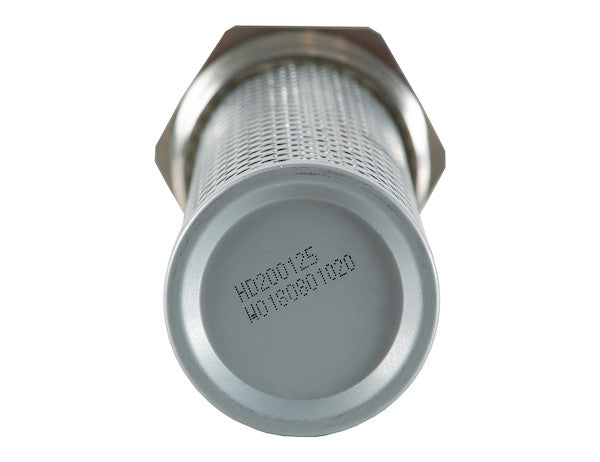
The Return Line Diffuser from Buyers Products reduces aeration in hydraulic fluid as it returns to the reservoir. It slows and manages the return flow, reducing foaming, turbulence, and noise. It also keeps the influx of returning hot oil from heating up the oil in the reservoir. The diffuser is 8-7/8 in. long and mounts inside the tank's return port.
Specifications
| Bushing Finish | Zinc Plated |
|---|---|
| Diffuser Material | 304 Stainless Steel |
| Opening Diameter (Female End) | 1.25 NPT |
| Opening Diameter (Male End) | 2 NPT |
| Overall Length | 8.75 |
| Tube Length | 7.375 |
In the intricate world of hydraulic systems, optimal fluid conditioning is paramount for achieving peak performance, longevity, and operational efficiency. The Return Line Diffuser, particularly the model from Buyers Products, represents a critical yet often underestimated component in this regard. Its fundamental role is to manage the ingress of hydraulic fluid returning from the system's actuators and other components back into the reservoir, transforming a potentially disruptive inflow into a controlled, laminar return. This meticulous control of fluid dynamics within the reservoir directly impacts several key performance indicators of the entire hydraulic circuit.
A hydraulic system's reservoir serves as more than just a storage vessel for hydraulic fluid; it is a vital component in the fluid conditioning process. It facilitates heat dissipation, settles contaminants, and, crucially, allows entrained air to separate from the oil. However, without proper management of the return flow, these functions can be severely compromised. Uncontrolled return flow, typically characterized by high velocity and direct impingement onto the reservoir's fluid surface or internal structures, introduces a cascade of detrimental effects that undermine system health and operational integrity.
One of the primary challenges addressed by the Return Line Diffuser is the reduction of aeration. Aeration occurs when air becomes entrained within the hydraulic fluid, forming tiny bubbles. In an uncontrolled return scenario, high-velocity oil returning to the reservoir splashes and agitates the fluid, effectively churning air into the oil. These air bubbles are highly compressible, leading to a phenomenon known as cavitation when they enter the suction side of a pump or are subjected to pressure differentials within the system. Cavitation manifests as a distinct popping or crackling sound, indicative of the violent collapse of air bubbles. This implosion generates localized shockwaves and extreme temperatures, causing significant damage to pump components, valve seats, and other precision parts. Over time, cavitation can lead to premature wear, reduced component lifespan, and catastrophic system failure. Furthermore, entrained air diminishes the fluid's bulk modulus, making the system "spongy" and less responsive, impacting control precision and power transmission efficiency. The Buyers Products Return Line Diffuser, with its carefully engineered design, significantly mitigates this by slowing and managing the return flow. Instead of a turbulent cascade, the fluid is gently dispersed below the surface, minimizing splash and the mechanical entrainment of air.
Closely related to aeration is the issue of foaming. When air is excessively entrained in the hydraulic fluid, particularly in fluids with certain additive packages, it can stabilize into persistent foam layers on the reservoir's surface. Foam accumulation reduces the effective volume of usable fluid, making the system susceptible to low fluid levels at the pump inlet. More critically, foam acts as an insulator, impeding the natural heat dissipation process from the fluid surface to the ambient environment. This can lead to elevated system temperatures, further exacerbating fluid degradation and reducing component lifespan. The presence of foam can also cause inaccurate level readings, leading to operational guesswork and potential dry running of pumps. By effectively curbing aeration, the Return Line Diffuser directly prevents the formation of problematic foam layers, ensuring consistent fluid levels and optimal thermal transfer capabilities within the reservoir.
Turbulence is another significant adverse effect of unmanaged return flow. High-velocity jets of oil entering the reservoir can create considerable turbulence, generating pressure fluctuations and disrupting the quiescent conditions necessary for effective contaminant settling and heat exchange. This turbulence can re-suspend particulate matter that would otherwise settle at the bottom of the reservoir, increasing the load on filtration systems and accelerating wear in other components. Mechanical vibration and noise are direct consequences of excessive turbulence. A hydraulic system operating with high levels of turbulence will be noticeably louder and experience higher levels of structural stress. The Buyers Products diffuser actively counters this by imposing a controlled flow path, transforming turbulent kinetic energy into a gentle, distributed flow. This not only minimizes noise but also fosters a more stable hydraulic environment, critical for precision applications and overall system integrity.
Thermal management is a crucial aspect of hydraulic system design, and the Return Line Diffuser plays a pivotal role in maintaining optimal operating temperatures. Hydraulic fluid returning from the system, especially after passing through pumps, valves, and actuators, often carries a significant heat load generated by friction and efficiency losses. In systems without a diffuser, this hot oil can impinge directly onto the cooler bulk fluid in the reservoir, creating localized hot spots and thermal stratification. These localized temperature increases can accelerate the oxidation of the hydraulic fluid, breaking down its chemical structure and reducing its lubricating properties. Furthermore, elevated temperatures can degrade seals, hoses, and other elastomer components, leading to leaks and premature failure. The diffuser's function of dispersing the returning hot oil across a wider area and below the fluid surface prevents these localized thermal spikes. By promoting uniform mixing and allowing the hot fluid to blend gradually with the cooler reservoir oil, it facilitates more efficient heat transfer to the reservoir walls and, if present, external heat exchangers. This contributes to a more stable overall fluid temperature, extending the life of both the hydraulic fluid and critical system components.
The design and construction of the Buyers Products Return Line Diffuser reflect a commitment to durability and performance. Crafted from 304 Stainless Steel for the diffuser body, it offers superior resistance to corrosion and chemical degradation, crucial for components submerged in hydraulic fluid over extended periods. 304 Stainless Steel is an austenitic stainless steel known for its excellent mechanical properties, including high strength and ductility, and its robust resistance to a wide range of corrosive media commonly found in hydraulic systems, including mineral-based and synthetic hydraulic oils. This material choice ensures a long service life and consistent performance, even in challenging operational environments. The bushing, which serves as the interface for mounting, features a Zinc Plated finish. Zinc plating provides an additional layer of corrosion protection, particularly important for components exposed to the atmosphere or external moisture. This dual-material strategy ensures both the submerged and exposed parts of the diffuser maintain their structural and functional integrity.
Dimensionally, the diffuser is engineered for effective integration into standard hydraulic reservoirs. With an overall length of 8.75 inches (8-7/8 in.) and a tube length of 7.375 inches, it is designed to extend sufficiently below the minimum operational fluid level in most reservoir configurations. This ensures that the return flow is always discharged beneath the fluid surface, even during periods of lower fluid volume, thereby maximizing its effectiveness in preventing aeration and turbulence. The connection points are specified with NPT (National Pipe Taper) threads, indicating a robust, leak-proof mechanical connection common in industrial hydraulic applications. The female end has an opening diameter of 1.25 NPT, while the male end features a 2 NPT opening. This differential sizing suggests a design intended to accommodate a specific flow rate and pressure differential, facilitating the controlled deceleration of fluid as it passes through the diffuser and into the reservoir. The mounting inside the tank's return port simplifies installation and ensures that the diffuser is correctly positioned to manage the incoming flow effectively.
The operational benefits of integrating the Buyers Products Return Line Diffuser are comprehensive and far-reaching across various hydraulic applications. In mobile equipment such as construction machinery, agricultural vehicles, and heavy-duty trucks, where hydraulic systems are subjected to demanding conditions, shock loads, and varying temperatures, reducing aeration and maintaining thermal stability is paramount for reliable operation and extended service intervals. For industrial machinery, including presses, injection molding machines, and automation systems, precision control and minimal downtime are critical. By mitigating noise, reducing turbulence, and ensuring stable fluid conditions, the diffuser contributes to smoother, more accurate machine operation and a safer working environment. In marine applications, where equipment is often exposed to harsh corrosive environments, the 304 Stainless Steel construction provides essential durability, while improved fluid conditioning contributes to the reliability of steering, crane, and propulsion systems.
In summary, the Return Line Diffuser from Buyers Products is an indispensable component for optimizing the health and performance of hydraulic systems. Its ability to strategically reduce aeration, mitigate foaming, control turbulence, and manage thermal distribution within the hydraulic reservoir directly translates into tangible operational advantages:
- Enhanced System Performance: By ensuring a stable and well-conditioned fluid, the diffuser allows pumps, valves, and actuators to operate at their peak efficiency, leading to more responsive controls and consistent power delivery.
- Extended Component Life: The prevention of cavitation, reduced particulate re-suspension, and stable thermal conditions significantly reduce wear on critical hydraulic components, prolonging their operational life and decreasing the frequency of costly repairs or replacements.
- Prolonged Fluid Life: Minimizing aeration and localized overheating slows the degradation of hydraulic fluid, preserving its lubricating, anti-wear, and anti-foaming properties, thereby extending fluid change intervals and reducing consumable costs.
- Improved Thermal Stability: Effective dispersion of hot return oil prevents thermal stratification and promotes uniform heat dissipation, keeping the fluid within optimal operating temperature ranges and protecting seals and other temperature-sensitive components.
- Reduced Maintenance Costs: Fewer component failures, longer fluid life, and generally healthier system operation contribute to a substantial reduction in overall maintenance requirements and associated expenses.
- Environmental and Safety Benefits: A quieter hydraulic system operating with reduced vibration enhances workplace safety and comfort. Additionally, extended component and fluid life translate to less waste generation, contributing to more sustainable operational practices.
Installation of the Return Line Diffuser is straightforward, requiring placement within the designated return port inside the reservoir. Its robust construction means minimal ongoing maintenance is required beyond routine system inspections. However, proper sizing and positioning within the reservoir are critical to achieving its full benefits. It is important for system designers and maintenance personnel to recognize that while seemingly simple, the Return Line Diffuser is a sophisticated fluid dynamic control device whose impact reverberates throughout the entire hydraulic circuit. It acts as a silent guardian, ensuring the hydraulic fluid, the lifeblood of any hydraulic system, remains in optimal condition.
In an era where hydraulic systems are increasingly relied upon for precision, power, and efficiency across diverse industries, overlooking fundamental fluid conditioning components like the Return Line Diffuser can lead to significant operational inefficiencies and premature system degradation. The Buyers Products Return Line Diffuser offers a professional, durable, and technically sound solution to common challenges faced in hydraulic fluid management, ultimately contributing to more reliable, quieter, and longer-lasting hydraulic operations.