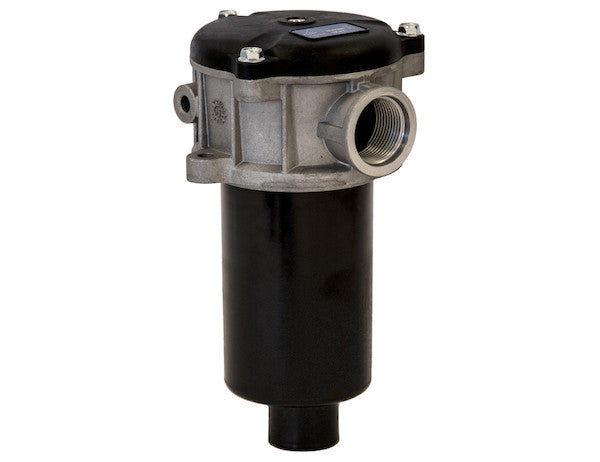
The HFA9 Series 26 GPM In-Tank Filter from Buyers Products blocks contaminants as small as 10 microns from returning to your hydraulic reservoir. Located inside the reservoir, the filter assembly saves space by not having to be installed externally, and can operate in temperatures from -22?? F to 212?? F. It can handle up to 100 PSI working pressure and has a 25 PSI bypass. The assembly comes with the filter head and either a 10 or 25 micron filter element. The 25 micron element allows an increased flow rate of up to 40 GPM.
Specifications
| Filter Media | Cellulose |
|---|---|
| In Tank/Out of Tank | In-Tank |
| Maximum Flow Return (GPM) | 40 |
| Maximum Flow Suction (GPM) | Return Only |
| Maximum Operating Temperature | 212 |
| Maximum Pressure | 100 |
| Micron Filter Rating | 25 |
| Minimum Operating Temperature | -22 |
| Number of Elements | 1 |
| Port Size | 1 NPTF |
| Series | HFA9 |
| Thread Size | 1 NPTF |
Buyers Products HFA9 Series In-Tank Filter: Advanced Hydraulic System Protection
The Buyers Products HFA9 Series In-Tank Filter represents a highly engineered and indispensable solution for maintaining the pristine cleanliness of hydraulic fluids within demanding operational environments. Specifically designed for seamless integration within the hydraulic reservoir, this robust filter assembly, highlighted by its 1-inch NPTF connection, a standard 25-micron filtration rating, and a critical 25 PSI bypass valve, is pivotal in safeguarding hydraulic systems. With a nominal flow capacity engineered for 26 GPM, and an impressive maximum return flow rate of up to 40 GPM when equipped with the 25-micron element, the HFA9 Series ensures superior particulate removal, thereby extending component longevity and optimizing overall system efficiency across a diverse array of applications.
The Imperative of Hydraulic Fluid Cleanliness
In any high-performance hydraulic system, the operational integrity and extended lifespan of expensive, precision-engineered components such as pumps, motors, cylinders, and control valves are directly dependent on the purity of the hydraulic fluid. Contamination, primarily in the form of solid particulates, is unequivocally recognized as the predominant cause of hydraulic system failures, accounting for up to 80% of all recorded malfunctions. These contaminants originate from various sources: internal wear and tear generating metallic particles, ingress from ambient air during reservoir breathing, introduction during fluid top-offs or component replacement, and residual manufacturing debris. Once present, these microscopic particles act as abrasive agents, causing erosive wear on critical surfaces, scoring pump and cylinder walls, degrading seals, and blocking fine orifices in control valves. The cumulative effect is a progressive decline in system efficiency, increased heat generation, erratic performance, and ultimately, catastrophic component failure. The HFA9 Series filter serves as a crucial line of defense, intercepting these detrimental particles before they can inflict widespread damage throughout the hydraulic circuit. By consistently maintaining fluid cleanliness, this filter significantly mitigates wear, prevents premature component failure, reduces costly unscheduled downtime, and ensures consistent, reliable system performance, thereby delivering substantial returns on investment through optimized asset utilization and lower total cost of ownership.
In-Tank Design: Spatial Efficiency and Enhanced System Integration
A hallmark feature of the HFA9 Series is its innovative "in-tank" design, which provides substantial advantages over traditional external line filters. By being submerged directly into the hydraulic reservoir, this filter assembly uniquely addresses critical engineering challenges related to space utilization and system integrity. In mobile hydraulic equipment and compact industrial power units, where mounting space is severely constrained, the in-tank configuration eliminates the need for additional external mounting brackets, complex plumbing, and bulky filter housings, thereby conserving valuable real estate. This direct integration simplifies the hydraulic circuit, reducing the number of external hoses, fittings, and potential leak points, which enhances overall system reliability and reduces installation complexity and costs. Furthermore, filtering the fluid directly as it returns to the reservoir ensures that the cleaned oil is immediately available for recirculation, minimizing the risk of reintroducing contaminants from external piping or residual debris within the reservoir itself. The submerged placement offers an inherent degree of physical protection against external impacts, abrasion, and environmental elements, making it particularly suitable for rugged operational environments. The surrounding hydraulic fluid also aids in dissipating heat generated by fluid flow through the filter media, contributing to stable operating temperatures for both the filter and the hydraulic system. This thoughtful internal placement signifies a holistic approach to hydraulic system design, prioritizing performance, spatial efficiency, and robust protection in a single, integrated solution.
Precision Filtration: 25 Micron and Beyond
The core efficacy of the HFA9 Series hinges on its precision filtration capabilities, with a primary specified rating of 25 microns. This micron rating denotes the ability of the filter media to capture particulate matter equal to or larger than 25 micrometers with high efficiency, preventing its recirculation within the hydraulic system. To contextualize, the average diameter of a human hair is approximately 70 microns, highlighting the HFA9 Series' capacity to remove particles invisible to the naked eye. While the standard configuration features a 25-micron cellulose element, the HFA9 Series is engineered with interchangeability in mind, accommodating finer 10-micron filter elements. This flexibility empowers operators to tailor the level of fluid cleanliness to meet specific application demands or desired ISO cleanliness codes. For highly sensitive hydraulic systems requiring an elevated degree of particulate control, the 10-micron element provides enhanced contaminant removal, capable of blocking particles as small as 10 microns, offering a finer line of defense against even microscopic wear-inducing particulates. The filter media employed is high-quality cellulose, a material renowned for its excellent dirt-holding capacity and cost-effectiveness in general-purpose hydraulic return line applications. Cellulose fibers, with their intricate and tortuous pore structure, effectively trap and retain a broad spectrum of solid contaminants, preventing their re-entry into the critical hydraulic circuit. This precise filtration ensures that the hydraulic fluid consistently meets cleanliness standards, which is paramount for preventing abrasive wear, maintaining the tight tolerances of hydraulic components, and significantly extending their operational lifespan. The ability to specify either 10 or 25-micron elements allows for a customized approach to fluid management, balancing filtration efficiency with flow characteristics and system requirements.
Flow Dynamics and Pressure Management: Ensuring Uninterrupted Performance
Optimized hydraulic system performance demands meticulous attention to fluid dynamics, particularly the unimpeded flow through filtration components. The HFA9 Series filter is engineered to accommodate substantial return flows, boasting a recommended nominal flow rate of 26 GPM and an impressive maximum return flow capacity of up to 40 GPM when utilizing the 25-micron filter element. This high flow capacity is crucial for ensuring that the filter assembly does not introduce undue back pressure into the return line, which could compromise system efficiency, generate excessive heat, or even lead to component damage upstream. The larger pore size characteristic of the 25-micron element, relative to finer filtration media, facilitates this elevated flow rate while still maintaining effective contaminant capture. The "Return Only" specification for suction flow clearly defines its role, emphasizing its dedicated function in processing fluid returning to the reservoir after it has traversed the system's actuators and control elements. This strategic placement ensures that the fluid is thoroughly cleaned just before being drawn back into the pump, protecting the most vulnerable components from recirculation of contaminants. A critical safety and performance feature is the precisely calibrated 25 PSI bypass valve. This valve is indispensable for ensuring continuous fluid flow through the hydraulic system, even under adverse conditions where the filter element might become partially or fully obstructed due to high fluid viscosity during cold starts, or accumulated contaminants nearing the element's dirt-holding capacity. Without a bypass mechanism, excessive pressure differential across a clogged filter could lead to filter element rupture, bypass clean oil, or, more severely, starve the hydraulic pump of fluid, resulting in cavitation, pump damage, and potential system failure. The 25 PSI setting of the bypass valve is optimally chosen to allow the filter to perform its primary contaminant removal function under normal operating conditions, only activating to divert fluid around the element when the pressure differential indicates significant restriction, thereby safeguarding critical components from fluid starvation and alerting operators to the need for filter element maintenance. The robust filter housing is engineered to withstand a maximum working pressure of 100 PSI, providing a substantial safety margin above the bypass activation pressure and ensuring structural integrity even under transient pressure spikes. This comprehensive approach to flow management and pressure regulation underscores the HFA9 Series' commitment to both fluid cleanliness and uninterrupted system operation.
Rugged Construction and Environmental Resilience
The HFA9 Series In-Tank Filter is constructed with durability and longevity in mind, employing robust materials capable of withstanding the rigors of demanding hydraulic applications. The filter head, a critical structural component, is manufactured from high-grade materials chosen for their resistance to hydraulic fluids, mechanical stress, and thermal cycling. These materials ensure a leak-free and secure connection within the reservoir, maintaining the integrity of the filtration system over extended periods of operation. The primary filter media, cellulose, is selected for its proven performance in hydraulic filtration, offering an excellent balance of dirt-holding capacity, filtration efficiency, and cost-effectiveness. The element design maximizes the effective surface area of the cellulose media, contributing to longer service intervals and consistent performance. A paramount consideration for hydraulic components is their ability to perform reliably across a broad spectrum of environmental conditions. The HFA9 Series excels in this regard, boasting an expansive operating temperature range from a frigid -22° F (-30° C) to a scorching 212° F (100° C). This wide thermal tolerance ensures that the filter maintains its structural integrity and filtration efficiency whether deployed in sub-zero climates or in high-temperature industrial processes. At lower temperatures, when hydraulic fluid viscosity increases significantly, the robust design in conjunction with the bypass valve ensures that fluid flow is maintained, preventing pump cavitation. Conversely, at elevated temperatures, the selected materials, including seals and media, are engineered to resist degradation, maintaining their physical properties and preventing leaks or efficiency loss. This exceptional thermal resilience makes the HFA9 Series a dependable choice for applications worldwide, offering reliable hydraulic system protection regardless of the ambient or operational temperature extremes encountered.
Seamless Connectivity and Proactive Maintenance Protocols
Facilitating straightforward installation and integration into a diverse array of hydraulic systems, the HFA9 Series filter is equipped with a standard 1-inch NPTF (National Pipe Taper Fuel/Fluid) port size. NPTF threads are a widely recognized and extensively utilized standard in North American hydraulic and pneumatic systems, ensuring broad compatibility with existing plumbing configurations and readily available fittings. The tapered thread design, when properly sealed with appropriate thread sealant, creates a robust, secure, and leak-proof connection, which is critically important in hydraulic systems where fluid containment and pressure integrity are non-negotiable. The 1-inch nominal pipe size is strategically chosen to effectively manage the specified flow rates of up to 40 GPM without introducing excessive pressure drops, which could otherwise hinder system efficiency or contribute to undesirable back pressure issues. This adherence to standardized connectivity significantly simplifies installation procedures, reducing the requirement for specialized adapters and minimizing both installation time and associated costs. Whether deployed in new equipment designs or retrofitted into existing hydraulic reservoirs, the 1-inch NPTF connection ensures efficient mechanical coupling, underscoring the overall versatility and user-friendliness of the HFA9 Series filter. To maximize the long-term benefits of this advanced filtration solution, proactive maintenance is essential. The primary maintenance activity involves the timely replacement of the filter element. While the HFA9 Series does not incorporate an integrated differential pressure indicator, operators can effectively monitor element condition through scheduled maintenance based on operating hours, or by observing external pressure gauges if installed. The activation of the 25 PSI bypass valve serves as a clear indication that the filter element is reaching its dirt-holding capacity and requires immediate replacement to prevent fluid bypassing or undue stress on the system. Neglecting element replacement can compromise fluid cleanliness and lead to costly repairs. Buyers Products ensures continuous operational readiness by providing readily available replacement elements in both 10-micron and 25-micron ratings, allowing for quick and efficient servicing and ensuring that the hydraulic system can consistently operate with optimal fluid purity. Regular inspection of the filter housing and seals during element replacement further contributes to the overall longevity and integrity of the unit, reinforcing a proactive maintenance strategy.
Versatile Applications Across Industries
The robust construction, high flow capacity, precise filtration capabilities, and exceptional environmental resilience of the HFA9 Series 26 GPM In-Tank Filter render it an ideal filtration solution for a wide spectrum of hydraulic applications across numerous industries. Its distinctive in-tank configuration is particularly advantageous for mobile hydraulic equipment, where the optimization of space is a critical design constraint. This includes heavy-duty construction machinery such as excavators, bulldozers, loaders, and graders, where operation in harsh, dusty environments necessitates superior fluid protection. Agricultural equipment, including tractors, combines, and sprayers, also benefits significantly from the HFA9 Series' ability to maintain clean hydraulic fluid under demanding field conditions. Furthermore, material handling vehicles like forklifts, telehandlers, and reach stackers, along with municipal fleets comprising refuse trucks, snowplows, and utility service vehicles, rely on dependable hydraulic systems that are effectively safeguarded by this in-tank filter. In industrial settings, the HFA9 Series provides essential return line filtration for stationary hydraulic power units employed in manufacturing processes, automation systems, and specialized machinery. Its capability to handle high flow rates and withstand extreme operating temperatures also makes it suitable for applications in forestry equipment, marine hydraulics, and custom-engineered systems where consistent fluid cleanliness is paramount for operational reliability and longevity. Across all these diverse applications, the HFA9 Series ensures that hydraulic systems benefit from a continuous supply of clean fluid, leading to demonstrably improved reliability, extended component service life, reduced maintenance expenditures, and ultimately, a lower total cost of ownership.
Conclusion: A Foundation for Unwavering Hydraulic Reliability
In summation, the Buyers Products HFA9 Series 26 GPM In-Tank Filter stands as a paramount component for any hydraulic system where fluid cleanliness, operational efficiency, and extended component lifespan are critical objectives. Its ingeniously designed in-tank placement not only conserves valuable space and enhances system protection but also streamlines plumbing and reduces potential points of failure. The precision 25-micron filtration, with the added flexibility of optional 10-micron elements, ensures superior contaminant removal, safeguarding delicate hydraulic components from wear-inducing particulates. This is complemented by a robust 40 GPM maximum flow capacity and a strategically calibrated 25 PSI bypass valve, which collectively guarantee continuous fluid flow and protect against pump starvation and element damage under diverse operating conditions. Further underscoring its technical excellence are its expansive operating temperature range from -22° F to 212° F, durable cellulose media, and industry-standard 1-inch NPTF connectivity, all contributing to its versatility and ease of integration. By proactively and effectively managing particulate contamination, the HFA9 Series actively contributes to significantly reduced maintenance requirements, minimized unscheduled downtime, and a substantially lower total cost of ownership for hydraulic machinery. For engineers, fleet managers, and operators committed to maximizing the performance and extending the service life of their hydraulic assets, the HFA9 Series In-Tank Filter provides an intelligent, reliable, and high-performance foundation for unwavering hydraulic system integrity.