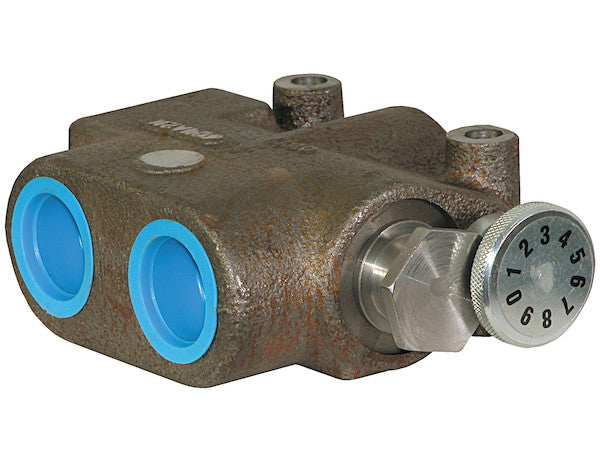
The Priority Flow Divider Valve from Buyers Products splits the oil from a single inlet into two separate flows, ensuring that your oil flow is maintained at the proper GMA regardless of load variations. One flow, the priority flow, is controllable and adjustable to your GPM needs using a knob on the valve. The remaining secondary oil can be used for another need -- at the same time -- without affecting the pressure of the priority flow. By splitting the flow in two, you can divert the secondary oil to a different operation while simultaneously ensuring you have the right GPM for your application. The valve can handle a maximum flow of 3000 PSI .
Specifications
| Material | Cast Iron |
|---|---|
| Maximum Flow Rate | 20 |
| Maximum Pressure | 3000 |
| Maximum Relief Pressure Setting | - |
| Number of Ports | 3 |
| Port Size | 3/4 NPTF |
Advanced Technical Overview: 3/4 Inch NPTF Priority Flow Divider Valve (20 GPM)
In advanced hydraulic systems, precise control and unwavering reliability are paramount for optimal operational efficiency and extended equipment longevity. The 3/4 Inch NPTF Priority Flow Divider Valve, meticulously engineered for a 20 GPM maximum priority flow and robust 3000 PSI system pressure, stands as an indispensable component. Its core function is to accurately divide a single incoming oil flow into two distinct, pressure-compensated output streams. This guarantees that a designated primary hydraulic circuit consistently receives its required flow rate, entirely independent of fluctuating loads or dynamic pressure variations within the secondary circuit. This capability is critical in sophisticated hydraulic architectures where multiple functions must operate concurrently, often with diverse flow and pressure prerequisites, yet one function demands absolute precedence.
The inherent design of this priority flow divider valve effectively isolates the performance characteristics of a critical application from less sensitive operations. Without such a mechanism, dynamic interactions between connected hydraulic components could lead to flow instability or unpredictable performance in the primary system, particularly when the secondary system experiences significant load changes. This valve mitigates these challenges by dedicating a consistent flow to the priority circuit, thereby ensuring its stable operation, while simultaneously making any surplus flow available for secondary, auxiliary tasks. The priority flow rate is precisely configured via an intuitive adjustment knob, allowing operators to fine-tune the system for optimal performance tailored to specific application needs, maximizing overall efficiency and control.
Operational Mechanics and Pressure Compensation Principles
The sophisticated functionality of the 3/4 Inch NPTF Priority Flow Divider Valve is founded on its internal pressure-compensated design. As hydraulic fluid enters the inlet port, it encounters a main spool, a calibrated flow metering orifice, and an internal spring. The fluid passing through the metering orifice generates a precise pressure differential across the main spool. This differential pressure, coupled with the opposing force exerted by the internal spring, dynamically positions the spool. The spool's precise position at any given moment dictates the exact proportion of fluid directed to the priority ("P") port and the amount shunted to the secondary ("EX" or "Excess") port. The adjustable knob, used to set the desired priority flow, effectively calibrates the spring tension or the effective area of the metering orifice, thus establishing the target flow rate for the priority circuit.
The engineering brilliance of its pressure-compensated design becomes evident during pressure fluctuations within either the priority or secondary circuits. For instance, should the load on the secondary circuit increase, causing a rise in its back pressure, the pressure differential across the spool would momentarily change. The spool dynamically and instantaneously repositions itself to ensure the preset flow to the priority circuit is rigorously maintained, effectively isolating and absorbing the pressure change originating from the secondary circuit. Similarly, if the pressure within the priority circuit shifts due to varying load conditions, the spool adjusts to preserve the constant flow rate. This active compensation mechanism ensures the priority circuit's performance remains consistently stable and predictable, a vital attribute for applications demanding precise speed regulation, synchronized movements, or consistent power delivery. The 20 GPM rating primarily denotes the maximum flow that can be accurately and consistently regulated to the priority circuit. The robust internal components are engineered to endure continuous operation at the maximum stated pressure of 3000 PSI, assuring long-term reliability even in the most demanding industrial environments.
Detailed Technical Specifications and Design Implications
The comprehensive specifications of the 3/4 Inch NPTF Priority Flow Divider Valve provide critical insights into its design, capabilities, and suitability for various hydraulic systems. Each parameter is carefully engineered to ensure optimal performance, durability, and seamless integration within complex hydraulic circuits.
Port Size: 3/4 Inch NPTF
The "3/4 Inch NPTF" designation specifies the valve's port size and thread type. NPTF, or National Pipe Taper Fuel, represents a specialized tapered thread designed to achieve a mechanical seal without requiring external sealing compounds, though these are sometimes used for added assurance. This tapered geometry facilitates a robust metal-to-metal seal as the threads are tightened, ensuring leak-free connections under high-pressure conditions. A 3/4-inch port size is optimally chosen for systems requiring moderate flow rates, providing an excellent balance between flow capacity and compact physical dimensions. This size effectively accommodates the 20 GPM flow rating, minimizing detrimental pressure drops while maintaining a manageable form factor. The use of NPTF threads guarantees secure and dependable connections, critical in hydraulic applications where fluid integrity is essential to prevent operational inefficiencies and safety risks.
Maximum Flow Rate: 20 GPM
The "20 GPM" (Gallons Per Minute) rating signifies the maximum flow rate this valve is capable of accurately and consistently delivering to the priority circuit. It also indicates the recommended maximum total inlet flow for the valve to operate within its optimal efficiency range. While hydraulic systems might possess higher pump outputs, this valve is engineered to precisely regulate up to 20 GPM for the priority function, directing any surplus to the secondary port. Operating within this specified flow rate prevents issues such as excessive internal velocities, increased pressure drops, potential cavitation, and accelerated component wear. The 20 GPM capacity positions this valve as an ideal solution for a broad array of mobile and industrial machinery where precise flow management is crucial for functions like motor speed control, accurate cylinder positioning, or responsive steering systems, simultaneously enabling residual flow to power auxiliary functions.
Maximum Pressure: 3000 PSI
A "3000 PSI" (Pounds per Square Inch) maximum pressure rating is a testament to the valve's structural integrity and its capacity for safe and effective operation within high-pressure hydraulic circuits. This robust pressure capability allows for its seamless integration into many contemporary hydraulic systems that leverage elevated pressures to achieve greater power density and force generation from smaller components. The inherent strength and rigidity of the cast iron construction, detailed further below, are fundamental to achieving this high-pressure resilience. Adherence to this specified pressure limit is critical for preventing component failure, ensuring system safety, and prolonging the operational life of the entire hydraulic installation. The ability to reliably withstand 3000 PSI underscores the valve's superior engineering and manufacturing quality, demanding precise tolerances and robust material properties.
Material: Cast Iron
The selection of "Cast Iron" for the valve body material offers significant advantages in the demanding operational environments characteristic of hydraulic applications. Cast iron is widely recognized for its exceptional strength, inherent rigidity, and superior resistance to deformation under extreme pressures. Its intrinsic metallurgical properties also provide excellent vibration dampening characteristics, which contribute significantly to quieter operational acoustics and reduced wear on both internal components and adjacent system elements. Furthermore, cast iron exhibits commendable machinability, enabling the precise fabrication of intricate internal passages and the highly accurate spool bores vital for the valve's pressure-compensated functionality. It also demonstrates good corrosion resistance in typical hydraulic fluid environments and is inherently durable, thereby contributing substantially to the valve's extended service life, even when exposed to harsh operating conditions and broad temperature fluctuations. This considered material choice emphatically reinforces the valve's design philosophy centered on unwavering reliability and enduring longevity.
Number of Ports: 3
The "3 Ports" configuration is the standard and most efficient arrangement for a priority flow divider valve, comprising a single inlet port (typically designated PUMP or IN), a priority outlet port (PRIORITY or REG), and a secondary/excess outlet port (EXCESS or SEC). This straightforward and logical port layout simplifies system plumbing and streamlines integration into diverse hydraulic architectures. The inlet port receives pressurized fluid directly from the hydraulic pump or pressure source. The priority port then channels the precisely regulated flow to the primary actuator or hydraulic circuit that necessitates a constant, unvarying flow. Concurrently, the secondary port diverts any remaining, unregulated flow to a less critical auxiliary function or back to the hydraulic reservoir, often via another control valve. This explicit and distinct separation of flow paths is foundational to the valve's core function, enabling independent flow control and robust pressure compensation between the priority and secondary circuits.
Key Advantages and System Integration Benefits
Integrating the 3/4 Inch NPTF Priority Flow Divider Valve into a hydraulic system yields a broad spectrum of operational and economic advantages, significantly enhancing overall system performance, reliability, and cost-effectiveness.
Precision Flow Control and System Stability
The most compelling benefit is the attainment of precise and consistent flow control for critical hydraulic functions. In applications demanding tight tolerance on actuator speed, hydraulic motor RPM, or process rates, this valve proves indispensable. Its pressure-compensated design ensures the priority circuit remains entirely unaffected by drastic load variations elsewhere in the system. This inherent stability minimizes operational errors, elevates product quality in manufacturing processes, and significantly enhances safety in applications requiring highly predictable movement.
Enhanced Efficiency and Simultaneous Operations
By efficiently dividing the hydraulic flow, this valve facilitates the simultaneous operation of multiple hydraulic functions from a single pump source without undesirable cross-interference. This capability obviates the need for multiple independent pumps, simplifying hydraulic system design, reducing the total component count, and consequently lowering overall capital expenditure. For example, in mobile machinery like agricultural tractors or construction equipment, the main implement function can receive priority flow for smooth, controlled operation, while the secondary flow concurrently powers auxiliary functions like attachments or steering, without compromising the stability of the primary task.
Optimized Resource Utilization and Energy Savings
The valve ensures that hydraulic power is precisely allocated where it is most critically needed. Any excess flow not required by the priority circuit is not wasted; instead, it is made readily available for secondary operations. This optimized resource utilization reduces overall energy consumption, as the pump only needs to generate the total flow necessitated by both active circuits, rather than designing for the cumulative peak demand of individual circuits operating in isolation. This directly translates into measurable fuel savings for mobile equipment and electricity savings in industrial settings, contributing to reduced operating expenses and a smaller environmental footprint.
Protection of Critical Components
Many sensitive hydraulic components, such as proportional valves, high-precision actuators, or hydrostatically driven systems, necessitate a stable and ripple-free flow to perform optimally and prevent premature wear. By effectively buffering the priority circuit from pressure and flow fluctuations originating from other parts of the system, the priority flow divider safeguards these critical components. This protection extends their operational lifespan and significantly reduces maintenance requirements. Furthermore, it minimizes the risk of system shock or cavitation, which are common issues in non-compensated systems experiencing abrupt load changes.
System Simplification and Cost Reduction
When compared to alternative methods of achieving equivalent functionality, such as implementing multiple dedicated pumps or complex electro-hydraulic control systems, the priority flow divider presents a comparatively simple, exceptionally robust, and highly cost-effective solution. Its mechanical design inherently provides advanced pressure compensation without requiring external sensors, sophisticated controllers, or intricate feedback loops. This intrinsic simplicity streamlines installation procedures, significantly reduces potential points of failure, and substantially lowers overall system complexity and long-term maintenance costs.
Durability and Reliability in Harsh Environments
Constructed from high-grade cast iron and meticulously designed for continuous operation at 3000 PSI, this valve is purpose-built for exceptional endurance. Its robust construction guarantees reliable and consistent performance in the most demanding industrial and mobile applications, often characterized by elevated pressures, significant temperature variations, and continuous duty cycles. The inherently straightforward mechanical design further contributes to its outstanding reliability, necessitating minimal intervention once correctly installed and calibrated, thereby ensuring maximum uptime and operational continuity.
Typical Applications and Use Cases
The inherent versatility and consistently robust performance of the 3/4 Inch NPTF Priority Flow Divider Valve render it an indispensable component across an extensive spectrum of hydraulic applications. Its unparalleled ability to efficiently manage and precisely distribute hydraulic power is leveraged effectively in numerous industries, enhancing system performance and operational precision. For instance, in mobile hydraulics, agricultural machinery like tractors and harvesters frequently require unwavering flow for critical functions such as hydrostatic steering, implement lift, or PTO-driven attachments, while simultaneously powering auxiliary functions like bale wrappers. Similarly, construction equipment such as excavators, wheel loaders, and forklifts extensively utilize these valves for precise control of primary movements like boom and bucket articulation, allowing auxiliary functions (e.g., grapples, hydraulic hammers, or cooling fans) to operate concurrently without detrimental impact on primary controls. In industrial hydraulics, within CNC machining centers or other automated production equipment, critical functions such as spindle speed control, tool clamping mechanisms, or precise linear motion stages can be assigned priority flow to ensure highly consistent, repeatable operation, while auxiliary functions like coolant pumps or lubrication systems efficiently utilize the secondary flow. Material handling systems, including conveyor systems, automatic guided vehicles (AGVs), and robotic manipulators, greatly benefit from precise speed control for their primary motion axes, ensuring smooth product flow or accurate positioning, with secondary flow effectively managing clamping or indexing mechanisms.
Installation, Maintenance, and Best Practices
Adhering to correct installation procedures and embracing best practices are paramount for maximizing the performance, ensuring the reliability, and extending the operational longevity of the 3/4 Inch NPTF Priority Flow Divider Valve.
Installation Guidelines
Proper installation begins with ensuring the entire hydraulic system is thoroughly cleaned, as particulate contamination remains the predominant cause of premature hydraulic component failure. All lines must be flushed, and appropriate filtration integrated. Meticulously identify the inlet (PUMP/IN), priority (PRIORITY/REG), and secondary (EXCESS/SEC) ports, as incorrect plumbing will invariably lead to improper operation or catastrophic system malfunction. NPTF threads must be tightened to the manufacturer's specified torque to achieve a secure, leak-free seal; while NPTF is designed for metal-to-metal sealing, a minimal application of thread sealant compatible with hydraulic fluids can be used for supplementary assurance, strictly avoiding overtightening which can compromise thread integrity or damage the valve body. Securely mount the valve to a stable, rigid surface, ideally offering easy accessibility for future adjustments and routine inspections, ensuring sufficient clearance for hydraulic lines and the adjustment knob. While orientation typically does not critically affect performance, always consult and adhere to any specific manufacturer recommendations. Integrate highly efficient filtration (e.g., 10-micron absolute) upstream of the valve to safeguard its precision internal components. Finally, verify that the hydraulic fluid used is compatible with the valve's internal materials and seals, and ensure the hydraulic system consistently operates within the recommended temperature range to prevent fluid degradation and premature seal wear.
Adjustment and Calibration Procedures
The priority flow rate is precisely adjusted via an accessible manual knob. To accurately set the desired priority flow, initiate system operation and allow it to reach its normal working temperature, ensuring fluid viscosity is stable. Begin with the priority flow adjustment knob fully turned to its minimum flow setting (or fully closed, depending on the specific design). Gradually and incrementally open the knob, carefully observing the speed or output of the priority actuator; a calibrated flow meter in the priority line provides the most accurate measurement. Continue adjusting until the exact desired GPM is achieved for the priority circuit. Subsequently, monitor the performance of both the priority and secondary circuits under various typical load conditions to confirm stable and predictable operation across the entire operational envelope. It is crucial to understand that the secondary flow is inherently unregulated; its volume will fluctuate based on the total inlet flow available and the dynamic demand of the priority circuit. If the total inlet flow from the pump is less than the priority flow setting, the priority circuit will only receive the available inlet flow, and consequently, there will be no secondary flow whatsoever. The valve's function is to *divide* the available flow, not to generate additional flow.
Maintenance and Troubleshooting Best Practices
Due to its robust cast iron construction and inherently simple mechanical design, routine maintenance for this valve is typically minimal, focusing primarily on preventative measures. Regularly monitor hydraulic fluid levels and critically assess fluid quality, adhering strictly to manufacturer guidelines for fluid replacement and filter changes to prevent detrimental contamination. Periodically conduct thorough inspections of all port connections for any signs of hydraulic fluid leakage, and promptly address any detected leaks to prevent fluid loss, maintain system pressure, and ensure operational efficiency. Consistently monitor the performance of the priority circuit; should the flow become inconsistent, fluctuate, or noticeably deviate from its set point, investigate potential underlying issues such as internal blockages within passages or a sticking spool mechanism caused by dirt, debris, or degraded fluid. Also, check for insufficient or inconsistent inlet flow being supplied by the primary hydraulic pump. While the valve is pressure-compensated, extreme back pressure in either circuit can occasionally impact performance or indicate a downstream restriction or blockage. Conduct a visual inspection for any external physical damage to the valve body, ports, or the adjustment mechanism. Ultimately, the robust cast iron body and precision-engineered internal design ensure that this priority flow divider valve delivers exceptional reliability and an extended operational lifespan when integrated into a properly maintained hydraulic system.
Conclusion
The 3/4 Inch NPTF Priority Flow Divider Valve, rated for 20 GPM and 3000 PSI, represents an indispensable component for hydraulic system designers and engineers committed to optimizing system performance and achieving superior operational efficiency. Its advanced pressure-compensated design guarantees unwavering consistency for critical hydraulic functions, simultaneously providing an uninterrupted and available flow for secondary operations without compromise. Fabricated from highly durable cast iron and meticulously engineered for a robust 3000 PSI, this valve is constructed to withstand the most rigorous and continuous operational demands across diverse environments. By delivering precise flow control, enabling simultaneous multi-function operations, and contributing significantly to overall system simplification and tangible energy savings, this priority flow divider valve constitutes a strategic and intelligent investment. It ensures unparalleled reliability, enhanced productivity, and prolonged longevity of hydraulic machinery across an extensive array of applications. Its straightforward mechanical operation, combined with formidable performance capabilities, positions it as the quintessential choice for ensuring that hydraulic power is delivered with exacting precision, exactly where and when it is needed, without any performance degradation.