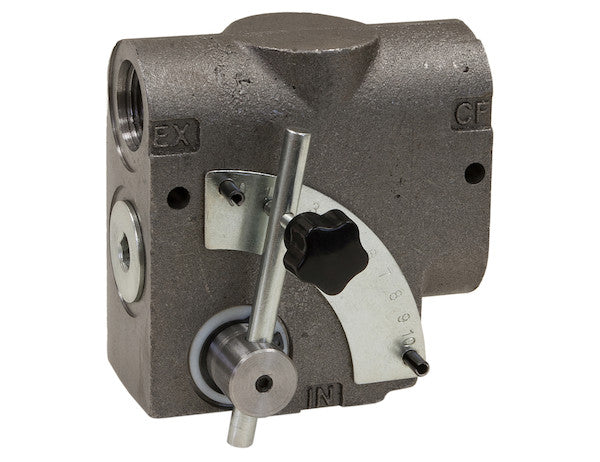
The Side Ported Priority Flow Divider Valve from Buyers Products splits the oil from a single inlet into two separate flows, ensuring that your oil flow is maintained at the proper speed (GPM) GMA regardless of load variations. One flow, the priority, is controllable and adjustable to your GPM needs using a lockable knob on the valve. The remaining secondary oil can be used for another need -- at the same time -- without affecting the pressure of the priority flow, or it can be returned to the tank. By splitting the flow in two, you can divert the secondary oil to a different operation while simultaneously ensuring you have the right GPM for your application. The valve can handle a maximum flow of 3000 PSI .
Specifications
| Material | Cast Iron |
|---|---|
| Maximum Flow Rate | 30 |
| Maximum Pressure | 3000 |
| Maximum Relief Pressure Setting | - |
| Number of Ports | 3 |
| Port Size | 3/4 NPTF |
Advanced Technical Overview: 3/4 Inch NPT Side Ported Adjustable Priority Flow Divider Valve 0-30 GPM
In complex hydraulic systems, the ability to precisely manage fluid flow is paramount for achieving optimal performance, efficiency, and operational safety. The 3/4 Inch NPT Side Ported Adjustable Flow Divider Valve, designed for a flow range of 0-30 GPM, represents a critical component engineered to meet these demands. This comprehensive technical description delves into the intricate mechanisms, advanced features, and diverse applications of this robust hydraulic device, highlighting its indispensable role in sophisticated fluid power circuits.
Fundamental Principles of Flow Division and Pressure Compensation
At its core, a flow divider valve serves to apportion a single incoming flow of hydraulic fluid from a pump into two or more separate, often independent, outlet flows. This functionality is crucial in applications where multiple actuators or functions must operate simultaneously from a single hydraulic power source, each requiring a specific and consistent flow rate regardless of varying load conditions on other functions. The "priority" designation in this valve type signifies its primary function: to dedicate a precisely controlled portion of the inlet flow to a designated "priority" circuit, while the remaining "secondary" flow is available for other, often less critical, operations or for return to the hydraulic reservoir.
The operational integrity of this valve is founded upon the principle of pressure compensation. Unlike simpler, non-compensated flow control valves (such as fixed orifices) which are highly susceptible to pressure fluctuations, a pressure-compensated flow divider actively maintains a constant flow rate to the priority circuit by automatically adjusting its internal resistance in response to changes in system pressure. This is achieved through a precisely engineered internal spool mechanism. As the pressure in either the priority or secondary circuit changes due to varying loads, the spool dynamically shifts, altering the effective orifice size to ensure that the pressure differential across the flow-regulating element remains constant. This unwavering pressure differential directly translates into a stable and consistent flow rate to the priority output, thereby guaranteeing predictable actuator speed and performance regardless of external influences.
Without pressure compensation, a heavy load on one actuator connected to the secondary circuit could cause a significant drop in pressure, potentially starving the priority circuit of flow and leading to inconsistent or erratic operation. This valve's design mitigates such issues, providing a highly stable and reliable flow division, critical for sensitive applications requiring precise motion control.
Key Design Features and Technical Specifications
1. Adjustable Priority Flow (0-30 GPM)
The defining feature of this valve is its adjustable priority flow, ranging from 0 to 30 Gallons Per Minute (GPM). This adjustability is achieved via a lockable knob, a critical ergonomic and functional element. The knob mechanism allows operators to precisely set the desired flow rate for the priority circuit. The lockable feature is vital for preventing accidental or unauthorized adjustments, ensuring that once a specific flow rate is configured for an application, it remains consistent throughout operation. This level of precision control enables system designers and operators to fine-tune the performance of primary hydraulic functions, such as motor speed or cylinder extension/retraction rates, to meet exact operational requirements. For instance, in an agricultural spreader application, this allows for precise control of the spreader motor's RPM, directly influencing material distribution, while excess flow can power a lift cylinder without affecting spreader performance.
2. Side Ported Configuration
The "Side Ported" design refers to the physical orientation of the inlet and outlet ports on the valve body. In contrast to inline valves where ports are typically aligned axially, side-ported valves feature ports on the sides of the main body. This configuration offers significant advantages in terms of hydraulic circuit layout and installation flexibility. It simplifies plumbing by allowing hoses and rigid lines to connect perpendicular to the valve's main axis, often resulting in more compact and aesthetically organized installations. This can be particularly beneficial in space-constrained environments found in mobile equipment or industrial machinery, facilitating easier hose routing, reducing bend radius requirements, and simplifying maintenance access.
3. 3/4 Inch NPTF Port Size
The valve features 3/4 Inch NPTF (National Pipe Taper Fuel) ports. The NPTF standard is a specific type of NPT (National Pipe Taper) thread designed for mechanical seal without the need for additional sealant, although proper thread sealant is still recommended for robust hydraulic connections to prevent leaks, especially in high-pressure applications. The tapered design of NPTF threads creates an interference fit as they are tightened, forming a metal-to-metal seal. The 3/4 inch nominal pipe size is commonly utilized in hydraulic systems where flow rates up to 30 GPM are expected. This sizing ensures adequate fluid conductance, minimizing pressure drops across the valve and maintaining system efficiency. The widespread availability of 3/4 NPTF fittings and hoses further simplifies system integration and maintenance, making this valve a highly compatible choice for many existing hydraulic infrastructures.
4. 3000 PSI Maximum Pressure Rating
With a maximum operating pressure rating of 3000 PSI (Pounds per Square Inch), this valve is engineered for demanding hydraulic environments. This robust pressure handling capability ensures reliable operation across a broad spectrum of industrial and mobile applications, including those involving heavy loads and high force requirements. The design and material selection (Cast Iron) are optimized to withstand continuous exposure to such pressures without compromising structural integrity or sealing performance, contributing significantly to the overall durability and longevity of the hydraulic system.
5. Cast Iron Construction
The valve body is constructed from high-grade Cast Iron. Cast iron is a preferred material for hydraulic components due to several advantageous properties:
- Strength and Rigidity: Cast iron offers excellent compressive strength and rigidity, making it highly resistant to deformation under high internal pressures and external stresses.
- Wear Resistance: Its inherent metallurgical structure provides good wear resistance, essential for components subjected to continuous fluid flow and internal moving parts.
- Vibration Damping: Cast iron possesses superior vibration damping characteristics compared to other metals, which can contribute to quieter operation and reduced stress on connected components.
- Thermal Stability: It maintains stable mechanical properties across a wide range of operating temperatures typical of hydraulic systems.
- Cost-Effectiveness: While robust, cast iron remains a cost-effective material, allowing for the production of high-performance components without prohibitive expense.
6. Three-Port Configuration
The valve features three distinct ports:
- Inlet (P or IN): Receives the hydraulic fluid from the pump.
- Priority Outlet (CF or REG): Delivers the precisely controlled, adjustable flow to the primary hydraulic function.
- Secondary Outlet (EX or BF): Delivers the remaining, unregulated flow, which can be used for a secondary function or returned to the tank.
7. Independent Pressure Operation
A critical technical advantage of this priority flow divider is its ability to ensure that the pressure in the priority circuit remains unaffected by pressure variations in the secondary circuit. This is a direct consequence of its pressure-compensated design. The internal spool mechanism dynamically reacts to pressure changes in the secondary line, maintaining a constant pressure drop across the priority flow control orifice. This isolation means that a sudden increase in load or pressure requirement in the secondary circuit will not "steal" flow or pressure from the priority circuit. This independence is invaluable for applications where the primary function requires absolute consistency, even when auxiliary functions are subjected to highly variable loads, thus preventing performance degradation and ensuring predictable operation of the most critical machine elements.
Applications and Operational Scenarios
The versatility and precision offered by this adjustable priority flow divider make it suitable for an extensive range of hydraulic applications across various industries:
-
Mobile Hydraulics:
- Snowplows and Salt Spreaders: Critical for controlling the precise speed of a salt spreader motor (priority flow) while simultaneously allowing the plow lift/angle cylinders (secondary flow) to operate without affecting the spreading accuracy.
- Utility Vehicles: Powering a primary attachment (e.g., boom operation, winch) with a consistent flow, while diverting excess flow to auxiliary functions like outriggers or tool circuits.
- Agricultural Machinery: Regulating the speed of a planter drive motor or sprayer pump for accurate application rates (priority) while permitting other implements (e.g., furrow openers, markers) to operate from the secondary flow.
-
Industrial Hydraulics:
- Machine Tools: Providing a highly consistent feed rate to a critical machining axis (priority) while allowing faster, less precise movements for tool changes or clamping (secondary).
- Material Handling Equipment: Ensuring a smooth, controlled speed for a conveyor belt or lifting mechanism (priority) while permitting fast action for clamping or ejection mechanisms (secondary).
- Process Control Systems: Maintaining a precise flow for mixing, dosing, or filling operations (priority), with the secondary flow used for agitation or auxiliary cooling circuits.
- Test Benches: Creating controlled flow conditions for testing hydraulic components or systems, where a stable primary flow is essential for accurate data collection.
In each scenario, the valve enables multi-function operation from a single pump, simplifying hydraulic circuits, reducing component count, and enhancing overall system efficiency by minimizing energy waste associated with separate pumps for each function.
Installation and System Integration Considerations
Proper installation is crucial for the optimal performance and longevity of the flow divider valve. Key considerations include:
- System Cleanliness: Hydraulic systems must be kept meticulously clean. Contaminants are the leading cause of hydraulic component failure. Implementing high-quality filtration upstream of the valve is essential to protect its sensitive internal spool mechanism.
- Port Identification: Correctly connecting the inlet (P), priority outlet (CF), and secondary outlet (EX) ports according to the application's requirements is paramount. Reversing connections can lead to unpredictable operation or damage.
- Mounting: While side-ported valves offer flexibility, ensuring the valve is securely mounted to a stable surface prevents vibration-induced wear and maintains connection integrity.
- Hose and Fitting Selection: All connecting hoses and fittings must be rated for the system's maximum operating pressure (3000 PSI) and should be sized appropriately for the expected flow rates to prevent cavitation or excessive pressure drops.
- System Relief Valves: A system relief valve should always be installed in the main pump line to protect the entire circuit, including the flow divider, from overpressure conditions.
- Secondary Flow Management: Careful consideration must be given to how the secondary flow is utilized. If not used by an actuator, it must be routed back to the tank, ideally through a low-pressure return line filter, to prevent unnecessary backpressure build-up.
Operational Benefits and Advantages
The deployment of the 3/4 Inch NPT Side Ported Adjustable Priority Flow Divider Valve yields numerous operational and economic benefits:
- Precision Control: Provides unparalleled accuracy in regulating flow to critical hydraulic functions, ensuring consistent actuator speeds and predictable system behavior, vital for quality and safety.
- Enhanced System Efficiency: Optimizes the utilization of hydraulic power from a single pump, reducing energy consumption and minimizing heat generation by preventing unnecessary throttling losses associated with simpler control methods.
- Versatility and Flexibility: Enables a single hydraulic power unit to support multiple, often disparate, functions simultaneously, simplifying system design and expanding operational capabilities.
- Cost-Effectiveness: Eliminates the need for multiple pumps or more complex, expensive control systems to manage concurrent operations, leading to reduced capital expenditure and lower maintenance costs.
- System Simplification: Streamlines hydraulic circuits by consolidating control functions, reducing the number of components and potential leak points.
- Improved Reliability and Longevity: The robust cast iron construction and pressure-compensated design contribute to exceptional durability and extended service life, even in harsh industrial and mobile environments. Consistent flow and pressure management also reduce stress on other hydraulic components.
- Safety Assurance: Consistent control over primary functions reduces the risk of operational errors or unexpected movements, enhancing overall machine safety.
Maintenance and Longevity
While designed for robustness, routine maintenance contributes significantly to the valve's longevity. This primarily involves:
- Fluid Quality: Regularly checking and maintaining the cleanliness and condition of the hydraulic fluid according to manufacturer specifications is paramount. Contaminated fluid accelerates wear on internal components.
- Leak Checks: Periodically inspecting all port connections and the valve body for hydraulic fluid leaks. Addressing minor leaks promptly prevents system contamination and pressure loss.
- Mounting Integrity: Ensuring the valve remains securely mounted and that there are no loose connections.
- Functional Checks: Occasionally verifying the adjustability and consistency of the priority flow, especially if operational parameters appear to drift.
Conclusion
The 3/4 Inch NPT Side Ported Adjustable Flow Divider Valve (0-30 GPM) is a sophisticated and indispensable component for advanced hydraulic systems. Its ability to provide a pressure-compensated, precisely adjustable priority flow while simultaneously making remaining flow available for secondary functions, all from a single pump, significantly enhances system control, efficiency, and versatility. Constructed from durable cast iron and rated for 3000 PSI, this valve is built for reliable performance in demanding environments. For engineers and system integrators seeking to optimize multi-functional hydraulic operations with a focus on precision, consistency, and robustness, this adjustable priority flow divider represents a superior technical solution, offering substantial operational advantages and contributing to the overall longevity and performance of hydraulic machinery.