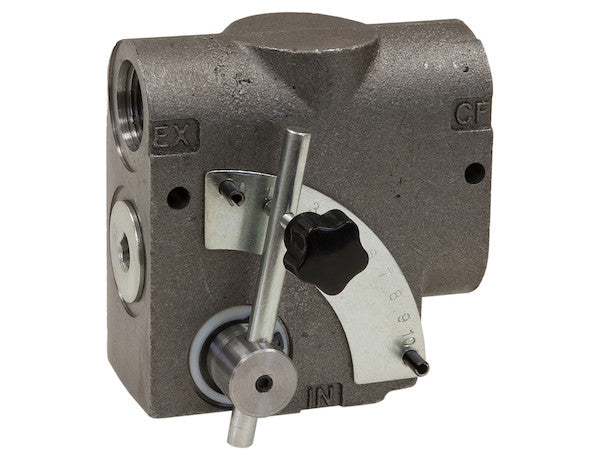
The Side Ported Priority Flow Divider Valve from Buyers Products splits the oil from a single inlet into two separate flows, ensuring that your oil flow is maintained at the proper speed (GPM) GMA regardless of load variations. One flow, the priority, is controllable and adjustable to your GPM needs using a lockable knob on the valve. The remaining secondary oil can be used for another need -- at the same time -- without affecting the pressure of the priority flow, or it can be returned to the tank. By splitting the flow in two, you can divert the secondary oil to a different operation while simultaneously ensuring you have the right GPM for your application. The valve can handle a maximum flow of 3000 PSI .
Specifications
| Material | Cast Iron |
|---|---|
| Maximum Flow Rate | 30 |
| Maximum Pressure | 3000 |
| Port Size | 3/4 SAE ORB (-12) |
Technical Deep Dive: #12 SAE Side Ported Adjustable Flow Divider Valve 0-30 GPM
The #12 SAE Side Ported Adjustable Flow Divider Valve is an indispensable component for sophisticated hydraulic systems demanding precise, load-independent flow control. Engineered to meticulously manage hydraulic power, this valve effectively splits a single incoming oil flow into two distinct, independently controlled output flows. Its primary function is to guarantee a predetermined volume of oil, known as the priority flow (CF), is consistently delivered to a critical primary circuit, irrespective of fluctuating load pressures on either the priority or secondary circuits. The remaining fluid, designated as the secondary or excess flow (EX), is then available to power auxiliary functions simultaneously or can be efficiently returned to the hydraulic reservoir. This critical capability ensures unwavering operational speed and function for vital components, even when other hydraulic operations run concurrently under variable loads. The valve's robust design optimizes overall system performance, enhances operational safety, and extends the service life of interconnected hydraulic components by preventing cavitation and ensuring consistent, demand-driven power delivery across diverse operating scenarios.
Operational Mechanics and Load Independence
At its core, the valve operates on advanced pressure compensation principles to achieve its precision. Hydraulic fluid enters the single inlet port and immediately encounters an internal spool mechanism. This spool dynamically senses the pressure differential across a precision orifice, which is integral to the flow division process. To establish the desired priority flow, the valve continuously adjusts its internal passages. If the pressure within the priority circuit increases due to changing load conditions, the spool automatically modulates its position to maintain the pre-set flow rate, effectively compensating for the pressure change. Crucially, fluctuations in the secondary circuit's pressure do not impact the stability of the priority flow—a defining characteristic known as "load independence." This mechanism allows for simultaneous, uninterrupted operation of critical functions, guaranteeing performance consistency. The robust, lockable adjustment knob provides operators with the ability to precisely set the priority GPM within a broad 0-30 GPM range. This granular control accurately tailors performance to specific hydraulic motors, cylinders, or other actuators, optimizing their speed and power output for various applications. The locking mechanism securely fastens the chosen setting, preventing accidental adjustments during demanding operations. Excess fluid (secondary flow) is then efficiently utilized to power non-critical functions or returned to the tank, effectively minimizing heat generation and maximizing overall energy efficiency within the hydraulic system.
Key Technical Specifications Explained
The valve's design incorporates several critical specifications that collectively define its high-performance capabilities and ensure its reliability in demanding hydraulic environments:
- SAE #12 Side Porting: This designation refers to a 3/4 inch nominal diameter for the valve's hydraulic ports, which utilize an SAE O-Ring Boss (ORB) thread type. SAE ORB connections are highly favored in high-performance hydraulic systems due to their superior, leak-free sealing capabilities, which significantly outperform traditional tapered pipe threads, especially under high-pressure conditions and intense vibration. The O-ring provides a positive, durable seal that is highly resistant to thermal expansion and contraction. The "Side Ported" configuration strategically places the inlet and outlet ports on the valve body's sides, enhancing installation flexibility and space optimization within complex hydraulic circuits, facilitating more compact plumbing layouts and easier maintenance access.
- Adjustable Flow Range (0-30 GPM): This broad and precise capability allows operators to accurately regulate the priority flow from a complete shut-off (0 GPM) up to its maximum capacity of 30 GPM. Such versatility ensures optimal compatibility with a wide array of hydraulic actuators, from those requiring minimal flow for delicate, precise movements (e.g., fine positioning) to larger components demanding higher flow rates for rapid operation (e.g., fast cycling). Granular and continuous control over the primary hydraulic function's speed is paramount for optimizing energy consumption, preventing cavitation, and extending component life by precisely preventing both under-performance and over-performance.
- Maximum Pressure (3000 PSI): This robust pressure rating confirms the valve is meticulously engineered to consistently withstand continuous operating pressures up to 3000 Pounds per Square Inch (PSI) without compromising its structural integrity or sealing effectiveness. This is a common and critical pressure standard prevalent across a vast array of medium to heavy-duty hydraulic systems in demanding industries such as agriculture, construction, material handling, and general industrial machinery. Operating within this specified limit ensures prolonged component lifespan for the valve and its interconnected system elements, significantly contributing to the overall reliability, durability, and safety of the entire hydraulic circuit.
- Material (Cast Iron): The selection of cast iron as the primary material for the valve body is a deliberate engineering choice, leveraging its advantageous mechanical properties for demanding hydraulic applications. Cast iron provides an excellent combination of high compressive strength, exceptional rigidity, and superior vibration dampening characteristics. Its high compressive strength effectively resists the substantial internal pressures inherent in hydraulic systems, directly supporting the impressive 3000 PSI rating. The material's inherent rigidity minimizes deflection and distortion under load, which is crucial for maintaining the precise alignment and operation of internal spool mechanisms, ensuring accurate flow division. Furthermore, its superior vibration dampening reduces noise and protects sensitive components from fatigue. This makes cast iron a cost-effective, durable, and highly reliable solution for demanding hydraulic flow divider applications, guaranteeing extended operational life with minimal maintenance requirements.
Versatile Applications and Industry Integration
This #12 SAE Side Ported Adjustable Flow Divider Valve is an indispensable asset in systems where dedicated flow for primary functions must be maintained with unwavering precision, while simultaneously supporting auxiliary operations across diverse industrial and mobile sectors:
- Mobile Equipment: Crucial for agricultural machinery (e.g., precise combine header speed, consistent tractor steering response), construction equipment (e.g., controlled excavator swing, stable loader bucket lift), utility vehicles (e.g., aerial lift platform stability for precise positioning), and refuse trucks (e.g., controlled packer blade movement during compaction cycles, independent of lift).
- Material Handling: Ensures accurate and independent control of lift, tilt, or conveyor speeds in forklifts, telehandlers, and similar material handling equipment, operating independently of power demands for traction or steering, thereby optimizing load handling safety and overall operational efficiency.
- Industrial Automation: Integral for precision applications in machine tools, presses, and automated manufacturing lines, where precise actuator speed (e.g., consistent feed rates for machining, controlled clamping force for assembly) is paramount for product quality, process repeatability, and operational safety, even when auxiliary functions like cooling or lubrication systems are simultaneously active.
- Marine & Offshore: Vital for applications such as winches, cranes, and steering gears on vessels or offshore platforms, guaranteeing constant, reliable flow to critical systems for safety and efficiency, regardless of variable loads on secondary hydraulic functions like hatch control or deck machinery.
- Forestry Equipment: In heavy machinery like log splitters, chippers, and felling machines, it effectively prioritizes flow to high-power cutting or splitting mechanisms, maintaining consistent force and speed while simultaneously powering grappling, positioning, or delimbing functions without compromise to the primary operation.
Strategic Benefits for Hydraulic Systems
Implementing the #12 SAE Side Ported Adjustable Flow Divider Valve into hydraulic system designs delivers substantial operational and economic advantages that significantly enhance overall performance and longevity:
- Maximized System Efficiency: By intelligently distributing hydraulic power, the valve prevents oversupply to non-critical functions and ensures precise, demand-driven delivery to primary circuits, leading to optimized energy consumption and potentially lower fuel costs in mobile applications.
- Superior Control and Precision: The ability to maintain a consistent, load-independent GPM for the priority flow translates directly into highly accurate and repeatable control over essential machine movements, speeds, and forces, which is absolutely crucial for applications requiring high accuracy, fine tuning, and process consistency.
- Enhanced Productivity: This fundamental capability facilitates the concurrent operation of multiple distinct hydraulic functions from a single pump source, significantly increasing machine uptime and operational throughput without compromising the performance, stability, or safety of primary tasks.
- Unwavering Performance (Load Independence): The inherent pressure compensation mechanism guarantees that the priority flow remains stable and consistent regardless of load changes on either the priority or secondary circuit, effectively eliminating unexpected speed fluctuations and bolstering both operational safety and consistency.
- Extended Component Life: Stable and controlled flow rates significantly mitigate stress on all hydraulic components, preventing damaging conditions like cavitation, excessive heat buildup, or destructive pressure surges, thereby extending their service life and reducing the frequency of preventative maintenance.
- Simplified System Design and Cost Reduction: By enabling a single hydraulic pump to reliably power diverse functions, the need for additional pumps, motors, or more complex control logic can often be entirely eliminated, simplifying hydraulic architecture and substantially reducing both initial acquisition and long-term installation costs.
- Adaptable Operation: The highly adjustable flow rate, coupled with a secure lockable knob, provides unparalleled operational flexibility, allowing for quick and precise tuning of system performance to perfectly match varied application demands and ensure optimal machine behavior across diverse operating conditions.
Installation Guidelines and Maintenance Best Practices
To ensure optimal performance and achieve the maximum longevity from your #12 SAE Side Ported Adjustable Flow Divider Valve, strict adherence to proper installation procedures and rigorous maintenance protocols is essential. Installation requires the use of correctly sized SAE ORB fittings, ensuring that all connection surfaces are meticulously clean, free of any debris, and torqued precisely to the manufacturer's specifications to prevent leaks and maintain system integrity under operational pressures. The side-ported configuration offers considerable routing flexibility for hydraulic lines, but adequate clearance for hose bends, ease of service access, and future component inspection should always be carefully considered during the overall system design phase. While hydraulic flow dividers are typically insensitive to mounting orientation, consulting any specific manufacturer guidelines for optimal performance or ease of access is always prudent. Paramount to the health and efficiency of any hydraulic system is effective fluid filtration; actively preventing contaminants from entering the valve is critical, as particulate matter can severely impair the precise movement of the internal spool, leading to erratic performance, reduced accuracy, or premature wear of internal components. Regular visual inspections of the valve body and its connections for any signs of leakage (e.g., weeping, drips, fluid accumulation) are crucial, as these can indicate potential seal degradation, fitting fatigue, or improper torque. The lockable adjustment knob should be periodically verified for secure fastening at the desired flow setting to prevent unintended operational changes that could compromise system performance or safety. Although robust cast iron bodies offer exceptional durability, internal precision components and seals may eventually require replacement after prolonged service, a long-term consideration contingent upon rigorous system maintenance. Conforming to manufacturer recommendations for hydraulic fluid type, filtration levels, and preventative maintenance schedules will guarantee the valve’s efficient, reliable operation throughout its extended service life, maximizing its contribution to your hydraulic system's overall performance and reliability.
Conclusion
The #12 SAE Side Ported Adjustable Flow Divider Valve, with its versatile 0-30 GPM range, stands as a crucial advancement for modern hydraulic systems demanding precision, efficiency, and simultaneous multi-functional capabilities. Its sophisticated pressure-compensated design ensures critical operations consistently receive a load-independent flow rate, significantly bolstering control, accuracy, and safety across diverse applications. Featuring robust cast iron construction, a high 3000 PSI pressure rating, broad adjustability, and convenient SAE #12 side-ported connections, this valve is meticulously engineered for the most demanding industrial and mobile applications. By providing a reliable and precise method for hydraulic flow splitting and control, it fundamentally optimizes system performance, drastically reduces design complexity, and extends the operational lifespan of valuable hydraulic equipment. Investing in this high-quality flow divider directly translates into improved productivity, substantially reduced operational expenditures, and enhanced overall reliability for any integrated hydraulic circuit, offering a superior solution for intricate flow management challenges.