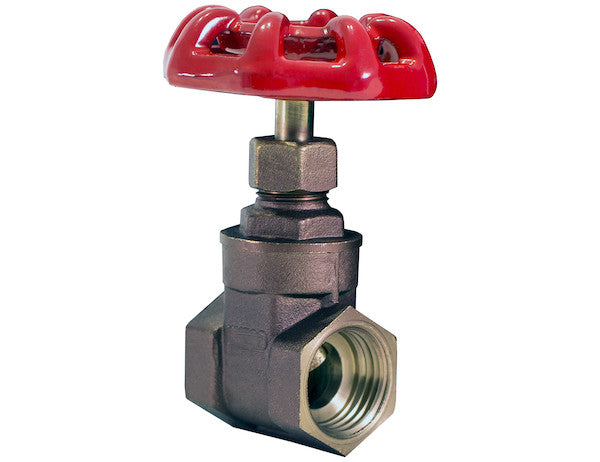
The Full Flow Gate Valve from Buyers Products reliably controls the flow of fluid in your truck's hydraulic system. It allows full flow for maximum pressure. Easy to install, the valve's small footprint is ideal for tight spaces. It has a non-rising stem and easy to operate bonnet. Its durable and airtight brass construction features a solid wedge disk and integral seats. It's built to handle 200 PSI of non-shock pressure. The valve can be conveniently repacked while it is in service and under pressure. Choose from a range of valve sizes to meet your needs. Note: The valve is not suitable for steam or potable water applications.
Specifications
| Ball Material | Brass |
|---|---|
| Body Finish | Smooth |
| Body Material | Brass |
| Body Style | Gate |
| Handle Material_1 | Carbon Steel |
| Maximum Pressure (Water, Oil, Gas) | 200 |
| Maximum Working Pressure | 200 |
| Pipe Size | 0.500 |
| Seat Material | Brass |
| Thread Size | 1/2 NPT |
| Wedge Material | Brass |
1/2 Inch Brass Gate Valve for Hydraulic Systems: Precision Flow Control and Robust Durability
The 1/2 Inch Gate Valve represents a critical component in the precise management of hydraulic fluid flow within demanding applications, particularly mobile hydraulic systems found in trucks. Engineered to deliver exceptional performance and longevity, this valve is meticulously designed to meet the rigorous requirements of industrial and vehicular environments where reliable fluid control is paramount. Its designation as a "full flow" valve underscores its capacity to facilitate an unimpeded passage for hydraulic fluid, minimizing pressure drop and optimizing system efficiency, a vital consideration for maximizing the operational integrity and power delivery of hydraulic machinery.
Advanced Design and Core Functionality
At its core, the gate valve operates on a straightforward yet highly effective principle. A wedge-shaped gate, or disc, is moved perpendicularly to the flow path. When the valve is fully open, the gate is lifted entirely out of the fluid stream, creating a full-bore passage that replicates the internal diameter of the connecting pipe. This design characteristic is pivotal for hydraulic systems, as it ensures negligible flow restriction, preventing energy loss due to turbulence and maintaining maximum system pressure. Conversely, when fully closed, the wedge seats firmly against the integral valve seats, establishing a leak-tight seal that completely obstructs fluid passage. This binary control — fully open or fully closed — makes gate valves ideal for isolation duties rather than throttling or flow regulation, where precise intermediate flow control is required.
This particular 1/2 Inch Gate Valve incorporates a non-rising stem design, a significant advantage in compact installations such as those prevalent in truck hydraulic systems. In a non-rising stem configuration, the valve stem threads into the gate itself. As the handwheel is rotated, the stem turns, but it does not move axially out of the bonnet. Instead, the gate travels up or down along the rotating stem. This design conserves vertical clearance above the valve, which is often a constraint in tight engine compartments or chassis-mounted hydraulic assemblies. Beyond space efficiency, the non-rising stem also protects the stem threads from environmental contaminants and reduces wear on the stem packing, contributing to the valve's overall longevity and consistent sealing performance.
Superior Material Construction: The Strength of Brass
The choice of brass for the primary construction materials – including the body, wedge, and seats – is a testament to its exceptional properties suited for hydraulic applications. Brass is an alloy primarily composed of copper and zinc, offering a unique combination of characteristics that enhance the valve's durability and performance:
- Corrosion Resistance: Brass exhibits excellent resistance to corrosion from a wide range of hydraulic fluids, including petroleum-based oils, synthetic lubricants, and some glycol-based fluids. This resistance ensures the internal components remain free from rust and degradation, preserving the valve's sealing integrity and operational smoothness over its service life.
- Mechanical Strength: While ductile, brass possesses sufficient tensile strength and hardness to withstand the dynamic pressures and mechanical stresses inherent in hydraulic systems. Its robustness contributes to the valve's ability to handle up to 200 PSI of non-shock pressure, ensuring structural integrity under typical operating conditions.
- Machinability: Brass is highly machinable, allowing for the precise manufacturing of intricate components such as the wedge, seats, and bonnet. This precision is critical for achieving the tight tolerances necessary for effective sealing and smooth operation. The smooth finish on the body further attests to this manufacturing quality.
- Airtight Construction: The inherent density and non-porous nature of brass, combined with meticulous manufacturing processes, contribute to the valve's "airtight" characteristic. This is crucial in hydraulic systems where air ingress or fluid leakage can severely compromise system performance, leading to cavitation, reduced efficiency, and potential component damage.
The handle, crafted from robust carbon steel, provides a durable and ergonomic interface for manual operation. Carbon steel is selected for its high strength-to-weight ratio and resistance to bending or breaking under repetitive use, ensuring reliable actuation of the valve over many cycles.
Precision Sealing and Operational Reliability
Central to the valve's performance is its solid wedge disk and integral seats. The solid wedge disk, machined from brass, offers superior strength and rigidity compared to flexible or split-wedge designs, which might be susceptible to deformation under hydraulic forces or thermal cycling. This solid construction ensures consistent contact with the valve seats for a reliable seal.
Integral seats, also crafted from brass, are cast or machined directly into the valve body. This design eliminates the potential for leakage paths that can occur with replaceable screwed-in or pressed-in seats, offering enhanced structural integrity and a prolonged leak-free service life. The precise interface between the solid brass wedge and the integral brass seats forms a metal-to-metal seal, providing robust fluid shut-off capabilities.
The "easy to operate bonnet" design facilitates both assembly and maintenance. The bonnet is the valve component that houses the stem, packing, and packing gland, and it is bolted or threaded to the valve body. An "easy to operate" design suggests a user-friendly mechanism for accessing these internal components, often featuring standard threading or accessible fasteners that do not require specialized tools for basic servicing.
Performance Specifications and Hydraulic System Integration
With a maximum working pressure of 200 PSI for non-shock applications involving water, oil, and gas (WOG), this valve is well-suited for a broad spectrum of low to medium-pressure hydraulic circuits. The term "non-shock pressure" is a critical specification, indicating that the valve is designed to withstand a static or gradually changing pressure up to 200 PSI without sustaining damage. It cautions against sudden, rapid pressure increases (hydraulic shock or water hammer), which can generate significantly higher transient pressures capable of damaging valve components or the entire hydraulic system. Proper system design, including the incorporation of accumulators or slow-acting components, is essential to mitigate such shock events.
The 1/2 inch nominal pipe size, coupled with 1/2 NPT (National Pipe Taper) threading, ensures broad compatibility with standard hydraulic fittings and piping components. NPT threads are widely used in North America for pressure applications, providing a robust, leak-resistant mechanical connection through a metal-to-metal interference fit that seals as the tapered threads are tightened. Proper installation with appropriate thread sealant is crucial to achieve a leak-proof connection capable of withstanding the specified pressure.
Designed with a small footprint, this valve is particularly advantageous for installations where space is at a premium. In truck hydraulic systems, where hydraulic pumps, reservoirs, hoses, and actuators must be integrated into confined chassis or body spaces, compact components are indispensable. The valve's efficient design allows for flexible positioning without impeding other vehicle systems or requiring extensive modifications.
Maintenance and Longevity: Repackable Under Pressure
A standout feature of this gate valve is its ability to be conveniently repacked while in service and under pressure. This capability significantly reduces downtime and maintenance costs associated with hydraulic systems. The packing around the valve stem is designed to prevent fluid leakage along the stem's travel path. Over time, packing material can wear, harden, or degrade, leading to external leakage. The "repackable under pressure" feature means that the packing gland can be tightened or replaced without depressurizing the entire hydraulic system and removing the valve from the line. This is achieved through a back-seating mechanism on the stem, which seals against the bonnet when the valve is fully open, allowing the packing box to be accessed safely. This minimizes operational interruptions, ensures continuous system availability, and extends the overall service life of the valve, making it a cost-effective choice for demanding commercial applications.
Application Context and Exclusions
While ideally suited for controlling the flow of hydraulic fluids in truck applications – such as dump trucks, snowplows, refuse vehicles, utility trucks, and other heavy equipment requiring hydraulic power – it is imperative to adhere to the specified application exclusions. The valve is expressly noted as "not suitable for steam or potable water applications." This exclusion is critical and based on material compatibility and pressure/temperature ratings. Steam applications typically involve high temperatures and pressures that can exceed the design limits of brass and its associated packing materials, potentially leading to material degradation, leakage, or catastrophic failure. For potable water systems, brass containing lead (even in small quantities common in general-purpose brass alloys) can leach into the water, posing health risks. While modern brass alloys often minimize lead content for potable water, this valve is explicitly designated for non-potable, hydraulic oil applications to ensure compliance and safety.
Ensuring Peak Hydraulic System Performance
The reliability of a hydraulic system is directly proportional to the quality and suitability of its individual components. The 1/2 Inch Full Flow Gate Valve from Buyers Products stands as a testament to engineering excellence in fluid control. By providing unrestricted flow, a robust brass construction that resists corrosion and wear, and a non-rising stem for compact integration, it ensures that hydraulic systems operate at their peak efficiency. Its capacity to handle 200 PSI non-shock pressure, combined with the practical benefit of being repackable under pressure, translates into enhanced operational safety, reduced maintenance expenditure, and extended component lifespan. For professionals seeking a dependable and technically sound solution for isolating fluid flow within their truck’s hydraulic architecture, this gate valve offers a superior blend of performance, durability, and ease of maintenance.
From controlling auxiliary hydraulic circuits on work trucks to managing fluid transfer in industrial equipment, the precise design and material selection of this 1/2-inch gate valve underscore its value as a foundational element in robust hydraulic control strategies. Its consistent performance contributes to the overall stability and efficiency of heavy-duty vehicular operations, solidifying its position as a preferred choice for hydraulic system engineers and technicians.