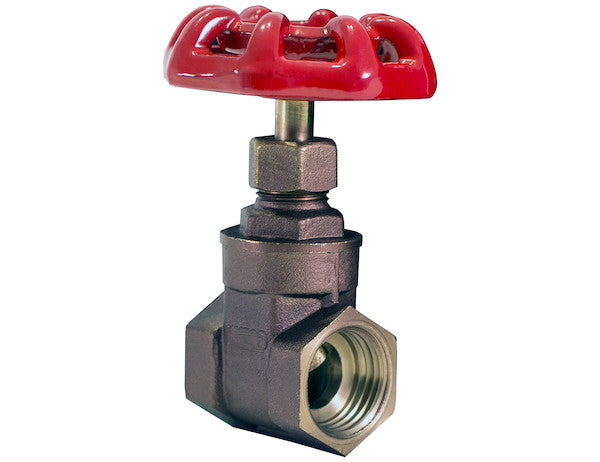
The Full Flow Gate Valve from Buyers Products reliably controls the flow of fluid in your truck's hydraulic system. It allows full flow for maximum pressure. Easy to install, the valve's small footprint is ideal for tight spaces. It has a non-rising stem and easy to operate bonnet. Its durable and airtight brass construction features a solid wedge disk and integral seats. It's built to handle 200 PSI of non-shock pressure. The valve can be conveniently repacked while it is in service and under pressure. Choose from a range of valve sizes to meet your needs. Note: The valve is not suitable for steam or potable water applications.
Specifications
| Ball Material | Brass |
|---|---|
| Body Finish | Smooth |
| Body Material | Brass |
| Body Style | Gate |
| Handle Material_1 | Carbon Steel |
| Maximum Pressure (Water, Oil, Gas) | 200 |
| Maximum Working Pressure | 200 |
| Pipe Size | 1.000 |
| Seat Material | Brass |
| Thread Size | 1 NPT |
| Wedge Material | Brass |
Advanced Technical Overview: 1-Inch Brass Full Flow Gate Valve for Hydraulic Systems
The 1-inch Gate Valve, meticulously engineered by Buyers Products, represents a critical component in the precise control and efficient management of fluid dynamics within demanding hydraulic systems, particularly those found in commercial truck applications. This valve is designed to deliver reliable on-off fluid control, prioritizing unrestricted flow and system integrity. Its robust construction and intelligent design features cater specifically to environments requiring dependable shut-off capabilities with minimal hydraulic resistance.
Design Philosophy and Operational Principles
At the core of this valve's performance is its fundamental design as a full flow gate valve. Unlike throttling valves that modulate flow, gate valves are specifically intended for applications demanding either a fully open or fully closed state. When fully open, the gate, or wedge disk, is completely withdrawn from the flow path, creating a clear, unobstructed conduit. This design characteristic is pivotal for achieving "full flow," which minimizes pressure drop across the valve. In hydraulic systems, minimizing pressure drop is paramount for maintaining system efficiency, reducing energy consumption, and ensuring that pumps and other hydraulic components operate within their intended parameters without excessive load. The benefit of full flow translates directly to reduced fluid turbulence, diminished heat generation, and optimal power transfer throughout the hydraulic circuit.
The valve incorporates a non-rising stem design, a feature that offers distinct advantages in space-constrained installations, such as the undercarriage or chassis of a heavy-duty truck. In a non-rising stem configuration, the stem rotates but does not translate vertically as the valve is actuated. This ensures that the overall height of the valve remains constant, eliminating the need for additional clearance above the handwheel for stem movement. This compact footprint is crucial for integration into tight spaces and prevents potential interference with other components or structures. While non-rising stems do not provide a visual indication of the gate position from the stem's height, this is often less critical in hydraulic shut-off applications where the operational state (open/closed) is typically determined by the system's functional requirements rather than a visual check of the valve stem. The stem's contained movement also offers enhanced protection against external damage or contamination, contributing to the valve's overall longevity in harsh operating environments.
Material Selection and Construction Integrity
The choice of brass as the primary material for the valve body, ball (referring to the internal components acting as the gate, though technically a wedge in a gate valve context), seat, and wedge is a deliberate engineering decision based on its superior properties suitable for hydraulic applications. Brass, an alloy primarily of copper and zinc, offers an exceptional balance of mechanical strength, ductility, and corrosion resistance. In hydraulic systems, brass provides excellent resistance to degradation from various hydraulic fluids, including mineral oils, synthetic oils, and other common non-corrosive liquids, ensuring long-term operational integrity and preventing material breakdown that could lead to contamination or leakage. The smooth finish of the body further aids in corrosion resistance and facilitates cleaning.
The solid wedge disk, also manufactured from durable brass, is central to the valve's sealing capability. A solid wedge is inherently robust, offering superior mechanical strength compared to flexible or split wedge designs in applications where positive shut-off and resistance to deformation under pressure are critical. When the valve is closed, this wedge is driven firmly against the integral seats. The integral seat design is a hallmark of quality and durability. Unlike renewable seats that are threaded or pressed into the valve body, integral seats are machined directly into the valve body casting. This eliminates potential leak paths between the seat and the body, enhances the structural integrity of the valve, and provides a highly precise sealing surface that maintains its geometry over extended periods of operation, even under repetitive cycling. The synergistic combination of a solid brass wedge and integral brass seats ensures an exceptionally tight, reliable seal against back pressure and flow.
The bonnet, which encloses the packing gland and stem mechanism, is designed for ease of operation and maintenance. Its robust construction provides a secure housing for the internal components, contributing to the valve's airtight integrity. The handwheel, crafted from carbon steel, is chosen for its high tensile strength and resistance to torsional stresses during valve actuation. Carbon steel provides the necessary durability to withstand repeated manual operation in industrial settings, offering a reliable interface for users to control the valve's open and closed states.
Performance Specifications and Operating Parameters
This 1-inch Gate Valve is rated for a maximum working pressure of 200 PSI (Pounds per Square Inch) of non-shock pressure for water, oil, and gas applications. The term "non-shock pressure" is crucial; it signifies the maximum static pressure the valve can safely withstand in a system where fluid velocity changes, such as sudden valve opening or closing, are not generating significant hydraulic shock or water hammer. Hydraulic systems, especially in mobile equipment, can experience pressure surges. Therefore, proper system design should incorporate measures to mitigate shock pressures, ensuring the valve operates within its specified limits. The 200 PSI rating is well-suited for a broad spectrum of auxiliary hydraulic circuits found in heavy-duty trucks, including those for dump bodies, refuse compactors, snowplows, lift gates, and various PTO (Power Take-Off) driven implements, where continuous operating pressures typically fall within or below this range.
The valve features a nominal pipe size of 1.000 inches, indicating its compatibility with standard 1-inch piping systems. Connection is facilitated via 1 NPT (National Pipe Taper) threading. NPT threads are a widely adopted standard in North America for joining pipes and fittings, especially in hydraulic and pneumatic applications. The tapered nature of NPT threads, combined with the application of appropriate thread sealant (such as PTFE tape or pipe dope), creates a mechanical seal that becomes progressively tighter as the threads are engaged. This design ensures a robust, leak-free connection capable of withstanding the specified system pressures. Correct installation procedures, including proper torque application and sealant use, are essential to fully leverage the sealing capabilities of NPT connections.
Installation, Maintenance, and Field Serviceability
Ease of installation is a key attribute of this valve. Its small footprint, a direct benefit of the non-rising stem design, allows for versatile placement even in confined machinery spaces. This is particularly advantageous in mobile hydraulic systems where component density is high. Standard installation practices for threaded components should be followed, ensuring proper alignment, adequate thread engagement, and sealing to prevent leaks and ensure system integrity.
A significant operational advantage of this gate valve is its repackable design, specifically the ability to repack the stem packing while the valve is in service and under pressure. This feature is paramount for minimizing system downtime and reducing maintenance costs. Over time, the packing material around the valve stem, which prevents fluid leakage to the atmosphere, can wear or degrade, leading to external leaks. Traditionally, addressing such leaks would necessitate depressurizing the entire system, isolating the valve, and potentially draining a portion of the hydraulic fluid. With a repackable design, trained technicians can incrementally tighten or replace the packing material through the packing gland, effectively restoring the stem seal without interrupting the hydraulic operation. This capability is invaluable in continuous operation scenarios or remote locations where extended downtime is economically prohibitive.
Application Spectrum and Industry Relevance
While specifically highlighted for truck hydraulic systems, the robust design and performance characteristics of this 1-inch brass gate valve extend its applicability to a broader range of industrial and mobile hydraulic contexts. In commercial truck fleets, common applications include:
- Dump Truck Hydraulics: Controlling flow to hydraulic cylinders for bed lifting and lowering.
- Refuse Vehicles: Managing hydraulic fluid for compactor mechanisms, lifters, and ejection systems.
- Snow Plows and Salt Spreaders: Directing hydraulic power to raise, lower, angle blades, or operate spreading mechanisms.
- Utility Service Vehicles: For boom controls, outriggers, and auxiliary equipment on utility trucks, wrecker bodies, and service vehicles.
- Lift Gates: Providing shut-off for hydraulic systems powering rear-mounted lift gates for cargo handling.
- Auxiliary PTO Systems: General shut-off for various PTO-driven hydraulic pumps and motors.
Beyond mobile equipment, brass gate valves with similar specifications are suitable for general industrial fluid control where on-off service is required for non-corrosive liquids and gases. Their durability and reliable sealing make them a viable option for utility lines, process water (non-potable), and other general-purpose industrial applications, provided the fluid compatibility and pressure/temperature ratings are observed.
Exclusions and Limitations
It is imperative to note the explicit exclusion for steam and potable water applications. This restriction is based on several technical considerations:
- Steam: High-temperature steam applications demand specialized materials and designs capable of withstanding elevated temperatures and pressures, as well as the erosive and corrosive nature of steam condensate. Brass, while durable, may not possess the necessary high-temperature strength or resistance to steam-induced dezincification for long-term reliability in steam service.
- Potable Water: Valves intended for potable (drinking) water systems are subject to stringent regulatory standards and certifications (e.g., NSF/ANSI 61 in North America) to prevent leaching of harmful substances into the water supply. While brass is generally considered safe, specific lead content regulations and testing protocols are required for potable water contact. This valve is not certified for such use, making it unsuitable for applications where human consumption is a factor.
These exclusions underscore the importance of selecting the correct valve for specific media and operating conditions to ensure both safety and system longevity.
Conclusion
The 1-inch Brass Full Flow Gate Valve from Buyers Products stands as a testament to purpose-built engineering, offering a robust, reliable, and maintainable solution for on-off fluid control in diverse hydraulic systems. Its brass construction ensures compatibility with hydraulic fluids and provides excellent corrosion resistance. The full flow design minimizes pressure drop, contributing to system efficiency, while the non-rising stem and compact footprint facilitate installation in confined spaces. Key features such as the solid wedge disk, integral seats, and the ability to repack under pressure collectively enhance the valve's operational lifespan and reduce maintenance overhead. By adhering to its specified non-shock pressure rating of 200 PSI and avoiding incompatible media like steam and potable water, users can depend on this valve for consistent, leak-free performance in their demanding hydraulic applications, ensuring both operational efficiency and long-term system integrity.