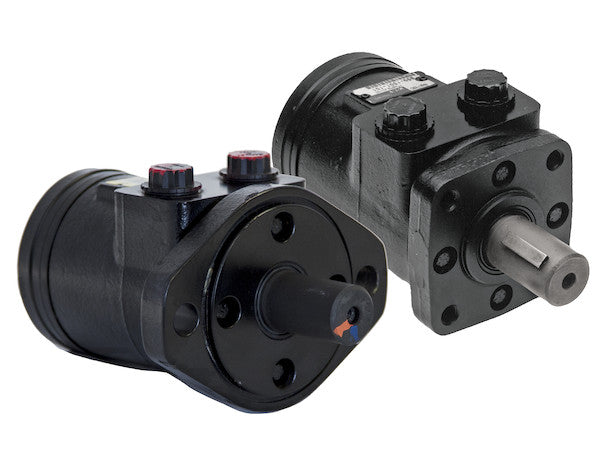
Char-Lynn Hydraulic Motors from Buyers Products are designed to be economical, efficient, compact, and powerful. They are a great solution for powering medium-duty applications like compressors, augers, winches, cranes, and spreaders. The motors have an industry-proven spool valve design combined with state-of-the-art gerotors. They excel at jobs that need a high degree of start-up torque or just the right mixture of torque and flow rate. Choose from a wide range of motors depending on your needs for flow rates, torque, and starting torque. Each model is available with either a 2-bolt or 4-bolt mount. The last digit of the part number (2 or 4) will indicate the number of bolts.
Specifications
| Compares To | 101-1755-009 |
|---|---|
| Displacement | 7.3 |
| Flow (Continuous) | 15 |
| Flow (Intermittent) | 18 |
| Input Mount Type | 4 Bolt |
| Material | Cast Iron |
| Maximum Case Pressure (Without Case Drain) | 1500 |
| Maximum Speed (Continuous) | 585 |
| Maximum Speed at Continuous Flow | 585 |
| Maximum Speed at Intermittent Flow | 702 |
| Minimum Starting Torque (Continuous Pressure) | 1100 |
| Minimum Starting Torque (Intermittent Pressure) | 1510 |
| Pilot Diameter | 1.75 |
| Port Size | 1/2 NPT |
| Pressure ? Bar (Continuous) | 1800 |
| Pressure ? Bar (Intermittent) | 2400 |
| Shaft Keyway | 0.25 |
| Shaft Size | 1.00 |
| Shaft Type | Straight |
| Torque Rating (Continuous) | 1368 |
| Torque Rating (Intermittent) | 1510 |
Advanced Technical Overview: Hydraulic Motor with 4-Bolt Mount, NPT Threads, and 7.3 Cubic Inches Displacement
This comprehensive technical overview details the design, operational principles, performance characteristics, and application suitability of the hydraulic motor featuring a 4-bolt mount, NPT threads, and a 7.3 cubic inches (CI) displacement. Engineered by Char-Lynn and distributed by Buyers Products, this motor is a prime example of advanced hydraulic technology, optimized for robust performance in demanding medium-duty applications.
Fundamental Principles of Hydraulic Motor Operation
Hydraulic motors convert hydraulic energy (fluid flow and pressure) into mechanical energy (rotational torque and speed). At their core, these devices utilize the principle of differential pressure acting on internal components to generate continuous rotary motion. The specific design employed in this Char-Lynn motor is an orbital motor, a variant of the gerotor motor, renowned for its efficiency, compactness, and high torque output at low speeds. Unlike hydraulic cylinders that provide linear motion, motors are designed for continuous rotational power, making them ideal for driving various industrial and mobile equipment.
The Advanced Gerotor (Orbital) Design
The heart of this hydraulic motor lies in its state-of-the-art gerotor set. A gerotor, an acronym for "generated rotor," consists of an inner rotor with N teeth and an outer rotor with N+1 teeth. In the case of orbital motors, the inner rotor rotates eccentrically within the stationary outer rotor (or vice versa, depending on the exact configuration). As the inner rotor orbits and rotates, it creates expanding and contracting fluid chambers. High-pressure fluid is directed into the expanding chambers, forcing the inner rotor to turn and orbit. As the chambers contract, the low-pressure fluid is expelled through the outlet port. This continuous cycle generates the motor's rotational output.
The "state-of-the-art" designation for these gerotors implies several critical engineering advancements:
- Precision Machining: Tightly controlled manufacturing tolerances minimize internal leakage (slip), thereby maximizing volumetric efficiency. This precision also contributes to smoother operation and reduced wear over time.
- Optimized Tooth Profiles: Modern gerotor designs feature advanced tooth geometries that enhance fluid sealing, reduce pressure ripple, and improve the conversion of hydraulic power into mechanical torque. This leads to higher starting torque and overall operating efficiency.
- Material Science: The gerotor components are crafted from specialized, wear-resistant materials, often hardened steels or composites, to withstand high pressures, rotational stresses, and the abrasive nature of hydraulic fluid contaminants, ensuring extended service life.
- Reduced Friction: Surface treatments and advanced bearing technologies within the gerotor assembly minimize friction, translating into higher mechanical efficiency and less heat generation.
The Industry-Proven Spool Valve Mechanism
Complementing the advanced gerotor is an industry-proven spool valve design. The spool valve acts as the hydraulic commutator, precisely timing the introduction of high-pressure fluid to the expanding gerotor chambers and the expulsion of low-pressure fluid from the contracting chambers. Its function is analogous to the commutator in an electric motor, ensuring continuous, unidirectional rotation.
Key attributes of this spool valve design include:
- Robust Construction: Designed for durability and reliability, the spool valve assembly is built to withstand continuous cycling under varying pressure conditions.
- Optimized Timing: The valve's precise timing ensures efficient fluid distribution, minimizing pressure losses and maximizing torque generation. This is crucial for maintaining high volumetric and mechanical efficiencies.
- Integrated Design: The spool valve is seamlessly integrated with the gerotor set, often directly interacting with the output shaft or orbital motion, which simplifies the motor's overall construction and reduces potential failure points.
- Smooth Reversal Capability: For applications requiring bi-directional operation, the spool valve design facilitates smooth and controlled reversal of the motor's rotation, essential for machinery like winches or augers.
Detailed Performance Characteristics (Based on 7.3 Cubic Inches Displacement)
The motor's performance is intrinsically linked to its displacement, which for this specific model is 7.3 cubic inches per revolution. This value dictates the volume of fluid required to complete one full revolution of the output shaft and, consequently, defines the motor's torque and speed characteristics when combined with system pressure and flow.
- Displacement (7.3 CI): A displacement of 7.3 CI signifies a medium-displacement motor, capable of generating substantial torque. Generally, higher displacement motors produce more torque per unit of pressure but operate at lower speeds for a given flow rate, making them suitable for applications requiring high force rather than extreme velocity.
-
Torque Output:
- Continuous Torque Rating: 1368 in-lbs (pound-inches). This is the maximum torque the motor can sustain indefinitely without detrimental wear or overheating under specified operating conditions.
- Intermittent Torque Rating: 1510 in-lbs. This higher value represents the maximum torque the motor can produce for short durations or cycles, often under peak load conditions, without sustaining damage. This capacity for intermittent high torque is crucial for overcoming initial resistance or handling temporary overloads.
- Minimum Starting Torque (Continuous Pressure): 1100 in-lbs. This metric indicates the torque available at standstill when continuous operating pressure is applied. High starting torque is a hallmark of gerotor motors and is vital for applications like augers or winches that must initiate motion against significant static loads.
- Minimum Starting Torque (Intermittent Pressure): 1510 in-lbs. Under intermittent pressure conditions, the motor can deliver even greater starting torque, mirroring its intermittent running torque capability, which is beneficial for break-away forces.
-
Speed Range:
- Maximum Speed (Continuous) / Maximum Speed at Continuous Flow: 585 RPM. This represents the sustained operational speed under continuous flow conditions (15 GPM).
- Maximum Speed at Intermittent Flow: 702 RPM. When subjected to intermittent flow rates (18 GPM), the motor can achieve a higher rotational speed for brief periods.
-
Pressure Ratings:
- Pressure (Continuous): 1800 psi. This is the maximum hydraulic pressure the motor can withstand and operate efficiently under continuous duty.
- Pressure (Intermittent): 2400 psi. This higher pressure rating signifies the motor's capacity to handle elevated system pressures for short durations, corresponding to peak torque demands.
-
Flow Rates:
- Flow (Continuous): 15 GPM. The recommended continuous flow rate for optimal performance and longevity.
- Flow (Intermittent): 18 GPM. The maximum flow rate the motor can accept for short periods, enabling higher intermittent speeds and power outputs.
- Maximum Case Pressure (Without Case Drain): 1500 psi. Case pressure refers to the pressure within the motor's housing, external to the main pressure chambers. While many systems utilize a case drain line to relieve internal pressure, this motor's design allows for operation up to 1500 psi case pressure without one, simplifying plumbing in certain applications. However, for prolonged high-pressure operation or when facing significant return line restrictions, a case drain is generally recommended to prevent seal damage and ensure motor longevity.
Construction and Durability Enhancements
The durability and reliability of this hydraulic motor are fundamentally supported by its construction materials and design principles:
-
Material (Cast Iron): The motor housing is fabricated from high-grade cast iron. Cast iron is selected for its exceptional properties:
- High Compressive Strength: Essential for containing the significant internal hydraulic pressures.
- Excellent Vibration Damping: Cast iron effectively absorbs and dissipates vibrations, contributing to smoother, quieter operation and reducing stress on other system components.
- Good Heat Dissipation: The thermal conductivity of cast iron aids in radiating operational heat, which is vital for maintaining fluid and component temperatures within acceptable limits.
- Rigidity and Stability: Provides a stable platform for the internal moving parts, ensuring consistent performance and component alignment over time.
- Internal Bearing Systems: Robust internal bearings (e.g., roller bearings or hydrostatic bearings) are crucial for supporting the radial and axial loads exerted on the output shaft and orbital components. These bearings are designed for high load capacity and minimal friction, contributing significantly to the motor's overall mechanical efficiency and operational lifespan.
- Advanced Sealing Technology: High-performance seals (e.g., Viton or NBR compounds) are strategically placed to prevent internal and external fluid leakage. These seals are selected for their compatibility with various hydraulic fluids, temperature resistance, and durability under continuous pressure fluctuations. The integrity of the sealing system is paramount for maintaining volumetric efficiency and preventing contamination of the surrounding environment.
Mounting and Porting Standards for Seamless Integration
This hydraulic motor is designed for straightforward integration into a wide array of hydraulic systems, adhering to common industry standards for mounting and fluid connections.
- 4-Bolt Mount (Input Mount Type): The specification of a 4-bolt mount indicates a robust and widely adopted industrial standard. This mounting pattern provides superior stability and distributes mechanical stresses more evenly across the mounting surface compared to a 2-bolt configuration. The precise pilot diameter of 1.75 inches ensures accurate concentricity and alignment with the driven equipment, minimizing vibration and wear on both the motor and the connected load. This sturdy mounting is essential for applications involving high torque, shock loads, or significant mechanical vibrations.
-
NPT Threads (National Pipe Taper) and Port Size (1/2 NPT): The motor utilizes 1/2 NPT threads for its hydraulic ports. NPT is a standard in North America for tapered threads used on pipes and fittings. Key features of NPT threads include:
- Self-Sealing Design: The tapered profile allows the threads to wedge together, creating a seal as they are tightened. This inherent sealing capability, when combined with appropriate thread sealant, provides a robust and leak-free connection for hydraulic lines.
- Commonality: NPT is ubiquitous in industrial and mobile hydraulic applications, simplifying system design, maintenance, and component sourcing.
- Durability: These threads are designed for high-pressure applications, ensuring secure and reliable fluid connections.
-
Shaft Configuration:
- Shaft Type: Straight. A straight shaft is a common and versatile output shaft design, suitable for direct coupling to driven components or for mounting pulleys/sprockets.
- Shaft Size: 1.00 inch. This diameter provides ample strength for transmitting the motor's considerable torque output to the connected load.
- Shaft Keyway: 0.25 inch. The presence of a standard keyway allows for a positive mechanical connection between the motor shaft and the driven component via a key. This prevents slippage and ensures reliable power transmission, even under fluctuating torque loads or sudden reversals. The keyway dimensions adhere to industry standards, facilitating easy coupling with standard components.
Application Suitability and Versatility
The specific characteristics of this 7.3 CI hydraulic motor—its high starting torque, compact design, and robust construction—make it exceptionally well-suited for a range of medium-duty applications where reliable, controllable power is paramount.
- Compressors: Hydraulic motors can drive air compressors in mobile or remote applications where electrical power is unavailable or impractical. The motor's consistent torque output ensures stable compressor operation.
- Augers: For agricultural, construction, or utility augers (e.g., post-hole diggers, earth drills), the motor's high starting torque is critical for breaking through soil, compacted earth, or other resistant materials. The ability to deliver strong torque at low speeds allows for powerful, controlled drilling.
- Winches: In applications such as utility truck winches, marine winches, or industrial lifting equipment, the motor's high starting torque and precise speed control are invaluable. It enables smooth lifting and lowering of heavy loads, as well as the ability to hold loads securely under pressure.
- Cranes: Similar to winches, hydraulic motors are integral to crane operations, driving hoist drums, slewing mechanisms, and sometimes even telescopic boom extensions. The controlled torque and speed are essential for safe and precise load manipulation.
- Spreaders: For agricultural spreaders (fertilizer, seed) or municipal salt/sand spreaders, the motor provides the consistent, adjustable speed required to accurately meter and distribute materials. The ability to handle variable loads and maintain consistent RPM is key to even spreading.
Beyond these specific examples, this motor's attributes also render it suitable for conveyor drives, mixer drives, brush cutters, trenchers, and various other industrial and mobile equipment requiring efficient and robust rotary power.
System Integration, Maintenance, and Longevity
Optimal performance and extended service life for this hydraulic motor depend significantly on its proper integration into a well-designed hydraulic system. This includes selecting appropriate hydraulic pumps that can deliver the required continuous and intermittent flow rates and pressures, as well as correctly sized control valves for directional and speed control. The quality and cleanliness of the hydraulic fluid are paramount; proper filtration is essential to prevent wear on the precision components of the gerotor and spool valve. Maintaining hydraulic fluid within specified temperature ranges through adequate heat exchangers or reservoirs is also critical for system efficiency and component longevity.
Regular maintenance, including fluid checks, filter replacement, and inspection of connections and seals, will ensure the motor operates at its peak performance for years. The robust cast iron construction and high-quality internal components minimize the need for frequent servicing, making this Char-Lynn motor a reliable long-term investment.
Conclusion
The Char-Lynn hydraulic motor from Buyers Products, with its 4-bolt mount, NPT threads, and 7.3 cubic inches of displacement, represents a sophisticated piece of hydraulic engineering. Its integration of state-of-the-art gerotors with an industry-proven spool valve design ensures exceptional performance in terms of efficiency, compact size, and, most notably, high torque output, particularly strong starting torque. Constructed from durable cast iron and designed for seamless integration via standard mounting and porting, this motor is a dependable and powerful solution for medium-duty applications across various demanding sectors. Its robust specifications for continuous and intermittent operation, including impressive torque and pressure ratings, affirm its capability to provide reliable and consistent power, making it an ideal choice for engineers and operators seeking a high-performance hydraulic drive.