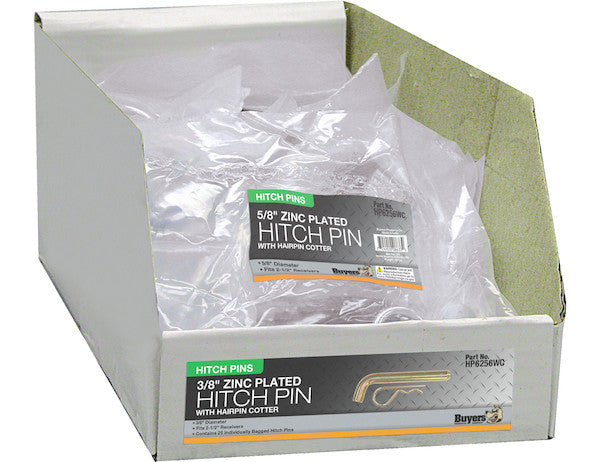
Zinc-plated hitch pins from Buyers Products are corrosion-resistant to withstand weather and road conditions. Available in various sizes to fit different receiver tubes. The hitch pins include a retaining cotter pin to keep your ball mount or other hitch-mounted accessory in place. The hitch pins can be purchased individually or in a Quick Pack box of 25. Replacement cotter pins are also available.
Specifications
| Color_1 | Silver |
|---|---|
| Diameter (in.) | 5/8 |
| Finish | Zinc Plated Yellow |
| Locking (Y/N) | No |
| Material | Carbon Steel |
| Receiver Tube Size (in.) | 2, 2-1/2, 3 |
| Usable Pin Length (in.) | 3.816 |
Advanced Technical Overview: The 5/8 x 3.8 Inch Yellow Zinc Heavy-Duty Hitch Pin for 2-1/2 Inch Receivers
The integrity of a towing system hinges critically on the robustness and reliability of its foundational components. Among these, the hitch pin plays a paramount role, serving as the primary mechanical linkage securing the ball mount or hitch-mounted accessory to the vehicle's receiver. This detailed technical exposition focuses on the 5/8 x 3.8 Inch Yellow Zinc Heavy-Duty Hitch Pin with Cotter, specifically engineered for optimal performance with 2-1/2 Inch Receivers. We delve into its meticulous design, material science, advanced surface treatments, and operational advantages, underscoring its pivotal contribution to towing safety and operational longevity.
Precision Engineering and Dimensional Specifications for Optimal Engagement
The design and dimensional precision of a hitch pin are non-negotiable for reliable towing. This heavy-duty hitch pin features a nominal 5/8-inch diameter, a standard specification that ensures compatibility with the standardized bore diameters of 2-1/2 inch receiver tubes. The 5/8-inch dimension is not arbitrary; it represents a critical balance between shear strength requirements for heavy-duty towing applications and the need for efficient insertion and removal without excessive play, which could lead to accelerated wear or stress concentrations. Dimensional tolerances are strictly controlled during manufacturing to ensure a snug yet functional fit, minimizing rattling and dynamic stresses on the pin itself and the receiver.
Crucially, the usable pin length of 3.816 inches is a specific engineering dimension that dictates the effective reach of the pin through the receiver tube and the attachment. For 2-1/2 inch receiver tubes, which typically have a substantial wall thickness, this length is meticulously calculated to pass through both walls of the receiver and the mounting collar of the ball mount or accessory, leaving sufficient exposed length for the secure placement of the cotter pin. An insufficient usable length would compromise the securement, while an excessive length could introduce unnecessary leverage or snagging points. This precise length ensures that the cotter pin can be fully engaged, thereby preventing any inadvertent disengagement of the primary hitch pin under dynamic load conditions or vehicle vibration. While the product specifications indicate compatibility with 2-inch and 3-inch receivers, this particular 3.816-inch length is optimized to provide maximum security and proper fitment within the typical geometry of a 2-1/2 inch receiver and its associated ball mounts.
Material Science: Carbon Steel for Uncompromised Strength and Durability
The selection of Carbon Steel as the base material for this heavy-duty hitch pin is a deliberate engineering choice driven by the demanding mechanical properties required in towing applications. Carbon steel offers an exceptional balance of tensile strength, yield strength, and shear strength, making it ideal for components subjected to significant shear forces and bending moments. During towing, the hitch pin is continuously subjected to forces from acceleration, braking, road irregularities, and trailer sway, all of which translate into complex stress patterns on the pin. High-quality carbon steel, often specified to meet or exceed standards such as ASTM A36 or similar structural grades, provides the necessary resilience to resist permanent deformation and fracture under these arduous conditions.
The "heavy-duty" designation in the product title directly correlates with the intrinsic strength characteristics of carbon steel. This material is inherently capable of withstanding the substantial weight and dynamic loads associated with Class III, IV, and sometimes Class V towing applications, which are typically facilitated by 2-1/2 inch receiver hitches. The inherent microstructure of carbon steel, often enhanced through controlled manufacturing processes, contributes to its fatigue resistance—a critical attribute for components experiencing cyclical loading over prolonged periods. This ensures that the hitch pin maintains its structural integrity over thousands of miles and countless towing operations, contributing significantly to the overall safety margin of the towing setup.
Advanced Corrosion Protection: The Yellow Zinc Plating System
While carbon steel provides the foundational mechanical strength, its inherent susceptibility to corrosion in challenging environmental conditions necessitates a robust surface treatment. This heavy-duty hitch pin employs a sophisticated Zinc Plated Yellow finish, a choice made for its superior corrosion resistance and enhanced durability. This finish is not merely aesthetic but represents a multi-layered protective system.
The process begins with electroplating, where a uniform layer of pure zinc is deposited onto the carbon steel substrate. Zinc serves as a sacrificial anode, meaning that in the presence of moisture and oxygen, it will corrode preferentially to the underlying steel, thereby protecting the steel base material through galvanic action. This mechanism significantly extends the lifespan of the hitch pin, especially in environments exposed to road salts, chemicals, humidity, and general atmospheric weathering. The thickness of the zinc layer is precisely controlled to ensure long-term protective performance without compromising dimensional tolerances.
Following the zinc plating, a yellow chromate conversion coating is applied. This chromate layer chemically reacts with the zinc to form a passive film that further enhances corrosion resistance. The yellow chromate not only imparts the characteristic golden hue but also offers several key benefits:
- Enhanced Barrier Protection: It acts as an additional physical barrier against corrosive elements, sealing the porous nature of electroplated zinc.
- Self-Healing Properties: The chromate film possesses a degree of self-healing capability; if scratched or lightly damaged, the chromate can reform, continuing to offer protection.
- Adhesion Promotion: It improves the adhesion of subsequent coatings, if any, although for hitch pins, the chromate typically serves as the final protective layer.
- Reduced White Rust: It significantly delays the formation of "white rust," which is the powdery corrosion product of zinc itself, ensuring the component maintains its appearance and functionality for longer.
This dual-layer protection system, conforming to industry standards such as ASTM B633 for electrodeposited coatings of zinc on iron and steel, ensures that the hitch pin maintains its structural integrity and operational reliability even in the harshest outdoor and road conditions. This meticulous attention to corrosion prevention is crucial for a component that is constantly exposed to the elements and plays a critical role in towing safety.
The Integral Role of the Retaining Cotter Pin: Uncompromising Security
The product's designation includes "with Cotter," emphasizing the critical role of the accompanying retaining cotter pin. While the hitch pin itself provides the primary shear strength, the cotter pin is the indispensable secondary locking mechanism that ensures the hitch pin remains securely in place throughout the towing operation. This non-locking design, as indicated by "Locking (Y/N): No," prioritizes reliability, simplicity, and immediate visual confirmation of engagement over a key-operated locking mechanism, which can be prone to seizing, key loss, or mechanical failure in harsh conditions.
The cotter pin, typically fashioned from spring steel for its excellent elastic properties, is designed to be easily inserted through a pre-drilled hole at the distal end of the hitch pin. Once inserted, its inherent spring tension or specific shape (e.g., R-clip or hairpin style) holds it firmly in place, physically preventing the hitch pin from sliding out of the receiver tube. This simple yet highly effective mechanical interlock is impervious to vibrations, shock loads, and varying temperatures, which could potentially compromise more complex locking mechanisms.
The availability of replacement cotter pins, as stated in the initial description, is a crucial detail for maintenance and long-term operational continuity. Cotter pins can occasionally be lost or deformed during removal or through prolonged use. Ensuring readily available replacements means that the critical safety function of securing the hitch pin is never compromised due to a missing or damaged cotter pin.
Versatility and Application Scope for Heavy-Duty Towing
The 5/8 x 3.8 Inch Yellow Zinc Heavy-Duty Hitch Pin is engineered to support a broad spectrum of towing and hauling applications, particularly those involving 2-1/2 inch receiver hitches. These receivers are typically found on heavy-duty pickup trucks (e.g., Ford F-250/F-350, Ram 2500/3500, Chevrolet Silverado 2500HD/3500HD), commercial vehicles, and some larger SUVs, signifying their use in more demanding scenarios. This pin is essential for:
- Trailer Towing: Securing various types of trailers, including large utility trailers, boat trailers, heavy-duty enclosed cargo trailers, travel trailers, fifth-wheel (with appropriate adapters), and even some smaller commercial trailers. The heavy-duty nature ensures it can handle the significant tongue weights and gross trailer weights associated with these applications.
- Cargo Management: Attaching hitch-mounted cargo carriers, which, when fully loaded, can impose substantial leverage and weight on the hitch pin.
- Recreational Equipment: Securing multi-bike racks or specialized carriers for off-road vehicles or other heavy recreational gear.
- Agricultural and Construction Equipment: For certain implements or attachments that connect via a standard receiver hitch, providing a robust connection point.
Its robust construction and precise dimensions ensure that it performs reliably across diverse operational environments, from highway cruising to challenging off-road conditions, where shock loads and vibrations are amplified. The inherent simplicity of the design, coupled with its robust materials and protective finish, contributes to its reputation as a dependable component in critical towing setups.
Installation, Maintenance, and Best Practices for Enhanced Safety
Proper installation and routine maintenance are paramount to maximizing the lifespan and ensuring the safe operation of any towing component, particularly the hitch pin. The installation procedure is straightforward: align the ball mount or accessory shank with the receiver tube, push the hitch pin through the aligned holes in both the receiver and the shank, and then firmly insert the cotter pin through the designated hole at the end of the hitch pin. It is crucial to ensure that the cotter pin is fully engaged and seated to prevent accidental dislodgement.
Regular inspection is a critical best practice. Before each towing operation, and periodically during extended trips, users should visually inspect the hitch pin and cotter pin for any signs of:
- Wear and Deformation: Look for bending, flattening, or elongation of the pin's shaft or eyelet, which could indicate excessive stress or material fatigue.
- Corrosion: While yellow zinc plating offers excellent protection, prolonged exposure to extremely harsh conditions or physical damage to the coating can lead to localized corrosion. Any significant rust formation should prompt consideration for replacement.
- Cotter Pin Integrity: Ensure the cotter pin is not bent, cracked, or excessively worn, and that it retains its spring tension for secure retention.
- Fitment: Check for excessive play between the hitch pin and the receiver bore. While some minimal clearance is necessary for insertion, significant looseness could indicate wear on either component.
Although the yellow zinc finish offers substantial corrosion resistance, occasional cleaning with mild soap and water can remove accumulated road grime and salt, further prolonging its aesthetic appeal and protective efficacy. Lubrication of the pin shaft with a light grease or anti-seize compound can facilitate easier insertion and removal, particularly in areas prone to rust or where environmental exposure is severe. Replacement of the hitch pin should be considered if any significant signs of structural compromise, severe corrosion, or excessive wear are observed, prioritizing safety above all else.
Commitment to Industry Standards and Quality Assurance
The design and manufacture of this 5/8 x 3.8 Inch Yellow Zinc Heavy-Duty Hitch Pin reflect an adherence to recognized industry standards and a commitment to stringent quality assurance protocols. While specific certifications like SAE J684 (relating to trailer hitches and balls) are primarily for hitches and ball mounts, the components within the towing system must inherently support the performance and safety requirements outlined by such standards. The chosen material (carbon steel), the precise dimensions, and the robust finish are all selected to ensure that the hitch pin contributes to the overall safety and load-bearing capacity of the integrated towing system.
Buyers Products, as a reputable manufacturer, employs rigorous quality control at every stage of the production process. This includes meticulous material sourcing to ensure carbon steel meets specified mechanical properties, precise machining and forming to achieve the exact 5/8-inch diameter and 3.816-inch usable length, and a carefully monitored electroplating process to ensure a uniform and durable yellow zinc chromate finish. Each hitch pin is designed to withstand the shear forces and dynamic stresses inherent in heavy-duty towing applications, ensuring long-term reliability and peace of mind for the operator.
The availability of these hitch pins individually or in a Quick Pack box of 25 further exemplifies a strategic understanding of diverse customer needs. Individual units cater to specific replacement requirements, while the bulk option offers convenience and cost-effectiveness for fleet operators, dealerships, or businesses that regularly require multiple hitch pins for their operations.
Conclusion: A Foundation of Strength and Reliability
The 5/8 x 3.8 Inch Yellow Zinc Heavy-Duty Hitch Pin with Cotter represents a meticulously engineered component, specifically optimized for the demanding requirements of 2-1/2 inch receiver hitches. Its foundational strength derived from high-grade carbon steel, coupled with advanced yellow zinc plating for unparalleled corrosion resistance, ensures exceptional longevity and performance in even the most challenging environments. The precise dimensional engineering guarantees optimal fitment and load transfer, while the integrated cotter pin provides an uncompromising layer of security against accidental detachment. This combination of material excellence, protective technology, and practical design underscores its indispensable role in maintaining the safety and operational efficiency of heavy-duty towing systems, affirming its status as a reliable choice for discerning professionals and enthusiasts alike.