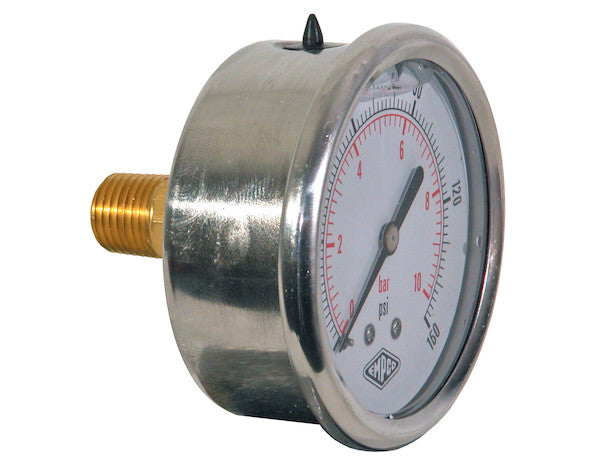
The Silicone Filled Pressure Gauge - Center Back Mount from Buyers Products stays accurate and readable in the most extreme temperatures and work conditions. The silicone also protects the delicate workings of the gauge against vibration and keeps out dirt and condensation. The dual scale, 2-1/2 in. diameter gauge has a stainless steel case and bezel. It contains a built-in relief valve to protect the device from pressures higher than its rated maximum. The gauge has an accuracy within 1.6%. Choose from two gauges measuring up to either 160 PSI or 300 PSI.
Specifications
| Built-In Relief? | Yes |
|---|---|
| Diameter | 2.5 |
| Pressure Range | 300 |
| Silicone Filled? | Yes |
| Style | Center Back |
| Thread | 1/4 NPT |
Precision Pressure Monitoring: The Advanced Silicone Filled Gauge for Demanding Environments
In the realm of industrial and mobile hydraulics, pneumatics, and process control, the accurate and reliable measurement of pressure is paramount. The Silicone Filled Pressure Gauge with a Center Back Mount, specifically designed for a 0-300 PSI range, represents a pinnacle of robust engineering tailored for the most challenging operational contexts. This instrument transcends conventional pressure measurement by incorporating advanced design features and high-grade materials, ensuring unparalleled performance, longevity, and operator safety. Its construction is meticulously optimized to maintain precision and readability even when subjected to the harshest mechanical and environmental stressors, making it an indispensable component for critical systems requiring consistent performance.
The Critical Advantage of Silicone Filling: Engineered for Stability and Durability
The defining characteristic of this pressure gauge is its silicone liquid filling. Unlike dry gauges or those filled with less robust alternatives like glycerin, silicone offers a superior set of physiochemical properties that directly translate into enhanced operational benefits. The internal mechanism of a pressure gauge, typically a Bourdon tube or diaphragm, is inherently susceptible to external disturbances. The silicone filling strategically mitigates these vulnerabilities through several key mechanisms:
Vibration Dampening Mechanics
Operational machinery frequently generates significant levels of vibration and pulsation. In a dry gauge, these mechanical oscillations are directly transmitted to the delicate internal gearing and pointer assembly. This constant micro-movement leads to several detrimental effects: accelerated wear of moving parts, erratic pointer fluctuation that hinders accurate readings, and eventual mechanical failure. The high viscosity and density of the silicone fluid surrounding the internal mechanism act as a highly effective shock absorber. It physically dampens these vibrations, stabilizing the Bourdon tube and gears, and critically, smoothing the pointer's movement. This results in a steady, easily readable indication, even in environments with severe vibration, thereby extending the gauge's operational lifespan significantly and reducing the frequency of replacement or calibration.
Thermal Stability Across Extreme Conditions
Industrial applications often involve exposure to a broad spectrum of temperatures. Standard pressure gauges can suffer from performance degradation under thermal stress. Low temperatures can cause internal components to stiffen, affecting responsiveness, while high temperatures can lead to material expansion and potential internal damage, compromising accuracy. Silicone fluid, however, exhibits remarkable thermal stability. Its viscosity remains relatively consistent across a wide temperature range, from sub-zero conditions to elevated operational heats. This inherent stability ensures that the dampening properties and the overall responsiveness of the gauge are maintained consistently, allowing for accurate pressure readings whether the gauge is deployed in a freezing outdoor environment or adjacent to a high-temperature process. This capability ensures that the instrument remains accurate and functional regardless of the ambient or process temperature fluctuations.
Protection Against Environmental Ingress
The integrity of a pressure gauge's internal components is crucial for its sustained accuracy. Industrial environments are often characterized by the presence of airborne contaminants such as dust, dirt, metallic particles, and moisture. Ingress of these substances into the gauge casing can lead to corrosion, fouling of the gears, and eventual mechanical seizure, rendering the gauge inoperable or inaccurate. The silicone filling provides an additional layer of protection against such ingress. While the stainless steel case forms the primary barrier, the internal filling prevents condensation from forming within the gauge, which is a common issue in environments with fluctuating humidity and temperature. This condensation, if allowed to develop, can lead to rust and obscure the dial. Furthermore, the positive internal pressure created by the liquid fill can help to prevent the vacuum-induced pull of external contaminants through minor seal imperfections. By creating an inert, protected internal environment, the silicone filling significantly extends the operational life of the gauge and preserves its measurement integrity.
Longevity and Reduced Maintenance
The combination of vibration dampening, thermal stability, and protection against environmental ingress culminates in a product with significantly enhanced longevity and reduced maintenance requirements. Dry gauges in harsh environments may require frequent recalibration, repair, or outright replacement. The silicone-filled design minimizes internal wear, maintains calibration stability for longer periods, and resists common failure modes associated with challenging conditions. This translates directly into lower total cost of ownership (TCO) for industrial operations, reducing downtime associated with instrument failure and ensuring continuous, reliable pressure monitoring for critical systems.
Precision Engineering: Core Components and Construction
Beyond the benefits of silicone filling, the overall construction of this pressure gauge reflects a commitment to precision and durability. Each component is selected and engineered to contribute to the instrument's robust performance.
The Bourdon Tube Principle
At the heart of this mechanical pressure gauge is the Bourdon tube. This C-shaped or helical tube, typically made of brass or stainless steel, is sealed at one end and connected to the pressure source at the other. When fluid pressure is applied, the tube tends to straighten. This minute deformation is precisely transmitted through a system of linkages and gears to the pointer on the dial. The accuracy and repeatability of this mechanical transformation are fundamental to the gauge's performance. The silicone filling ensures that the Bourdon tube's movement is smooth and unimpeded by external vibrations, allowing for a consistent and true representation of the applied pressure.
Robust Stainless Steel Enclosure
The housing of the pressure gauge, including its case and bezel, is constructed from high-grade stainless steel. This material choice is not arbitrary; stainless steel offers exceptional resistance to corrosion, rust, and chemical attack, properties that are essential in diverse industrial settings where exposure to moisture, corrosive chemicals, and abrasive particles is common. Furthermore, stainless steel provides superior mechanical strength and rigidity, protecting the delicate internal mechanism from external impacts and ensuring the gauge's structural integrity over extended periods of operation. The aesthetic appeal of stainless steel also ensures a professional and clean appearance that endures even in demanding conditions.
Dual Scale Functionality
The gauge features a dual scale, which significantly enhances its versatility and user-friendliness in various international and cross-disciplinary applications. Typically, one scale will display pressure in Pounds per Square Inch (PSI), the predominant unit in the United States, while the other scale might display pressure in kilopascals (kPa) or Bar, units commonly used in metric-based systems globally. This dual indication eliminates the need for manual conversions, reduces the potential for reading errors, and facilitates seamless integration into systems that adhere to different measurement standards, enhancing the gauge's utility for a global user base.
Optimized 2.5-inch Diameter
With a 2-1/2 inch (2.5 in.) diameter, the gauge strikes an optimal balance between readability and compactness. This size ensures that the dial and pointer are sufficiently large and clear for quick, accurate readings, even from a moderate distance, without requiring excessive panel space. This makes it suitable for integration into control panels, machinery, and various equipment where space might be at a premium but clear visibility remains critical.
Strategic Mounting and Connection: Center Back and 1/4 NPT
The physical integration of a pressure gauge into a system is as crucial as its internal mechanics. The specified mounting style and thread type are key to its application and reliability.
Advantages of Center Back Mounting
The Center Back Mount configuration is a widely adopted standard in many industrial and OEM applications. In this design, the pressure connection is located at the center of the back of the gauge. This mounting style offers several advantages: it allows the gauge to be mounted directly onto a pipe, manifold, or panel using a bulkhead fitting, often resulting in a clean and compact installation. It also facilitates easy viewing when the gauge is positioned at eye level or integrated flush into a control panel, as the connection point is out of the direct line of sight. This design also provides robust support for the gauge, minimizing cantilevered stress on the connection point, which is particularly beneficial in vibrating environments.
Universal 1/4 NPT Threading
The 1/4 NPT (National Pipe Taper) thread is an industry-standard connection type for pressure gauges and other fluid power components. Its tapered design ensures a tight, leak-proof seal when properly installed with thread sealant. The widespread adoption of 1/4 NPT means that this gauge is highly compatible with existing plumbing and connection hardware across a vast array of industrial equipment and systems, simplifying installation, replacement, and ensuring interchangeability. This universal compatibility minimizes installation complexity and the need for specialized adapters, streamlining procurement and maintenance processes.
Performance Metrics: Accuracy, Range, and Safety
Understanding the specified performance metrics of the gauge is essential for selecting the appropriate instrument for a given application.
Accuracy Class 1.6%
The stated accuracy of "within 1.6%" refers to its precision relative to the full scale deflection (FSD) of the gauge. This is a common accuracy class for industrial gauges, often aligning with ASME B40.100 Grade B or Class 1.6 specifications. An accuracy of 1.6% means that the maximum error in reading at any point across the entire scale will not exceed 1.6% of the full-scale range. For a 300 PSI gauge, this translates to a maximum deviation of approximately ±4.8 PSI. This level of accuracy is highly suitable for a broad spectrum of industrial monitoring and control applications where precise but not hyper-critical measurements are required. It ensures reliable process control and equipment monitoring without the excessive cost associated with ultra-high precision instruments, offering an optimal balance of performance and value.
Versatile Pressure Ranges (0-160 PSI & 0-300 PSI)
The availability of two pressure ranges, 0-160 PSI and 0-300 PSI, allows users to select the most appropriate gauge for their specific system pressure. For applications where maximum system pressure does not exceed 160 PSI, selecting the 0-160 PSI gauge provides finer resolution across the operating range, enhancing readability and precision within that lower range. Conversely, the 0-300 PSI variant is ideal for higher-pressure hydraulic or pneumatic systems that operate up to or near 300 PSI, ensuring the gauge can safely and accurately measure the full spectrum of anticipated pressures without over-ranging. It is a best practice to select a gauge where the normal operating pressure falls within the middle half of the gauge's total range (25% to 75% of FSD) to maximize accuracy and prolong instrument life, as sustained operation at the very extremes of the range can accelerate wear.
Integrated Overpressure Protection: The Relief Valve
A critical safety and protection feature of this gauge is the built-in relief valve. This valve is designed to vent internal pressure if it exceeds a predetermined threshold, which is typically slightly above the gauge's maximum rated pressure (e.g., above 300 PSI for the 0-300 PSI variant). Overpressure conditions can arise from system malfunctions, sudden pressure spikes, or incorrect operation, and they pose a significant risk to the gauge's integrity and potentially to operator safety. Without a relief valve, extreme overpressure could deform or rupture the Bourdon tube, leading to permanent damage to the instrument or, in worst-case scenarios, a catastrophic failure that could eject parts. The relief valve acts as a mechanical fuse, protecting the gauge from such destructive events by allowing excess pressure to safely escape, thus extending the instrument's lifespan and enhancing overall system safety.
Diverse Industrial Applications
The robust design, accuracy, and reliability of the Silicone Filled Pressure Gauge make it suitable for a vast array of industrial and commercial applications:
- Hydraulic Systems: Indispensable for monitoring pressure in hydraulic power units, cylinders, pumps, and presses. Its 300 PSI range is well-suited for many common hydraulic applications, providing critical feedback for system performance and troubleshooting.
- Pneumatic Networks: Essential for monitoring air pressure in compressors, air lines, and pneumatic actuators, ensuring efficient operation and preventing damage from over-pressurization.
- Process Control and Automation: Utilized in manufacturing plants, chemical processing facilities, and refineries to monitor pressure in pipelines, tanks, and reactors, playing a vital role in maintaining process parameters and product quality.
- Industrial Machinery and Equipment: Integrated into a wide range of heavy machinery, agricultural equipment, construction vehicles, and material handling systems for monitoring various operational pressures.
- HVAC and Refrigeration: Used in heating, ventilation, air conditioning, and refrigeration systems to monitor refrigerant and water pressures, crucial for system efficiency and fault detection.
- Water and Wastewater Management: Applied in pumping stations, filtration systems, and irrigation networks to monitor water pressure, ensuring efficient distribution and preventing pipe bursts.
- OEM Integration: Its standard specifications, reliability, and robust construction make it an ideal choice for Original Equipment Manufacturers (OEMs) looking to integrate high-quality pressure measurement into their products without extensive customization.
Installation, Calibration, and Maintenance Best Practices
To maximize the performance and longevity of the Silicone Filled Pressure Gauge, proper installation, routine calibration, and conscientious maintenance are essential.
Proper Installation Techniques
When installing, always use the correct tools and avoid applying torque directly to the gauge case; instead, use a wrench on the flats of the connection fitting. Apply an appropriate thread sealant (e.g., PTFE tape or liquid sealant) to the 1/4 NPT threads to ensure a leak-free connection. The gauge should be installed in a location that is easily accessible for reading and where it is protected from direct impacts or excessive heat radiation. For applications with severe pressure spikes, a snubber may be considered in addition to the built-in relief valve to further protect the gauge and extend its life, though the silicone filling already provides substantial dampening.
Environmental Considerations
While the silicone filling provides excellent thermal stability and protection against condensation, prolonged exposure to extreme corrosive atmospheres should still be minimized where possible. The stainless steel case offers robust protection, but understanding the chemical environment can help in optimizing gauge placement and potentially dictate more frequent inspection schedules in severely aggressive conditions.
Routine Calibration and Verification
Despite its inherent stability, all precision instruments benefit from periodic calibration and verification. Depending on the criticality of the application and regulatory requirements, a calibration schedule should be established, typically annually or biannually. This involves comparing the gauge's readings against a known, certified pressure standard to confirm its accuracy and make any necessary adjustments. This practice ensures continued reliability and compliance with quality standards.
Ensuring Long-Term Performance
Regular visual inspections can help identify potential issues early, such as a damaged case, obscured dial, or signs of leakage. Keeping the gauge clean and free from accumulated dirt and grime will preserve its readability and help in detecting any wear or damage. The silicone filling is designed for a long service life and typically does not require replenishment under normal operating conditions. However, a significant loss of silicone fluid would indicate a breach in the gauge's integrity, necessitating immediate replacement.
Comprehensive Advantages for Operational Excellence
The Silicone Filled Pressure Gauge with a Center Back Mount (0-300 PSI) offers a compelling array of benefits that directly contribute to operational excellence in diverse industrial settings. Its advanced design ensures:
- Enhanced Reliability: Through superior vibration dampening and environmental protection, the gauge delivers consistent, accurate readings over extended periods, minimizing unexpected failures.
- Extended Operational Life: The robust construction and silicone filling significantly reduce wear and tear on internal components, leading to a much longer service life compared to conventional dry gauges.
- Reduced Downtime: By providing reliable measurements and resisting common failure modes, the gauge helps prevent system malfunctions and the costly downtime associated with instrument repair or replacement.
- Improved Safety: The built-in relief valve provides a critical layer of protection against overpressure events, safeguarding both the instrument and personnel.
- Cost-Effectiveness Over Time: The combination of durability, low maintenance, and extended lifespan results in a lower total cost of ownership, offering substantial long-term savings.
- Versatility: Dual scale and multiple pressure range options, combined with standard mounting and threading, allow for broad application across various industries and systems.
Conclusion
The Silicone Filled Pressure Gauge - Center Back Mount 0-300 PSI stands as a testament to engineering excellence in pressure measurement. By meticulously addressing the inherent challenges of industrial environments through innovative design elements like silicone filling, stainless steel construction, and integrated safety features, Buyers Products has delivered an instrument that offers exceptional accuracy, durability, and reliability. This gauge is not merely a component; it is an investment in the operational integrity, safety, and efficiency of any system requiring precise and unwavering pressure monitoring. For engineers, technicians, and system integrators demanding uncompromising performance in the face of extreme temperatures, vibrations, and environmental contamination, this silicone-filled gauge represents the optimal solution, ensuring accurate data and sustained operational excellence for years to come.