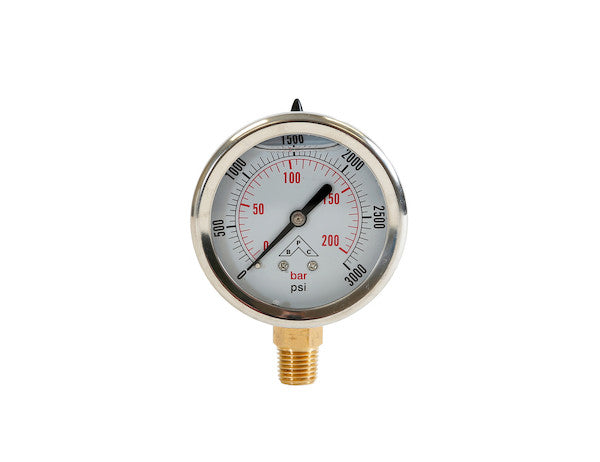
The Silicone Filled Pressure Gauge - Stem Mount from Buyers Products maintains accuracy and readability in the most extreme temperatures and work conditions. The silicone also protects the delicate workings of the gauge against vibration and keeps out dirt and condensation. The dual scale, 2-1/2 in. diameter gauge has a stainless steel case and bezel, and features a built-in relief valve. Its stem fits a standard 1/4 in. NPT. The gauge has an accuracy within 1.6%. Choose from a range of gauges measuring from 0-100 PSI to 0-10,000 PSI.
Specifications
| Built-In Relief? | Yes |
|---|---|
| Diameter | 2.5 |
| Pressure Range | 3000 |
| Silicone Filled? | Yes |
| Style | Stem |
| Thread | 1/4 NPT |
The Silicone Filled Pressure Gauge - Stem Mount, with a specific range of 0-3,000 PSI, represents a pinnacle of precision engineering tailored for demanding industrial and commercial applications. This instrument is meticulously designed to deliver unparalleled accuracy and readability, even in the most challenging environmental and operational conditions. Its foundational principle lies in the strategic use of a silicone fill fluid, a feature that significantly enhances its performance characteristics and longevity compared to traditional dry or glycerin-filled counterparts.
The primary function of the silicone fill is to act as a viscoelastic dampening medium. In environments characterized by high vibration, mechanical shock, or rapid pressure pulsations, a dry gauge's pointer would oscillate erratically, rendering accurate readings nearly impossible. The high viscosity of the silicone fluid effectively dampens these external forces, absorbing kinetic energy and stabilizing the internal Bourdon tube mechanism and the pointer. This stabilization ensures that the needle provides a smooth, steady, and easily interpretable reading, even when the underlying system pressure is subject to dynamic fluctuations. The reduction in pointer oscillation not only improves readability but also significantly mitigates wear and tear on the delicate gear train and pivot points within the gauge, extending its operational lifespan and reducing the frequency of maintenance or replacement.
Beyond vibration dampening, silicone's remarkable thermal stability is a critical advantage. Unlike other common fill fluids such as glycerin, silicone exhibits a significantly lower coefficient of thermal expansion and maintains a consistent viscosity across an exceptionally broad temperature spectrum. This characteristic ensures that the dampening effect remains uniform whether the gauge is operating in sub-zero conditions or elevated ambient temperatures, which is particularly relevant for heavy equipment, outdoor machinery, and process lines exposed to variable climates. Glycerin, for instance, can become overly viscous and sluggish in cold conditions, impeding pointer movement, or thin out excessively at high temperatures, reducing its dampening efficacy. Silicone's consistent performance across extreme temperature gradients (typically from -50°F to 160°F or even wider) guarantees reliable operation and sustained accuracy where other fill fluids would fail.
The silicone filling also plays a crucial role in protecting the internal mechanisms from environmental ingress. The fully sealed case, combined with the silicone fill, creates an internal environment that is impervious to dirt, dust, and moisture. This is especially vital in harsh industrial settings such as mining, construction, and agricultural applications, where airborne particulates and humidity are prevalent. Furthermore, the silicone fill acts as an effective barrier against internal condensation. Temperature fluctuations, particularly when the external ambient temperature drops below the internal gauge temperature, can cause moisture present in the air inside a dry gauge to condense on the inner surface of the lens. This fogging can severely obscure the dial, making readings impossible. The silicone fill eliminates this airspace, preventing condensation buildup and ensuring clear readability at all times. This protective encapsulation also provides continuous lubrication for the moving parts within the gauge, further reducing friction and extending the life of the intricate mechanism.
The construction of this gauge further underscores its robustness and reliability. The 2-1/2 inch diameter dial is an industry-standard size, offering an optimal balance between compact form factor and clear readability. The dual scale feature, common on many precision gauges, typically presents pressure readings in both Pounds per Square Inch (PSI) and an equivalent metric unit such as Bar or Kilopascals (kPa). This dual-unit display is invaluable in diverse operational environments and for international compatibility, eliminating the need for on-the-spot conversions and reducing the potential for human error in critical applications. The clarity of the white dial with black markings and a high-contrast pointer further enhances readability under various lighting conditions.
Encasing this precision mechanism is a robust stainless steel case and bezel. Stainless steel, specifically AISI 304 or 316 grade, is chosen for its superior resistance to corrosion, rust, and chemical degradation. This material choice is critical for applications in marine environments, chemical processing plants, food and beverage industries, and outdoor installations where exposure to corrosive elements is common. The durability of stainless steel also provides exceptional mechanical strength, protecting the gauge from accidental impacts and ensuring the integrity of the internal components. The polished bezel not only adds to the aesthetic appeal but also securely seals the lens, contributing to the overall ingress protection of the instrument.
A key safety feature integrated into this specific model is the built-in relief valve. This valve serves as a crucial overpressure protection mechanism. In systems where pressure surges or accidental overpressurization can occur, the relief valve prevents potential damage to the gauge and, more importantly, enhances operator safety. When internal pressure within the gauge case exceeds a predetermined safe limit, the relief valve automatically vents the excess pressure, typically through a small port or a rupture disc designed to fail predictably. This prevents catastrophic failure of the gauge, such as the expulsion of the lens or the complete disintegration of the case, which could lead to flying debris and serious injury. The presence of a built-in relief valve is indicative of a thoughtful design focused on long-term reliability and adherence to safety protocols.
Mounting versatility is addressed by the stem mount configuration with a standard 1/4 inch NPT (National Pipe Taper) connection. The stem mount, also known as lower back mount, is one of the most common and practical mounting styles for pressure gauges, allowing direct installation into pressure ports on machinery, hydraulic lines, pneumatic systems, or instrument panels. The 1/4 inch NPT thread is a globally recognized standard for tapered pipe threads, ensuring a secure, leak-tight connection without the need for additional sealants when properly torqued. The tapered design of NPT threads facilitates a mechanical seal as the threads are tightened, making it highly suitable for high-pressure fluid applications. This standardized connection simplifies installation, replacement, and system integration across a wide range of industrial equipment.
The accuracy specification of "within 1.6%" positions this gauge within an industry-recognized class of precision. In accordance with ASME B40.100, "within 1.6%" typically corresponds to an Accuracy Grade 1A. This means that at any point on the dial, the maximum permissible error is ±1.6% of the full-scale span. For a 0-3,000 PSI gauge, this translates to an accuracy of ±48 PSI. This level of precision is more than adequate for a vast array of industrial monitoring and control applications where reliable, repeatable measurements are essential for operational efficiency, process optimization, and safety compliance. For instance, in hydraulic systems, accurate pressure readings are critical for setting relief valves, monitoring pump performance, and troubleshooting component malfunctions. In pneumatic systems, precise pressure control is vital for consistent tool operation and energy efficiency. The factory calibration ensures that each gauge meets this stringent accuracy standard upon delivery, providing users with confidence in their measurements from the outset.
While the title specifically mentions a 0-3,000 PSI range, it is crucial to note the broader product offering of "0-100 PSI to 0-10,000 PSI." This wide array of pressure ranges underscores the versatility of this gauge series, allowing engineers and operators to select the most appropriate instrument for their specific application. Proper selection of a pressure gauge involves matching the gauge's full-scale range to the system's operating pressure. As a general rule, the normal operating pressure should fall within the middle third of the gauge's full-scale range (i.e., between 33% and 66% of the maximum reading). This ensures optimal accuracy, as gauges are typically most accurate in this range, and provides adequate headroom for pressure spikes without over-ranging the instrument, which can permanently damage its internal mechanism or compromise its calibration. For example, a 0-3,000 PSI gauge is ideal for systems with nominal operating pressures around 1,000-2,000 PSI, commonly found in medium to heavy-duty hydraulic circuits, compressed air distribution, and various industrial machinery.
The applications for such a high-performance silicone-filled pressure gauge are extensive and varied. In the realm of heavy equipment, including excavators, bulldozers, and cranes, these gauges monitor hydraulic system pressures, ensuring safe and efficient operation of critical components like cylinders, motors, and pumps. In manufacturing and process control, they are indispensable for overseeing pressure in chemical reactors, filtration systems, and fluid transfer lines, where process stability and product quality are paramount. The mining industry benefits from their robustness in harsh, dusty, and vibrating environments, monitoring everything from rock drills to dust suppression systems. Marine applications, characterized by corrosive saltwater environments and constant vibrations from engines, also rely heavily on the durability and accuracy of stainless steel, silicone-filled gauges. Furthermore, in commercial HVAC systems, they provide crucial insights into refrigerant and water pressures, contributing to system efficiency and predictive maintenance strategies.
In summary, the Silicone Filled Pressure Gauge - Stem Mount 0-3,000 PSI is not merely a measurement device; it is a critical component engineered for maximum reliability, durability, and safety in the most demanding operational contexts. Its silicone filling provides superior dampening against vibration and pulsation, maintains performance across extreme temperatures, and prevents internal fogging and contamination. The robust stainless steel construction ensures resistance to corrosion and physical impact, while the built-in relief valve adds a vital layer of safety. With its precise 1.6% accuracy, dual-scale readability, and industry-standard 1/4 NPT stem mount, this gauge offers an exceptional blend of technical sophistication and practical utility. It stands as an essential instrument for professionals seeking uncompromising performance and longevity in pressure monitoring applications across a multitude of industrial sectors. Its design fundamentally addresses the challenges of harsh environments, providing consistent, clear, and accurate pressure indications vital for operational efficiency and the safety of personnel and equipment.