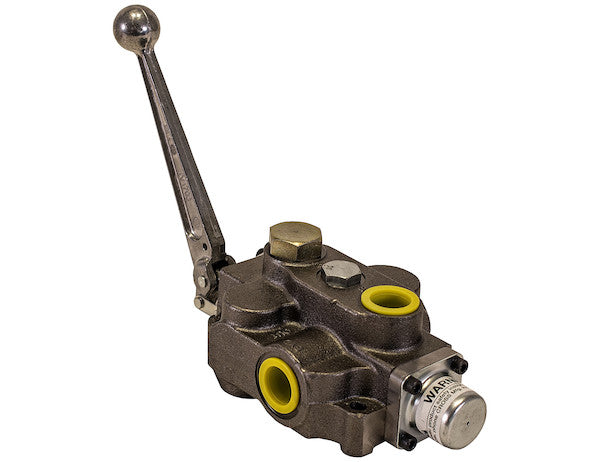
The 1 Spool Directional Control Valve from Buyers Products is compact, precise, and reliable. It directs flow smoothly where and when you need it. It's built of cast iron for durable, dependable performance. Small enough to fit anywhere, with plenty of force for the job, the control valve has a max flow of 30 GPM and a working pressure of 2500 PSI (maximum 4000 PSI). The integral relief valve is adjustable (factory-set at 2000 PSI/10 GPM). Each valve has a built-in load check to prevent flow reversal when shifting. Precision-machined and ground spools provide minimal leakage and smooth operation. The spool seals are external for easy replacement without having to disassemble the valve. The handle is sold separately. Additional configurations are available. Please contact Customer Service for further information.
Specifications
| Electrically Operated (y/n) | No |
|---|---|
| Inlet Port Size | 3/4 SAE ORB (-12) |
| Main Relief Setting | 2000 |
| Maximum Flow Rate | 30 |
| Maximum Pressure | 3500 |
| Out Port Size | #12 |
| Outlet Port Size | 3/4 SAE ORB (-12) |
| Port Type | SAE |
| Power Beyond (y/n) | No |
| Spool Action 1 | Power Up/Power Down |
| Spool Function | Double Acting 4 Way |
| Work Port Size | 3/4 SAE ORB (-12) |
Advanced Technical Overview: 1 Spool Directional Control Valve 4-Way Spring Center
Introduction to Hydraulic Directional Control Valves
The 1 Spool Directional Control Valve, featuring a 4-way configuration and a spring-center mechanism, represents a cornerstone component in modern hydraulic systems. Engineered by Buyers Products, this valve is meticulously designed to provide precise, reliable, and efficient control over hydraulic fluid flow, thereby governing the motion and force of hydraulic actuators such as cylinders and motors. In essence, a directional control valve dictates the path of hydraulic fluid within a system, channeling pressurized fluid from the pump to the appropriate actuator port and returning exhaust fluid to the reservoir. This particular model, with its robust construction and carefully selected specifications, is optimized for a wide array of mobile and industrial applications requiring a single, dependable hydraulic function.
Fundamental Principles: 4-Way, 1-Spool, Spring-Center Design
Understanding the core design elements of this valve is critical for appreciating its operational capabilities and suitability for various applications.
The 4-Way Configuration
A "4-way" directional control valve signifies its capacity to direct fluid through four primary ports: a pressure port (P), a tank port (T), and two work ports (A and B). This configuration is ideally suited for controlling double-acting hydraulic cylinders or reversible hydraulic motors. In a double-acting cylinder application, port A might extend the cylinder, while port B retracts it. By shifting the spool, the valve can:
- Connect P to A and B to T (e.g., extend cylinder).
- Connect P to B and A to T (e.g., retract cylinder).
- Block all ports or connect P to T in the neutral position (depending on the spool type), as is the case with a spring-center open-circuit design.
This comprehensive control over fluid direction enables precise management of actuator movement, making it indispensable for tasks requiring both extension and retraction, or forward and reverse motion.
The 1-Spool Design
The "1-spool" designation indicates that the valve is equipped with a single internal spool element. Each spool within a directional control valve is responsible for controlling one independent hydraulic function. Therefore, this 1-spool valve is designed to manage a singular hydraulic circuit, such as the lifting and lowering of a loader arm, the extension and retraction of a single cylinder on an implement, or the rotation of a hydraulic motor in one direction and then the other. While multi-spool valves exist for complex systems controlling multiple functions, the single-spool design offers simplicity, compactness, and cost-effectiveness for applications that only require control over one specific actuator.
The Spring-Center Mechanism
The "spring-center" feature is a crucial safety and operational attribute. This mechanism employs springs to automatically return the valve's spool to its neutral position when the operator releases the control handle. In the neutral position, the valve is configured to safely manage the hydraulic circuit. For this particular 4-way valve, the spring-center typically establishes an open-center condition. In an open-center valve, when the spool is in the neutral (spring-centered) position, the pump flow (P) is directed directly to the tank (T), often bypassing the work ports (A and B) or leaving them blocked. This design is common in systems where a single fixed-displacement pump supplies multiple functions, allowing the pump to offload pressure when no function is active, thus preventing unnecessary heat generation and conserving energy. The spring-center ensures that the hydraulic function ceases motion and returns to a safe, parked, or held state immediately upon operator disengagement, minimizing the risk of unintended actuation and enhancing overall system safety.
Robust Construction and Enhanced Durability
The foundation of this valve's reliability lies in its robust construction. "Built of cast iron for durable, dependable performance," the valve body leverages the inherent advantages of this material in hydraulic applications.
Advantages of Cast Iron
Cast iron is an exceptionally suitable material for hydraulic valve bodies due to its high compressive strength, excellent vibration damping characteristics, and superior resistance to thermal distortion. These properties contribute significantly to the valve's long-term operational integrity, even under demanding conditions. Its inherent stiffness minimizes deflection under high internal pressures, ensuring the precise alignment of internal components. Furthermore, cast iron offers good machinability, allowing for the creation of intricate internal passages and precision bores necessary for optimal valve performance.
Precision-Machined and Ground Spools
The internal spools are "precision-machined and ground," a critical manufacturing process that ensures tight tolerances and a smooth surface finish. This meticulous craftsmanship is paramount for:
- Minimal Leakage: Precise machining reduces the clearance between the spool and the valve bore, minimizing internal leakage (also known as "spool bypass"). Reduced leakage translates directly to higher system efficiency, as less pressurized fluid is wasted, and better load-holding capabilities.
- Smooth Operation: A finely ground spool surface glides effortlessly within the valve body, resulting in smooth, predictable, and responsive control. This reduces operator fatigue and enhances the precision with which hydraulic actuators can be maneuvered.
- Extended Service Life: Minimized friction between the spool and the bore reduces wear over time, significantly extending the operational life of the valve.
External Spool Seals for Simplified Maintenance
A notable design feature is the inclusion of "external spool seals for easy replacement without having to disassemble the valve." This thoughtful engineering consideration offers substantial benefits in terms of maintenance efficiency and reduced downtime. In many valve designs, internal seals necessitate a complete disassembly of the valve body for replacement, which is a time-consuming and often complex procedure. By positioning the seals externally, technicians can quickly access and replace worn seals, restoring the valve's integrity and preventing fluid leaks with minimal interruption to operations. This feature underscores a commitment to practical serviceability and lower total cost of ownership.
Detailed Performance Specifications and System Integration
The operational parameters of this directional control valve are carefully specified to ensure compatibility and optimal performance within various hydraulic systems.
Maximum Flow Rate: 30 GPM
The valve is rated for a "max flow of 30 GPM (Gallons Per Minute)." This specification is a critical determinant of how quickly an actuator can perform its intended task. For instance, a higher flow rate allows a hydraulic cylinder to extend or retract faster, or a hydraulic motor to rotate at a higher RPM. A 30 GPM capacity makes this valve suitable for a wide range of medium-duty applications, providing ample flow for efficient operation of cylinders up to several inches in diameter and moderately sized hydraulic motors. Proper sizing of the valve to the pump's output flow is essential to avoid excessive pressure drops or restrict system performance.
Pressure Ratings: 2500 PSI Working, 3500 PSI Maximum
The valve features a "working pressure of 2500 PSI" and a "maximum pressure of 3500 PSI." The working pressure represents the continuous operating pressure at which the valve is designed to function reliably over extended periods. The maximum pressure, or proof pressure, indicates the absolute highest pressure the valve can safely withstand without structural damage. The specified 3500 PSI maximum, with a momentary peak tolerance up to 4000 PSI as indicated in some contexts, highlights the robust design and structural integrity of the cast iron body, ensuring it can endure transient pressure spikes that are common in dynamic hydraulic systems. These pressure ratings make the valve compatible with many common medium-to-high pressure hydraulic systems found in mobile and industrial machinery.
Integral Relief Valve: Adjustable and Factory-Set
A critical safety and system protection feature is the "integral relief valve," which is "adjustable (factory-set at 2000 PSI/10 GPM)." The relief valve's primary function is to limit the maximum pressure within the hydraulic circuit, preventing system components from being damaged by over-pressurization. When the system pressure exceeds the relief valve's setting, it opens to divert excess fluid directly back to the tank, thus protecting the pump, hoses, cylinders, and other components. The adjustability allows for fine-tuning the relief setting to match the specific pressure requirements of the application, ensuring optimal performance and protection. The "factory-set at 2000 PSI" provides a common starting point, suitable for many applications, with the flexibility for field adjustment. The "10 GPM" specified with the relief setting indicates the flow rate at which this pressure is regulated or measured, ensuring accurate calibration and consistent performance under load.
Built-in Load Check Valve
Each valve is equipped with a "built-in load check to prevent flow reversal when shifting." A load check valve is an essential component, particularly in applications involving suspended loads. Its function is to prevent the actuator from drifting or dropping momentarily when the directional control valve's spool is shifted from the neutral position to an active position, or during the transition between active positions. As the spool moves, there can be a brief moment of reduced back pressure or slight fluid reversal. The load check immediately closes to prevent this, ensuring stable and controlled movement of the load as soon as pressure is applied, thereby enhancing safety and operational precision.
Port Sizing and Type: 3/4 SAE ORB (-12)
All critical ports – "Inlet Port Size: 3/4 SAE ORB (-12)," "Outlet Port Size: 3/4 SAE ORB (-12)," and "Work Port Size: 3/4 SAE ORB (-12)" – utilize the SAE ORB (O-Ring Boss) connection type. The "-12" designation corresponds to a 3/4-inch nominal tube size. SAE ORB fittings are highly regarded in hydraulic applications for their superior leak-resistance compared to traditional tapered pipe threads. The O-ring provides a robust, positive seal, minimizing the risk of fluid leakage, which is crucial for system efficiency, environmental protection, and safety. Consistent port sizing ensures appropriate flow velocity and minimizes pressure drop across the valve, contributing to overall system performance and energy efficiency. The "Port Type: SAE" specification further confirms adherence to industry-standard connection protocols, simplifying integration and component sourcing.
Spool Action and Function: Power Up/Power Down, Double Acting 4 Way
The "Spool Action 1: Power Up/Power Down" and "Spool Function: Double Acting 4 Way" collectively define how the valve interacts with the actuator. "Power Up/Power Down" explicitly states that the valve provides hydraulic power for both the extension ("Power Up") and retraction ("Power Down") strokes of a double-acting cylinder. This aligns perfectly with the "Double Acting 4 Way" spool function, meaning the valve can actively supply pressurized fluid to either work port (A or B) while simultaneously directing return fluid from the other work port back to the tank, enabling complete control over a double-acting actuator's movement in both directions. This capability is fundamental for machinery requiring powered movement in two opposing directions, such as lifting and lowering, pushing and pulling, or clamping and unclamping.
Ergonomics and Modularity
While the internal workings are critical, the valve also considers practical user interaction and system adaptability.
Handle Sold Separately
The fact that "The handle is sold separately" offers system designers and end-users flexibility. This allows for the selection of a handle type that best suits the specific application's ergonomic requirements, mounting constraints, and operational environment. Options might include various lengths, grip styles, or specialized detent mechanisms, ensuring optimal operator comfort and control.
Additional Configurations and Customer Service
The statement "Additional configurations are available. Please contact Customer Service for further information" is a testament to the product's adaptability and the manufacturer's commitment to meeting diverse application needs. This suggests that while the base model offers robust functionality, variants may exist with different spool functions (e.g., motor spools, regeneration spools), detent options, or special features tailored for unique hydraulic challenges. Engaging with customer service allows for expert guidance in selecting the most appropriate valve configuration for specific performance criteria or system integration requirements.
Application Spectrum and Industry Relevance
Given its robust specifications and reliable design, the 1 Spool Directional Control Valve with its 4-way, spring-center configuration is highly versatile and finds extensive use across numerous sectors:
- Agricultural Machinery: Ideal for controlling single functions on tractors, such as front-end loader attachments (lift/tilt), three-point hitch implements, or auxiliary hydraulic circuits for operating various tools. The spring-center action provides a safe default position for implements when not actively being manipulated.
- Construction Equipment: Suitable for compact construction machinery like mini excavators, skid steers, or backhoes where a single, precise hydraulic function is required, such as boom lift, bucket curl, or auxiliary tool control. Its compact size facilitates integration into space-constrained designs.
- Material Handling Equipment: Can be employed in forklifts (for tilt or side-shift functions), small scissor lifts, or conveyor systems where controlled vertical or horizontal movement of goods is necessary.
- Utility Vehicles and Truck-Mounted Equipment: Essential for controlling snowplow lifts and angles, salt/sand spreader gates, dump body hoists, or crane outriggers on service trucks and municipal vehicles. The reliability and durability of cast iron are particularly beneficial in harsh outdoor environments.
- Industrial Applications: Applicable in various industrial settings for controlling presses, clamping mechanisms, gate valves, or any single-action hydraulic circuit requiring precise, spring-return control.
The valve's ability to handle up to 30 GPM and 2500 PSI continuously ensures it can provide substantial force and speed for a wide array of demanding tasks, while the integral relief valve safeguards against system overloads, making it a reliable choice for critical operations.
Installation and System Best Practices
For optimal performance and longevity of the 1 Spool Directional Control Valve, adherence to best practices during installation and system design is paramount:
- System Cleanliness: Hydraulic systems must be kept meticulously clean. Contaminants are the leading cause of hydraulic component failure. Proper filtration is crucial upstream of the valve.
- Fluid Compatibility: Use hydraulic fluid recommended by the equipment manufacturer, ensuring it meets viscosity requirements and is compatible with the valve's seals and materials.
- Correct Plumbing: Ensure all hoses and lines are correctly sized to match the valve's port sizes and flow rate. Improperly sized lines can lead to excessive pressure drop and heat generation.
- Secure Mounting: The valve should be securely mounted to prevent vibration and stress on connections.
- Relief Valve Adjustment: While factory-set, the integral relief valve should be verified and adjusted if necessary, by a qualified technician, to match the specific pressure requirements and limitations of the hydraulic system and actuator being controlled.
- Regular Inspection: Periodic checks for leaks, wear on seals (which are externally replaceable for ease), and proper functioning of the spool mechanism will ensure sustained peak performance.
Conclusion
The 1 Spool Directional Control Valve 4-Way Spring Center from Buyers Products stands as a testament to intelligent hydraulic engineering, combining robust construction, precise fluid control, and practical maintenance features. Its cast iron body, precision-machined spool, integral relief valve, and load check mechanism are meticulously integrated to deliver dependable and efficient performance under challenging conditions. With a substantial flow capacity of 30 GPM and robust pressure ratings up to 3500 PSI, this valve is engineered to control a single hydraulic function with accuracy and safety. Whether deployed in demanding agricultural, construction, or industrial environments, this valve provides the core functionality needed for powerful and precise control of double-acting hydraulic actuators, ensuring consistent productivity and operational longevity. Its design emphasis on durability, performance, and ease of maintenance makes it an invaluable asset for any hydraulic system requiring a high-quality, single-spool control solution.