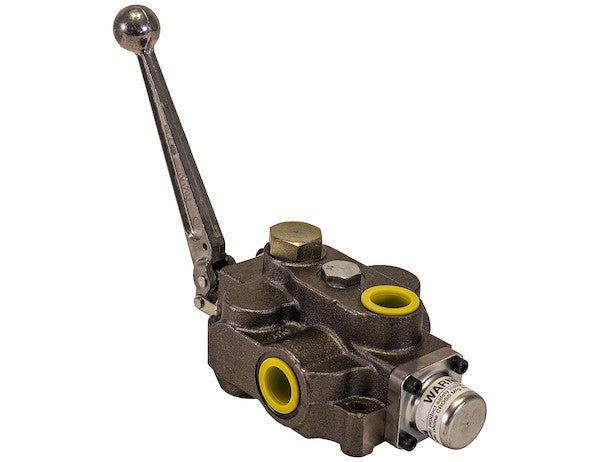
The 1 Spool Directional Control Valve from Buyers Products is compact, precise, and reliable. It directs flow smoothly where and when you need it. It's built of cast iron for durable, dependable performance. Small enough to fit anywhere, with plenty of force for the job, the control valve has a max flow of 30 GPM and a working pressure of 2500 PSI (maximum 4000 PSI). The integral relief valve is adjustable (factory-set at 2000 PSI/10 GPM). Each valve has a built-in load check to prevent flow reversal when shifting. Precision-machined and ground spools provide minimal leakage and smooth operation. The spool seals are external for easy replacement without having to disassemble the valve. The handle is sold separately. Additional configurations are available. Please contact Customer Service for further information.
Specifications
| Electrically Operated (y/n) | No |
|---|---|
| Inlet Port Size | 3/4 SAE ORB (-12) |
| Main Relief Setting | 2000 |
| Maximum Flow Rate | 30 |
| Maximum Pressure | 3500 |
| Outlet Port Size | 1/2 SAE ORB (-8) |
| Port Type | SAE |
| Power Beyond (y/n) | No |
| Spool Action 1 | Power Up/Power Down |
| Spool Function | Double Acting 4 Way |
| Work Port Size | 3/4 SAE ORB (-12) |
Technical Overview: The 1 Spool Directional Control Valve 4-Way Spring Center
The Buyers Products 1 Spool Directional Control Valve with a 4-Way Spring Center configuration represents a pinnacle of hydraulic control technology, engineered for applications demanding precise fluid management, unwavering reliability, and robust performance. This component is integral to the efficient operation of various hydraulic systems, providing the critical interface between the hydraulic power unit and the actuated mechanism. Its design philosophy emphasizes a compact footprint without compromising the force and flow capabilities required for demanding industrial and mobile hydraulic tasks.
Fundamental Principles of Directional Control Valves
A directional control valve (DCV) is a core component in any hydraulic system, responsible for directing the flow of pressurized fluid from the pump to the appropriate actuator (e.g., cylinder or motor) and subsequently back to the reservoir. The "1 Spool" designation indicates that this valve manages a single hydraulic circuit, controlling one double-acting actuator. The "4-Way" characteristic refers to the valve's ability to provide four distinct flow paths. These paths typically include: a pressure port (P) from the pump, a tank port (T) back to the reservoir, and two work ports (A and B) connecting to the actuator. The 4-way design allows for comprehensive control over a double-acting cylinder, enabling both extension and retraction, or forward and reverse motion for a hydraulic motor.
The "Spring Center" mechanism is a crucial operational feature. It implies that when the control lever (handle sold separately) is released, internal springs automatically return the spool to a neutral or center position. In this neutral state, the valve typically blocks all ports (closed center) or connects the pressure line to the tank while blocking the work ports (open center), or connects all ports in various configurations to ensure safety and prevent unwanted actuator movement. For this specific valve, the spool action is 'Power Up/Power Down,' indicating precise control over lifting and lowering functions, often associated with applications like dump bodies, snowplows, or trailer ramps. The spring center ensures that the system returns to a safe, defined state when not actively operated, enhancing system stability and preventing unintended actuator creep.
Robust Construction for Enduring Performance
Durability is paramount in hydraulic components, especially those subjected to harsh operating conditions. This directional control valve is constructed from high-grade cast iron, a material renowned for its exceptional strength, rigidity, and resistance to wear and fatigue. Cast iron's metallurgical properties provide superior vibration damping characteristics, contributing to quieter operation and extended component life. Its inherent resistance to corrosion also makes it suitable for deployment in challenging environments where exposure to moisture, chemicals, or abrasive substances might degrade lesser materials. The robust cast iron body encapsulates the internal precision components, offering a protective shell that ensures long-term, dependable performance, minimizing the risk of structural failure even under fluctuating high pressures and thermal cycling.
Optimized Performance Metrics
The operational capabilities of this valve are defined by its impressive performance metrics, which are critical for matching the valve to its intended application:
- Maximum Flow Rate (30 GPM): A maximum flow rate of 30 Gallons Per Minute (GPM) signifies the volume of hydraulic fluid the valve can efficiently pass without excessive pressure drop or cavitation. This substantial flow capacity makes the valve suitable for systems powering moderately sized actuators that require relatively quick operational speeds. Proper sizing of the valve's flow rate to the pump's output and the actuator's requirements is essential for optimizing system efficiency and avoiding overheating or sluggish performance.
- Pressure Ratings (Working 2500 PSI, Maximum 3500 PSI, Max 4000 PSI): The valve is designed for a nominal working pressure of 2500 PSI (Pounds per Square Inch), indicating its ideal operational pressure range for continuous duty cycles. A maximum pressure rating of 3500 PSI (as per specifications) defines the highest permissible pressure the valve can safely withstand during intermittent operation without structural deformation or accelerated wear. The quoted 4000 PSI may refer to a transient peak pressure or burst pressure tolerance, providing a significant safety margin against sudden pressure spikes. These robust pressure ratings underscore the valve's capability to handle demanding loads and dynamic hydraulic forces, ensuring system integrity and reliability under strenuous conditions.
Integrated Safety and Control Mechanisms
Beyond its primary function of flow direction, this valve incorporates advanced features for system protection and enhanced control:
- Integral Relief Valve: An integral relief valve is a critical safety device designed to protect the hydraulic system from overpressure conditions. This valve is adjustable and factory-set at 2000 PSI (at a flow rate of 10 GPM). When system pressure exceeds this preset threshold, the relief valve opens, diverting excess fluid back to the reservoir, thereby preventing damage to the pump, actuators, hoses, and other components. The adjustability feature provides flexibility for system designers to fine-tune the maximum operating pressure to specific application requirements, optimizing performance while maintaining a safety margin. The 10 GPM reference for the factory setting indicates the flow rate at which the relief pressure was measured, which is important for understanding its performance characteristics under different flow conditions.
- Built-in Load Check: Each spool within the valve is equipped with a built-in load check valve. A load check valve is a non-return valve positioned in the work port lines. Its primary function is to prevent reverse flow from the actuator when the main spool is shifting or in a neutral position, especially under load. This is crucial for preventing the load from dropping unexpectedly (e.g., a cylinder retracting rapidly under gravity) when the operator shifts the valve, ensuring smooth and controlled actuator movement and enhancing operator safety. It also helps in preventing cavitation in the pump by maintaining a positive pressure on the inlet side during transient conditions.
Precision Spool Design and Operational Efficiency
The heart of any directional control valve lies in its spool and the precision of its movement. This valve features:
- Precision-Machined and Ground Spools: The spools are manufactured with extremely tight tolerances, undergoing precision machining and subsequent grinding processes. This meticulous fabrication ensures a very close fit between the spool and the valve bore, minimizing internal leakage (also known as volumetric efficiency loss). Minimal leakage translates directly into better energy efficiency and more precise control over the actuator's position and speed. The smooth, ground surfaces reduce friction during spool movement, contributing to smooth operation, reduced wear on seals, and extended valve life.
- External Spool Seals: A significant advantage for maintainability and longevity, the spool seals are externally mounted. This design allows for easy replacement of worn seals without requiring the complete disassembly of the valve body or its removal from the hydraulic circuit. This significantly reduces downtime, simplifies routine maintenance, and ultimately lowers the total cost of ownership over the product's lifespan.
- Spool Function (Double Acting 4 Way): As a double-acting 4-way valve, it is engineered to control hydraulic cylinders that require fluid pressure to move in both directions (extend and retract). In one shifted position, fluid is directed to one side of the cylinder piston while simultaneously allowing fluid from the other side to return to the tank. In the opposite shifted position, these flow paths are reversed. This functionality is indispensable for most modern hydraulic applications requiring bi-directional actuator control.
- Spool Action (Power Up/Power Down): This specific action descriptor typically means that when the spool is shifted in one direction, it powers the actuator "up" (e.g., lifting a dump body), and when shifted in the other direction, it powers the actuator "down" (e.g., lowering a dump body). This implies that both directions of movement are actively driven by hydraulic pressure, providing controlled and forceful action, as opposed to a "power up/gravity down" configuration.
Optimized Porting and Connectivity
Connectivity within a hydraulic system is crucial, and this valve utilizes industry-standard port types for reliable integration:
- SAE ORB (O-Ring Boss) Port Type: All ports are SAE ORB (Society of Automotive Engineers O-Ring Boss) type. SAE ORB connections are highly regarded in hydraulic systems for their superior leak resistance compared to pipe thread connections. The O-ring provides a positive seal, even under high pressures and vibration, ensuring a clean and efficient hydraulic circuit. This significantly reduces the risk of fluid loss, environmental contamination, and potential system damage from air ingress.
-
Specific Port Sizes:
- Inlet Port Size: 3/4 SAE ORB (-12): The larger inlet port size ensures efficient flow of pressurized fluid from the pump, minimizing pressure drops at the valve's entry point.
- Work Port Size: 3/4 SAE ORB (-12): Symmetrical with the inlet, the work ports are adequately sized to deliver the maximum flow rate to the actuator with minimal restriction, crucial for achieving desired actuator speeds.
- Outlet Port Size: 1/2 SAE ORB (-8): The slightly smaller outlet port can sometimes be designed to create a small amount of back pressure, which can aid in stable system operation or be a design choice depending on the specific hydraulic architecture for return flow to the reservoir. However, it's also common for return lines to be larger to reduce back pressure on the system, so this specific sizing should be considered in the context of the overall hydraulic schematic. The general principle is to match port sizes to expected flow rates to minimize energy losses and heat generation.
Manual Control and System Integration
This valve is explicitly designated as "Not Electrically Operated," highlighting its purely manual control interface. The handle, sold separately, provides direct mechanical control over the spool position. This makes it ideal for applications where direct operator interaction is preferred or where electrical systems are not feasible, such as in certain agricultural machinery, construction equipment, or custom hydraulic setups where simplicity and reliability are prioritized over remote or automated control. Manual control offers immediate tactile feedback to the operator, allowing for intuitive and precise adjustments.
The "Power Beyond (y/n): No" specification indicates that this valve does not include a power-beyond port. A power-beyond port allows pressurized fluid to be routed from the outlet of the first valve to the inlet of a subsequent valve in a series circuit, enabling the operation of multiple functions from a single pump. The absence of this feature means that if multiple hydraulic functions are required, they would typically need to be managed by a separate pump, a parallel circuit arrangement, or a different type of valve system. This design simplifies the internal flow paths of the single spool valve, focusing on its dedicated function without the complexities of series circuit integration for multiple valves.
Versatile Applications
Given its robust construction, precise control, and significant flow/pressure capabilities, the 1 Spool Directional Control Valve with a 4-Way Spring Center is exceptionally well-suited for a wide array of mobile and industrial hydraulic applications. Typical uses include:
- Agricultural Machinery: Controlling the lift and tilt functions of loaders, operating auxiliary implements, or managing trailer dump mechanisms.
- Construction Equipment: For light-duty excavators, skid steers (for a single function), small cranes, or controlling outriggers and attachments.
- Material Handling: Operating lift tables, compactors, small forklifts, or other equipment requiring precise vertical and horizontal movement.
- Municipal and Utility Vehicles: Ideal for snowplow angle and lift, salt spreader gate control, or operating small utility vehicle attachments.
- Marine Applications: Managing small winches, steering systems, or other deck machinery where manual control is advantageous.
- Specialized OEM Equipment: Custom machinery where a single, robust hydraulic function is paramount.
Its compact size allows for installation in space-constrained areas, while its powerful capabilities ensure it can perform the necessary work with ample force. The combination of high flow, significant pressure handling, and integrated safety features makes it a reliable choice for critical hydraulic functions.
Installation and Maintenance Considerations
Installation of the valve involves securing it to a stable mounting surface and connecting the hydraulic lines (pressure, tank, and two work lines) using the specified SAE ORB fittings. Proper torqueing of fittings and ensuring clean hydraulic fluid are essential for optimal performance and preventing leaks. Given its manual operation, the mechanical linkage for the handle (sold separately) must also be robustly installed to ensure smooth and accurate spool manipulation.
Maintenance is simplified by the external spool seals, which significantly reduce the time and complexity associated with seal replacement. Regular inspection of the valve body for external damage, checking hydraulic fluid quality, and verifying the relief valve setting periodically will contribute to the valve's extended service life and consistent performance. The cast iron construction, while highly durable, still benefits from routine inspection to prevent any potential issues arising from extreme operational environments.
Conclusion
The Buyers Products 1 Spool Directional Control Valve 4-Way Spring Center is a testament to engineering excellence in hydraulic control. Its blend of compact design, robust cast iron construction, precise spool operation, and integrated safety features such as the adjustable relief valve and load checks, positions it as an exceptionally reliable and high-performing component. With a substantial maximum flow rate of 30 GPM and a robust pressure handling capability up to 3500 PSI (with a peak of 4000 PSI), this manually operated valve offers unparalleled control for a single double-acting hydraulic function. Its external spool seals highlight a commitment to ease of maintenance and longevity, making it a cost-effective solution over its operational lifespan. For critical applications demanding straightforward, powerful, and dependable hydraulic actuation, this valve provides an optimal solution. For specific configurations or to discuss how this valve can be integrated into your unique hydraulic system, please do not hesitate to contact our dedicated Customer Service team.