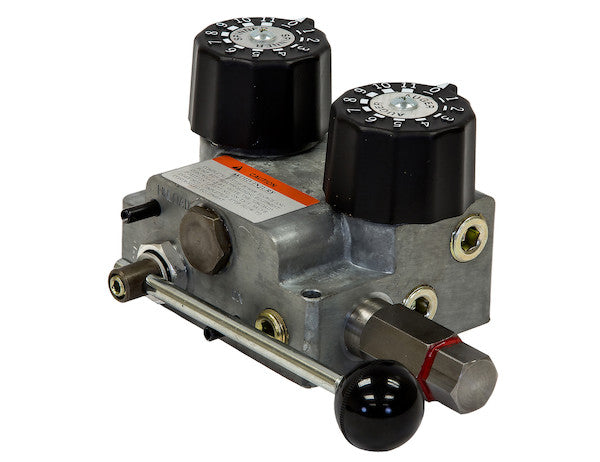
The Dual Flow Hydraulic Spreader Valve from Buyers Products is compact and easy to install, with a durable aluminum body. It features a built-in on/off control lever, system relief, and pressure compensation. Flow for each operation is easy to adjust, with two detent knobs that each feature 11 positive positions. Choose from a 7/15 GPM or a 10/30 GPM model to meet your needs.
Specifications
| Auger/Chain Flow Rate Max (GPM) | 15 |
|---|---|
| Auger/Chain Flow Rate Max (LPM) | 57.5 |
| Auger/Chain Port | 5/8 SAE ORB (-10) |
| Flow (GPM) | 22 |
| Flow (LPM) | 85 |
| Functions Supported | Spinner/Auger |
| GPS Capable? | No |
| GPS Included? | No |
| Included Control Type | Manual |
| Inlet Port | 3/4 NPT |
| Load Sensing Port | - |
| Main Relief Setting | 1500 |
| Mount Type | Base |
| Number of Ports | 4 |
| Pre-Wet Supported? | No |
| Pressure | 2000 |
| Pressure (Bar) | 140 |
| Relief Cartridge Setting | 1500 |
| Single or Dual Flow | Dual |
| Spinner Flow Rate Max (GPM) | 7 |
| Spinner Flow Rate Max (LPM) | 57.5 |
| Spinner Port | 1/2 NPT |
| Tank Port | 3/4 SAE ORB (-12) |
| Type | Fixed Displacement |
| What's Included | Valve Only |
The #12 SAE Dual Flow Hydraulic Spreader Valve from Buyers Products represents a pinnacle of hydraulic control engineering, specifically designed for demanding material spreading applications. This robust and highly efficient valve is meticulously crafted to deliver unparalleled precision and reliability, making it an indispensable component for professional operators in sectors such as municipal services, agricultural operations, and commercial landscaping. Its inherent capabilities facilitate superior control over material distribution, ensuring optimal coverage, minimizing waste, and enhancing overall operational productivity.
At its core, this hydraulic valve is engineered for dual-flow functionality, meaning it concurrently manages two distinct hydraulic circuits critical for spreader operations: the auger/chain mechanism and the spinner assembly. This synchronous yet independently adjustable control is paramount for achieving precise and consistent material output. The integrated design simplifies hydraulic plumbing and reduces the overall footprint, contributing to its "compact and easy to install" attribute, a significant advantage for vehicle integration where space and complexity are often constraining factors.
The construction of the valve features a "durable aluminum body," a deliberate material choice that confers several technical and operational benefits. Aluminum is renowned for its excellent strength-to-weight ratio, contributing to a lighter assembly without compromising structural integrity. Crucially, in environments where spreaders operate—often exposed to corrosive agents like road salt, de-icing chemicals, and moisture—aluminum offers superior corrosion resistance compared to other metallic alternatives. This inherent resilience ensures prolonged operational life and reduces maintenance requirements, even under the harshest environmental conditions. Furthermore, aluminum's thermal conductivity aids in heat dissipation, helping to maintain optimal hydraulic fluid temperatures and prevent premature wear of internal components.
Operational control is streamlined through a "built-in on/off control lever." This manual control interface provides immediate and intuitive engagement or disengagement of the spreading function, empowering operators with direct command over material flow. The simplicity of a manual lever enhances system reliability by minimizing reliance on complex electrical or electronic interfaces, which can be susceptible to environmental ingress or electrical faults in rugged applications. This manual approach is consistent with the "Included Control Type: Manual" specification, highlighting a design philosophy focused on robustness and straightforward functionality.
Critical to the valve's performance and system integrity are its "system relief and pressure compensation" features. The integrated system relief mechanism acts as a crucial safety component, preventing overpressure situations within the hydraulic circuit. Should the hydraulic pressure exceed the predetermined "Main Relief Setting" of 1500 PSI (approximately 103 Bar), the relief valve diverts excess fluid back to the tank, thereby protecting the hydraulic pump, motors, and other downstream components from potential damage. This safeguards the entire hydraulic system, extending its lifespan and preventing costly downtime associated with component failure. The "Relief Cartridge Setting" of 1500 PSI further corroborates this protective measure, indicating a precisely calibrated pressure threshold.
Pressure compensation is an equally vital attribute, ensuring that the flow rates to both the auger/chain and spinner motors remain consistent, regardless of variations in system load or pressure drops. In practical terms, this means that as hydraulic system pressure fluctuates due to changing demands (e.g., encountering higher resistance in the auger or variations in engine RPM), the pressure-compensated design actively maintains the desired flow rate to each actuator. This intelligent control prevents surging or lagging of material delivery, guaranteeing a uniform spread pattern and application rate. For precision spreading, such as de-icing or fertilizing, this consistency is paramount for effectiveness, economic material usage, and environmental compliance.
The granular control over material flow is facilitated by "two detent knobs that each feature 11 positive positions." These detent knobs provide tactile feedback and positive locking at each setting, allowing operators to precisely and repeatably adjust the flow rate for both the auger/chain and spinner functions. The 11 distinct positions offer fine-tuning capabilities, enabling operators to optimize material delivery rates and spread patterns to match specific application requirements, material types, and environmental conditions. For instance, adjusting the auger flow controls the volume of material delivered to the spinner, while adjusting the spinner flow dictates the spread width and velocity. This independent, high-resolution control is a significant advantage over simpler, less adjustable systems, contributing directly to operational efficiency and material conservation. The specified "Auger/Chain Flow Rate Max" of 15 GPM (57.5 LPM) and "Spinner Flow Rate Max" of 7 GPM (57.5 LPM for the 7/15 GPM model) indicate the upper limits of these adjustable ranges, catering to a wide array of spreading tasks. The mention of a "10/30 GPM model" highlights the product line's adaptability to even higher flow demands, though the current product specifically focuses on the 7/15 GPM range.
Reviewing the detailed specifications, the valve’s hydraulic interfaces are clearly defined. The "Inlet Port: 3/4 NPT" specifies the connection for the pressurized hydraulic fluid entering the valve. NPT (National Pipe Taper) is a widely used standard in North America, known for its tapered threads that provide a mechanical seal when properly torqued, suitable for moderate to high-pressure applications. The 3/4-inch size is robust enough to handle the maximum "Flow (GPM)" of 22 GPM (85 LPM) which represents the total potential flow capacity of the valve’s internal passages, exceeding the individual flow rates to ensure sufficient supply.
The "Tank Port: 3/4 SAE ORB (-12)" indicates the return line connection to the hydraulic reservoir. The use of SAE ORB (O-Ring Boss) fittings is a significant advantage over NPT for return lines and other critical connections. SAE ORB fittings utilize an O-ring to create a superior, leak-free seal, resisting vibration and pressure pulses more effectively than tapered threads. The "-12" designation corresponds to a 3/4-inch nominal hose or tube size, which is generously sized to minimize back pressure on the return line, preventing heat buildup and ensuring efficient system operation.
For the output ports, the "Auger/Chain Port: 5/8 SAE ORB (-10)" connects to the hydraulic motor driving the auger or conveyor chain. The -10 size (5/8-inch) is appropriately matched to deliver up to 15 GPM for robust material feeding. Similarly, the "Spinner Port: 1/2 NPT" connects to the hydraulic motor powering the spinner. The 1/2-inch NPT connection is standard for spinner motors, providing adequate flow for up to 7 GPM, which is suitable for many common spinner designs. The combination of NPT and SAE ORB fittings reflects a strategic design choice, utilizing the best characteristics of each standard for specific connection points within the hydraulic circuit.
The valve operates at a maximum "Pressure" of 2000 PSI (140 Bar), affirming its capability to handle the typical operating pressures found in mobile hydraulic systems, particularly those integrated into commercial and municipal vehicles. This pressure rating, combined with the 1500 PSI relief setting, ensures a safe and effective operating envelope for connected hydraulic motors and other components.
Classified as "Type: Fixed Displacement," the valve integrates with fixed displacement pumps commonly found in many mobile hydraulic systems. While the pump delivers a constant flow, this valve, through its pressure compensation, accurately meters and controls the flow to the individual functions, effectively creating a controlled-flow system for the spreader components. This is in contrast to load-sensing systems (indicated by "Load Sensing Port: -" confirming no load-sensing capability), where the pump's displacement varies with load demand. For many spreader applications, a fixed displacement system combined with a pressure-compensated valve offers a cost-effective, reliable, and adequately precise solution.
The "Mount Type: Base" signifies that the valve is designed for stable, direct mounting to a flat surface on the vehicle chassis or a dedicated hydraulic manifold. This robust mounting method ensures secure installation, minimizing vibration-induced stress on connections and components and contributing to the valve's overall durability and longevity in demanding mobile applications.
With "Number of Ports: 4," the valve efficiently consolidates the necessary connections: one inlet from the pump, one return to the tank, and two distinct outlets for the auger/chain and spinner motors. This integrated design streamlines plumbing and reduces the potential points of failure often associated with complex hydraulic systems. The clear distinction of "Functions Supported: Spinner/Auger" further emphasizes its dedicated purpose and optimized design for spreader equipment.
The absence of "GPS Capable?" and "GPS Included?" features, along with "Pre-Wet Supported? No," indicates that this model is a straightforward, manually controlled hydraulic valve focused solely on precise flow regulation for dry material spreading. It is designed for operators who require reliable, direct control without the added complexity and cost of electronic feedback or auxiliary functions like pre-wetting systems. This simplicity often translates to enhanced reliability and lower acquisition costs, making it an ideal choice for many standard spreading operations.
In conclusion, the #12 SAE Dual Flow Hydraulic Spreader Valve Only 7-15 GPM by Buyers Products stands as a testament to intelligent hydraulic engineering. Its combination of a durable aluminum body, integral system relief, advanced pressure compensation, and highly adjustable detent flow controls provides a robust, reliable, and precise solution for a wide range of material spreading applications. From its leak-resistant SAE ORB and robust NPT porting to its straightforward manual operation, every aspect of this valve is designed to optimize performance, enhance operator control, and ensure the longevity of critical spreading equipment. For professionals seeking a high-performance, durable, and easily maintainable hydraulic valve for their spreader systems, this model offers a compelling blend of technical sophistication and practical reliability. Its ability to deliver consistent and independently controlled flow rates for both auger/chain and spinner functions ensures that materials are spread uniformly and efficiently, ultimately leading to superior operational outcomes and reduced material consumption.