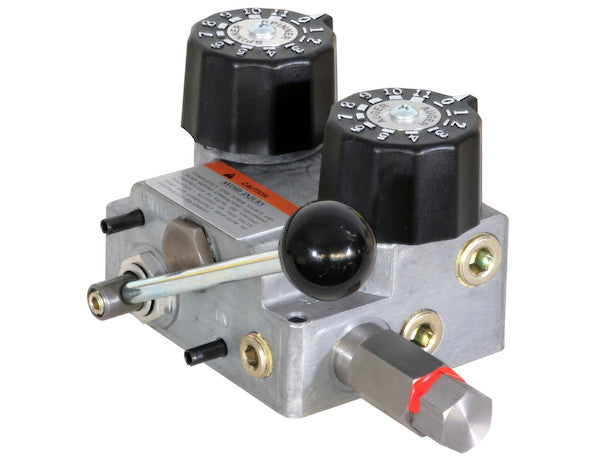
The Dual Flow Hydraulic Spreader Valve from Buyers Products is compact and easy to install, with a durable aluminum body. It features a built-in on/off control lever, system relief, and pressure compensation. Flow for each operation is easy to adjust, with two detent knobs that each feature 11 positive positions. Choose from a 7/15 GPM or a 10/30 GPM model to meet your needs.
Specifications
| Auger/Chain Flow Rate Max (GPM) | 22 |
|---|---|
| Auger/Chain Flow Rate Max (LPM) | 57.5 |
| Auger/Chain Port | 3/4 NPT |
| Flow (GPM) | 22 |
| Flow (LPM) | 85 |
| Functions Supported | Spinner/Auger |
| GPS Capable? | No |
| GPS Included? | No |
| Included Control Type | Manual |
| Inlet Port | 3/4 NPT |
| Load Sensing Port | - |
| Main Relief Setting | 1500 |
| Mount Type | Base |
| Number of Ports | 4 |
| Pre-Wet Supported? | No |
| Pressure | 2000 |
| Pressure (Bar) | 140 |
| Relief Cartridge Setting | 1500 |
| Single or Dual Flow | Dual |
| Spinner Flow Rate Max (GPM) | 7 |
| Spinner Flow Rate Max (LPM) | 57.5 |
| Spinner Port | 1/2 NPT |
| Tank Port | 3/4 NPT |
| Type | Fixed Displacement |
| What's Included | Valve and Console |
Advanced Hydraulic Control: Precision and Reliability with the 3/4 Inch NPT Dual Flow Spreader Valve and Console
The 3/4 Inch NPT Dual Flow Hydraulic Spreader Valve and Console, specifically designed for applications requiring precise and independent control over material spreading mechanisms, represents a pinnacle of hydraulic engineering for demanding environments. This comprehensive system integrates advanced hydraulic functionality with user-centric control, ensuring optimal performance for a wide array of spreading tasks, from winter road maintenance to agricultural nutrient distribution. Its robust construction, coupled with sophisticated internal components, guarantees a long operational lifespan and consistent output.
Core Functionality and Design Philosophy
At the heart of this system lies a sophisticated dual-flow architecture, specifically engineered to provide independent hydraulic power to two distinct functions: typically a spinner mechanism for broadcast spreading and an auger or chain conveyor for material delivery. This capability is paramount in applications where precise modulation of both the spread pattern and the material feed rate is critical for efficiency and effectiveness. The valve’s design prioritizes optimal fluid dynamics, minimizing pressure drop and maximizing volumetric efficiency across its operating range of 7-15 GPM, or the higher 10-30 GPM model, ensuring that hydraulic energy is converted efficiently into mechanical work.
Dual Flow Architecture: Precision in Material Distribution
The fundamental advantage of a dual-flow system is its capacity for independent control. Unlike single-flow systems that necessitate compromises in either material delivery or spread pattern, this valve allows for discrete regulation of the auger/chain and spinner functions. This means an operator can fine-tune the rate at which material (e.g., salt, sand, fertilizer) is fed from the hopper by adjusting the auger/chain speed, while simultaneously controlling the spread width and density via the spinner speed. This level of granular control is crucial for applications demanding specific coverage rates, preventing over-application or insufficient coverage, thereby optimizing material usage and minimizing environmental impact. The ability to vary these parameters independently ensures adaptability to diverse conditions, such as varying vehicle speeds, material types, and target application rates.
NPT Port Standard: Seamless System Integration
Utilizing the National Pipe Taper (NPT) standard for its hydraulic ports is a deliberate design choice that ensures broad compatibility and ease of integration into existing hydraulic systems. The 3/4 NPT inlet and tank ports, alongside the 3/4 NPT auger/chain port and 1/2 NPT spinner port, conform to widely accepted industrial standards. NPT threads are designed to form a pressure-tight seal when tapered male and female threads are joined with appropriate sealant, providing a robust and leak-free connection. The specified port sizes are meticulously selected to facilitate efficient hydraulic flow at the stated GPM rates, minimizing flow restrictions and ensuring adequate pressure delivery to the actuators. This standardization significantly simplifies installation, maintenance, and sourcing of compatible hoses and fittings, reducing overall operational overhead and potential for system incompatibility.
Robust Aluminum Body: Engineering for Endurance
The valve's durable aluminum body is not merely an aesthetic feature; it is a critical engineering element contributing significantly to the product's longevity and performance. Aluminum alloys offer an exceptional strength-to-weight ratio, which results in a lighter overall unit compared to steel counterparts, easing installation and reducing the payload on the vehicle's hydraulic system. Furthermore, aluminum exhibits inherent resistance to corrosion, a vital attribute for equipment exposed to harsh environmental conditions such such as road salts, moisture, and abrasive materials. This corrosion resistance minimizes degradation over time, preserving the internal integrity of the valve and preventing contamination of the hydraulic fluid. The excellent thermal conductivity of aluminum also aids in dissipating heat generated during hydraulic operation, contributing to the thermal management of the system and extending the life of hydraulic fluid and seals.
Advanced Control and Operational Precision
Beyond its fundamental architecture, the valve is equipped with several advanced features that elevate its performance, safety, and ease of use. These include an integrated on/off control, robust system relief, precise pressure compensation, and finely adjustable flow settings, all designed to optimize operator control and safeguard the hydraulic system.
Integrated On/Off Control Lever: Ergonomic Simplicity
The built-in on/off control lever provides a direct and intuitive interface for engaging or disengaging the hydraulic functions. This manual control mechanism is renowned for its reliability and immediate responsiveness, offering operators a tangible and unambiguous control point. The simplicity of a mechanical lever means fewer complex electronic components, reducing potential points of failure and simplifying troubleshooting. Its ergonomic placement on the console ensures that operators can quickly and safely manage the spreading operation, enhancing both productivity and safety during demanding tasks, particularly in environments where fine motor control might be compromised by gloves or vibrations.
System Relief and Pressure Compensation: Safeguarding Your Investment
The inclusion of a built-in system relief mechanism, set at 1500 PSI, is a critical safety and longevity feature. This relief valve acts as a hydraulic fuse, diverting excess pressure back to the tank when the system pressure exceeds a predetermined threshold. This prevents over-pressurization, which could otherwise lead to component damage, hose ruptures, or even catastrophic failure of the hydraulic pump or actuators. This protective measure is essential for maintaining the integrity of the entire hydraulic circuit under varying load conditions. Concurrently, the integrated pressure compensation feature ensures that the flow rate to each function remains constant regardless of variations in load pressure. In a spreading application, this means that even as the auger encounters denser material or the spinner faces increased air resistance, the hydraulic fluid flow, and thus the rotational speed, remains consistent. This active regulation ensures an unvarying application rate and spread pattern, which is paramount for achieving uniform material distribution and optimizing resource consumption.
Adjustable Flow Rates: Tailored Application Control
The dual detent knobs, each featuring 11 positive positions, offer an unparalleled level of precision in flow adjustment for both the auger/chain and spinner functions. A detent mechanism provides tactile feedback, allowing operators to confidently select and maintain specific flow settings without visual confirmation, even in low-light conditions or during active operation. The 11 distinct positions enable fine-tuning of flow rates within the specified 7-15 GPM or 10-30 GPM ranges, providing versatility to adapt to different material types, desired spread patterns, and environmental conditions. This granular control allows for empirical calibration, enabling operators to achieve highly repeatable results, which is essential for consistent material application and regulatory compliance in many spreading operations.
Technical Specifications Deep Dive
A detailed examination of the provided specifications reveals the engineering considerations that underpin the valve's robust performance and suitability for demanding applications.
Flow Rate Parameters: Optimizing Spreading Performance
The valve's maximum flow capacity of 22 GPM (85 LPM) signifies its ability to handle substantial hydraulic power, catering to a wide range of spreader sizes and material delivery requirements. The individual flow rates—Auger/Chain Max of 22 GPM (57.5 LPM) and Spinner Max of 7 GPM (57.5 LPM)—are calibrated to the typical power requirements of these respective mechanisms. The higher flow for the auger/chain ensures rapid and consistent material delivery, while the controlled flow for the spinner allows for precise speed regulation crucial for broadcast patterns. The availability of models like the 7/15 GPM and 10/30 GPM further underscores the flexibility in matching the valve to specific hydraulic pump outputs and actuator needs, ensuring optimal system synergy and avoiding hydraulic inefficiencies such as cavitation or overheating.
Hydraulic Pressure Ratings: Reliability Under Demand
With an operational pressure rating of 2000 PSI (140 Bar) and a main relief setting of 1500 PSI, the valve is engineered to operate reliably within typical mobile hydraulic system pressures. The substantial pressure rating indicates robust construction capable of withstanding significant hydraulic forces, contributing to its durability. The relief setting, as discussed, is a crucial safety mechanism, set below the maximum operating pressure to protect the system from damaging pressure spikes, thereby extending the lifespan of all interconnected hydraulic components.
Port Configuration: Versatile System Connectivity
The valve features four distinct ports, each strategically sized and threaded for optimal function:
- Inlet Port (3/4 NPT): This port connects directly from the hydraulic pump, serving as the main entry point for pressurized fluid. The 3/4 NPT size accommodates significant flow rates, minimizing inlet restrictions.
- Tank Port (3/4 NPT): The return line for hydraulic fluid back to the reservoir, also sized at 3/4 NPT to efficiently return spent fluid and prevent backpressure accumulation.
- Auger/Chain Port (3/4 NPT): Dedicated to the material conveyor system, this port's size supports the higher flow rates often required for consistent material delivery.
- Spinner Port (1/2 NPT): Designed for the broadcast spinner, the slightly smaller 1/2 NPT port is appropriately sized for the typically lower flow requirements of the spinner motor, allowing for fine control and preventing excessive speeds that could lead to material waste or uneven spreading.
Manual Control Interface: Dependable Operator Interaction
The inclusion of a manual control type emphasizes simplicity and reliability. In harsh environments or where electronic systems might be susceptible to moisture, dust, or vibration, a manual control provides an unfailing method of operation. Operators benefit from direct tactile feedback and straightforward adjustments, making the system highly dependable and reducing the learning curve. While automated systems offer certain advantages, the manual control of this valve prioritizes robustness, ease of repair, and consistent performance under adverse conditions, making it ideal for utility and municipal applications where downtime is unacceptable.
Fixed Displacement Valve Principle: Consistent Power Delivery
Operating as a fixed displacement valve, this unit provides a consistent and predictable output for a given input, making it inherently stable and reliable for spreader applications. In a fixed displacement system, the pump delivers a constant flow rate regardless of pressure, and the valve then divides and directs this flow. This characteristic simplifies system design and provides a stable platform for the dual-flow functionality. While variable displacement systems offer energy savings in some applications, fixed displacement valves are prized for their simplicity, cost-effectiveness, and ruggedness, which are critical attributes for equipment used in demanding and often abusive environments like material spreading.
Applications and Operational Advantages
The versatility and robustness of the 3/4 Inch NPT Dual Flow Hydraulic Spreader Valve and Console make it an indispensable component across numerous industries requiring precise material distribution.
Winter Road Maintenance: Enhancing Public Safety
This valve is exceptionally suited for winter maintenance vehicles, including salt and sand spreaders. The independent control of the auger/chain (for salt/sand delivery) and the spinner (for spread width) allows municipalities and contractors to apply de-icing agents with unparalleled accuracy. This precision minimizes material waste, reduces environmental impact, and ensures optimal coverage for safer roads, ultimately leading to significant cost savings in materials and labor. The durable aluminum body and reliable manual controls are perfectly adapted to the cold, wet, and corrosive conditions typical of winter operations.
Agricultural and Horticultural Applications: Precision Nutrient and Seed Distribution
In agriculture, the accurate spreading of fertilizers, seeds, and soil amendments is crucial for crop yield and resource management. This dual-flow valve enables farmers to precisely control the flow rate of granular materials to the field and the broadcast pattern, optimizing nutrient placement and seed density. This precision directly translates to healthier crops, reduced input costs, and minimized runoff, aligning with modern sustainable farming practices. Similarly, in large-scale landscaping or horticultural operations, the valve facilitates the even distribution of mulch, topsoil, or granular treatments.
Industrial and Commercial Spreading: Versatility in Material Handling
Beyond traditional applications, the valve can be integrated into various industrial and commercial spreading equipment, such as those used for distributing aggregates, specialized chemicals, or even waste products for environmental remediation. Its robust design and high flow capacity ensure reliable performance even with challenging materials, offering a flexible solution for diverse material handling needs.
Installation, Maintenance, and Longevity
The thoughtful design extends to considerations for installation, maintenance, and long-term durability, ensuring maximum uptime and value.
Streamlined Installation: Rapid Deployment
The "compact and easy to install" attribute, combined with a "Base" mount type, signifies that the valve and console are engineered for straightforward integration into existing vehicle hydraulic systems. The standardized NPT ports minimize the need for specialized adapters, and the complete valve and console package simplifies sourcing and assembly. This focus on ease of installation reduces labor time and complexity, allowing for rapid deployment of spreading equipment.
Hydraulic System Compatibility: Best Practices
For optimal performance and longevity, it is crucial to ensure that the valve is integrated into a hydraulic system with appropriate pump capacity, reservoir volume, and filtration. The 2000 PSI pressure rating requires compatible hoses and fittings capable of handling these pressures. Regular checks of hydraulic fluid cleanliness and viscosity are paramount, as contaminated or degraded fluid can significantly reduce the lifespan of hydraulic components, including the valve itself. The fixed displacement nature of the valve works best with systems designed to deliver consistent flow.
Durability and Reduced Maintenance: Maximizing Uptime
The robust aluminum body, combined with internally protected components and a reliable manual control system, contributes significantly to reduced maintenance requirements. The absence of complex electronics typically associated with automated systems means fewer potential failure points and simpler diagnostics. Regular inspection of hydraulic connections for leaks, and ensuring the control levers operate smoothly, will generally suffice for routine maintenance. This inherent durability and simplicity directly translate to maximized operational uptime and lower total cost of ownership over the product's extensive service life.
Economic and Performance Benefits
Investing in the 3/4 Inch NPT Dual Flow Hydraulic Spreader Valve and Console offers compelling economic and performance advantages for any operation dependent on precise material spreading.
Optimized Material Usage: Cost Efficiency
The unparalleled precision offered by independent flow control for both auger/chain and spinner functions directly impacts material consumption. By preventing over-application and ensuring uniform distribution, businesses and municipalities can significantly reduce expenditure on costly spreading materials such as salt, fertilizer, or specialized aggregates. This optimization not only yields direct cost savings but also contributes to environmental responsibility by minimizing waste and potential ecological impact.
Enhanced Operator Control: Productivity and Safety
The intuitive and robust manual control system empowers operators with direct and immediate command over the spreading process. The tactile feedback of the detent knobs and the clear on/off lever improve operator confidence and reduce fatigue, especially during long shifts or in challenging conditions. This enhanced control minimizes errors, improves application consistency, and ultimately boosts overall productivity and operational safety.
Long-Term Value: A Strategic Investment
The durable construction, high-quality components, and emphasis on reliability translate into a product with an extended service life and minimal downtime. This longevity ensures that the initial investment continues to provide value for many years, offering a superior return on investment compared to lesser-quality alternatives that may require frequent repairs or replacement. The straightforward design also contributes to lower long-term maintenance costs.
Conclusion
The 3/4 Inch NPT Dual Flow Hydraulic Spreader Valve and Console with a 7-15 GPM operating range is a meticulously engineered solution for professional-grade material spreading. Its dual-flow capability, precise adjustability with 11 positive detent positions, integrated safety features like system relief and pressure compensation, and rugged aluminum construction set it apart as a leader in hydraulic control for spreader applications. Whether deployed for critical winter road maintenance, precision agricultural tasks, or diverse industrial material distribution, this valve and console system provides an optimal balance of technical sophistication, operational reliability, and user-friendly control, ensuring efficient, consistent, and safe material application across various demanding environments. It represents a strategic asset for any operation seeking to optimize its spreading processes and achieve superior results with lasting performance.