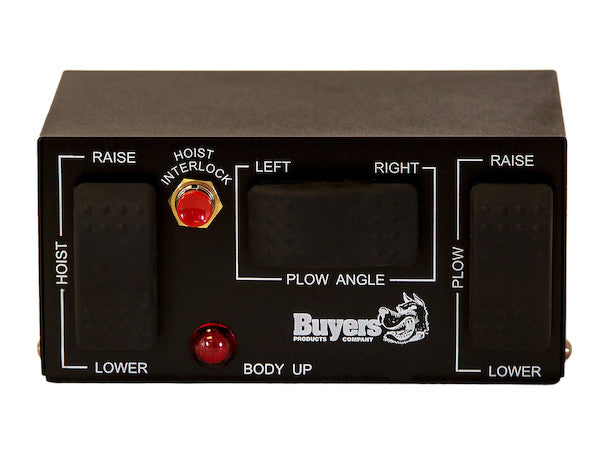
The Switch Panel for Electric Sectional Valve from Buyers Products is a space-saving way to control the electrically operated sectional valve. It's easy to install and use in your cab. Two rocker switches control momentary actions, and another rocker switch holds the operation in detent. The panel also has a lockout feature that will block neutral when performing a hoist operation, and a light that signals when the truck body is up.
The Switch Panel for Electrically Operated Sectional Valve from Buyers Products represents a critical advancement in the precise and safe management of hydraulic systems in a wide array of industrial and commercial vehicles. Engineered to integrate seamlessly into modern vehicle cabs, this control panel is more than just a collection of switches; it is a sophisticated interface designed to enhance operational efficiency, ensure operator safety, and extend the lifespan of complex hydraulic machinery. Its design ethos centers on reliability, ergonomic usability, and robust electrical engineering, making it an indispensable component for any vehicle utilizing electrically actuated sectional valves.
At its core, this switch panel is designed to command an electrically operated sectional valve. To fully appreciate its function, it's important to understand the valve it controls. Sectional valves are fundamental components in hydraulic systems, directing fluid flow to various actuators (e.g., hydraulic cylinders, motors) to perform specific tasks like lifting, tilting, extending, or rotating. Traditionally, these valves were often controlled by mechanical levers, requiring direct physical manipulation. However, the advent of electrically operated sectional valves—which utilize solenoids to shift spools internally—allows for remote and more sophisticated electronic control. This is where the Buyers Products switch panel excels. It translates the operator's input into precise electrical signals that actuate the solenoids on the hydraulic valve, enabling remote operation from the comfort and safety of the cab, away from the immediate vicinity of moving machinery or harsh environmental conditions. This transition from mechanical to electrical control offers significant advantages in terms of design flexibility, ease of integration with other electronic systems, and overall system responsiveness.
The control panel’s interface is meticulously designed for intuitive operation, featuring distinct rocker switches tailored for different control requirements. Two of these rocker switches are dedicated to controlling momentary actions. Momentary switches, by their nature, return to a neutral or off position once the operator releases them. This design is crucial for functions that require precise, temporary engagement or “feathering” of hydraulic movements. For example, when making small, incremental adjustments to a snow plow angle, fine-tuning the height of a material handler, or precisely positioning a utility boom, momentary control allows the operator to engage the function only for the exact duration required, preventing over-extension or abrupt movements. Electrically, these switches typically complete a circuit only while depressed, sending a signal to energize a specific solenoid on the valve, which then directs hydraulic fluid flow. Releasing the switch de-energizes the solenoid, returning the valve spool to its neutral position and stopping the hydraulic action. This ensures a high degree of control and prevents unintended continuous operation, contributing significantly to both operational precision and safety.
Complementing the momentary switches is a dedicated rocker switch designed for detent operation. A detent switch, unlike its momentary counterpart, maintains its activated position once engaged until manually moved back to neutral. This feature is invaluable for hydraulic functions that require continuous engagement without constant operator input. A prime example highlighted in the initial description is the “hoist operation.” When lifting a dump body, for instance, the operator needs the hydraulic cylinder to extend continuously until the desired height is reached. Engaging the detent switch allows the hydraulic valve to remain in the "raise" position, energizing the relevant solenoid for an extended period without the operator having to continuously hold the switch. This significantly reduces operator fatigue, especially during prolonged or repetitive tasks, and allows them to focus on monitoring the operation and the surrounding environment. Once the hoist operation is complete or needs to be paused, the operator can simply nudge the detent switch back to its neutral position, de-energizing the solenoid and stopping the hydraulic flow. The robust design of these industrial-grade rocker switches ensures a satisfying tactile feedback, confirming to the operator that the input has been registered, which is crucial in noisy or vibration-prone environments.
A paramount feature integrated into this control panel is the advanced safety system, specifically the lockout mechanism designed to block neutral when performing a hoist operation. This feature is a critical safeguard against accidental or unintended movements, particularly during dynamic and potentially hazardous operations such as lifting a heavy dump body. When the hoist function is engaged, the lockout mechanism ensures that the hydraulic valve cannot accidentally revert to a neutral state due to vibration, operator error, or an internal fault. This prevents sudden drops or instability of the raised load, which could lead to severe accidents, equipment damage, or personal injury. Electrically, this lockout function often involves an interlock circuit. When the hoist detent switch is activated, the panel engages an internal relay or logic gate that prevents any signal from reaching the "lower" or "neutral" solenoids until the hoist operation is deliberately disengaged or the load is fully lowered. This intelligent interlock adds a robust layer of protection, demonstrating Buyers Products' commitment to operator safety and compliance with industry best practices for heavy equipment operation. The implications of such a feature are profound, significantly reducing the risk profile associated with material handling and lifting tasks.
Further enhancing the safety profile is the inclusion of a crucial indicator light that signals when the truck body is up. This seemingly simple feature plays a vital role in preventing accidents and ensuring safe vehicle operation. For trucks equipped with dump bodies or other elevating platforms, driving with the body in a raised position can lead to catastrophic collisions with overhead obstructions such as bridges, power lines, or tree branches. The indicator light, typically a bright LED, provides an immediate and unambiguous visual cue to the operator, confirming the status of the truck body. This warning light is typically triggered by a proximity sensor or limit switch installed on the vehicle's chassis, which sends a signal to the control panel when the body is not fully lowered and latched. Integrating this visual feedback directly into the control panel ensures that the operator has constant awareness of a critical safety parameter, especially before moving the vehicle. This feature is not just a convenience; it's a critical safety measure that can avert costly damage, environmental spills, and life-threatening incidents, aligning with stringent safety regulations and best operating procedures.
From an engineering perspective, the Buyers Products Switch Panel is designed for optimal performance and longevity in demanding environments. Its "space-saving" characteristic is achieved through a thoughtful, compact layout that allows for easy integration into various cab configurations without obstructing other controls or driver visibility. This compact design does not compromise on durability or functionality. The panel's housing is typically constructed from high-impact, UV-stabilized polymers, engineered to withstand the rigors of commercial vehicle operation. This includes resistance to temperature extremes, from freezing cold to scorching heat, as well as exposure to dust, dirt, moisture, and common automotive fluids. The switches themselves are industrial-grade components, selected for their electrical current handling capabilities, mechanical endurance (rated for thousands or even millions of cycles), and tactile resilience. Sealing around the switches and the panel’s enclosure protects internal circuitry from water and dust ingress, often meeting or exceeding IP (Ingress Protection) ratings appropriate for automotive and off-highway applications, ensuring reliable operation even in harsh weather conditions or dusty work sites.
The electrical interface of the panel is equally robust. Designed for compatibility with common vehicle electrical systems, it operates seamlessly within standard 12V or 24V DC configurations. The internal wiring and connectors are selected for their ability to carry the necessary current to energize hydraulic solenoids, which can sometimes draw significant power, without overheating or voltage drop. Attention is paid to ensuring secure, vibration-resistant connections to prevent intermittent operation or failures over time. While the panel itself might not include active overcurrent protection (like fuses or circuit breakers for the main circuit), it is designed with the expectation that such protection will be present in the vehicle’s main electrical system, preventing damage to both the panel and the hydraulic solenoids in the event of an electrical fault. Furthermore, considerations for electromagnetic compatibility (EMC) and radio frequency interference (RFI) are integral to the design, ensuring that the panel operates reliably without interfering with other sensitive electronic systems within the vehicle, which is increasingly important in modern, highly integrated vehicle platforms.
Installation and ease of use are central tenets of the product’s design. The "easy to install" aspect means the panel is engineered for straightforward mounting within the cab, often featuring standardized dimensions and mounting points. Clear, concise wiring diagrams and potentially pre-wired harnesses simplify the electrical connection process, reducing installation time and the potential for wiring errors. This attention to detail ensures that the panel can be quickly and correctly integrated into new vehicles or retrofitted into existing fleets with minimal downtime. The "easy to use" characteristic extends beyond just the switch functionality; it encompasses the overall ergonomic layout, the clarity of any labeling or iconography, and the intuitive response of the controls. Such design considerations minimize the learning curve for new operators, reduce cognitive load during operation, and ultimately contribute to a safer, more efficient work environment.
The applications for such a precise and robust switch panel are extensive across various industries. While the hoist operation is a prominent example, the panel is equally suited for controlling a wide array of electrically operated sectional valves in vehicles such as snow plows and salt spreaders (controlling blade angles, wing extensions, and spreader functions), refuse collection vehicles (managing packer plates, dump cycles, and lift mechanisms), utility service trucks (operating crane outriggers, boom movements, and tool circuits), and even agricultural or construction equipment where precise hydraulic control from the cab is essential. Its versatility and rugged construction make it an ideal choice for any mobile hydraulic system requiring reliable and intuitive electronic control.
In summary, the Buyers Products Switch Panel for Electrically Operated Sectional Valve delivers a multifaceted range of benefits for operators, fleet managers, and equipment owners. It significantly enhances safety through critical features like the hoist lockout and body-up indicator light, mitigating risks of accidents and ensuring regulatory compliance. Operational efficiency is greatly improved by providing precise, intuitive control over complex hydraulic functions, reducing operator fatigue, and allowing for faster, more accurate task execution. The robust engineering and durable construction ensure long-term reliability and resistance to the harsh conditions inherent in commercial vehicle operation, leading to reduced maintenance costs and extended equipment lifespan. By transforming the interaction between operator and machine, this switch panel is not merely a control device but a vital component that underpins the productivity, safety, and longevity of modern hydraulic-equipped vehicles. Buyers Products continues its legacy of providing high-quality, purpose-built solutions that meet the rigorous demands of the industry, and this switch panel stands as a testament to that commitment, offering unparalleled control and peace of mind.