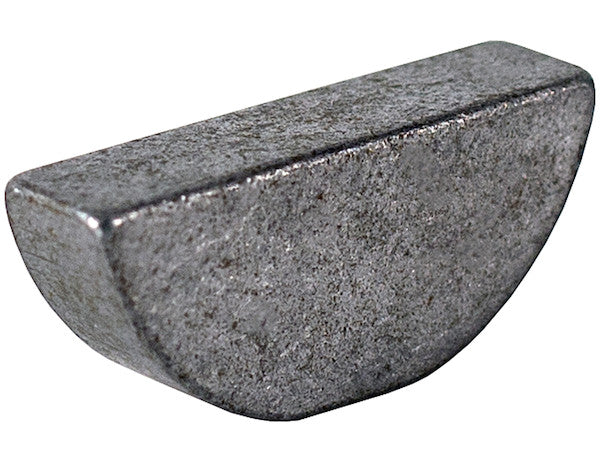
Buyers Products Woodruff Key comes in a variety of diameters and thicknesses to fit your driveline needs.
Specifications
| Diameter | 1.00 |
|---|---|
| Finish | Plain |
| Material | Carbon Steel |
| Thickness | .25 |
The Woodruff Key, specifically the 1/4 x 1 Inch variant, represents a critical component in mechanical power transmission systems, engineered for precision, reliability, and ease of assembly. This particular key, with its distinctive semi-circular profile, is designed to accommodate a diverse range of driveline applications where secure fastening and efficient torque transfer are paramount. Manufactured from robust carbon steel with a plain finish, it adheres to rigorous industry standards, ensuring consistent performance and compatibility within various mechanical assemblies. Its unique design offers distinct advantages over traditional square or rectangular keys, particularly in minimizing stress concentrations on shafts and facilitating self-alignment during installation. Buyers Products’ commitment to providing a comprehensive selection of these essential components ensures that specific driveline requirements, including varying diameters and thicknesses, are met with exactitude and superior material quality, thereby contributing to the overall operational integrity and longevity of machinery.
At the core of its functionality, the Woodruff Key’s semi-circular geometry is its defining characteristic. Unlike conventional keys that sit in a rectangular keyway cut axially along the shaft, the Woodruff key engages a keyseat that is essentially a semi-cylindrical slot milled into the shaft. This allows a portion of the key to protrude from the shaft, fitting into a corresponding keyway in the mating component, such as a gear, pulley, or coupling (often referred to as the hub). The specified dimensions, 1/4 inch thickness and 1 inch diameter, are crucial for proper engagement and load distribution. The 1/4 inch thickness dictates the width of the key and consequently the width of the keyway and keyseat, directly influencing the shear strength and torque capacity of the connection. The 1-inch diameter refers to the nominal diameter of the complete circle from which the semi-circular key is derived, which in turn defines the curvature and depth of the keyseat in the shaft. This precise dimensional control is vital for achieving the desired interference fit and preventing any rotational play or backlash, which could lead to premature wear or catastrophic failure in dynamic applications.
One of the primary advantages of the Woodruff key design lies in its ability to effectively mitigate stress concentrations within the shaft. A traditional rectangular keyway, with its sharp corners, can act as a stress riser, weakening the shaft and potentially leading to fatigue failure, especially under cyclic loading. The semi-circular keyseat required for a Woodruff key, however, features a smoother, more gradual transition, which significantly reduces these stress concentrations. This inherent design characteristic enhances the shaft's resistance to bending fatigue and torsional stresses, thereby extending the lifespan of the entire assembly. Furthermore, the Woodruff key's capacity for self-alignment simplifies the assembly process. During installation, the key can pivot slightly within its semi-circular keyseat, allowing for easier mating with the hub's keyway, even if there are minor misalignments. This feature is particularly beneficial in production environments where efficiency and precision are both highly valued. It also provides a degree of tolerance for slight manufacturing variations in the keyway or keyseat, making the assembly more robust against minor imperfections.
The material choice for this Woodruff key—carbon steel—is fundamental to its performance attributes. Carbon steel is a ferrous alloy primarily composed of iron and carbon, with varying amounts of other elements that influence its mechanical properties. For keys, medium-carbon steels (typically ranging from 0.25% to 0.60% carbon content) or low-carbon steels (less than 0.25% carbon) are commonly employed. While the specific grade is not detailed, common choices like AISI 1018 or AISI 1045 are frequently utilized. AISI 1018, a low-carbon steel, offers an excellent balance of strength, ductility, and machinability, making it suitable for applications requiring moderate strength and good formability. AISI 1045, a medium-carbon steel, provides higher strength and hardness, often preferred for applications demanding greater wear resistance and torque capacity. The carbon content directly correlates with the steel's hardness and tensile strength; as carbon content increases, so does strength and hardness, but ductility generally decreases. The selection of carbon steel ensures that the key possesses sufficient shear strength to transmit torque without deforming or failing, and adequate hardness to resist wear and indentation from the mating components, maintaining the integrity of the power transmission linkage over time.
The "plain finish" specified for this Woodruff key indicates that the steel has not undergone any additional surface treatment, such as plating, coating, or black oxide treatment. This means the key's surface is simply the result of its manufacturing process, typically exhibiting a metallic gray appearance. While a plain finish is cost-effective and perfectly suitable for many enclosed or lubricated environments, it does imply that the key is susceptible to corrosion (e.g., rust) if exposed to moisture, humidity, or corrosive agents without proper protective measures. In applications where corrosion is a concern, users might consider applying a rust-inhibiting coating or ensuring adequate lubrication to shield the key from environmental degradation. For internal components within gearboxes or engines where oil circulates, the plain finish is often ideal as the lubricating oil provides sufficient corrosion protection. The plain finish also ensures a direct metal-to-metal contact within the keyway and keyseat, which can be advantageous for maintaining a consistent friction coefficient and preventing slip, provided the fit is appropriately engineered.
The manufacturing process for Woodruff keys involves several critical stages to achieve the required precision and mechanical properties. Typically, these keys are produced through methods such as cold drawing, stamping, or precision machining. Cold drawing involves pulling steel rods through dies to reduce their diameter and achieve desired cross-sectional shapes and improved surface finish and mechanical properties (increased tensile strength and hardness). Stamping uses presses and dies to cut the semi-circular shape from sheet or plate stock, a high-volume, cost-effective method. Precision machining, such as milling or grinding, is used for higher-tolerance applications or for smaller batch productions, offering exceptional dimensional accuracy and surface finish. Regardless of the specific method, stringent quality control measures are implemented throughout the manufacturing process. These measures include dimensional inspections using calipers, micrometers, and optical comparators to ensure that the key's thickness, diameter, and radius conform to the specified tolerances. Material testing, such as hardness testing (e.g., Rockwell hardness) and chemical composition analysis, is also performed to verify that the carbon steel meets the required mechanical and metallurgical standards. This meticulous attention to detail during manufacturing guarantees that each Woodruff key will perform reliably under its intended operational loads and conditions.
Woodruff keys find extensive application across a vast spectrum of industries and mechanical systems due to their robust design and reliable performance. In the automotive sector, they are indispensable components in internal combustion engines, securing camshafts, crankshafts, and accessory drives like alternators and water pumps, ensuring precise timing and power transfer. Agricultural machinery relies heavily on Woodruff keys for transmitting power in tractors, harvesters, and cultivators, connecting various gears, sprockets, and shafts in demanding outdoor environments. Industrial equipment, ranging from pumps and compressors to conveyor systems and machine tools, frequently employs Woodruff keys to couple electric motors to driven components, providing a dependable means of torque transmission. Small engines, commonly found in lawnmowers, generators, and recreational vehicles, also utilize Woodruff keys for securing flywheels and other rotating parts. The marine industry employs them in propulsion systems and auxiliary equipment, where durability and resistance to dynamic stresses are paramount. Their versatility also extends to power tools, material handling equipment, and a myriad of general machinery where a secure, precisely aligned, and easily serviceable shaft-to-hub connection is required. The choice of a Woodruff key over other key types, such as square keys, often stems from specific design requirements where reduced stress concentration on the shaft, ease of assembly, or the ability to accommodate slight axial adjustments are critical considerations.
Proper installation and maintenance are crucial for maximizing the operational life and ensuring the reliable performance of any Woodruff key assembly. Prior to installation, it is imperative to ensure that both the shaft's semi-circular keyseat and the hub's keyway are clean, free of burrs, and dimensionally accurate. Any imperfections can lead to an improper fit, causing localized stress concentrations or allowing for rotational play, which will accelerate wear and potentially lead to key shearing. The Woodruff key should fit snugly into its keyseat in the shaft, with minimal radial or axial movement. When the hub is slid onto the shaft, the key should align smoothly into the hub's keyway, providing a tight, interference fit without excessive force, which could damage either the key or the mating components. If lubrication is specified for the application, it should be applied to both the key and the mating surfaces to reduce friction during assembly and operation, and to provide a measure of corrosion protection, especially for plain finish keys. During operation, a properly installed Woodruff key effectively transmits torque by resisting shear forces. However, if the key is undersized for the applied torque, or if the fit is loose, it can shear off, causing a loss of power transmission. Regular inspection of key connections, particularly in high-vibration or high-impact applications, can help identify early signs of wear or fretting, allowing for timely replacement and preventing more extensive mechanical failures. Consideration should also be given to the operating environment; for plain carbon steel keys, exposure to corrosive media necessitates robust sealing or the application of protective coatings.
The technical specifications and adherence to established industry standards are fundamental to the global interchangeability and reliable performance of Woodruff keys. This 1/4 x 1 Inch key conforms to a precise set of dimensional and material standards, typically outlined by organizations such as the American Society of Mechanical Engineers (ASME B17.2 for Woodruff Keys and Keyseats) or international bodies like Deutsches Institut für Normung (DIN 6888). These standards define not only the nominal dimensions like thickness (width) and diameter but also critical tolerances for these features, ensuring that keys from different manufacturers can be interchanged without affecting fit or function. For instance, the "1/4 inch" typically refers to the nominal width (or thickness) of the key, which is the dimension measured across the flat top of the semi-circle. The "1 inch" refers to the nominal diameter of the full circle from which the key's semi-circular profile is derived. These standards also stipulate requirements for keyseat dimensions in the shaft and keyway dimensions in the hub, creating a harmonized system that guarantees proper engagement and load distribution. Material specifications, including allowable carbon content ranges and minimum mechanical properties (e.g., tensile strength, shear strength, hardness), are also covered by these standards. Adherence to such standards is not merely a matter of compliance but a critical factor in ensuring component reliability, reducing design complexities for engineers, and facilitating maintenance and repair by ensuring readily available compatible parts. Understanding these technical specifications allows for the correct selection and application of Woodruff keys, preventing costly errors associated with incorrect sizing or material choice for a given power transmission requirement. Precision engineering in the creation of keyways and keyseats is just as important as the key itself; the fit must be tight to eliminate movement that can lead to fretting corrosion and eventual failure.
In summary, the Woodruff Key 1/4 x 1 Inch from Buyers Products stands as an exemplary component for diverse driveline applications. Its carbon steel construction ensures robust mechanical properties, including high shear strength and wear resistance, critical for sustained performance in demanding operational environments. The plain finish, while requiring consideration for corrosion protection in specific applications, provides a cost-effective and functionally sound surface. The unique semi-circular design offers significant engineering advantages, notably superior stress distribution within the shaft, thereby enhancing the fatigue life of the entire assembly. Furthermore, the inherent self-aligning characteristic simplifies the assembly process, reducing installation time and mitigating potential issues arising from minor manufacturing tolerances. Adherence to precise dimensional specifications and material standards guarantees interchangeability and consistent, reliable torque transmission. Ultimately, this Woodruff key provides a dependable, efficient, and durable solution for securing rotating components, contributing significantly to the operational integrity and longevity of mechanical systems across a broad spectrum of industries, reflecting Buyers Products' commitment to quality and technical excellence in power transmission components.