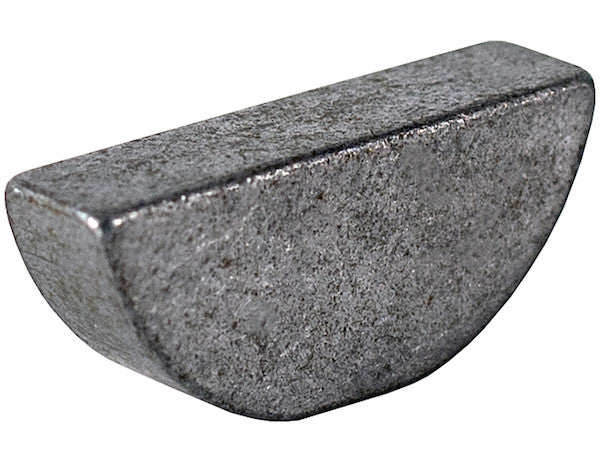
Buyers Products Woodruff Key comes in a variety of diameters and thicknesses to fit your driveline needs.
Specifications
| Diameter | 0.63 |
|---|---|
| Finish | Plain |
| Material | Carbon Steel |
| Thickness | .13 |
Precision Engineering for Robust Power Transmission: The Woodruff Key 1/8 x 5/8 Inch
The Woodruff Key, specifically the 1/8 x 5/8 inch variant from Buyers Products, represents a critical component in the realm of mechanical power transmission, meticulously engineered for applications demanding reliable torque transfer and secure rotational alignment. This specific key, characterized by its nominal thickness of 1/8 inch (0.125 inches or approximately 3.175 mm) and a nominal diameter of 5/8 inch (0.625 inches or approximately 15.875 mm), is manufactured from high-grade carbon steel with a plain finish, ensuring optimal performance across a diverse range of driveline systems. Its distinctive semi-circular profile in cross-section, with a flat top surface, offers distinct advantages over traditional square or rectangular keys, particularly in minimizing stress concentrations and facilitating assembly in confined or blind keyways. This comprehensive technical overview delves into the engineering principles, material science, application specifics, and operational advantages that underpin the superior functionality of this essential industrial component.
Understanding the Woodruff Key Design and its Advantages
The Woodruff key distinguishes itself through its unique semi-circular segment form. Unlike parallel keys which require a rectangular keyway cut axially along both the shaft and the hub, the Woodruff key's corresponding keyway on the shaft is a semi-circular pocket, milled using a specialized Woodruff key seat cutter. This design offers several significant engineering benefits. Firstly, the semi-circular keyway inherently reduces stress concentration points within the shaft. Sharp corners, common in rectangular keyways, act as stress risers that can initiate fatigue cracks under cyclic loading, ultimately leading to premature shaft failure. The smooth, radius-bottomed keyway of the Woodruff design mitigates this issue, enhancing the overall fatigue life and structural integrity of the shaft. Secondly, the manufacturing process for the shaft keyway is often simpler and more cost-effective. A single pass with a Woodruff key seat cutter can create the precise pocket, as opposed to the more complex machining operations sometimes required for accurately cut parallel keyways. Furthermore, the Woodruff key's design facilitates easier assembly, especially in blind keyway applications or when the shaft and hub have slight angular misalignment. The key can pivot slightly within its semi-circular seat on the shaft, allowing it to align more readily with the rectangular keyway in the mating hub, thereby simplifying installation and reducing assembly time.
Detailed Dimensional Analysis: The 1/8 x 5/8 Inch Specification
The specification "1/8 x 5/8 Inch" precisely defines the critical dimensions of this Woodruff key. The "1/8 inch" refers to the nominal thickness (T) of the key, which is 0.125 inches. This dimension is crucial for the fit within the keyway of the mating component (e.g., a gear, pulley, or coupling hub). The "5/8 inch" refers to the nominal diameter (D) of the key's circular segment, which is 0.625 inches. This diameter dictates the depth of the semi-circular keyway cut into the shaft. The supplied specifications note a diameter of 0.63 inches and a thickness of 0.13 inches, which are nominal, slightly rounded values corresponding directly to the 5/8 and 1/8 inch dimensions, respectively. Precision in these dimensions is paramount. Adherence to tight manufacturing tolerances, typically governed by standards such as ASME B17.1 for keys and keyseats, ensures proper fit and optimal load distribution. An undersized key can lead to excessive backlash and fretting, causing premature wear and potential failure. An oversized key may prevent proper assembly or induce unwanted stresses. The interaction between the key's dimensions and the geometry of both the shaft and hub keyways is critical for establishing a secure, non-rotational connection capable of transmitting the intended torque without slippage or undue stress on the components.
Material Science: The Indispensable Role of Carbon Steel
The selection of carbon steel as the material for this Woodruff key is not coincidental but a result of meticulous engineering considerations based on a balance of mechanical properties, manufacturability, and cost-effectiveness. Carbon steel, typically in grades such as SAE 1018, 1040, or 1045 for key applications, provides an excellent combination of strength, hardness, and ductility. These properties are vital for a component subjected to shear stresses and bearing loads during torque transmission. SAE 1018, a low-carbon steel, offers good machinability and reasonable strength, often used for keys in lighter duty applications. For higher torque requirements, medium-carbon steels like SAE 1040 or 1045 may be specified due to their superior tensile strength and hardness, which can be further enhanced through heat treatment processes like quenching and tempering. The material's microstructure, typically a ferrite-pearlite matrix, contributes to its ability to resist deformation and fatigue. The carbon content influences the hardenability and ultimate strength. A key must be sufficiently hard to resist crushing (bearing stress) against the keyway walls of both the shaft and hub, yet tough enough to withstand sudden impacts or torsional shock loads without brittle fracture. Buyers Products' choice of carbon steel ensures that the key can reliably perform its function of maintaining a fixed angular relationship between the shaft and hub, even under dynamic operating conditions prevalent in industrial and automotive drivelines. The material's inherent strength-to-weight ratio and its proven track record in demanding mechanical applications make it an industry standard for such critical components.
Surface Finish: Implications of a "Plain" Key
The "Plain" finish specified for this Woodruff key indicates that it has not undergone any secondary surface treatment or coating, such as plating (e.g., zinc, chrome) or phosphating. While some applications may demand corrosion-resistant coatings, a plain finish is often preferred for several technical reasons. In many scenarios, the key operates within an enclosed, lubricated environment, such as a gearbox or engine housing, where direct exposure to corrosive elements is minimal. In such cases, the cost and potential dimensional impact of a coating can be avoided without compromising performance. A plain finish ensures direct metal-to-metal contact, which can be beneficial for establishing precise interference or transition fits, crucial for preventing fretting corrosion and ensuring robust torque transfer. However, it also implies that the key, if exposed to moisture, oxygen, or aggressive chemicals, will be susceptible to oxidation (rusting). For applications in harsh or outdoor environments, engineers must account for this by either specifying a different key with a protective coating or by incorporating external corrosion prevention measures, such as protective grease, paint, or sealed enclosures. The plain finish allows for maximum material integrity at the surface, which is critical for resisting the high bearing stresses concentrated at the contact points between the key and its mating keyways. Furthermore, the absence of a coating simplifies quality control processes related to dimensional accuracy and surface hardness, ensuring that the key meets its specified mechanical properties without compromise from a deposited layer.
Engineering Mechanics: Torque Transmission and Stress Analysis
The fundamental purpose of a Woodruff key, like any mechanical key, is to facilitate the positive transmission of torque from a rotating shaft to a hub, or vice versa, while preventing relative angular motion. The effectiveness of this transmission relies on the key's ability to withstand various stresses. The primary failure modes for a key are shear failure and crushing (bearing) failure. Shear stress occurs along the planes where the key material is subject to cutting forces from the relative rotation of the shaft and hub. The cross-sectional area of the key that resists shear is approximately the product of its length (which is its thickness in the case of a Woodruff key in the active shear zone) and its effective width. For a Woodruff key, the shear plane is roughly defined by the chord line connecting the points where the key enters the hub's keyway, and its thickness. Crushing stress, or bearing stress, occurs at the contact surfaces between the key and the keyway walls. If the bearing stress exceeds the material's yield strength, localized deformation (crushing) will occur, leading to looseness, backlash, and ultimately failure. The design of the Woodruff key, with its semi-circular base, effectively distributes these bearing stresses over a larger area within the shaft keyway compared to the sharp corners of a rectangular keyway, reducing localized stress concentrations. Engineers perform calculations that consider the applied torque, shaft diameter, key dimensions, and material properties (yield strength in shear and compression) to determine the adequacy of a chosen key for a specific application. Factors such as keyway fit (clearance, transition, or interference), operating temperature, and cyclic loading also play significant roles in the overall performance and fatigue life of the keyed connection. Buyers Products ensures that the material and dimensions of this 1/8 x 5/8 inch Woodruff key are optimized to reliably manage these critical stresses within its intended application range.
Applications in Driveline and Power Transmission Systems
The 1/8 x 5/8 inch Woodruff key finds widespread application across numerous industries, primarily within driveline and general power transmission systems where secure and repeatable torque transfer is paramount. Its compact size and robust design make it suitable for a variety of medium-duty applications where space might be a constraint or where the advantages of reduced shaft stress are highly valued. Common applications include:
- Automotive Drivelines: Used in engine components such as crankshafts for timing gears, camshafts for cam sprockets, and in auxiliary drives for components like water pumps, oil pumps, and alternators. The reduced stress concentration on the shaft is particularly beneficial in these high-cycle fatigue environments.
- Industrial Machinery: Found in gearboxes, pumps, compressors, mixers, and conveyor systems, connecting shafts to gears, sprockets, pulleys, or couplings. Its self-aligning property simplifies assembly and maintenance in complex machinery.
- Agricultural Equipment: Essential in various farm machinery, including PTO (Power Take-Off) shafts, hydraulic pump drives, and linkages for implements, ensuring reliable operation under varying loads and environmental conditions.
- Machine Tools: Employed in lathes, milling machines, and drilling presses to secure cutting tool holders, feed mechanisms, and spindle drives, where precise indexing and robust torque transmission are crucial for accuracy and performance.
- Electric Motors and Generators: Used to attach output shafts to couplings or drive components, facilitating the transfer of electrical energy into mechanical work.
- Small Engines and Recreational Vehicles: Found in lawnmowers, ATVs, snowmobiles, and marine engines for securing various drive components.
Installation, Maintenance, and Best Practices
Proper installation and routine maintenance are critical to maximizing the service life and performance of a Woodruff key. The installation process begins with ensuring that both the shaft keyway and the hub keyway are clean, free of burrs, and dimensionally accurate according to specifications. The semi-circular keyway in the shaft is typically created using a specialized Woodruff key seat cutter, which ensures the correct profile and depth. The key is then inserted into the shaft keyway. Due to its design, the Woodruff key can be rocked into place, often self-aligning within its seat. The hub or mating component, with its corresponding rectangular keyway, is then slid onto the shaft, aligning with the flat top of the Woodruff key. During assembly, excessive force should be avoided, as this can deform the key or keyway surfaces, leading to premature wear or failure. A light interference fit between the key and the hub keyway is generally desirable to prevent fretting and ensure a secure connection. From a maintenance perspective, regular inspection is crucial. Engineers and technicians should look for signs of wear, such as fretting corrosion (small particles of wear debris), deformation of the key (shearing, bending, or crushing), or evidence of the key "rocking" within its seat, which indicates a loose fit. Corrosion on the plain carbon steel key, especially in non-lubricated or exposed environments, necessitates replacement. The presence of rust can compromise the key's dimensional integrity and strength. Replacement keys should always match the original specifications precisely in terms of dimensions and material properties. Adhering to manufacturer guidelines for torque settings on fasteners that secure the hub to the shaft (if applicable) is also vital, as overtightening or undertightening can impact the integrity of the keyed joint. By following these best practices, the reliability and longevity of systems utilizing the Buyers Products Woodruff Key can be significantly enhanced.
Manufacturing Excellence and Quality Assurance
The production of high-quality Woodruff keys like the 1/8 x 5/8 inch variant from Buyers Products involves rigorous manufacturing processes and stringent quality control protocols. The typical manufacturing steps include:
- Material Sourcing: Starting with certified carbon steel bar stock that meets specific metallurgical standards for chemical composition and mechanical properties.
- Cutting/Blanking: The raw material is cut or stamped to approximate dimensions, forming the key blanks.
- Machining/Forming: Precision milling, grinding, or cold forming operations are employed to achieve the final semi-circular profile, thickness, and length with extremely tight tolerances. This is critical for ensuring proper fit and load distribution.
- Deburring: Edges are deburred to remove sharp points or material irregularities that could cause stress concentrations or hinder assembly.
- Heat Treatment (Optional but common for higher strength): Depending on the required hardness and strength, keys may undergo processes like through-hardening or case hardening (carburizing) followed by tempering. This enhances wear resistance and shear strength. While not explicitly stated for this "Plain" key, general carbon steel keys often benefit from heat treatment.
- Surface Finish: As specified, a "Plain" finish implies no additional coating. However, the surface quality (smoothness, absence of defects) is still critical for optimal performance.
- Inspection: Comprehensive quality assurance checks are performed throughout the manufacturing process. This includes dimensional verification using precision gauges (micrometers, calipers, go/no-go gauges), material hardness testing (e.g., Rockwell hardness), and visual inspection for surface defects.
Comparative Analysis: Woodruff vs. Other Key Types
Understanding when to specify a Woodruff key requires a comparative analysis with other prevalent keying mechanisms.
- Parallel (Square/Rectangular) Keys: These are simple, common keys fitted into rectangular keyways on both the shaft and hub. While robust for many applications, they create sharp 90-degree corners in the shaft keyway, which are significant stress concentration points, making the shaft more susceptible to fatigue failure, particularly under alternating or shock loads. Woodruff keys mitigate this by eliminating these sharp corners on the shaft.
- Taper Keys: Taper keys, often with a slight taper, are driven into matching tapered keyways on the shaft and hub, creating a tight, interference fit. They are excellent for transmitting high torque and can prevent axial movement of the hub. However, they require precise machining of tapered keyways and can sometimes be challenging to remove. Woodruff keys offer easier installation and removal and are generally preferred where a simpler, less critical axial retention is sufficient, or where shaft fatigue is a primary concern.
- Splines: Splines involve multiple keys (teeth) machined directly onto the shaft and into the bore of the hub, providing a robust, high-torque connection with excellent load distribution and often allowing for axial movement. Splines offer the highest torque capacity but are significantly more complex and expensive to machine than a single keyway for Woodruff or parallel keys. They are typically reserved for heavy-duty applications.
- Set Screws: Set screws rely on friction and indentation to transmit torque, which is generally suitable only for very light loads or for axial positioning rather than primary torque transmission. They are vastly inferior to keys for robust power transfer.
Future Outlook and Advanced Considerations
While the fundamental design of the Woodruff key has remained consistent for decades due to its inherent effectiveness, advancements in material science and manufacturing technologies continue to refine its application and potential. Research into advanced high-strength steels, potentially with enhanced fatigue properties or improved corrosion resistance for plain finishes, could further extend the performance envelope of these components. The integration of precision manufacturing techniques, such as advanced CNC machining and metrology, ensures even tighter tolerances, leading to more consistent fits and optimized load distribution. Furthermore, in the context of Industry 4.0 and predictive maintenance, the health of keyed connections might one day be monitored using integrated sensor technologies, detecting micro-movements or temperature changes that could indicate impending failure. While the 1/8 x 5/8 inch carbon steel Woodruff key is a conventional component, its enduring relevance underscores the foundational importance of sound mechanical engineering principles in even the most complex modern machinery. Buyers Products continues to provide these essential, high-quality components, ensuring that driveline systems globally can operate with maximum reliability and efficiency.
Conclusion: The Enduring Reliability of Buyers Products Woodruff Keys
The Buyers Products Woodruff Key 1/8 x 5/8 Inch stands as a testament to effective mechanical design, robust material selection, and precision manufacturing. Engineered from durable carbon steel with a functional plain finish, this specific key, characterized by its precise 0.125-inch thickness and 0.625-inch nominal diameter, offers a superior solution for torque transmission within a vast array of driveline and power transmission systems. Its distinct semi-circular profile on the shaft effectively mitigates stress concentrations, enhancing shaft fatigue life, while simultaneously simplifying assembly procedures. From automotive engines to industrial machinery and agricultural equipment, the advantages of reduced stress risers, self-alignment, and efficient manufacturing make it an indispensable component. Buyers Products' commitment to quality ensures that each key consistently meets rigorous dimensional and material specifications, providing engineers and maintenance professionals with a reliable and performance-optimized solution for maintaining the integrity and operational efficiency of critical rotating machinery. This Woodruff key is more than just a small piece of metal; it is a meticulously engineered component pivotal to the smooth and dependable operation of countless mechanical systems worldwide, offering longevity and security where it matters most.