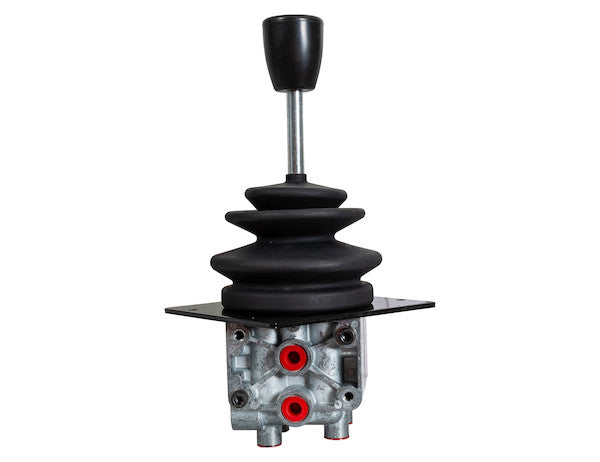
Dual Axis Feathering Non-Disengage PTO/Pump Air Control Valve
Specifications
| Feathering | Yes |
|---|---|
| Series | K70 |
| Spring to Neutral / Deadman Control (y/n) | No |
Advanced Control: The Dual Axis Feathering Non-Disengage PTO/Pump Air Control Valve
In the realm of hydraulic and pneumatic power transmission, precise and intuitive control is paramount for optimizing operational efficiency, ensuring safety, and extending the lifespan of critical machinery. The Dual Axis Feathering Non-Disengage PTO/Pump Air Control Valve, specifically within the robust K70 Series, represents a pinnacle in advanced control solutions. This technical exposition delves into the engineering principles, operational advantages, and strategic applications of this specialized valve, elucidating its significance in demanding industrial and mobile equipment environments.
Understanding Dual Axis Control
The term "Dual Axis" refers to the valve's capability to provide independent, simultaneous, or sequential control over two distinct operational parameters or outputs from a single control interface. This advanced design departs significantly from conventional single-axis controls, offering operators a far greater degree of dexterity and command over complex machinery functions. In the context of a PTO (Power Take-Off) or pump system, this typically translates to the ability to modulate two separate hydraulic or pneumatic circuits, or to control two independent aspects of a single circuit, such as speed and direction, or the engagement of two distinct power consumers. This multi-dimensional control paradigm streamlines complex operations, reducing the need for multiple discrete control levers, improving operator ergonomics and reaction times. For example, one axis might control boom extension while the other manages winch speed. This independent, co-ordinated control allows complex maneuvers to be executed with a single hand, enhancing precision and operational fluidity, especially when simultaneous adjustments are required.
The Precision of Feathering Capability
Feathering, a critical feature, denotes the valve's capacity for infinitely variable, proportional control of power output or flow rate, rather than simple ON/OFF switching. This proportional modulation is achieved through a sophisticated internal pneumatic circuit that translates varying air pressure inputs from the control lever into corresponding, finely graduated output pressure to actuate the PTO or pump clutch. The essence of feathering lies in its ability to allow smooth, gradual engagement and disengagement of power, preventing abrupt mechanical shocks, surges, or stalls. This capability is indispensable in applications requiring precise positioning, gentle acceleration, or controlled deceleration. For instance, when lifting a delicate load, feathering allows the operator to slowly initiate movement, gently accelerate, and smoothly decelerate the load, minimizing pendulum swings and ensuring stable placement. Feathering significantly reduces mechanical stress on the PTO, pump, clutch, and associated driveline components. This translates directly into extended equipment lifespan, reduced maintenance intervals, and lower total cost of ownership. The K70 series valve provides responsive and predictable feathering, offering immediate feedback and fine-grained control over connected hydraulic or mechanical systems.
Non-Disengage PTO/Pump System Integration
The "Non-Disengage" characteristic is a deliberate design choice with significant implications for system architecture and operational philosophy. Unlike conventional PTOs or pumps that can be fully disengaged, a non-disengage system implies the PTO or pump remains continuously coupled, or in readiness for immediate activation, without complete mechanical disconnect. This design is advantageous where intermittent operation with rapid, on-demand power delivery is required, or when constant hydraulic pressure availability is necessary. For instance, in refuse collection vehicles or certain construction equipment, the pump may need to be active frequently. A non-disengage setup, combined with feathering control, allows the hydraulic system to be brought online smoothly and precisely without delay or wear from repeated clutch engagements. While "Non-Disengage" implies continuous mechanical linkage, the feathering capability manages power transmission, allowing the PTO/pump to effectively be "idled" or brought to full operational capacity as needed without harsh engagement. This architectural decision can simplify driveline design and improve system response times, critical in dynamic operational environments. It requires careful system design to manage heat generation and efficiency during minimal load periods, but offers substantial advantages where immediate, controlled power application is a priority.
Pneumatic Control System Advantages
As an "Air Control Valve," this device leverages the inherent advantages of pneumatic systems for command and control. Pneumatic systems offer a compelling alternative to hydraulic or electrical controls, particularly in robust operation environments, for intrinsic safety, or remote actuation. Air control valves operate by manipulating compressed air signals to actuate mechanical components, such as clutches or spool valves. The primary benefits include:
- Inherent Safety: Air systems are non-flammable and generally safer in environments where sparks or electrical failures could pose a hazard. Leaks typically present less of an environmental or safety risk compared to hydraulic fluid leaks.
- Robustness and Reliability: Pneumatic components are often simpler in design, featuring fewer moving parts than complex electrical or hydraulic counterparts. This simplicity contributes to higher reliability and a longer operational lifespan, especially in environments exposed to dust, moisture, and extreme temperatures.
- Remote Control Capability: Air pressure signals can be transmitted over considerable distances with minimal loss, enabling remote operation of equipment. This is crucial for operator safety in hazardous environments or for improving ergonomics in large machinery.
- Cleanliness: Compared to hydraulic systems, pneumatic systems are inherently cleaner, reducing the risk of contamination in sensitive applications.
- Cost-Effectiveness: While an air compressor is required, the overall cost of pneumatic control components and maintenance can often be more economical than equivalent hydraulic or complex electronic systems.
- Environmental Adaptability: Pneumatic systems generally perform consistently across a wide range of temperatures, from sub-zero to high heat, making them suitable for diverse geographical and operational conditions.
Technical Design and Engineering Excellence of the K70 Series
The K70 Series Dual Axis Feathering Non-Disengage PTO/Pump Air Control Valve is engineered for demanding industrial and mobile applications, emphasizing durability, precision, and longevity. Its robust housing, often cast from high-strength aluminum or composite materials, provides excellent resistance to corrosion, impact, and vibration. Internal components are meticulously machined from wear-resistant alloys, ensuring tight tolerances and consistent performance. Sealing elements, critical for pneumatic integrity, are fabricated from advanced elastomers selected for resilience across broad temperature ranges and resistance to common industrial lubricants. The design integrates pressure regulators and restrictors to precisely manage compressed air flow and pressure, fundamental for fine feathering control. The dual-axis mechanism utilizes precision linkages and cams to translate operator input into modulated air signals for each independent control path. These linkages are engineered for minimal friction, contributing to smooth operation. While minimal, maintenance accessibility is considered in the modular construction for component replacement, though the K70 series is built for extended service. Pneumatic porting is designed for standard industrial connections, facilitating straightforward integration into existing air supply and control networks. The K70 series typically incorporates internal filtration or tolerates standard industrial air quality, minimizing contamination risk. The ergonomic design of the control lever or joystick ensures operators can exert precise control with minimal fatigue.
Operational Principles and Performance Characteristics
The operational principle of the K70 series valve revolves around its ability to proportionally vary output air pressure based on operator input. When the control lever is actuated along either axis, internal metering valves progressively open, allowing compressed air from the supply line to pass through to the output ports. The degree of lever displacement directly correlates to the increase in output pressure, which in turn modulates the engagement of the PTO clutch or the pump's hydraulic output. This proportional relationship is finely tuned to provide a linear and predictable response, essential for precise feathering. The valve's performance is defined by several key metrics:
- Pressure Range: Optimized for standard industrial compressed air systems, typically operating within a specified pressure envelope (e.g., 80-150 PSI).
- Flow Capacity: Designed to provide sufficient airflow to rapidly actuate and control the intended PTO/pump clutches or pneumatic actuators, ensuring responsive system operation.
- Response Time: Engineered for quick yet smooth response, minimizing lag between operator input and system reaction, crucial for dynamic control.
- Repeatability: The ability to consistently reproduce a specific output pressure for a given input position, critical for predictable and reliable operation.
- Durability: Rated for high cycle life, enduring millions of operational cycles under arduous conditions.
- Temperature Range: Capable of reliable operation across extreme ambient temperatures, from freezing arctic conditions to scorching desert environments.
- Vibration Resistance: Designed to withstand significant vibration typical in heavy machinery applications without compromising performance or integrity.
Strategic Applications and Industry Adoption
The Dual Axis Feathering Non-Disengage PTO/Pump Air Control Valve, particularly the K70 Series, finds indispensable application across a broad spectrum of industries where precision, robust control, and continuous power availability are paramount. Its unique combination of features makes it ideal for integrating complex hydraulic or mechanical functions into mobile and stationary equipment. Key application sectors include:
- Construction Equipment: Essential for machinery such as concrete pumps, excavators with auxiliary attachments, asphalt pavers, and specialized lifting equipment. The feathering capability allows for precise control of boom movements, outrigger deployment, and material flow, while the non-disengage feature ensures hydraulic power is readily available.
- Municipal and Utility Vehicles: Widely used in refuse compactors, street sweepers, and snowplows. For refuse vehicles, it controls packer plate movement with feathering, and for snowplows, it offers precise control over blade angling and lift, ensuring efficient and safe operation.
- Agriculture Machinery: In advanced agricultural equipment, this valve can manage multiple hydraulic functions for implements like planters, sprayers, and harvesting machinery, providing operators with fine control over various operational parameters simultaneously.
- Material Handling: Crucial for telehandlers, forklifts with specialized attachments, and loading cranes, enabling precise positioning and manipulation of loads, enhancing safety and reducing product damage.
- Forestry Equipment: Harvesters, forwarders, and chippers benefit from the dual-axis feathering for controlling grapple movements, felling heads, and conveyor speeds, ensuring efficient and safe timber processing.
- Oil and Gas Field Equipment: Used in various specialized vehicles and stationary equipment requiring robust and precise control of pumps and power take-offs in harsh, often explosive, environments where pneumatic safety is a significant advantage.
The Significance of "No Spring to Neutral / Deadman Control"
The specification "Spring to Neutral / Deadman Control (y/n): No" is a deliberate characteristic influencing the operational philosophy and safety protocols of the K70 Series valve. A "deadman" control automatically returns to a neutral or safe state upon release by the operator. The absence of this feature in the K70 series implies the control lever, once positioned, will remain in that commanded position without continuous operator input. This is not a deficiency but a specific engineering choice tailored for applications where sustained, continuous output at a set level is required, or where the operator needs to free their hands for other tasks after setting an operational parameter. For example, in applications like operating a concrete pump where consistent flow needs to be maintained, or controlling a conveyor belt at a steady speed, a non-spring-return control allows the operator to set the desired output and then monitor the process without continuously holding the lever. This design can reduce operator fatigue and facilitate multitasking. However, it places a greater onus on the system's overall safety architecture; auxiliary safety systems, such as emergency stops and pressure relief valves, become even more critical. Operators must be thoroughly trained in the specific operational nuances of machinery equipped with such controls. This design highlights the valve's suitability for sophisticated, purpose-built systems where professional operators are cognizant of equipment characteristics, and the benefits of sustained control outweigh the need for a momentary 'deadman' fail-safe. It emphasizes intentional control, ensuring any output change is a direct, deliberate action from the operator, streamlining operations where an engaged state is expected for prolonged durations.
Installation, Maintenance, and Longevity
The K70 Series Dual Axis Feathering Non-Disengage PTO/Pump Air Control Valve is designed for ease of installation and minimal maintenance, contributing to a lower total cost of ownership. Installation typically involves securing the valve within the operator's cabin, connecting the compressed air supply, and routing the output pneumatic lines to the respective PTO/pump actuation mechanisms. Standardized pneumatic fittings ensure compatibility with common industrial systems. Maintenance requirements are low due to robust construction and simplicity of pneumatic operation. Routine checks generally include verifying air supply quality, inspecting pneumatic lines for leaks, and confirming smooth lever operation. High-quality, durable materials for seals and internal components mean infrequent replacement. The design minimizes wear points, with critical pivot points utilizing low-friction materials. The K70 series is engineered for exceptional longevity, designed to perform reliably over millions of cycles. Factors contributing to this extended lifespan include:
- Material Selection: Corrosion-resistant alloys and high-performance elastomers.
- Precision Manufacturing: Tight tolerances reduce leakage and wear.
- Robust Housing: Protection against environmental factors and physical damage.
- Overpressure Protection: Internal design handles momentary pressure spikes.
Conclusion: Elevating Operational Precision and Efficiency
The Dual Axis Feathering Non-Disengage PTO/Pump Air Control Valve from the K70 Series stands as an exemplary solution for advanced power transmission control. Its unique combination of dual-axis functionality, sophisticated feathering capability, and non-disengage system integration, all within a robust pneumatic framework, addresses the most stringent demands of modern industrial and mobile equipment. By enabling operators to achieve unparalleled precision, smooth modulation, and efficient deployment of power, this valve significantly enhances productivity, extends equipment longevity, and improves overall operational safety in complex applications. The deliberate absence of a spring-to-neutral 'deadman' control underscores its design for applications requiring sustained, deliberate operator control, optimizing for efficiency in specific operational contexts. As industries continue to seek greater automation, precision, and reliability, the K70 Series air control valve provides a foundational component for systems aiming to push the boundaries of performance and control.