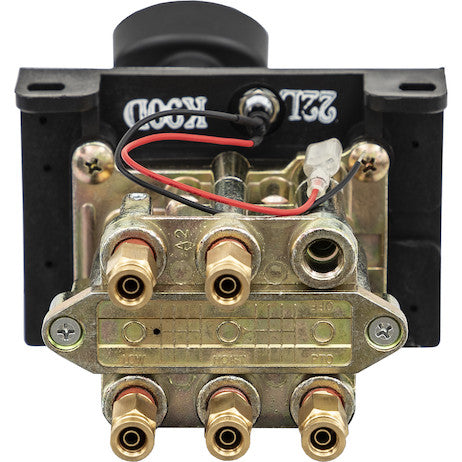
Buyers Products K90 Series Power Take Off/Hoist Control Valve operates pneumatic truck functions with the simplicity of a single lever. It's built to perform with a design that allows for controlled lowering (feathering) and smoother operation. Built-in safety features vary by style and help reduce operator error. All valves have a control pad indicator light that warns of PTO engagement. The K90 has automatic disengagement of the PTO in lower setting, while the K90D has a "dead man" control on the hoist lever, which returns to neutral position and stops motion when user engagement is not present.
Specifications
| Feathering | Yes |
|---|---|
| Number of Ports | 5 |
| Port Type | Brass Push Lock Fittings |
| Rated Pressure | 125 |
| Series | K90 |
| Spring to Neutral / Deadman Control (y/n) | Yes |
| Valve Action | Feathering |
| Valve Actuation | Manual Lever |
| Valve Primary Application | PTO/Pump Valve |
Advanced Pneumatic Control: The K90 Series Single Lever Air Control Valve for PTO/Pump Systems
The Buyers Products K90 Series Single Lever Air Control Valve represents a critical component in the sophisticated management of pneumatic systems within heavy-duty vocational trucks. Engineered for robust performance and operational precision, this valve streamlines the engagement and disengagement of Power Take-Off (PTO) units and the controlled manipulation of hydraulic pump functions, primarily for hoist applications. Its design prioritizes both efficiency and operator safety, integrating advanced control mechanisms and robust construction to meet the rigorous demands of commercial and industrial environments. This technical exposition delves into the engineering principles, functional advantages, and safety protocols that define the K90 series, establishing its value as an indispensable asset for modern truck applications.
Core Functionality and Pneumatic System Integration
At its essence, the K90 Series valve is an air control device designed to manage the flow of compressed air, which, in turn, actuates various pneumatic components. In a typical vocational truck, compressed air is supplied by the vehicle's air brake system, regulated and filtered before being directed to control valves like the K90. This valve functions as the primary interface for engaging the vehicle's PTO, which mechanically transmits power from the engine or transmission to auxiliary equipment, such as hydraulic pumps. Beyond PTO engagement, the K90 series also facilitates the command of these hydraulic pumps, specifically for hoist operations. Through a carefully orchestrated sequence of pneumatic signals, the valve directs air to pilot cylinders or air-operated hydraulic valves, thereby initiating the raising or lowering of a dump body, crane, or other hydraulically powered attachments.
The integration of a single lever for both PTO engagement and hoist control simplifies the operator's interface, reducing the cognitive load and potential for error associated with multi-lever or button-based systems. This consolidated control paradigm is particularly beneficial in dynamic operational environments where quick, decisive actions are often required. The valve's internal pneumatic circuitry is meticulously designed to provide precise air pressure delivery to the controlled devices, ensuring smooth transitions and responsive actions from the connected equipment. This level of integration and streamlined control is a hallmark of the K90 series' commitment to operational excellence.
Precision Control: The Feathering Mechanism
One of the most critical technical attributes of the K90 Series is its “feathering” capability. In the context of hydraulic hoist applications, feathering refers to the ability to precisely modulate the speed and position of the hydraulic cylinder during lowering operations. Unlike conventional ON/OFF valves that provide only full-speed lowering, a feathering valve allows for proportional control of air pressure to the hydraulic control mechanism. This translates into a graduated control over the hydraulic fluid flow, enabling the operator to “feather” the load down incrementally, at a controlled pace, or even to hold it at an intermediate position. This capability is paramount for several reasons:
- Enhanced Safety: Controlled lowering prevents sudden drops, which can lead to equipment damage, instability, and injury to personnel working near or under the load.
- Reduced Equipment Wear: Abrupt stopping and starting of hydraulic cylinders generate significant shock loads within the hydraulic system and the structural components of the truck. Feathering minimizes these stresses, extending the lifespan of hydraulic pumps, cylinders, hoses, and the truck chassis itself.
- Improved Operational Efficiency: For tasks requiring precise load placement, such as spreading materials (e.g., gravel, salt) or positioning sensitive equipment, feathering provides the necessary dexterity. Operators can achieve desired outcomes with greater accuracy and less rework.
- Material Handling Optimization: In applications like dumping aggregate or refuse, feathering allows operators to control the discharge rate, preventing material surge and ensuring an even spread or controlled deposit.
The K90's internal valving architecture, coupled with its manual lever actuation, is specifically engineered to provide this proportional control. The mechanical linkage from the lever to the internal pneumatic spool allows for a linear response, where the degree of lever displacement directly correlates to the airflow and, consequently, the lowering speed. This direct mechanical feedback enhances the operator's intuitive feel for the controlled action, contributing to safer and more efficient operations.
Advanced Safety Protocols: Spring Return to Neutral and Dead Man Control
Safety is a paramount consideration in the design of the K90 Series, manifested through its “Spring Return to Neutral” and “Dead Man Control” features. The core principle behind these mechanisms is to ensure that the controlled functions revert to a safe, disengaged state in the absence of deliberate operator input.
Spring Return to Neutral
As indicated by its title, the K90 Series valve incorporates a robust spring return mechanism that automatically brings the control lever back to the neutral position when released. This is a fundamental safety feature for any control system involving moving machinery. In the neutral position, all pneumatic outputs associated with the hoist function are typically vented, and the PTO engagement signal is deactivated. This ensures that the hydraulic pump ceases operation and the hoist remains stationary, preventing unintended movement of the attached equipment. This intrinsic design reduces the risk of accidental activation or prolonged engagement, thereby safeguarding both equipment and personnel.
K90 vs. K90D Safety Feature Delineation
The K90 Series offers distinct safety configurations tailored to specific operational philosophies:
- K90 Model: Automatic PTO Disengagement in Lower Setting: This variant is engineered to automatically disengage the PTO when the hoist lever is moved into the “lower” position. This feature prevents the hydraulic pump from unnecessarily operating while the load is being lowered, conserving energy, reducing wear on the PTO and pump, and preventing potential overpressure conditions should the pump continue to run against a lowered cylinder. It represents an intelligent integration of operational and safety logic, optimizing system performance and longevity.
- K90D Model: “Dead Man” Control on Hoist Lever: The “dead man” control is an active safety mechanism that demands continuous operator engagement for the hoist function to remain active. If the operator releases the hoist lever at any point during a raise or lower operation, the lever instantaneously returns to the neutral position, and all motion stops. This feature is particularly critical in applications where unforeseen circumstances might cause an operator to lose control or become incapacitated. By requiring constant, conscious input, the “dead man” control significantly mitigates the risk of runaway hoists or unintended movements, adhering to stringent safety regulations in many jurisdictions.
Both models also include a control pad indicator light. This highly visible signal illuminates to warn the operator when the PTO is engaged, providing immediate feedback on the system's active state. This simple yet effective visual cue is crucial for preventing driving with an engaged PTO, which can lead to severe damage to the drivetrain and auxiliary equipment.
Technical Specifications and Construction Integrity
The specifications of the K90 Series underscore its robust engineering and suitability for demanding applications.
-
Number of Ports: 5: The presence of five ports is indicative of the valve's comprehensive control capabilities. A typical configuration for a PTO/pump hoist valve includes:
- One inlet port for the main air supply from the vehicle's pneumatic system.
- One exhaust port to vent air when the valve returns to neutral or a controlled position, releasing pressure from pneumatic actuators.
- One output port for the PTO engagement signal, directed to the pneumatic PTO shift cylinder.
- One output port for the “raise” signal, typically directed to a pilot-operated hydraulic valve or an air-shift mechanism for the hydraulic pump.
- One output port for the “lower” signal, similarly routed to control the hydraulic lowering function.
- Port Type: Brass Push Lock Fittings: The choice of brass push-lock fittings provides significant advantages in installation and long-term reliability. Brass is highly resistant to corrosion, a common issue in truck environments exposed to moisture, road salts, and various chemicals. Push-lock fittings offer a quick, tool-free method for connecting pneumatic tubing, drastically reducing installation time and labor costs. More importantly, when properly installed, these fittings create a secure, airtight seal, preventing costly air leaks that can degrade system performance and efficiency. Their reusability and ease of maintenance further contribute to the valve's overall value proposition.
- Rated Pressure: 125 PSI: This pressure rating is critical for compatibility and durability. Commercial truck air systems typically operate within a pressure range of 100-120 PSI. A 125 PSI rating for the control valve provides an adequate safety margin, ensuring that the valve can safely and reliably operate under peak system pressures without risk of damage or premature failure. This specification confirms the valve's resilience and suitability for integration into standard heavy-duty vehicle pneumatic circuits.
- Valve Action: Feathering; Valve Actuation: Manual Lever: These specifications reinforce the discussion on precise, operator-controlled modulation and the intuitive interface of the single lever.
- Spring to Neutral / Deadman Control (Y/N): Yes: This confirms the inclusion of these crucial safety mechanisms across the K90 series, underlining Buyers Products' commitment to operator safety and responsible equipment operation.
Material Science and Manufacturing Excellence
The enduring reliability of the K90 Series valve is attributable to its superior material selection and manufacturing processes. Internal components, critical for sealing and precision airflow, are typically constructed from high-grade polymers and corrosion-resistant metals, designed to withstand the wear of continuous pneumatic operation and variations in air quality. The valve body itself is engineered from robust materials, ensuring structural integrity against physical impact and environmental stressors prevalent in vocational truck applications. Precision machining techniques are employed to achieve tight tolerances, which are essential for the feathering capability and for preventing internal air leakage that could lead to inefficient operation or premature wear. The use of durable seals and O-rings, formulated for pneumatic applications, guarantees consistent performance across a broad range of operating temperatures and pressures, minimizing the need for frequent maintenance and maximizing uptime.
Versatile Applications and Industry Relevance
The K90 Series Single Lever Air Control Valve finds extensive application across a multitude of heavy-duty vocational sectors where precise and safe control of PTO-driven equipment is paramount. Its primary application as a PTO/Pump Valve makes it indispensable for:
- Dump Trucks: For the engagement of the PTO and the controlled raising and lowering of the dump body, facilitating material discharge with precision.
- Refuse Vehicles: Controlling the hydraulic compacting mechanism and container lifting systems.
- Snowplows and Spreaders: Managing hydraulic functions for plow articulation, lift, and spreader operations, often requiring fine adjustments in harsh winter conditions.
- Service and Utility Trucks: Operating cranes, aerial lifts, and other auxiliary hydraulic tools where controlled movement is essential for safe and efficient work.
- Tow Trucks and Wreckers: Engaging PTO for winch operations and controlling hydraulic boom and lift functions.
In each of these applications, the K90 Series delivers not just control, but a superior operational experience characterized by ease of use, enhanced safety, and extended equipment life. Its adherence to stringent performance and safety standards makes it a preferred choice for fleet managers and owner-operators seeking to optimize their vehicle’s auxiliary functions.
Conclusion
The Buyers Products K90 Series Single Lever Air Control Valve for PTO/Pump applications embodies a sophisticated synergy of ergonomic design, precision engineering, and comprehensive safety features. By offering a single, intuitive control for both PTO engagement and the delicate feathering of hoist functions, it dramatically simplifies complex operations. The integration of robust spring return to neutral and “dead man” control mechanisms, coupled with a clear PTO engagement indicator, establishes a new benchmark for operator safety and system reliability. With its durable brass push-lock fittings, appropriate pressure rating, and meticulous construction, the K90 Series stands as a testament to engineering excellence in pneumatic control systems. It is not merely a component but a critical enabler for maximizing the efficiency, safety, and longevity of vocational truck fleets, providing a compelling solution for demanding operational environments.