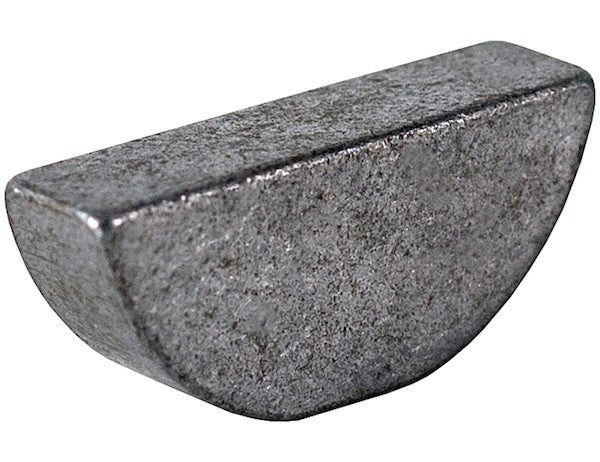
Buyers Products Woodruff Key comes in a variety of diameters and thicknesses to fit your driveline needs.
Specifications
| Diameter | 0.88 |
|---|---|
| Finish | Plain |
| Material | Carbon Steel |
| Thickness | .25 |
Advanced Technical Overview: Woodruff Key 1/4 x 7/8 Inch for Precision Driveline Applications
The Woodruff Key, specifically the 1/4 x 7/8 inch variant offered by Buyers Products, represents a critical component in mechanical power transmission systems, designed to secure rotating elements to a shaft and ensure synchronized motion. This particular key, with its distinct semi-circular profile, is engineered for demanding applications where reliability, ease of assembly, and minimal stress concentration on the shaft are paramount. Understanding its unique characteristics, material properties, and operational advantages is essential for engineers, technicians, and procurement specialists.
Fundamental Design and Mechanical Principles
A Woodruff key differentiates itself from traditional square or rectangular keys by its unique semi-circular (segmental) form. The designation "1/4 x 7/8 inch" indicates its nominal dimensions: a thickness of 1/4 inch (or 0.25 inches) and a full diameter of 7/8 inch (or 0.875 inches). This design means that approximately half of the key's circular profile is recessed into a corresponding semi-circular keyway milled into the shaft, while the flat top surface protrudes to engage with a mating keyway in the hub or mounted component (such as a gear, pulley, sprocket, or coupling).
The primary function of any key is to transmit torque between a shaft and a hub, preventing relative rotational movement. The Woodruff key achieves this by acting as a shear pin, transferring rotational forces. When torque is applied, the key is subjected to shear stress along its cross-section and crushing stress where it contacts the keyways. The careful selection of material and precise manufacturing tolerances are crucial to ensure that the key can withstand these stresses without deformation or failure, thereby maintaining the integrity and efficiency of the driveline system.
Material Science: Carbon Steel for Robust Performance
The 1/4 x 7/8 inch Woodruff Key from Buyers Products is manufactured from high-quality carbon steel. Carbon steel is a ferrous alloy primarily composed of iron and carbon, with carbon content typically ranging up to 2.1% by weight. The specific grade of carbon steel chosen for keys is critical for achieving the desired mechanical properties necessary for power transmission applications. Generally, medium-carbon steels (0.25% to 0.60% carbon) or higher-carbon steels are preferred due to their excellent balance of strength, hardness, and toughness.
The advantages of utilizing carbon steel for Woodruff keys include:
- High Tensile Strength: Carbon steel exhibits high resistance to pulling forces, crucial for preventing the key from stretching or deforming under load.
- Excellent Shear Strength: The key's primary mode of failure is shear. Carbon steel provides superior resistance to shearing forces, ensuring the key maintains its structural integrity when transmitting torque.
- Good Hardness: The material’s hardness contributes to its wear resistance, preventing premature degradation of the key and its mating keyways due to repeated stress cycles and minor rotational shifts.
- Cost-Effectiveness: Carbon steel is a readily available and economically viable material, offering a high strength-to-cost ratio, which is beneficial for industrial applications requiring large volumes of components.
- Machinability: Carbon steels are generally easy to machine, allowing for the precise milling and grinding required to produce the accurate semi-circular profile and thickness tolerances critical for proper fitment.
While the product description specifies a "Plain" finish, implying no additional surface treatment, the inherent properties of the carbon steel itself provide a robust foundation. For applications in corrosive environments, additional coatings or specialized materials might be considered, but for general industrial use within protected environments, plain carbon steel offers optimal performance.
Dimensional Precision: 1/4 inch Thickness and 7/8 inch Diameter
The precise dimensions of a Woodruff key are paramount for its function. For this specific 1/4 x 7/8 inch key:
- Thickness (1/4 inch / 0.25 inches): The thickness dictates the width of the keyway on both the shaft and the hub. This dimension is directly correlated with the key's shear strength and its ability to transmit torque. A 1/4 inch thickness suggests suitability for a broad range of medium-duty power transmission applications. Proper keyway width on the shaft and hub is critical to ensure a snug fit, minimizing play that could lead to backlash, fretting, and accelerated wear.
- Diameter (7/8 inch / 0.875 inches): This dimension refers to the full diameter of the circular blank from which the key segment is cut. It defines the depth of the semi-circular keyway that must be milled into the shaft. The larger the diameter, the deeper the key sits into the shaft, which can influence the key's resistance to tipping and its stability. The diameter also affects the overall height of the key above the shaft surface, which must be accommodated by the hub's keyway depth.
Adherence to established industry standards (such as ANSI B17.2, DIN 6888, or ISO equivalents) for key and keyway dimensions is essential. These standards specify tolerances for width, height, and form to ensure interchangeability and proper function across different manufacturers and assemblies. Buyers Products' commitment to providing keys that fit common driveline needs implies adherence to such precise manufacturing standards.
The "Plain" Finish: Implications and Benefits
The specification of a "Plain" finish indicates that the key is supplied without any additional surface coatings or treatments beyond its natural metallic state after manufacturing. This choice of finish has several implications:
- Surface Protection: Plain finish carbon steel offers minimal inherent corrosion resistance. In environments prone to moisture, humidity, or aggressive chemicals, the key may be susceptible to rust. For such applications, it is often assumed the key will operate within a lubricated or sealed environment, or users may apply their own protective coatings (e.g., grease, paint, or specialized oils).
- Cost-Effectiveness: Omitting additional finishing processes like plating (zinc, cadmium) or black oxide treatment reduces manufacturing costs, allowing for a more economical product.
- Dimensional Accuracy: A plain finish ensures that the precisely machined dimensions are not altered by the thickness of a coating, which is crucial for maintaining tight tolerances and proper fit with the mating keyways.
- Direct Metal-to-Metal Contact: In some applications, direct metal-to-metal contact, potentially with the aid of specific lubricants, is preferred for optimal friction and torque transfer characteristics.
While a plain finish is suitable for a vast majority of internal machinery applications, customers should assess their environmental conditions and consider supplementary corrosion protection if the key is exposed to elements.
Engineering Advantages of the Woodruff Key
The Woodruff key design offers several distinct engineering advantages over traditional square or rectangular keys, particularly in specific application scenarios:
- Reduced Stress Concentration on the Shaft: Perhaps the most significant advantage is the way the keyway is cut into the shaft. A semi-circular keyway requires less material removal from the shaft's critical diameter compared to a deep, square-cornered keyway. More importantly, the rounded bottom of the Woodruff keyway eliminates sharp corners that act as stress concentrators. Stress concentration factors are significantly lower for a semi-circular notch than for a square notch, leading to a stronger shaft with improved fatigue life. This is particularly beneficial for shafts subjected to dynamic loading, bending, or torsion.
- Self-Aligning Properties: During assembly, the semi-circular profile of the Woodruff key allows it to pivot and seat itself correctly in the shaft keyway, accommodating slight misalignments between the shaft and the hub. This self-aligning feature simplifies assembly, reducing installation time and the risk of damage during component fitting.
- Improved Fit and Stability: The design ensures a tighter fit. Once the key is inserted into the shaft and the hub is slid over, the key is fully supported by the rounded bottom of the shaft keyway. This full seating prevents rocking or tipping of the key, which can be a problem with square keys on tapered shafts or under oscillating loads.
- Suitability for Tapered Shafts: Woodruff keys are exceptionally well-suited for tapered shafts. On a tapered shaft, a traditional square key, if improperly fitted, might tend to tip or wedge, creating uneven stress distribution. The ability of the Woodruff key to pivot in its semi-circular seat allows it to align perfectly with the keyway in a tapered hub, providing uniform contact and better load distribution.
- Easier Disassembly: In certain scenarios, particularly with deeply seated keys or light interference fits, the Woodruff key can be easier to remove than a tightly wedged square key.
Manufacturing Processes and Quality Control
The production of a high-quality Woodruff key involves several precise manufacturing steps:
- Material Selection and Preparation: High-grade carbon steel bar stock is selected, often subjected to chemical analysis to confirm composition and mechanical testing to verify properties.
- Blanking or Machining: Keys can be produced via stamping from sheet material (for smaller keys) or by milling and grinding from bar stock (common for keys of this size and larger). The semi-circular profile is accurately formed.
- Precision Grinding: Critical dimensions, especially the thickness and the radius of the circular segment, are often precision-ground to achieve tight tolerances. This ensures proper fitment in the keyways and optimal torque transmission.
- Deburring and Finishing: Edges are deburred to remove sharp points and ensure smooth surfaces that will not damage mating components during assembly. The "Plain" finish is then applied or simply results from the final machining step.
- Quality Inspection: Each batch of keys undergoes rigorous quality control checks. This includes dimensional verification using micrometers, calipers, and go/no-go gauges to ensure adherence to specified thickness, diameter, and form tolerances. Material hardness and surface finish may also be verified.
Buyers Products' commitment to providing solutions that "fit your driveline needs" implies a robust quality assurance process to ensure consistency and reliability across their product range.
Installation and Fitment Best Practices
Proper installation of a Woodruff key is crucial for the longevity and performance of the driveline assembly:
- Keyway Preparation: Ensure that both the shaft keyway and the hub keyway are clean, free of burrs, and precisely dimensioned according to engineering specifications. The keyway width should provide a slight clearance or an interference fit depending on the application's tolerance requirements and the desired holding force.
- Key Insertion: The Woodruff key is typically inserted into the shaft keyway first, ensuring it seats fully and correctly.
- Hub Alignment: The component (e.g., gear, pulley) is then carefully slid over the shaft, aligning its keyway with the protruding portion of the Woodruff key. Force should be applied evenly and gradually to prevent damage to the key or the keyways.
- Shaft-Hub Interface: For optimal performance, the hub is often press-fitted onto the shaft after key engagement or secured with additional fastening mechanisms such as set screws, retaining rings, or threaded nuts to maintain axial position.
- Tolerance Management: Excessive clearance between the key and keyway can lead to backlash, shock loading, and accelerated wear, eventually causing key or keyway deformation. Conversely, an overly tight interference fit can make assembly difficult and induce undesirable stresses in the shaft or hub.
Applications Across Industries
The 1/4 x 7/8 inch Woodruff Key is a versatile component found in a multitude of industrial, automotive, and agricultural applications where reliable power transmission is essential. Its robustness and design advantages make it suitable for:
- Automotive Systems: Used in crankshafts, camshafts, transmission components, steering columns, and accessory drives where precision timing and torque transfer are critical.
- Agricultural Machinery: Integral in tractors, combines, tillers, and other farm equipment for securing gears, pulleys, and sprockets in power take-off (PTO) systems and drive trains.
- Industrial Equipment: Found in gearboxes, electric motors, pumps, conveyors, machine tools, and various types of processing equipment requiring dependable coupling of rotating components.
- Marine Applications: Utilized in propeller shafts, engine components, and accessory drives where resistance to shock loads and reliable operation are paramount.
- Hydraulic and Pneumatic Systems: Often employed in the drive mechanisms of pumps and compressors.
The specific dimensions of 1/4 inch thickness and 7/8 inch diameter indicate its suitability for shafts of a corresponding size, typically ranging from 3/4 inch to 1 1/4 inch in diameter, depending on the application's torque requirements and the hub's design.
Maintenance and Service Life Considerations
While Woodruff keys are inherently durable, their service life is influenced by operational conditions. Regular inspection and appropriate maintenance practices can extend the life of the entire driveline system:
- Load Cycles and Vibration: Continuous heavy loads, frequent start-stop cycles, and high vibration can lead to fatigue over time.
- Lubrication: Although keys do not typically require direct lubrication for torque transmission, ensuring proper lubrication of adjacent bearings and components reduces overall system friction and heat, which indirectly benefits key longevity.
- Wear and Deformation: Keys should be inspected during overhaul or maintenance for signs of wear, such as flattening of the rounded portion, deformation of the top surface, or shear cracks. Any signs of significant wear or damage warrant replacement.
- Environmental Factors: As a plain carbon steel component, protecting the key and its assembly from excessive moisture and corrosive agents is important for long-term functionality.
Conclusion
The Buyers Products Woodruff Key 1/4 x 7/8 Inch stands as a testament to precision engineering in power transmission. Its specific dimensions, robust carbon steel construction, and inherent design advantages – particularly in reducing shaft stress concentration and facilitating assembly – make it an indispensable component for a wide array of driveline applications. By understanding the technical specifications, material properties, and installation nuances, engineers and maintenance professionals can ensure the optimal performance, reliability, and longevity of their mechanical systems. Buyers Products continues to offer a comprehensive range of such critical components, addressing the diverse and demanding needs of modern industrial and vehicular driveline requirements with quality and precision.