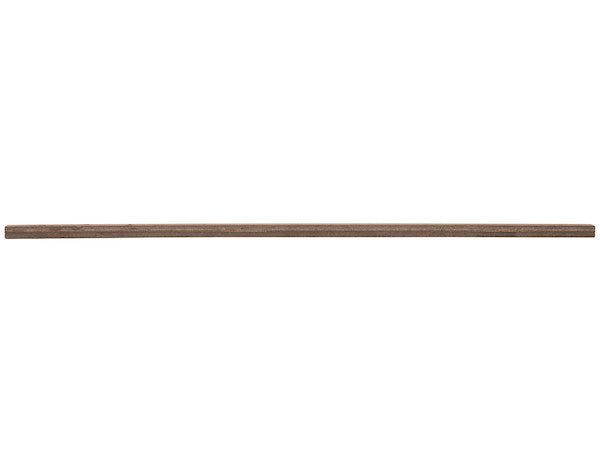
Specifications
| Finish | Plain |
|---|---|
| Key Length | 12.000 |
| Key Size (Width) | 0.312 |
| Key Type | Step |
| Material | Carbon Steel |
| Step Key Small Width | 0.250 |
The Step Key Stock, precisely dimensioned at 1/4 x 5/16 x 12 inches, represents a fundamental component in mechanical power transmission systems, engineered for robust and reliable coupling between rotating shafts and mating hubs, gears, or pulleys. This particular specification of step key, manufactured from high-quality Carbon Steel with a plain finish, is critical for applications demanding secure torque transfer, particularly in scenarios where keyway repair or accommodation of slight dimensional variances is necessary. Its unique stepped profile allows for a versatile solution in maintaining the integrity and functionality of industrial machinery.
In the realm of mechanical engineering, a key's primary function is to prevent relative rotational movement between a shaft and a component mounted on it. The efficacy of this connection directly impacts the performance, longevity, and safety of the entire mechanical assembly. While standard parallel keys are ubiquitous, the step key introduces a distinct advantage by offering two different widths along its profile. In this product, these widths are nominally 1/4 inch (0.250 inches) and 5/16 inch (0.312 inches), precisely defined by the "Step Key Small Width" and "Key Size (Width)" specifications respectively. The full length of the key stock is 12.000 inches, providing ample material for custom sizing to meet specific application requirements. This allows technicians and engineers to adapt the key to a range of keyway conditions, often rehabilitating worn or oversized keyways without the need for costly shaft or hub replacement.
The material choice for this key stock, Carbon Steel, is deliberate and optimized for the demanding mechanical stresses encountered in keyed connections. Carbon steel, known for its excellent balance of strength, hardness, and machinability, makes it an ideal candidate for transmitting significant torsional loads. Typically, key stock is manufactured from low to medium carbon steels, such as AISI 1018 or 1045. AISI 1018, for instance, is a general-purpose carbon steel renowned for its good ductility, weldability, and case hardening capabilities, offering a yield strength in the range of 32,000 to 54,000 psi (220 to 370 MPa) and a tensile strength of 58,000 to 64,000 psi (400 to 440 MPa) in its cold-drawn state. AISI 1045, a medium carbon steel, offers higher strength and hardness but reduced ductility, with yield strengths often exceeding 60,000 psi (415 MPa). The specific grade of carbon steel used for this key stock ensures it possesses the requisite shear strength and bearing stress resistance to withstand the forces exerted during torque transmission, preventing deformation or failure of the key itself. The "Plain" finish indicates that the key stock has not undergone any additional surface treatments like plating, coating, or specialized heat treatments for surface hardening. This is a common and cost-effective finish, suitable for many industrial environments, though considerations for corrosion protection might be necessary in humid or corrosive atmospheres.
The engineering principles governing keyed connections are multifaceted, involving careful consideration of various stress modes. When torque is applied, the key transmits force between the shaft and the hub, inducing shear stress within the key and bearing (crushing) stress at the contact surfaces between the key and the keyways in both the shaft and the hub. The shear stress (τ) in the key can be approximated by the formula τ = T / (r * A_shear), where T is the transmitted torque, r is the radius of the shaft, and A_shear is the shear area of the key. The bearing stress (σ_b) is calculated as the force divided by the projected contact area between the key and the keyway. For a successful key connection, both the shear strength of the key material and the bearing strength of both the key and keyway materials must exceed the maximum anticipated stresses. Furthermore, stress concentrations at the corners of keyways are critical factors in fatigue analysis, especially under cyclic loading conditions. The design and material selection of this Carbon Steel Step Key Stock are inherently optimized to mitigate these stresses, ensuring a reliable and long-lasting connection.
The inherent advantage of a step key, particularly one with the 1/4 inch to 5/16 inch configuration, lies in its ability to address common issues in existing machinery. Worn keyways, often resulting from extended operation, vibration, or improper installation, can lead to backlash, reduced torque transmission capacity, and ultimately, component failure. Replacing an entire shaft or hub, especially in large industrial equipment, can be prohibitively expensive and time-consuming. A step key provides an elegant repair solution by allowing the use of a keyway that might have become slightly oversized on one side due to wear. For instance, if a standard 1/4-inch keyway has worn on one side to slightly more than 1/4 inch but less than 5/16 inch, the step key can be precisely fitted to the larger width while still engaging the original, unworn 1/4-inch section of the keyway. This effectively 'shims up' the connection, restoring a tight fit and enabling continued operation without significant modification or replacement of critical components. The 12-inch length of this key stock provides sufficient material for the user to cut it to the exact required length for optimal engagement, ensuring maximum contact area for torque transfer.
The manufacturing process for key stock demands high precision to ensure compatibility with standardized keyways. Key stock is typically produced via cold drawing or hot rolling, followed by precision machining for the stepped profile. Cold drawing involves pulling a bar of steel through a die at room temperature, which refines its grain structure, improves its surface finish, increases its tensile and yield strength, and achieves tighter dimensional tolerances. Hot rolling, on the other hand, involves shaping the steel at elevated temperatures, generally used for larger sections and offering a more cost-effective production method, though with typically wider tolerances. For a step key, the critical stepped profile is achieved through milling or grinding operations, ensuring the accurate transition between the 0.250-inch and 0.312-inch widths along the length. Adherence to industry standards, such as ASME B17.1 for Woodruff Keys, Parallel Keys, and Keyseats, is paramount. These standards define the nominal dimensions, tolerances, and fit classes (e.g., clearance, transition, interference fits) necessary for proper key-keyway engagement. For instance, a common tolerance for key width might be h9, indicating a fundamental deviation 'h' and a tolerance grade '9', ensuring the key fits into a corresponding keyway (e.g., N9 or JS9) with a controlled amount of play or interference. The precision of the 1/4-inch and 5/16-inch widths and the 12-inch length specified for this product underscores its suitability for professional applications where dimensional accuracy is non-negotiable.
Applications for this 1/4 x 5/16 x 12 Inch Step Key Stock are diverse, spanning numerous industries. In industrial machinery, it finds use in pumps, gearboxes, electric motors, conveyors, and various power transmission units where shafts connect to impellers, gears, or pulleys. Agricultural equipment, including tractors, harvesters, and processing machinery, frequently utilizes keyed connections that are susceptible to wear and tear due to harsh operating conditions; step keys offer a reliable repair solution in these contexts. Within the automotive and marine sectors, while often employing more specialized spline or taper key designs for high-performance applications, standard keyed connections for auxiliary components or repair scenarios can benefit from step key utility. Furthermore, general machine building and repair shops value the versatility of step key stock for custom fabrication and emergency repairs, minimizing downtime and extending the operational lifespan of expensive capital equipment. Its ability to restore mechanical integrity to worn keyways makes it an invaluable asset in maintenance, repair, and overhaul (MRO) operations across manufacturing plants, processing facilities, and heavy industrial environments.
Proper installation and maintenance practices are crucial for maximizing the performance and longevity of any keyed connection, particularly with step keys. Before installation, both the shaft and hub keyways must be meticulously cleaned, deburred, and inspected for any imperfections that could impede a proper fit or create stress concentrations. The step key should be carefully seated into the keyway, ensuring full engagement along its length. Depending on the desired fit, it may be gently driven into place using a soft-faced hammer or press, taking care not to damage the key or keyway surfaces. Lubrication, such as an anti-seize compound, can be applied to the key or keyway surfaces in certain instances to facilitate installation and future disassembly, although it should not be relied upon to prevent rotational movement, which is the sole responsibility of the mechanical interference and friction provided by the key. Regular inspection of keyed joints for signs of wear, corrosion, or deformation is a critical part of a proactive maintenance schedule. While a step key is an excellent repair tool for worn keyways, it is essential to assess the overall condition of the shaft and hub. Severe damage or excessive wear may indicate that the components are beyond repair, and replacement might be the only safe and durable solution. Adherence to safety protocols, especially when working with rotating machinery, is paramount to prevent accidents and ensure operational reliability.
Comparing step keys to other key types highlights their unique advantages. Parallel keys are the most common, featuring a uniform width and height. Step keys become superior when a parallel key fit is compromised due to wear. Taper keys, characterized by a slight taper along their length, create an interference fit and are often used for heavy shock loads or for precise axial positioning; however, they do not address width variation like a step key. Woodruff keys, semicircular in shape, offer self-aligning properties and can reduce stress concentrations at the keyway ends in the shaft, but they have a smaller shear area compared to parallel or step keys. Gib head keys are a variation of the taper key with a head for easier removal. Splines and serrations offer significantly higher torque capacities due to multiple engaging keys machined directly into the shaft and hub, but they involve more complex and costly machining processes. In scenarios where existing components have experienced wear, or when a slightly oversized keyway needs to be accommodated without remachining the shaft or hub, this 1/4 x 5/16 x 12 Inch Carbon Steel Step Key Stock provides an optimal, cost-effective, and technically sound solution, bridging the gap between standard keys and more complex, expensive component replacements. Its plain finish allows for further customization if required, such as applying specific coatings or surface treatments post-installation, based on the operating environment.
In conclusion, the 1/4 x 5/16 x 12 Inch Step Key Stock, crafted from durable Carbon Steel with a plain finish, represents a critical and highly adaptable component in the field of mechanical power transmission. Its precisely engineered stepped profile, with nominal widths of 1/4 inch and 5/16 inch, offers a distinct advantage for repairing worn keyways, accommodating dimensional discrepancies, and restoring the mechanical integrity of shaft-to-hub connections. Manufactured to exacting standards, this key stock provides the strength, durability, and reliability essential for transmitting torque efficiently and safely across a multitude of industrial, agricultural, and general machinery applications. Engineers and maintenance professionals seeking a dependable and cost-effective solution for extending the service life of their equipment will find this step key stock an indispensable asset, ensuring operational continuity and enhanced system performance.