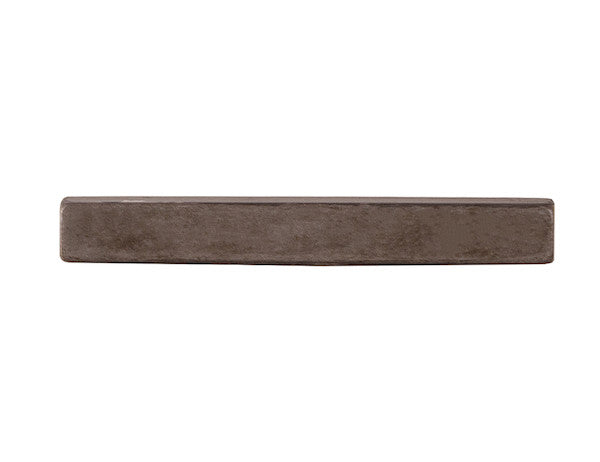
Specifications
| Finish | Plain |
|---|---|
| Key Length | 4.000 |
| Key Size (Width) | 0.312 |
| Key Type | Square |
| Material | Carbon Steel |
The 5/16 Inch Square Key Stock x 4 Inch represents a fundamental component in mechanical power transmission systems, engineered to facilitate the secure connection between a rotating shaft and a hub, gear, pulley, or other rotary component. This precision-manufactured key stock, characterized by its specific dimensions and material composition, is designed to prevent relative rotational movement, ensuring the efficient and reliable transfer of torque. Its critical role in machinery demands a deep understanding of its material properties, geometric specifications, and application principles, all of which contribute to the integrity and longevity of the assembled system.
At its core, key stock functions as a shear element within a mechanical assembly. It is inserted into mating grooves, known as keyways, machined into both the shaft and the bore of the component it is intended to drive. When torque is applied to the shaft, the key bears the resultant shear forces, preventing the hub from slipping. The 5/16 inch square profile of this key stock is a common and versatile geometry, offering a balanced distribution of stress and ease of manufacturing. The 4-inch length provides ample engagement surface for a wide range of applications, allowing for robust torque transfer in systems requiring a compact yet strong connection.
Material Science: Carbon Steel for Optimal Performance
The selection of carbon steel as the material for this key stock is deliberate and optimized for the demanding mechanical environments it will encounter. Carbon steel, primarily an alloy of iron and carbon, is renowned for its excellent balance of strength, hardness, ductility, and cost-effectiveness. The specific properties of carbon steel key stock are critical for its function:
- Tensile Strength: This property dictates the maximum stress the material can withstand before fracture when subjected to a stretching force. For a key, high tensile strength is essential to resist the pulling apart forces that can arise from torsional loads, especially during shock loading or rapid acceleration/deceleration.
- Yield Strength: Crucially, yield strength defines the stress at which the material begins to deform plastically (permanently). In keying applications, it is paramount that the key material operates well within its elastic limit to prevent permanent deformation, which would lead to backlash, loss of torque transmission, and ultimately, system failure.
- Hardness: Hardness refers to the material's resistance to indentation, scratching, or abrasion. A sufficiently hard key resists wear at the interface with the keyways in both the shaft and the hub, thereby maintaining tight tolerances and reducing the likelihood of fretting corrosion over time.
- Shear Strength: Directly relevant to its primary function, shear strength is the material's ability to resist forces that cause it to deform by sliding along a plane parallel to the applied force. The square key is designed to fail in shear if overloaded, acting as a "mechanical fuse" to protect more expensive components. The carbon steel composition ensures a predictable and high shear strength.
- Fatigue Strength: Many mechanical systems operate under dynamic loads, where torque is applied and removed repeatedly. Fatigue strength is the material's ability to withstand repeated stress cycles without failing. Carbon steel, when properly manufactured and applied, exhibits good fatigue resistance, ensuring reliable operation over extended periods.
Typically, key stock is manufactured from cold-drawn carbon steel, often grades like C1018 or C1045, though the general classification "Carbon Steel" suggests a broader range of suitable compositions. Cold drawing is a manufacturing process where the steel is pulled through a die at room temperature. This process significantly improves the material's dimensional accuracy, surface finish, and mechanical properties, including increased yield and tensile strength due to work hardening. The fine grain structure achieved through cold drawing also contributes to enhanced fatigue resistance, making it ideal for precision engineering components such as key stock.
Geometric Precision: The 5/16 Inch Square Profile and 4-Inch Length
The specified dimensions of this key stock—a 5/16 inch (0.3125 inches) square profile and a 4-inch length—are fundamental to its application and performance:
-
5/16 Inch Square Profile: The square cross-section is a robust and widely utilized key type. It offers several advantages:
- Symmetry: A square key allows for uniform stress distribution along its four faces when fitted into mating keyways. This symmetry simplifies design calculations and ensures predictable performance.
- Ease of Manufacturing: Both the key itself and the corresponding keyways in shafts and hubs are relatively straightforward to machine, contributing to cost-effectiveness and broad availability.
- Standardization: The 5/16 inch dimension is a standard size, ensuring interchangeability and compatibility with a vast array of industrial components designed to ASME B17.1 (Keys and Keyways) or equivalent international standards. This adherence to standards guarantees precise fit and simplifies procurement and maintenance.
- Contact Area: The specific width of 5/16 inch dictates the contact area between the key and the keyway walls. This contact area directly influences the compressive stress that the key can withstand before crushing, and the shear stress it can endure before shearing. For a given torque, a larger key width provides a larger shear area, reducing stress levels.
-
4-Inch Length: The length of the key is a critical parameter that impacts the total shear area and compressive bearing area.
- Shear Area: For a square key under torsional load, the critical shear plane runs parallel to the shaft axis. A 4-inch length, combined with the 5/16 inch width, provides a significant shear area, directly influencing the maximum torque that can be transmitted. The longer the key, the greater the shear area, and thus the higher the torque capacity for a given key material and width.
- Bearing Area: The length also defines the bearing area where the key contacts the keyway walls. This area resists the crushing forces exerted by the shaft and hub. Adequate bearing area prevents plastic deformation of the key or keyway walls, which could lead to looseness and eventual failure. A 4-inch length is often chosen to provide sufficient engagement without excessively weakening the shaft or hub.
- Flexibility in Application: A 4-inch length provides flexibility. In some applications, the key may be used as is. In others, it might be cut to a shorter, precise length to match a specific hub width or design requirement, minimizing material waste and offering customizability from a standard stock item.
- Proportionality: Mechanical design principles often dictate a relationship between key dimensions and shaft diameter. For a 5/16 inch width, a 4-inch length is typically suitable for shafts of corresponding diameters, ensuring the key is neither undersized nor excessively long, which could lead to stability issues or unnecessary material consumption.
The manufacturing process for such precision key stock involves stringent quality control to maintain tight dimensional tolerances. Typical tolerances for cold-drawn key stock are in the range of +/- 0.0005 to +/- 0.002 inches on the width and height, and excellent straightness and minimal twist along the length. These tight tolerances are essential for achieving the desired fit – whether it's an interference fit (press fit), a transition fit, or a clearance fit – which is crucial for preventing backlash and ensuring efficient torque transfer without excessive wear.
Surface Finish and Manufacturing Considerations: The "Plain" Finish
The "Plain" finish specified for this key stock indicates that the material is supplied in its as-manufactured state, without any additional surface coatings or treatments such as plating, galvanizing, or painting. This characteristic has several implications:
- Cost-Effectiveness: Eliminating secondary surface treatments reduces manufacturing costs, making the key stock an economical choice for a wide range of industrial applications where corrosion resistance is provided by the environment (e.g., oil bath, enclosed machinery) or managed through other means.
- Machinability: A plain finish typically means that the surface is free of any brittle or excessively hard coatings that could interfere with subsequent machining operations, should the end-user need to modify the key (e.g., chamfering, creating a radius).
- Friction Characteristics: The absence of a coating allows the inherent friction characteristics of the cold-drawn carbon steel to come into play at the key-keyway interface. While a plain finish offers minimal inherent corrosion resistance in humid or corrosive environments, its surface integrity is ideal for tight mechanical fits.
- Corrosion Management: In environments where corrosion is a concern, a plain carbon steel key would typically be protected by the system's lubricant (e.g., oil, grease), housed within a sealed enclosure, or the end-user might apply a protective coating post-installation. For example, within gearboxes or pumps, components are often continuously bathed in oil, rendering additional corrosion protection on the key unnecessary.
The cold-drawing process not only refines the mechanical properties but also imparts a smooth, clean surface finish that is inherently suitable for critical mechanical fits. The typical surface roughness for cold-drawn key stock is significantly lower than hot-rolled alternatives, contributing to a better fit within the keyway and reduced friction during assembly.
Applications and Engineering Design Principles
The 5/16 Inch Square Key Stock x 4 Inch finds extensive application across a multitude of industries due to its reliability and adherence to established engineering principles. Common applications include:
- Electric Motors and Generators: Connecting shafts to pulleys, fans, or couplings.
- Gearboxes and Speed Reducers: Securing gears to input and output shafts.
- Pumps and Compressors: Transmitting power from motor shafts to impellers or crankshafts.
- Agricultural Machinery: Durable connections in tractors, harvesters, and other farm equipment.
- Machine Tools: Ensuring precise motion in lathes, milling machines, and drills.
- Conveyor Systems: Driving sprockets or rollers for material handling.
- General Industrial Machinery: Any application requiring reliable torque transfer between a shaft and a hub.
When designing with key stock, engineers consider several critical factors to ensure system integrity:
- Torque Requirements: The primary consideration is the maximum torque the key is expected to transmit, including peak loads and shock loads. This dictates the required shear strength of the key and the bearing strength of both the key and keyway materials.
- Material Compatibility: The key material, carbon steel, must be compatible with the shaft and hub materials. Ideally, the key should be softer than the shaft and hub keyway walls to prevent excessive wear on the more expensive components, but strong enough to transmit the required torque.
- Keyway Dimensions and Tolerances: The keyways in the shaft and hub must be accurately machined to match the key's dimensions with appropriate fit tolerances. Loose fits can lead to backlash, impact loading, and fretting corrosion, while overly tight fits can make assembly difficult and induce unwanted stresses. ASME B17.1 provides standardized dimensions and tolerances for parallel keys and keyways.
- Stress Concentration: Sharp corners in keyways can act as stress concentrators, potentially leading to fatigue cracks in the shaft or hub. Design standards often recommend specific corner radii for keyways to mitigate this effect.
-
Failure Modes: Keys are typically designed to fail in either shear or crushing.
- Shear Failure: Occurs when the torsional load exceeds the key's shear strength, causing the key to break. The shear area is calculated as key width × effective key length.
- Crushing (Bearing) Failure: Occurs when the compressive stress at the interface between the key and the keyway walls exceeds the yield strength of the weaker material, leading to permanent deformation. The bearing area is typically half the key width × effective key length, as only half the key face bears against the keyway.
- Key Length vs. Hub Length: The effective length of the key should be proportional to the hub length. Often, the key extends through the entire length of the hub to maximize the contact area and distribute the load. However, in some cases, shorter keys are used, provided they still meet the torque transmission requirements. A 4-inch length provides significant flexibility in matching various hub lengths.
Standards and Quality Assurance
Adherence to industry standards is paramount for key stock to ensure interchangeability, reliable performance, and safety. For parallel keys and keyways, the primary standard in North America is ASME B17.1, which specifies dimensions, tolerances, and design considerations. Other international standards like ISO 2492 (for metric keys) or DIN standards also exist. When procuring 5/16 Inch Square Key Stock, ensuring it meets or exceeds these standards provides assurance of its quality and dimensional accuracy.
Manufacturers of high-quality key stock employ rigorous quality control procedures throughout the production process. This includes:
- Raw Material Inspection: Verifying the chemical composition and mechanical properties of the incoming carbon steel.
- Dimensional Gauging: Continuous or periodic measurement of the key's width, height, and length during and after cold drawing to ensure adherence to tight tolerances.
- Straightness and Twist Checks: Ensuring the key stock is free from significant bowing or twisting, which would impede proper fitment.
- Surface Finish Inspection: Visual and sometimes instrumental checks to ensure a smooth, defect-free surface.
These measures guarantee that the 5/16 Inch Square Key Stock x 4 Inch supplied is a precision-engineered component, ready for immediate integration into critical mechanical assemblies. Its plain carbon steel composition, combined with the carefully selected square profile and generous 4-inch length, makes it a robust, versatile, and cost-effective solution for a wide array of industrial power transmission challenges.
In conclusion, the 5/16 Inch Square Key Stock x 4 Inch, forged from high-grade carbon steel and presented with a plain finish, is more than just a simple metal bar. It is a precisely engineered component, integral to the reliable operation of countless machines across diverse industries. Its design is a testament to established mechanical engineering principles, balancing material strength, geometric efficacy, and manufacturing precision to deliver a dependable solution for torque transmission. Understanding these technical specifications and their implications allows engineers and technicians to confidently select and implement this critical component, ensuring the optimal performance and longevity of their mechanical systems.