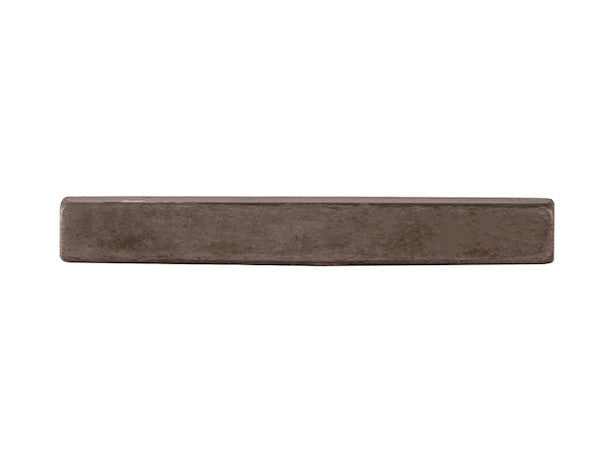
Specifications
| Finish | Plain |
|---|---|
| Key Length | 2.000 |
| Key Size (Width) | 0.375 |
| Key Type | Square |
| Material | Carbon Steel |
The 3/8 Inch Square Key Stock x 2 Inch is a vital component in mechanical engineering, engineered for robust and reliable transmission of rotational torque between a shaft and a rotating element such as a gear, pulley, sprocket, or coupling. This precisely dimensioned piece of solid material, characterized by its square cross-section, serves as a positive mechanical lock, preventing relative rotation and ensuring synchronized movement within power transmission systems. Its utility is foundational across a vast spectrum of industrial, commercial, and precision applications where secure power transfer is paramount. Meticulous adherence to specified dimensions and material properties ensures optimal performance and longevity in demanding operational environments.
Understanding Key Stock: Function and Importance
Key stock is a standardized, unmachined bar from which individual keys are cut and prepared. These keys are inserted into a keyway—a slot or recess machined into both the shaft and the mating component—to establish a mechanical link. This method of power transmission is favored for its simplicity, cost-effectiveness, and reliability, preventing slippage under torque. The fundamental principle ensures that any rotational force applied to the shaft is effectively transferred to the connected component, and vice-versa, making the assembly functional for torque transfer.
Selecting appropriate key stock involves considering factors such as transmitted torque magnitude, operating environment (temperature, corrosives), desired operational lifespan, and ease of assembly. The 3/8-inch square key stock is particularly suited for medium-duty applications, offering sufficient cross-sectional area for shear and crushing strength, while aligning with practical shaft and hub dimensioning. Its two-inch length provides ample material for precise cutting to the exact keyway length required, or for full utilization in applications demanding longer key engagement.
Dimensional Precision: 3/8-inch Square and 2-inch Length
The specified dimensions of this key stock are 0.375 inches (3/8 inch) for its square sides and a length of 2.000 inches. These dimensions are critical for ensuring a proper fit within corresponding keyways. In mechanical assemblies, the fit between a key and its keyway dictates assembly integrity and performance. Standard engineering practices often dictate either a clearance fit, a transition fit, or an interference (press) fit. For key applications, a slight interference or transition fit is commonly preferred to minimize backlash, maximize torque transfer efficiency, and aid key retention.
A 0.375-inch square cross-section signifies that both the width and height of the key are precisely 3/8 inch. This symmetry simplifies keyway machining and allows for uniform stress distribution across the key's faces under load. Manufacturing tolerances for key stock are typically very tight, ensuring interchangeability and consistent performance. Adherence to standards such as ASME B17.1 (Keys and Keyways) specifies these tolerances, crucial for achieving the desired fit type. For instance, a common tolerance for square key stock of this size might be ±0.002 inches, ensuring a snug fit without excessive play that could lead to premature wear or failure due to concentrated stresses or impact loading.
The 2.000-inch length offers significant flexibility. While standard keys often conform to specific length-to-diameter ratios relative to the shaft, this key stock length allows for custom cutting. For applications where the keyway extends along a significant portion of the shaft and hub, a longer key distributes the load over a larger area, reducing contact stresses and increasing load-carrying capacity. Conversely, for shorter keyways or multiple key configurations, the stock can be easily cut to the precise length, minimizing material waste and simplifying inventory management. The precise length specification of "2.000" emphasizes a manufacturing process designed for accuracy, preparing it for direct use or further machining.
Material Science: Carbon Steel
This key stock is manufactured from Carbon Steel, a classification encompassing a broad range of steel alloys defined primarily by their carbon content and the absence of significant quantities of other alloying elements. Carbon steel is a ubiquitous material in mechanical engineering due to its excellent balance of strength, ductility, machinability, and cost-effectiveness. Its specific properties, such as tensile strength, yield strength, and hardness, are influenced by carbon content and any subsequent heat treatment, though the "Plain" finish suggests no post-processing hardening.
For key stock applications, common carbon steel grades often fall into the low to medium carbon categories, such as AISI 1018 or 1045. AISI 1018, a low-carbon steel, is valued for its toughness, strength, and excellent machinability, making it suitable for components not requiring exceptionally high hardness but benefiting from good formability and general engineering properties. AISI 1045, a medium-carbon steel, provides superior strength and hardness, particularly when heat-treated. Even in its as-rolled or normalized condition, 1045 offers enhanced mechanical properties suitable for higher-stress applications compared to 1018. The choice of specific grade by the manufacturer aims to achieve a strength profile sufficient for preventing key failure under expected shear and compressive loads.
Carbon steel offers numerous advantages for key stock. Its inherent strength provides necessary resistance to shear and compressive stresses during torque transmission. Good machinability allows for easy cutting and shaping to achieve precise fits. Economical production makes it a cost-effective choice for mass-produced components and maintenance stock. While not inherently corrosion-resistant, its plain finish allows for subsequent treatments or coatings by the end-user if corrosion protection is required for specific environments.
Understanding the general properties of carbon steel is crucial for engineers performing stress calculations. The key's shear strength is a primary design parameter, as it is subjected to shear stresses across its cross-section. Bearing stress (crushing stress) between the key and keyway walls is another critical consideration, dependent on the key material's compressive yield strength and the hardness of mating shaft and hub materials. For optimal performance, the key material is generally selected to be softer than the shaft and hub materials, ensuring the more easily replaceable key shears before damage to more expensive components.
Finish: Plain
The "Plain" finish specification indicates that the key stock has not undergone any additional surface treatment or coating beyond its manufacturing process. This means the steel exhibits its natural mill finish—potentially a dark, oxide layer for hot-rolled products, or a brighter, smoother finish for cold-drawn products. "Plain" primarily refers to the absence of protective or decorative coatings like galvanization, zinc plating, black oxide, or paint.
The primary implication of a plain finish is limited inherent corrosion resistance. Carbon steel, when exposed to moisture and oxygen, will naturally oxidize and rust. Therefore, for applications in corrosive or humid environments, supplementary corrosion protection (e.g., painting, oiling, greasing, or specialized coating) will be necessary post-installation. For internal components within an enclosed, lubricated gearbox, a plain finish is often acceptable as the lubricant provides sufficient protection.
Despite the lack of inherent corrosion resistance, a plain finish offers practical advantages. It is generally the most economical option, avoiding additional plating or coating costs. Furthermore, a plain finish facilitates easier welding or further machining without needing to remove a surface layer, crucial for custom applications. The surface also readily accepts paints and other coatings, provided proper cleaning and preparation. For many industrial applications where the key is housed or routinely oiled, the plain finish offers a pragmatic and cost-effective solution.
Manufacturing Process Considerations
Key stock is typically produced through either hot rolling or cold drawing. Hot rolling shapes steel at elevated temperatures, yielding larger grain structures and a surface with potential mill scale and less precise dimensions. Cold drawing pulls steel through dies at room temperature, refining grain structure, increasing strength (cold work hardening), improving dimensional accuracy, and producing a smoother, brighter surface. For key stock requiring tight tolerances and superior surface finish, cold drawing is often preferred. The precise dimensions of this 0.375-inch square key stock along its 2.000-inch length suggest production via cold drawing or a similar precision forming method.
Applications in Mechanical Power Transmission
This 3/8 Inch Square Key Stock x 2 Inch finds application across diverse industrial and mechanical contexts demanding secure, non-slip torque transmission. Its primary role connects rotating components to shafts, including:
- Industrial Machinery: Gearboxes, pumps, compressors, conveyors, manufacturing equipment.
- Agricultural Equipment: Tractors, harvesters, PTO shafts, gear drives.
- Automotive and Marine: Transmission systems, auxiliary drives, propeller shafts (heavy-duty/older applications).
- Electric Motors and Generators: Coupling rotor shafts to external loads.
- Fluid Power Systems: Connecting hydraulic pumps and motors to drive shafts.
- Construction Equipment: Excavators, loaders, cranes for power transmission.
- General Engineering and Fabrication: Repair, maintenance, prototype development, custom machinery.
The standardized 3/8-inch square size ensures compatibility with a wide range of standard shafts and hubs, simplifying design and replacement. Its 2-inch length offers flexibility for various keyway lengths, from short, high-stress scenarios to longer, distributed load applications.
Technical Design Considerations for Keyed Connections
Engineers integrating a 3/8-inch square key must consider several critical technical factors for integrity and longevity. Primary failure modes for keys are shear failure and crushing (bearing) failure.
Shear Failure
Shear failure occurs when the tangential force exceeds the key material's shear strength. Shear stress (τ) on a square key is calculated from transmitted torque (T), shaft radius (r), key width (w), and engaged length (L). The key's torque capacity relates to its shear area (w * L) and the allowable shear stress (S_s) of the carbon steel. Selecting carbon steel with adequate shear strength is paramount, especially in dynamic or high-torque applications. Ultimate and yield shear strengths are typically estimated as a percentage of tensile strength (e.g., 60-70%).
Crushing (Bearing) Failure
Crushing failure occurs when compressive stress from the key on keyway walls exceeds the bearing strength of the shaft or hub materials. The bearing area for a square key is typically half its height multiplied by its engaged length (0.5 * h * L) in both shaft and hub. Bearing stress (σ_b) is the tangential force divided by this bearing area. High bearing strength for shaft and hub is crucial to prevent deformation. Often, key material is slightly softer than shaft/hub material, ensuring the key shears before damaging more expensive components. Contact pressure on the 3/8-inch key faces requires assessment against compressive yield strength of all involved materials.
Keyway Design and Stress Concentration
Keyway design and machining are equally critical. Sharp keyway corners act as stress concentrators, potentially leading to fatigue failure in the shaft or hub. Generous radii at corners mitigate this. Accurate keyway machining affects the fit and stress distribution. A loose fit causes backlash and impact loading; an overly tight fit induces residual stresses and complicates assembly.
Dynamic Loading and Fatigue
For applications with frequent starts/stops, reversals, or shock loads, fatigue analysis is essential. Repeated stress cycles cause microscopic cracks, leading to failure below static yield strength. Carbon steel material properties, surface finish, and joint design (including keyway stress concentrations) influence fatigue life. This "Plain" carbon steel key stock relies on its inherent material strength for fatigue resistance.
Fit and Tolerance
The chosen fit between key and keyway is paramount. Clearance fits (key slightly smaller than keyway) allow easy assembly but can cause backlash and impact loading. Interference fits (key slightly larger, requiring pressing/heating) eliminate backlash and create a rigid connection but induce stresses and complicate disassembly. Transition fits balance these. For a 3/8-inch key, standard tables and engineering handbooks provide recommended tolerances (e.g., ASME B17.1) for specific fit types.
Environmental Factors
Environmental considerations, especially corrosion, are vital for plain carbon steel key stock. In humid, wet, or chemically aggressive environments, unprotected plain carbon steel will rust, leading to seizing, pitting, and weakening. While mechanically strong, its plain finish necessitates external protection (coatings, sealants, lubrication) to mitigate corrosion, particularly for outdoor or marine use. The 2-inch length offers flexibility for coating the entire piece once cut or even prior to cutting.
Installation and Maintenance Best Practices
Proper installation is crucial. The key should be accurately cut to length, often chamfered or rounded to facilitate insertion and prevent stress concentrations. Keyways in both shaft and hub must be precisely machined to correct dimensions and finish for a snug fit. During assembly, the key is typically inserted into the shaft keyway, then the hub slides over it. For interference fits, controlled heating of the hub or cooling of the key may be used. Care must be taken to avoid damaging key or keyway surfaces.
Maintenance involves periodic inspection for wear, fretting corrosion, deformation, or looseness in critical applications. Lubrication, where applicable, reduces wear and prevents corrosion. A key is generally designed to be sacrificial; if failure occurs, replacement is relatively easy, minimizing damage to more expensive shaft or hub components. Standardized key stock like this simplifies replacement.
Quality Assurance and Industry Standards
Adherence to industry standards is paramount. Reputable manufacturers of 3/8-inch square carbon steel key stock ensure products conform to relevant American Society of Mechanical Engineers (ASME) standards, particularly ASME B17.1 "Keys and Keyways," specifying dimensions, tolerances, and design guidelines. The carbon steel material itself will meet American Society for Testing and Materials (ASTM) specifications for composition and mechanical properties (e.g., ASTM A36, or specific AISI/SAE grades). These standards assure dimensional accuracy, material integrity, and interchangeability, critical for reliable power transmission.
Conclusion
The 3/8 Inch Square Key Stock x 2 Inch is an indispensable component in mechanical engineering, providing a reliable and efficient means of transmitting torque. Its precise dimensions, coupled with the robust properties of plain carbon steel, make it suitable for a wide array of medium-duty industrial and commercial applications. Understanding its technical specifications – the 0.375-inch square profile, 2.000-inch length, carbon steel properties, and plain finish – enables engineers to effectively design, implement, and maintain secure power transmission systems. Meticulous consideration of shear and crushing stresses, keyway design, fit, and environmental factors ensures this seemingly simple component performs its vital function with integrity and longevity, upholding the operational efficiency and safety of mechanical assemblies globally.