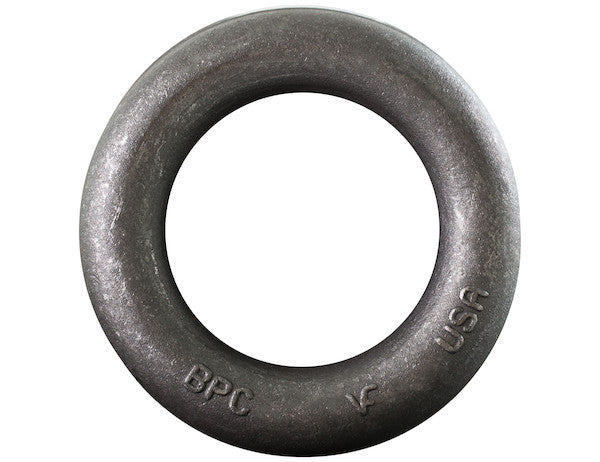
The Forged Lunette Eye from Buyers Products is a weldable forged steel ring for use in a range of OEM trailer applications.
Specifications
| Eye Inner Diameter (in.) | 3.00 |
|---|---|
| Eye Outer Diameter (in.) | 5.00 |
| Finish | Plain |
| M.G.T.W. (lbs.) | - |
| M.V.L. (lbs.) | - |
| Material | Forged Steel |
Advanced Technical Overview: The 3-Inch I.D. x 5-Inch O.D. Forged Lunette Eye for Heavy-Duty Towing Systems
In the demanding world of commercial, industrial, and specialized towing, the integrity and reliability of every component in the coupling system are paramount. The 3-inch Inner Diameter (I.D.) and 5-inch Outer Diameter (O.D.) Forged Lunette Eye from Buyers Products represents a critical link designed to deliver unparalleled strength and durability in a wide array of original equipment manufacturer (OEM) trailer applications. This detailed technical exposition delves into the engineering principles, material science, manufacturing excellence, and application considerations that define this superior forged steel lunette eye.
Precision Engineering and Dimensional Significance
The 3.00-inch I.D. and 5.00-inch O.D. dimensions are precisely engineered to meet industry standards for heavy-duty pintle hook coupling systems. The 3-inch inner diameter is a standard, optimized for seamless interface with appropriately sized pintle hooks, ensuring a secure, low-tolerance connection that minimizes slack and articulation play. This precise fit minimizes wear on both components, extending the entire towing apparatus's service life. The 5-inch outer diameter provides material thickness for exceptional load-bearing capacity and resistance to deformation under extreme tensile, compressive, and shear forces. This robust cross-section is fundamental in distributing stress effectively, preventing localized stress concentrations that could lead to premature failure. The design balances structural integrity with compatibility for various drawbar and trailer tongue mounting configurations.
The Unrivaled Advantages of Forged Steel
At its core, this product’s exceptional performance stems from its high-quality forged steel construction. Forging fundamentally alters the metal's grain structure, yielding superior mechanical properties compared to casting or machining from plate stock. During forging, steel billets are heated and subjected to controlled compressive forces, deforming the metal into the desired shape. This process refines the internal grain structure, aligning grain flow with the part's contour, which offers critical advantages:
- Enhanced Strength-to-Weight Ratio: Forged components exhibit higher tensile, yield, and fatigue strength, meaning greater load capacity and endurance under stress cycles before failure. This allows for robust, weight-efficient designs.
- Superior Toughness and Impact Resistance: Refined grain structure and absence of internal voids make forged steel highly resistant to sudden impacts and brittle fracture, vital in dynamic towing environments.
- Improved Fatigue Life: Components subjected to repetitive loading benefit immensely from increased fatigue resistance. Continuous grain flow minimizes stress risers, significantly extending operational lifespan.
- Reduced Internal Defects: Forging eliminates internal gas pockets, shrinkage, and micro-porosity common in castings, resulting in denser, homogeneous material with predictable performance.
- Excellent Weldability: The high-quality, uniform metallurgical structure of forged steel, especially when specified for welding, facilitates strong, reliable weld joints, critical for OEM integration.
The specific steel type is typically a medium to high-carbon alloy, selected for optimal strength, ductility, and weldability. The 'Plain' finish is strategic for weldable components, ensuring direct metal-to-metal contact for optimal weld integrity, free from coating contamination. Post-welding, the assembly can receive appropriate surface treatments (e.g., painting, powder coating, galvanization) for tailored corrosion protection.
Load Capacity and Performance Metrics: M.G.T.W. and M.V.L.
While explicit Maximum Gross Trailer Weight (M.G.T.W.) and Maximum Vertical Load (M.V.L.) ratings are not provided for this individual component, their significance to the overall coupling system is critical. M.G.T.W. defines the maximum allowable weight of a loaded trailer; M.V.L. (tongue weight) is the maximum downward force at the coupling point. For a lunette eye, these ratings are intrinsically linked to the entire towing system's design and certification, encompassing the pintle hook, drawbar, and vehicle hitch. The lunette eye's material strength, design geometry, and weldment quality contribute to these ratings. Engineers will calculate ultimate M.G.T.W. and M.V.L. based on comprehensive analysis, including:
- Tensile and Shear Strength Analysis: Determining maximum forces the lunette eye can withstand (tension, shear).
- Fatigue Analysis: Assessing endurance under repeated stress cycles without failure.
- Material Properties: Utilizing known mechanical properties (e.g., ultimate tensile strength, yield strength).
- Weld Joint Strength: The weld's integrity to the drawbar is as critical as the eye.
- Safety Factors: Applying mandated safety factors (e.g., SAE, DOT).
The absence of explicit M.G.T.W. and M.V.L. for the standalone lunette eye underscores its role as a critical component within a larger engineered system; its strength enables the final assembly to achieve high ratings when properly designed and certified.
Advanced Welding and Integration Considerations
The "weldable" characteristic highlights this forged lunette eye's critical utility: seamless integration into diverse trailer drawbar designs. Achieving a robust weld joint is paramount for system safety and longevity. Engineers and fabricators must adhere to stringent welding practices:
- Welding Process Selection: Common processes include Shielded Metal Arc Welding (SMAW), Gas Metal Arc Welding (GMAW), and Flux-Cored Arc Welding (FCAW). Choice depends on equipment, material thickness, desired penetration, and application environment.
- Filler Material Selection: Appropriate filler metals must match the base forged steel's mechanical properties, ensuring the weld joint is as strong or stronger than the parent material (e.g., AWS A5.1/A5.1M).
- Joint Preparation: Proper preparation, including cleaning, beveling, and fitting, is essential for full penetration and a defect-free weld.
- Pre-heating and Post-heating: Depending on steel's carbon equivalent and ambient temperature, pre-heating may slow weld/HAZ cooling, reducing hydrogen-induced cracking. Post-weld heat treatment may enhance ductility and reduce residual stresses for critical applications.
- Qualified Welders: All welding should be performed by certified, experienced welders per recognized standards (e.g., AWS D1.1).
- Quality Assurance: Non-destructive testing (NDT) methods (visual, magnetic particle inspection, ultrasonic testing) verify weld integrity and absence of flaws.
The "Plain" finish further streamlines manufacturing by eliminating the need to grind off coatings before welding, ensuring optimal weld quality.
Versatile Applications Across Industries
The 3-inch I.D. x 5-inch O.D. Forged Lunette Eye is a staple in heavy-duty towing applications across industries. Its robust design and material properties make it ideal where reliability and strength are non-negotiable:
- Commercial and Fleet Trailers: Used extensively on flatbed trailers, dry vans, utility trailers, and specialized heavy-haul trailers for construction, logistics, and transportation sectors.
- Agricultural Equipment: Essential for coupling large agricultural implements to tractors, often operating in challenging terrains.
- Construction Trailers: Integral to dump trailers, equipment haulers, and mobile workshops, transporting heavy machinery and materials.
- Military and Defense Applications: Employed in various military trailers and ground support equipment where extreme durability and reliability are critical.
- Specialized Transport: Used for custom-built trailers, emergency service vehicles, and unique towing requirements demanding a high-strength, articulated connection.
The pintle hook-and-lunette eye system offers distinct advantages over ball couplers in heavy-duty scenarios: superior articulation over uneven terrain, a more robust connection for high gross weights, and a simpler, more rugged design less susceptible to failure from wear or impact. The 3-inch I.D. is a widely accepted standard, ensuring broad compatibility with readily available pintle hooks from various manufacturers, offering flexibility in system design and component sourcing.
Maintenance and Longevity Considerations
While the forged lunette eye is designed for extreme durability, its lifespan is influenced by proper installation, regular inspection, and integration within a well-maintained towing system. Key considerations include:
- Initial Installation Verification: Ensure the lunette eye is correctly aligned and integrated to distribute forces evenly.
- Routine Visual Inspections: Regularly check for wear, deformation, cracks, or corrosion, especially on the inner surface contacting the pintle hook and around the weld joint. Any damage warrants immediate attention.
- Pintle Hook Condition: Mating pintle hook condition is equally important; excessive wear can accelerate lunette eye wear.
- Lubrication: While the lunette eye doesn't require lubrication, the pintle hook mechanism often does. Proper lubrication ensures smooth operation, reduces friction, and minimizes wear on both components.
- Environmental Factors: Exposure to corrosive environments (salt, chemicals) or extreme temperatures can affect the material. Post-welding coatings are crucial for protection.
- Load Management: Operating within the specified M.G.T.W. and M.V.L. of the complete towing system is paramount to prevent premature fatigue or catastrophic failure.
Adherence to these maintenance practices significantly extends service life and safe operation, maximizing ROI in high-quality components like the forged lunette eye.
Compliance with Industry Standards
The 3-inch I.D. x 5-inch O.D. Forged Lunette Eye's design and material specifications adhere to relevant industry standards and regulations. While specific component certification varies, its characteristics enable compliance for the complete towing system. Key standards include:
- SAE J847: This standard specifies performance requirements for pintle hook and lunette eye assemblies, covering ultimate longitudinal strength, vertical load capacity, and fatigue life. This lunette eye’s design directly supports J847 compliance when integrated into a certified system.
- Federal Motor Vehicle Safety Standards (FMVSS): FMVSS 393.70 (Coupling Devices and Towing Methods) sets requirements for vehicle towing systems. OEMs must ensure their final product complies with these safety standards.
- Regional and International Standards: Depending on the market, other standards (e.g., ISO, European directives) may apply, requiring consideration during OEM product development.
The commitment to forged steel and precise dimensions underscores dedication to facilitating compliance, providing OEMs with a foundational component for safe, reliable, and legally compliant towing solutions.
Conclusion: A Foundation of Strength and Reliability
The 3-inch I.D. x 5-inch O.D. Forged Lunette Eye from Buyers Products stands as an exemplary component for heavy-duty towing applications. Its meticulous design, leveraging forged steel's superior properties, ensures exceptional strength, durability, and resistance to rigorous commercial and industrial demands. Precise dimensions facilitate seamless integration with industry-standard pintle hooks, while its weldable 'plain' finish simplifies OEM manufacturing processes and guarantees robust weldments. More than just a steel ring, this lunette eye is a critical engineering element, embodying a commitment to safety, longevity, and high performance. For OEM manufacturers seeking reliable, secure towing components, this forged lunette eye offers an unparalleled combination of material excellence, manufacturing precision, and design integrity, ultimately enhancing the entire towing system's safety and operational efficiency.