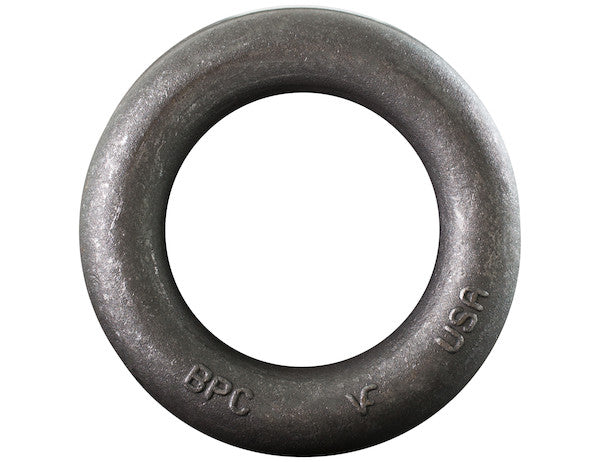
The Forged Lunette Eye from Buyers Products is a weldable forged steel ring for use in a range of OEM trailer applications.
Specifications
| Eye Inner Diameter (in.) | 3.00 |
|---|---|
| Eye Outer Diameter (in.) | 6.25 |
| Finish | Plain |
| M.G.T.W. (lbs.) | - |
| M.V.L. (lbs.) | - |
| Material | Forged Steel |
The 3 Inch I.D. And 6-1/4 Inch O.D. Forged Lunette Eye by Buyers Products represents a high-performance, robust, and precision-engineered component critical for heavy-duty towing applications. Designed as a weldable forged steel ring, this lunette eye serves as the essential mechanical interface between a tow vehicle's pintle hook and the towed implement. Its meticulous design, coupled with advanced manufacturing processes, ensures exceptional durability, reliability, and safety across a broad spectrum of demanding OEM trailer operations.
Material Excellence: The Advantage of Forged Steel
At the core of this lunette eye's superior performance is its construction from high-grade forged steel. Forging is a metallurgical process that fundamentally alters and refines the grain structure of the metal through controlled plastic deformation under immense pressure. Unlike casting, which involves pouring molten metal into a mold, or fabrication from multiple pieces of plate, forging creates a continuous grain flow that aligns with the contours of the part. This process eliminates internal voids, porosity, and structural inconsistencies common in cast components, while also surpassing the strength limitations of welded plate fabrications.
The benefits derived from forged steel are manifold and directly contribute to the lunette eye's operational excellence:
- Superior Strength-to-Weight Ratio: The refined grain structure of forged steel provides significantly higher strength for a given weight, optimizing performance without introducing unnecessary mass.
- Exceptional Toughness and Impact Resistance: Forged components exhibit unparalleled toughness, making them highly resistant to sudden impacts, shocks, and vibrational stresses encountered in demanding towing environments. This resilience is vital for enduring dynamic forces from braking, acceleration, and uneven terrain.
- Extended Fatigue Life: Components like lunette eyes are subjected to repetitive cyclic loading. The uniform grain structure and absence of internal defects in forged steel dramatically extend the component’s fatigue life, ensuring sustained performance over many years of rigorous use and preventing premature failure.
- Consistent and Predictable Mechanical Properties: Forging ensures uniform mechanical properties throughout the component, enabling precise engineering calculations and guaranteeing consistent, reliable performance across all manufactured units.
Precision Engineering: Dimensional Integrity and Functional Impact
The precise dimensions of this lunette eye are paramount to its function and safety:
- 3.00-inch (76.2 mm) Inner Diameter (I.D.): This critical dimension ensures a precise and secure fit with industry-standard pintle hook designs. A tightly toleranced I.D. minimizes unwanted slack and excessive play between the lunette eye and the pintle hook, which is crucial for reducing wear on both components, mitigating shock loads transmitted through the towing connection, and enhancing overall towing stability. Deviations in this dimension can lead to accelerated wear, increased operational noise, and potentially hazardous disconnections, underscoring the necessity of dimensional accuracy.
- 6.25-inch (158.75 mm) Outer Diameter (O.D.): The substantial 6.25-inch O.D. provides the necessary structural mass and surface area for effective welding and robust integration into the trailer's drawbar or tongue assembly. This dimension ensures adequate material thickness to withstand the immense shear, tensile, and compressive forces exerted during towing, braking, and maneuvering. The generous O.D. also provides a broad, stable foundation for the weld joint, efficiently distributing stresses and preventing localized stress concentrations that could compromise the integrity of the attachment.
Manufacturing processes for this lunette eye adhere to stringent dimensional tolerances. These tight tolerances are vital for both interoperability with standard pintle hooks and for optimizing stress distribution within the lunette eye itself, preventing potential weak points and guaranteeing consistent, reliable performance across every unit.
Optimized Weldability and Seamless Integration
Explicitly designed as a "weldable" component, this forged lunette eye offers metallurgical compatibility with standard welding practices prevalent in trailer manufacturing. The high-grade steel selected for forging possesses excellent weldability, facilitating robust and enduring integration into trailer chassis. Successful integration, however, necessitates adherence to established welding protocols:
- Pre-heating: Depending on the specific steel alloy, component thickness, and ambient temperature, pre-heating may be required. This helps reduce thermal gradients, minimize the risk of hydrogen embrittlement, and ensure a sound metallurgical bond.
- Filler Material Selection: Choosing the correct welding filler material is crucial to match the mechanical properties of the base forged steel, ensuring the weld joint exhibits comparable strength and ductility to the parent material.
- Welding Technique: Proper welding techniques, including appropriate amperage, voltage, travel speed, and weave patterns, are essential for achieving full penetration, adequate fusion, and minimal distortion in the weldment.
- Post-weld Treatment: For certain high-stress or extreme-duty applications, post-weld heat treatment might be considered to relieve residual stresses and further enhance the fatigue life of the welded assembly. For most standard trailer applications, however, sound welding practices alone are sufficient.
When correctly welded, this lunette eye becomes an integral, load-bearing extension of the trailer's drawbar. Its design facilitates direct welding to primary structural members of the trailer tongue, creating a monolithic connection capable of transferring substantial longitudinal, transverse, and vertical loads from the trailer to the tow vehicle with uncompromised integrity.
Unwavering Performance Under Duress
This forged lunette eye is inherently engineered to provide the foundational strength required for the most demanding applications. Its robust construction ensures reliable performance under the combined static and dynamic forces associated with heavy hauling:
- Dynamic Loading: Trailer operations involve constant cycles of tension (acceleration), compression (braking), shear (turning, traversing uneven terrain), and bending. The forged steel construction excels in managing these complex stress states. The refined, defect-free grain structure effectively resists crack initiation and propagation, which are primary mechanisms of fatigue failure in inferior materials.
- Impact Resistance: Accidental impacts, sudden jolts, or extremely rough terrain can subject the towing connection to severe shock loads. The superior toughness of forged steel provides a critical margin of safety, absorbing and dissipating impact energy without fracturing, thereby maintaining the structural integrity of the towing link and preventing catastrophic failure.
- Wear Resistance: Continuous articulation between the lunette eye and the pintle hook inevitably leads to abrasive wear. The inherent hardness, density, and consistent microstructure of forged steel contribute to exceptional wear resistance, significantly prolonging the service life of the component and reducing the frequency of maintenance or replacement.
While specific M.G.T.W. (Maximum Gross Trailer Weight) and M.V.L. (Maximum Vertical Load) ratings are ultimately determined by the entire coupling system and trailer design, the quality and strength of this forged lunette eye ensure it is capable of forming the basis for systems rated for substantial load capacities.
Manufacturing Excellence and Rigorous Quality Assurance
The production of such a critical safety component demands unwavering adherence to stringent manufacturing and quality control standards. From the initial selection of premium steel billets to the precise control of heating temperatures and forging pressures, every stage of production is meticulously managed to ensure optimal material properties and dimensional accuracy.
Buyers Products implements a comprehensive suite of quality control measures throughout the manufacturing process, which typically includes:
- Material Certification: Verification of raw material chemical composition and mechanical properties from reputable steel suppliers to ensure compliance with specifications.
- In-process Inspections: Continuous monitoring during the forging process to control temperature, die alignment, and deformation parameters.
- Dimensional Verification: Utilization of precision metrology equipment, such as Coordinate Measuring Machines (CMMs) or highly accurate gauges, to confirm critical dimensions like I.D., O.D., and thickness against engineering drawings.
- Non-Destructive Testing (NDT): Techniques such as Magnetic Particle Inspection (MPI) or Ultrasonic Testing (UT) may be employed to detect surface and subsurface defects, ensuring the internal and external integrity of the forged component.
- Mechanical Testing: Periodic destructive testing of production samples to confirm tensile strength, yield strength, elongation, and impact toughness, validating the material's performance characteristics.
- Traceability: A robust traceability system ensures that each lunette eye can be traced back to its raw material batch and specific manufacturing parameters, facilitating quality audits and continuous process improvement.
These rigorous quality assurance protocols underscore a profound commitment to delivering components that not only meet but often exceed industry safety and performance expectations, providing end-users with unparalleled reliability and peace of mind.
Versatile Applications in OEM Trailer Manufacturing
The 3 Inch I.D. And 6-1/4 Inch O.D. Forged Lunette Eye finds widespread utility across an extensive range of OEM trailer applications, particularly those requiring superior heavy-duty towing capabilities. This includes, but is not limited to:
- Construction Trailers: Heavy-duty flatbed trailers, equipment haulers, and dump trailers designed for transporting substantial machinery, building materials, and aggregates.
- Agricultural Trailers: Large farm wagons, grain carts, and specialized agricultural implements requiring robust and reliable towing connections for demanding field operations.
- Utility and Commercial Trailers: Heavy-duty utility trailers, car haulers, and industrial trailers engineered for rigorous commercial applications where durability is paramount.
- Military and Government Trailers: Specialized trailers for defense, disaster relief, and municipal services, where absolute reliability and structural integrity are non-negotiable mission-critical requirements.
- Mining Trailers: Trailers operating in extremely harsh, rugged, and abrasive environments, often carrying extraordinarily heavy loads.
For Original Equipment Manufacturers (OEMs), this lunette eye offers a reliable, pre-engineered solution that streamlines the design and fabrication process. Its consistent quality and proven performance characteristics allow OEMs to integrate it with confidence, knowing it will uphold the reputation and stringent safety standards of their final products. The weldable nature provides significant design flexibility, enabling engineers to optimize drawbar length, angle, and attachment methods to suit specific trailer designs and operational requirements, all while maintaining superior structural integrity.
Surface Finish and Environmental Resilience
The "Plain" finish indicates that the lunette eye is supplied in its as-forged or machined state, without any factory-applied surface coatings such as paint, powder coat, or galvanization. This plain finish offers several distinct advantages for OEM applications:
- Optimal Weldability: A clean, plain steel surface is ideal for welding, as it eliminates the need for stripping or extensive surface preparation, ensuring direct metal-to-metal contact and optimal weld penetration for the strongest possible bond.
- Customizable Finishing: OEMs retain the flexibility to apply their preferred surface treatments. This allows for seamless integration into existing production lines and offers customization for specific aesthetic requirements, unique corrosion protection needs, or compatibility with the trailer’s overall finishing scheme.
- Immediate Inspection: The plain finish allows for direct visual inspection of the forged surface for any potential imperfections prior to welding and final finishing processes.
While the plain finish is excellent for welding, for long-term corrosion resistance in outdoor and harsh environments, especially where exposure to road salts, moisture, and chemicals is anticipated, OEMs are advised to apply a suitable protective coating after welding. Common options include high-performance industrial paints, durable powder coatings, or hot-dip galvanization for superior long-term protection. The inherent density and homogeneity of the forged steel provide an excellent substrate for any applied coating, enhancing its adhesion and durability.
Longevity and Total Cost of Ownership (TCO)
Investing in a high-quality forged lunette eye translates directly into superior longevity for the entire trailer system. The inherent strength, fatigue resistance, and wear characteristics of forged steel significantly extend the operational life of the towing connection, minimizing the need for premature replacements and reducing unplanned downtime. Component failure in heavy-duty applications can result in substantial financial losses due to lost productivity and potential safety hazards. By utilizing a robust forged lunette eye, trailer operators can substantially mitigate the risk of unexpected failures, ensuring continuous and reliable operation.
Furthermore, the robust design and durable material properties lead to lower long-term maintenance requirements. While periodic inspections of all towing components are always recommended, the superior resilience of this lunette eye means fewer interventions for repair or replacement, contributing to a lower total cost of ownership over the operational lifetime of the trailer. Beyond economic considerations, the primary benefit of unparalleled durability is enhanced safety. A lunette eye that maintains its structural integrity under arduous conditions safeguards personnel, cargo, and equipment, mitigating accident risks associated with towing failures.
Compliance with Industry Standards and Best Practices
Manufacturers of towing components are obligated to meet or exceed various industry standards and regulatory requirements to ensure safety, interoperability, and consistent quality. The design and manufacturing processes for the Buyers Products Forged Lunette Eye are implicitly aligned with, and designed to surpass, recognized industry benchmarks. These may include relevant SAE (Society of Automotive Engineers) standards pertaining to trailer hitches, couplers, and drawbar eyes (e.g., SAE J847 for trailer hitches and drawbars), ASTM (American Society for Testing and Materials) standards for material specifications and mechanical testing of steel, and other applicable DOT (Department of Transportation) regulations governing trailer components for on-road use. The meticulous engineering and robust material selection ensure that trailers incorporating this lunette eye can be designed and certified to meet the most stringent national and international towing regulations, instilling confidence in both OEMs and end-users.
Installation and Maintenance Protocols for Optimal Performance
While the lunette eye is meticulously designed for weldable integration, it is imperative that installation be performed by qualified professionals adhering to appropriate welding equipment, techniques, and safety standards. Strict adherence to manufacturer-specific welding procedures and general industry best practices for structural welding is paramount to ensure the longevity and safety of the connection. Prior to welding, a thorough inspection of the lunette eye for any transit damage or manufacturing anomalies is recommended. Furthermore, the welding surfaces on both the lunette eye and the trailer's drawbar must be scrupulously clean, dry, and free from contaminants such as rust, paint, oil, or grease to facilitate a strong, defect-free weld.
Once installed, regular periodic inspections of the lunette eye and its weldment are crucial as part of a comprehensive trailer maintenance program. These inspections should encompass a visual check for cracks, deformation, excessive wear, or signs of corrosion, particularly in the critical weld area. Assessment of wear patterns on the inner diameter of the lunette eye is necessary to ensure it still articulates smoothly with the pintle hook without excessive play. The integrity of the weld bead should be examined for any signs of fatigue cracking, undercut, or inadequate fusion. Due to its robust forged steel construction, the lunette eye itself requires minimal maintenance beyond these inspections. Lubrication of the pintle hook mechanism, rather than the lunette eye, is typically recommended to reduce wear at the point of articulation. However, maintaining the integrity of any applied protective coating will significantly extend the aesthetic and functional life of the component.
Conclusion
The 3 Inch I.D. And 6-1/4 Inch O.D. Forged Lunette Eye from Buyers Products represents an exemplary solution for demanding heavy-duty towing applications. Its foundational strength, derived from the superior forging process, combined with precise dimensional control, excellent weldability, and rigorous quality assurance, positions it as a premier choice for original equipment manufacturers. This component delivers unparalleled levels of reliability, safety, and longevity, contributing to a lower total cost of ownership and enhanced operational efficiency for the end-user. For trailer builders seeking uncompromising quality and proven durability in their most critical towing connections, this forged steel lunette eye stands as an indispensable choice, ensuring that their products consistently meet the most demanding performance expectations in the field.