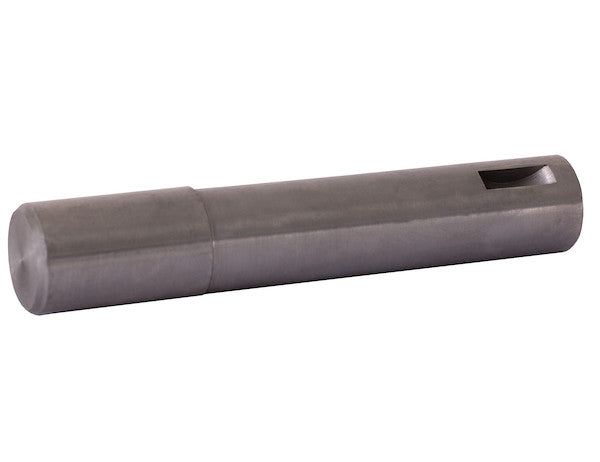
Buyers Products Midship Stub Shaft can extend the length of an H7 or B1310 Tubular Shaft Assembly in conjunction with a Pillow Block, Woodruff Key, and End Yoke -- all available from Buyers Products The Midship Stub Shaft economically couples components far away from the power source by extending the shaft assembly with a bearing support in the middle.
Specifications
| Center of Journal Assembly to Center of Journal Assembly Length | - |
|---|---|
| Description | Midship stub shaft for 1-1/4in OD x 0.095in wall tubing |
| Overall Length | 5.65 |
| Series | H7 / B1310 |
Advanced Technical Overview: Buyers Products Midship Stub Shaft for 1-1/4in Tubular Systems
The Buyers Products Midship Stub Shaft represents a critical component in the design and implementation of extended power transmission systems, specifically engineered for integration with 1-1/4 inch diameter tubular shaft assemblies. This precision-machined element is indispensable for applications requiring the efficient and reliable transfer of rotational power over distances that exceed the practical limits of a single-piece driveshaft. By facilitating the strategic division of a long driveshaft into multiple, shorter segments supported by intermediate bearings, the midship stub shaft significantly enhances system stability, mitigates vibrational issues, and extends the operational lifespan of the entire driveline.
Core Functionality and System Integration
At its essence, the Midship Stub Shaft is designed to extend the effective length of a power transmission shaft assembly. It achieves this by providing a robust and precisely dimensioned interface point for an intermediate support bearing, commonly a pillow block bearing. This bearing support is critical for managing the dynamic forces inherent in rotating shafts, particularly over extended lengths. The stub shaft is specifically engineered for seamless integration with H7 or B1310 Series Tubular Shaft Assemblies, which denotes its compatibility with industry-standard universal joint configurations. The incorporation of this component requires several other crucial elements, all meticulously engineered and available from Buyers Products, to form a complete and functional midship assembly: a Pillow Block for bearing support, a Woodruff Key for securing rotational components, and an End Yoke for connecting to the next shaft segment or output component.
The operational principle revolves around the concept of dividing a potentially long, flexible shaft into two or more stiffer, shorter segments. A single, excessively long driveshaft is susceptible to various detrimental phenomena, including critical speed resonance, excessive deflection, and harmonic vibrations, all of which can lead to premature failure and reduced efficiency. By introducing a midship support, the overall system's critical speed is effectively raised, allowing for higher operational speeds without encountering destructive resonances. Furthermore, the intermediate bearing support stabilizes the shaft, reducing bending moments and minimizing shaft "whipping" or dynamic instability, thereby ensuring a smoother, more reliable transfer of torque from the power source to the driven components. This modular approach not only enhances performance but also offers economic advantages by utilizing standard, readily available components rather than custom-fabricated, extremely long shafts.
Detailed Technical Specifications and Material Science
The Midship Stub Shaft is meticulously designed for 1-1/4 inch OD (Outer Diameter) x 0.095 inch wall thickness tubing. This specific dimensional compatibility is paramount for achieving a precise interference fit or weldment, ensuring optimal concentricity and robust torque transmission without slippage or excessive runout. The overall length of the stub shaft, at 5.65 inches, is optimized to provide adequate surface area for connection to the tubular shaft and engagement with the universal joint journal, while also allowing sufficient space for mounting within a pillow block assembly without introducing unnecessary leverage or mass.
Material selection for such a critical component is dictated by the demanding operational environment of power transmission systems. Typically, these stub shafts are manufactured from high-strength alloy steels, such as AISI 4140 or similar chromium-molybdenum alloys. These materials are chosen for their superior tensile strength, yield strength, and fatigue resistance. To further enhance these properties, the stub shafts undergo a precise heat treatment process, often involving hardening and tempering. This process modifies the microstructure of the steel, increasing its hardness, wear resistance, and toughness, which are crucial for components subjected to continuous torsional and bending stresses. Precision machining, including turning, milling, and grinding, ensures tight tolerances for all mating surfaces, particularly the journal diameters for universal joints and the spline or keyway interfaces. Surface finishes are carefully controlled to minimize friction, improve sealing capabilities, and enhance resistance to corrosion and fretting fatigue, especially in the areas where bearings and other components interface.
Compatibility with H7 / B1310 Series
The designation "H7 / B1310 Series" is critical, as it defines the universal joint specification with which this stub shaft is compatible. These series numbers typically refer to specific universal joint designs and dimensional standards, often cross-referencing to industry benchmarks such as Spicer, Mechanics, or Neapco component families. Understanding this compatibility is vital for proper system design and component selection.
- H7 Series: While specific series designations can vary by manufacturer, an "H7" series often implies a universal joint with a certain journal (bearing cup) diameter and overall cross dimension, dictating the torque capacity and speed rating. This series is generally suited for medium-duty applications, providing a balance of strength and compact design. The stub shaft's journal diameters are precision-machined to accommodate the bearing cups of the H7 series universal joint, ensuring a secure and free-moving connection.
- B1310 Series: Similarly, "B1310" typically refers to a universal joint series with specific cross dimensions and bearing cup diameters, signifying its particular load-carrying capacity and operational characteristics. The 1310 series is a widely recognized standard in automotive and industrial driveshaft applications, known for its robustness in transmitting moderate to high levels of torque. The stub shaft is engineered to interface seamlessly with the bearing cups of this series, allowing for angular misalignment while efficiently transferring rotational power.
The compatibility with both series indicates a versatile design, allowing engineers to select the appropriate universal joint based on the specific torque requirements, operating angles, and expected lifespan of their application. Both series are designed for durability and are capable of handling significant dynamic loads, making them suitable for a wide range of industrial, agricultural, and commercial vehicle applications where the Midship Stub Shaft is commonly employed.
Engineering Principles and Performance Advantages
The strategic deployment of a midship stub shaft, supported by an intermediate bearing, addresses several fundamental engineering challenges associated with long driveshafts:
- Critical Speed Enhancement: A driveshaft, being a rotating beam, possesses a natural frequency at which it will resonate (critical speed). If the operational speed approaches this critical speed, severe vibrations, deflection, and ultimately structural failure can occur. By introducing an intermediate support, the effective length of each individual shaft segment is reduced, which dramatically increases the critical speed of the system. This allows the driveshaft to operate at higher rotational velocities safely and reliably, far below its new, higher critical speed.
- Vibration Damping and Harmonic Control: Long, unsupported shafts are prone to undesirable harmonic vibrations, which can cause noise, accelerated wear on components, and discomfort in vehicle applications. The midship bearing support effectively dampens these vibrations by providing a fixed nodal point, breaking the continuous vibrating span of the shaft. This results in smoother operation, reduced noise levels, and improved component longevity throughout the driveline.
- Reduced Bending Moments and Deflection: Without intermediate support, a long driveshaft would experience significant static and dynamic deflection under its own weight and operational loads. This deflection leads to increased stress concentrations and potential for fatigue failure. The midship stub shaft and pillow block reduce the unsupported span, thereby minimizing bending moments and deflection. This ensures the shaft operates closer to its intended linear path, preserving universal joint life and optimizing power transmission efficiency.
- Improved Torque Transmission Efficiency: By maintaining shaft alignment and minimizing deflection and vibration, the Midship Stub Shaft helps ensure that torque is transmitted with minimal energy loss. Excessive deflection and misalignment force universal joints to operate at higher angles and with increased friction, leading to power loss and heat generation. A properly supported system maintains optimal operating angles for universal joints, maximizing efficiency.
- Enhanced Modularity and Serviceability: A multi-piece driveshaft system, made possible by the midship stub shaft, offers significant advantages in terms of manufacturing, installation, and maintenance. Shorter shaft sections are easier to balance dynamically, handle, and install. In the event of damage or wear to a specific section, only that segment needs to be replaced, rather than an entire, costly, and unwieldy long shaft. This modularity reduces downtime and repair costs.
Applications Across Industries
The versatility and robust design of the Buyers Products Midship Stub Shaft make it suitable for an extensive range of demanding applications across various industries:
- Commercial Trucking and Heavy Equipment: Essential for long-wheelbase trucks, articulated vehicles, and specialized heavy equipment (e.g., dump trucks, cement mixers, refuse vehicles) where power needs to be transmitted from the engine/transmission to distant drive axles or PTO units. It helps manage the significant length variations and operational stresses in these vehicles.
- Agricultural Machinery: Employed in large tractors, harvesters, and implements that require power transfer to various driven components over considerable distances, often under severe environmental conditions and heavy loads.
- Construction Equipment: Integral to machinery such as graders, loaders, and excavators, where precise and reliable power delivery to various hydraulic pumps, winches, or drive systems is paramount for operational effectiveness and safety.
- Industrial Power Transmission: Utilized in manufacturing plants, processing facilities, and material handling systems (e.g., conveyors, shredders, presses) where prime movers are located remotely from the driven machinery, necessitating robust and stable shafting solutions.
- Marine Applications: In certain marine propulsion systems or auxiliary power setups on larger vessels, where engine output must be delivered to propellers or equipment located some distance away, often requiring multiple shaft segments for alignment and vibration control.
- Specialty Vehicles: Custom-built vehicles, off-road applications, and other specialized transport where unique driveline configurations are required to meet specific performance or spatial constraints.
Installation, Maintenance, and Longevity
Proper installation is paramount to realizing the full benefits and ensuring the longevity of a driveshaft system incorporating a midship stub shaft. Precision alignment of all components – the stub shaft, universal joints, pillow block bearing, and connected shaft segments – is critical. Misalignment can introduce excessive stresses, vibrations, and premature wear on universal joints and bearings. Dynamic balancing of the entire driveshaft assembly (including the stub shaft and its connected segments) is also highly recommended, especially for high-speed applications, to minimize vibration and enhance smooth operation.
Regular preventative maintenance is equally important. This includes periodic inspection of the universal joints for wear (indicated by looseness or unusual noise), checking the pillow block bearing for signs of wear, contamination, or loss of lubrication, and inspecting the stub shaft itself for any signs of fatigue, corrosion, or damage. Lubrication of universal joints and pillow block bearings according to manufacturer specifications is essential for maximizing their operational life and maintaining system efficiency. By adhering to these best practices, the Midship Stub Shaft, along with its associated components, will deliver dependable, long-term performance.
Buyers Products Commitment to Quality
Buyers Products is renowned for its commitment to engineering excellence and manufacturing robust, reliable components for the toughest applications. The Midship Stub Shaft is a testament to this philosophy, designed and produced using advanced manufacturing techniques and stringent quality control processes. From the selection of high-grade alloy steels to precision machining and heat treatment, every step ensures that the final product meets the highest standards of strength, durability, and dimensional accuracy. This dedication to quality ensures that the Midship Stub Shaft will integrate seamlessly into your power transmission system, providing the extended operational life and consistent performance expected from Buyers Products components.