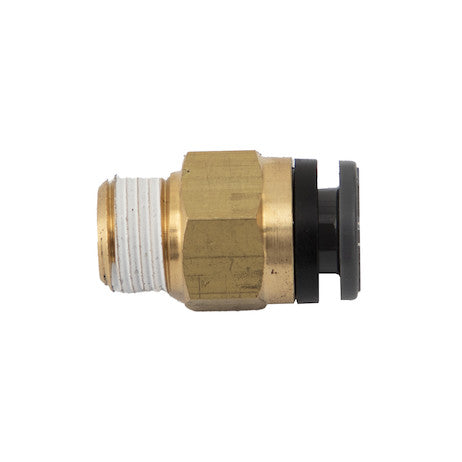
Buyers Products Male Connectors are made of long lasting corrosion-resistant brass and poly. They are designed to meet DOT FMVSS 571.106 air brake performance specifications.
Specifications
| Color | Black |
|---|---|
| Finish | Multiple |
| Fitting Shape | Straight |
| Male/Female/Union | Male |
| Material | Multiple |
| Meets D.O.T. FMVSS 571.106 Air Brake Performance Regulations (y/n) | Yes |
| Pipe Thread Size | 1/8 NPT |
| Swivel (y/n) | No |
| Works with Tube Outer Diameter | 1/4 |
Precision Engineered Brass/Poly DOT Push-In Male Connector: Unrivaled Performance for Critical Air Brake Systems
In the demanding world of commercial transportation and heavy-duty industrial applications, the integrity and reliability of pneumatic systems, particularly air brake lines, are paramount. The Brass/Poly DOT Push-In Male Connector, with its 1/4 Inch Tube O.D. and 1/8 Inch Pipe Thread, represents the pinnacle of fitting technology, meticulously engineered to deliver exceptional performance, unparalleled safety, and long-term durability. Designed to meet and exceed the stringent requirements of DOT FMVSS 571.106, this connector is the definitive choice for professionals who cannot compromise on quality or safety.
Advanced Material Science: The Brass and Polymer Synergy
The superior performance of this connector begins with its carefully selected composite materials: robust brass and advanced engineering polymer. This combination is not arbitrary; it is a deliberate engineering choice to harness the strengths of both materials, resulting in a fitting that excels in corrosion resistance, mechanical strength, sealing capability, and ease of use.
Brass: The Foundation of Strength and Durability
The primary metallic component, brass, is an alloy predominantly composed of copper and zinc. For pneumatic and hydraulic fittings, specific brass alloys are chosen for their optimal blend of properties. Key characteristics that make brass an ideal material for air brake connectors include:
- Exceptional Corrosion Resistance: Brass exhibits inherent resistance to oxidation and various corrosive agents, which is crucial in environments exposed to moisture, road salts, and automotive fluids. This prevents material degradation, ensuring the fitting maintains its structural integrity and sealing effectiveness over extended periods, directly contributing to system reliability and safety.
- High Mechanical Strength: Brass possesses a high tensile strength and hardness, allowing it to withstand the significant internal pressures inherent in air brake systems, as well as external mechanical stresses such as vibration and minor impacts. This robust nature prevents deformation or failure under operational loads.
- Excellent Machinability: The metallurgical properties of brass allow for precise machining, which is essential for creating the intricate internal and external geometries required for both the push-in mechanism and the pipe threads. This precision ensures tight tolerances, critical for both tube retention and leak-free threaded connections.
- Temperature Stability: Brass maintains its mechanical properties across a wide temperature range, making it suitable for diverse operating conditions encountered in commercial vehicles, from extreme cold to intense heat. This stability is vital for consistent performance of the air brake system.
- Fatigue Resistance: Components in air brake systems are subjected to constant pressure cycling and vibration. Brass exhibits good fatigue resistance, meaning it can endure repeated stress cycles without material fatigue and subsequent failure, ensuring a long operational lifespan.
Polymer Components: Enhancing Sealing and Ease of Use
Complementing the brass body are high-performance engineering polymer components, typically specified for their unique blend of flexibility, resilience, and chemical resistance. These components play a critical role in the push-in mechanism and sealing:
- Secure Tube Retention: The polymer collet or gripping mechanism is designed to firmly grasp the outer diameter of the air brake tubing. Its engineered teeth provide a secure, non-damaging grip that resists tube pull-out even under significant pressure and vibration, while allowing for quick release when necessary.
- Superior Sealing Performance: Integrated polymer O-rings or specialized seals create an airtight barrier around the inserted tubing. These seals are formulated to maintain elasticity and sealing force across varying temperatures and pressures, effectively preventing air leaks that could compromise brake system performance.
- Chemical Resistance: The polymers used are specifically chosen to be resistant to common automotive fluids, oils, and other chemicals that might be encountered in a vehicle's undercarriage, preventing degradation of the sealing elements.
- Vibration Dampening: The inherent flexibility of polymer components can help absorb minor vibrations, reducing stress on both the fitting and the connected tubing, thereby extending the life of the entire system.
- Lightweight Advantage: While the brass provides the bulk of the structural integrity, the polymer components contribute to the overall efficiency of manufacturing and can slightly reduce the overall weight of the fitting, a small but cumulative benefit in fleet applications.
Adherence to DOT FMVSS 571.106: The Benchmark of Safety
Compliance with DOT FMVSS 571.106 (Federal Motor Vehicle Safety Standard No. 106) is not merely a feature; it is a fundamental requirement for any component used in air brake systems on commercial vehicles. This standard outlines rigorous performance specifications for air brake hoses, assemblies, and fittings, ensuring that they can withstand the harsh operating conditions and critical demands of heavy-duty braking systems. This Brass/Poly DOT Push-In Male Connector is explicitly engineered and tested to meet these exacting standards, providing absolute assurance of its suitability for safety-critical applications.
What FMVSS 571.106 Entails:
The standard mandates comprehensive testing protocols to verify the integrity and performance of fittings under various simulated real-world conditions. These tests typically include:
- Leakage Test: Ensures that fittings maintain an airtight seal at specified pressures and temperatures, preventing any loss of air pressure that could compromise braking effectiveness.
- Tensile Test (Tube Pull-Out): Measures the force required to pull a properly installed air brake tube from the fitting. FMVSS 106 sets minimum retention force requirements to ensure the tube remains securely connected, even under extreme vibration or mechanical stress.
- Vibration Test: Subjects the fitting and tube assembly to prolonged periods of high-frequency vibration while under pressure and at elevated temperatures. This simulates the constant jarring and movement experienced by vehicle components, verifying the fitting's ability to maintain its seal and structural integrity.
- Corrosion Resistance Test: Involves exposure to salt spray or other corrosive environments to ensure that the materials and protective coatings withstand degradation over time, which could lead to leaks or structural failure.
- Pressure Cycling Test: Simulates the repeated application and release of air pressure within the system, mimicking the countless brake applications over a vehicle's lifespan. This test evaluates the fatigue resistance and long-term sealing capabilities of the fitting.
- Burst Pressure Test: Determines the maximum internal pressure the fitting can withstand before catastrophic failure, ensuring a significant safety margin above normal operating pressures.
- Temperature Endurance: Evaluates performance across the specified operating temperature range, ensuring materials do not become brittle in cold or soften in heat.
By meeting FMVSS 571.106, this connector assures users that it has been independently verified to perform reliably under the most strenuous conditions, thereby enhancing vehicle safety and preventing costly operational downtime due to component failure.
The Efficiency of Push-In Technology
The "Push-In" designation signifies a crucial advantage in installation and maintenance. This technology revolutionized pneumatic connections by eliminating the need for specialized tools, complex flaring, or cumbersome compression nuts, dramatically reducing installation time and effort. The mechanism is elegantly simple yet remarkably secure:
- Effortless Connection: To install, a properly prepared air brake tube (cut squarely and deburred) is simply pushed firmly into the fitting until it bottoms out. An internal collet or gripping ring automatically engages the tube, while an O-ring or similar seal creates an immediate, airtight connection.
- Rapid Installation: This tool-free installation method significantly speeds up assembly and repair processes, a critical advantage in high-volume manufacturing settings or time-sensitive field repairs.
- Secure Retention: Despite its ease of installation, the push-in mechanism provides exceptional tube retention. The design ensures that any attempt to pull the tube out actually increases the grip of the collet, making the connection more secure under tension.
- Reduced Skill Requirement: The simplified installation process reduces the potential for installer error, leading to more consistent and reliable connections across a workforce.
- Reusability (with proper practice): While not intended for constant re-connection, push-in fittings can typically be disconnected and reconnected several times with proper technique, by pressing the release collar evenly and pulling the tube out, without damaging the tube or fitting. This facilitates maintenance and system modifications.
Dimensional Precision: 1/4 Inch Tube O.D. x 1/8 Inch Pipe Thread
The specific dimensions of this connector are carefully chosen to align with industry standards and common applications within air brake systems.
1/4 Inch Tube O.D. (Outer Diameter)
The 1/4 inch O.D. is a widely used size for air brake tubing, particularly for smaller lines that carry air to various components like pressure gauges, auxiliary air systems, or certain brake chambers. The precision engineering of the push-in mechanism ensures a perfect fit with standard 1/4 inch O.D. nylon (PA11 or PA12) or polyurethane tubing, which are common in air brake systems due to their flexibility, durability, and resistance to chemicals.
Proper fit is paramount. A precisely dimensioned fitting ensures the gripping mechanism engages optimally and the internal seal forms an impenetrable barrier, preventing leaks and ensuring consistent pressure delivery throughout the system. The selection of materials and manufacturing processes guarantees that the internal bore and gripping components are calibrated for this exact tube size, maximizing retention and sealing integrity.
1/8 Inch Pipe Thread (NPT)
The 1/8 NPT (National Pipe Taper) thread is a common size for connecting to various air system components, including:
- Brake Valves: Connecting supply or control lines to air brake foot valves, hand valves, or relay valves.
- Air Tanks/Reservoirs: Often used for smaller port connections on air tanks, such as pressure gauge ports or auxiliary air take-offs.
- Pressure Switches and Sensors: Providing a secure pneumatic connection for devices that monitor or control air pressure.
- Actuators and Cylinders: In auxiliary pneumatic systems on commercial vehicles or industrial equipment.
The NPT thread standard is characterized by its tapered design, where the threads are not parallel but rather converge slightly. This taper is critical for creating a mechanical seal when the male and female threads are tightened together, as the flanks of the threads compress against each other. For optimal sealing and to prevent galling, the use of a thread sealant, such as PTFE tape or a liquid pipe thread sealant, is highly recommended during installation. The 1/8 NPT size provides a compact yet robust threaded connection point, suitable for a range of pressure applications without requiring excessive bulk.
Straight Fitting Configuration: Simplicity and Efficiency
The "Straight" fitting shape offers several advantages in system design and performance:
- Direct Flow Path: A straight connector provides the most direct and unrestricted path for air flow, minimizing pressure drop and turbulence within the line. This is crucial for maintaining consistent air pressure and rapid response in brake systems.
- Compact Design: Straight fittings are inherently compact, requiring minimal space for installation. This is beneficial in crowded engine compartments or chassis where space is at a premium.
- Ease of Routing: For applications where tubing runs in a straight line or requires a simple extension, a straight connector is the most straightforward and efficient solution.
- Reduced Installation Complexity: Without bends or complex angles, straight fittings are generally easier to install and integrate into existing layouts.
Performance Characteristics: Engineered for Excellence
Beyond compliance and materials, the overall performance of this connector is defined by its ability to maintain integrity under operational stresses:
- Pressure Endurance: Engineered to safely operate within the typical pressure ranges of commercial vehicle air brake systems (typically up to 150 psi or higher, with significant burst pressure margins).
- Temperature Resilience: Designed for consistent performance across a broad operational temperature range, ensuring seals remain effective in extreme cold or heat.
- Vibration Resistance: The robust design and secure tube retention mechanism prevent loosening or leakage even under constant vehicle vibration.
- Leak Integrity: The combination of precise machining, high-quality polymer seals, and proper NPT thread engagement guarantees a leak-free connection, critical for maintaining system pressure and safety.
- Chemical and Environmental Resistance: Built to withstand exposure to common lubricants, fuels, hydraulic fluids, and environmental contaminants without degradation.
Diverse Applications Across Industries
While primarily designed for DOT air brake systems, the robust construction and performance of this Brass/Poly Push-In Male Connector make it suitable for a broader range of applications requiring reliable pneumatic connections:
- Commercial Transportation: The core application in heavy-duty trucks, buses, trailers, and specialized commercial vehicles for air brake lines, suspension systems, and auxiliary pneumatic controls.
- Heavy Equipment: Construction machinery, agricultural vehicles, mining equipment, and other off-highway vehicles where robust and reliable pneumatic connections are essential for control systems, braking, and auxiliary functions.
- Industrial Pneumatics: In manufacturing and automation, for connecting pneumatic cylinders, valves, and other components in non-DOT regulated industrial settings where high-quality, durable fittings are desired.
- Fleet Maintenance and Repair: An indispensable component for mechanics and technicians performing routine maintenance, repairs, and system upgrades on commercial vehicle fleets, valued for its ease of installation and proven reliability.
Installation Best Practices for Optimal Performance
To ensure the Brass/Poly DOT Push-In Male Connector delivers its intended performance and longevity, adherence to proper installation procedures is essential:
- Tube Preparation: Cut the air brake tubing squarely and cleanly with a tube cutter designed for plastic tubing. Avoid using knives or hacksaws, as they can create burrs or uneven cuts that compromise the seal and retention. Deburr the inside and outside edges of the tube to ensure smooth insertion and prevent damage to the internal O-ring.
- Tube Insertion: Push the prepared tube firmly into the fitting until it reaches the stop. A slight resistance will be felt as the O-ring is engaged, followed by a positive "click" or feel as the collet locks onto the tube. A visual check can often confirm proper insertion depth, leaving no gap between the tube and the fitting body.
- NPT Thread Sealant: For the 1/8 NPT threaded end, always use a high-quality thread sealant. PTFE tape should be wrapped clockwise (in the direction of tightening) around the male threads, typically 2-3 layers, ensuring it does not overhang the first thread to prevent material entering the air system. Alternatively, a liquid pipe thread sealant specifically rated for pneumatic systems can be applied.
- Threaded Connection: Hand-tighten the connector into the female port until snug. Then, use an appropriate wrench to tighten it an additional 1-2 turns, or to the manufacturer's specified torque. Avoid over-tightening, as this can damage the threads, crack the female port, or compromise the integrity of the fitting. Conversely, under-tightening can lead to leaks.
- System Testing: After installation, pressurize the air brake system and conduct a thorough leak check. A common method involves spraying a soapy water solution around all connections. Any bubbling indicates a leak that requires immediate attention.
Following these guidelines ensures a secure, leak-free, and long-lasting connection, critical for the safety and operational efficiency of the air brake system.
Long-Term Maintenance and Longevity
The inherent design and material selection of the Brass/Poly DOT Push-In Male Connector contribute significantly to its longevity and low maintenance requirements. Regular visual inspections during routine vehicle service can further ensure its continued reliability. Check for any signs of physical damage, such as cracks in the plastic, deformation of the brass, or corrosion. Verify that the tubing remains fully inserted and that there are no visible leaks. Given its robust construction and adherence to stringent performance standards, this fitting is engineered to perform reliably for the entire service life of the vehicle or equipment it is installed on, minimizing the need for premature replacement.
The Buyers Products Advantage
When selecting components for air brake systems, the choice of supplier is as important as the product itself. Buyers Products is renowned for its commitment to engineering excellence, rigorous quality control, and unwavering dedication to product reliability and safety. This Brass/Poly DOT Push-In Male Connector embodies these principles, offering:
- Proven Reliability: Manufactured to exacting specifications, ensuring consistent performance.
- Regulatory Compliance: Guaranteed adherence to critical safety standards like DOT FMVSS 571.106.
- Material Superiority: The intelligent combination of corrosion-resistant brass and high-performance polymer.
- Installation Efficiency: The benefits of modern push-in technology for reduced labor and downtime.
- Expert Support: Backed by the reputation and customer service of Buyers Products.
Conclusion
The Brass/Poly DOT Push-In Male Connector, with its 1/4 Inch Tube O.D. and 1/8 Inch Pipe Thread, stands as a testament to advanced engineering in the field of pneumatic connections. Its thoughtful design, superior material composition, and rigorous adherence to DOT FMVSS 571.106 make it an indispensable component for any commercial vehicle or heavy-duty industrial application relying on air brake systems. By choosing this connector, professionals are investing in a product that delivers not just a connection, but a guarantee of safety, efficiency, and unwavering performance in the most critical of operational environments. It represents a commitment to maintaining the highest standards of system integrity, ensuring that vital air brake functions are performed flawlessly, every time.