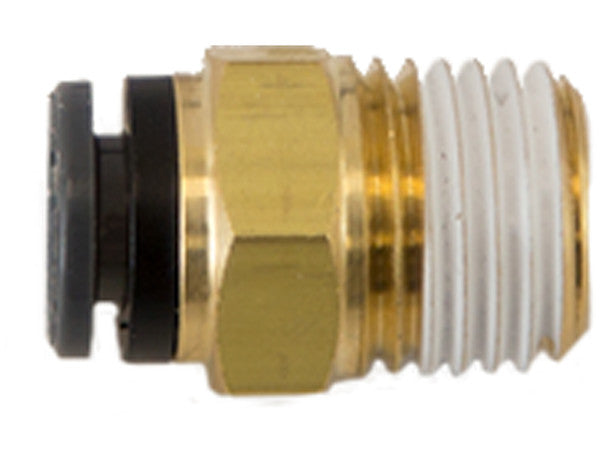
Buyers Products Male Connectors are made of long lasting corrosion-resistant brass and poly. They are designed to meet DOT FMVSS 571.106 air brake performance specifications.
Specifications
| Color | Black |
|---|---|
| Finish | Multiple |
| Fitting Shape | Straight |
| Male/Female/Union | Male |
| Material | Multiple |
| Meets D.O.T. FMVSS 571.106 Air Brake Performance Regulations (y/n) | Yes |
| Pipe Thread Size | 3/8 NPT |
| Swivel (y/n) | No |
| Works with Tube Outer Diameter | 3/8 |
Technical Overview: Brass/Poly DOT Push-In Male Connector for Air Brake Systems
The Buyers Products Brass/Poly DOT Push-In Male Connector, specifically engineered for 3/8-inch tube outer diameter (O.D.) and a 3/8-inch National Pipe Taper (NPT) pipe thread, represents a critical component in the intricate architecture of commercial vehicle air brake systems. This fitting embodies a fusion of advanced material science, precision engineering, and adherence to stringent safety regulations, making it an indispensable element for reliable and efficient pneumatic connections. Designed to facilitate a secure, leak-free interface between flexible air brake tubing and rigid system components, its construction leverages the synergistic properties of high-grade brass and sophisticated engineering polymers, ensuring full compliance with the demanding safety and performance mandates of DOT FMVSS 571.106.
Design and Functional Principles
The core function of this straight male connector is to establish a robust, inline pneumatic conduit. Its straight configuration is essential for direct connections, minimizing the potential for flow restriction and pressure drops often associated with complex angled fittings, and simplifying tube routing in constrained vehicle chassis environments. The "male" designation signifies its external NPT threading, designed for engagement with a corresponding internally threaded port on air reservoirs, valves, calipers, or other system components. This mechanical threaded connection, when properly torqued and sealed, forms a foundational, high-integrity joint capable of withstanding the dynamic pressures, vibrations, and mechanical stresses inherent in heavy-duty vehicle operation. The integration of modern push-in (also known as push-to-connect or instant) technology significantly streamlines the tube connection process, moving away from more labor-intensive traditional methods while simultaneously enhancing sealing integrity and overall system reliability.
Advanced Material Selection: Brass and Engineering Polymers
The superior performance and longevity of this connector are directly attributable to the meticulous selection and synergistic application of its constituent materials: brass and specialized engineering polymers.
Brass Componentry
The metallic body of the connector is precisely machined from high-grade brass, typically an alloy such as C36000 (Free Machining Brass). Brass is chosen for its exceptional machinability, which allows for the creation of intricate thread profiles and tight tolerances critical for reliable pneumatic seals. Its inherent properties make it ideally suited for the demanding environment of commercial vehicle air brake systems:
- **Corrosion Resistance:** Brass exhibits excellent resistance to oxidation, rust, and dezincification, particularly important in applications exposed to moisture, road salts, and various atmospheric contaminants common in heavy-duty vehicle operation. This ensures the structural integrity of the threaded connection and the overall fitting is maintained over extended service periods.
- **Strength and Durability:** While ductile, brass possesses sufficient tensile strength and hardness to withstand the mechanical stresses of repeated tightening, vibration, and internal pneumatic pressures without deformation or fatigue.
- **Thermal Stability:** Brass maintains its mechanical properties across a wide range of operating temperatures, crucial for components exposed to ambient temperature fluctuations and potential heat generated within the brake system.
- **Galvanic Compatibility:** Its electrochemical properties ensure good compatibility with other metallic components commonly found in air brake systems, minimizing the risk of accelerated galvanic corrosion.
- **Non-Sparking Properties:** In certain operational contexts, the non-sparking characteristic of brass provides an additional safety advantage.
Engineering Polymer Elements
Complementing the robust brass foundation, the internal elements of the push-in mechanism—specifically the collet and sealing components—are crafted from advanced engineering thermoplastics. High-performance polyamides (such as Nylon 11 or Nylon 12) or acetal resins are typically utilized for these critical parts. These polymers are selected for their outstanding physical and chemical properties:
- **Mechanical Strength and Flexibility:** Polymers used exhibit high tensile strength, excellent fatigue resistance, and superior resistance to abrasion. The polymer collet is ingeniously designed with multiple gripping teeth, or 'claws,' which flex upon tube insertion and then securely engage the outer diameter of the air brake tubing, preventing accidental dislodgement.
- **Chemical Resistance:** These materials possess remarkable chemical compatibility with various fluids encountered in heavy-duty applications, including oils, greases, diesel fuel, and air brake conditioning agents (e.g., alcohol used for moisture absorption), ensuring the long-term integrity of the seal and gripping mechanism.
- **Sealing Performance:** The internal O-ring seal, typically made from a high-resilience elastomer such as Nitrile Butadiene Rubber (NBR) or Ethylene Propylene Diene Monomer (EPDM) depending on specific chemical and temperature requirements, provides the primary hermetic barrier against air leakage. The low coefficient of friction of the polymer components facilitates smooth tube insertion, while their inherent flexibility allows for slight tube misalignment without compromising seal integrity.
- **Lightweight and Vibration Damping:** The use of polymers contributes to overall weight reduction compared to all-metal designs and offers some inherent vibration-dampening qualities, which can extend the lifespan of the connection under continuous vehicle motion.
This composite material approach ensures a connector that is both lightweight and exceptionally durable, optimized for the rigorous demands and harsh environments encountered by air brake systems.
Precision Dimensional Specifications: 3/8-Inch Tube O.D. x 3/8-Inch NPT
The precise dimensional specifications of 3/8-inch tube outer diameter (O.D.) and 3/8-inch National Pipe Taper (NPT) thread are paramount for ensuring proper fitment, optimal performance, and universal compatibility within standardized air brake systems.
- **3/8-Inch Tube O.D.:** This refers to the external dimension of the air brake tubing that the push-in connector is designed to accommodate. Adherence to this specific O.D. is critical for the polymer collet's gripping mechanism and the internal O-ring seal to function optimally. Upon insertion, the collet's claws engage the tube's surface, and the O-ring compresses against it, creating a secure mechanical lock and a leak-proof pneumatic barrier. Any deviation from the specified tube O.D.—whether undersized or oversized—can lead to an unreliable connection, potential air leakage, or an inability to properly insert the tube, thereby compromising the entire system's integrity and safety.
- **3/8-Inch NPT Pipe Thread:** The 3/8-inch NPT specification defines the standard for the male threaded end of the connector. NPT threads are distinctive for their tapered profile, which allows them to form a robust mechanical seal when tightened into a corresponding female NPT port. As the male and female tapered threads engage, their flanks wedge against each other, creating a metal-to-metal seal that resists internal pressure. The application of an appropriate thread sealant (e.g., PTFE tape or liquid pipe sealant) is always recommended to fill any helical leak paths and ensure a completely hermetic seal, especially given the critical high-pressure nature of air brake pneumatic systems. The "3/8" designation is a nominal pipe size; the actual physical dimensions of the threads, including pitch and taper, are meticulously standardized by specifications such as ASME B1.20.1, ensuring consistent cross-compatibility with a vast array of air brake components across the industry. Precision manufacturing of these threads is essential to prevent issues such as thread stripping, cross-threading, and to ensure optimal engagement and sealing performance under the dynamic operating conditions of commercial vehicles.
Unwavering Compliance with DOT FMVSS 571.106 Air Brake Performance Regulations
A cornerstone of this product's design philosophy and its primary value proposition is its unqualified compliance with DOT FMVSS 571.106, commonly known as Federal Motor Vehicle Safety Standard No. 106, specifically governing "Brake Hoses." This stringent federal regulation, established by the National Highway Traffic Safety Administration (NHTSA), is a critical safety standard devised to guarantee the integrity, durability, and consistent performance of all air brake hose assemblies employed in commercial motor vehicles. The overarching objective is to prevent catastrophic brake system failures that could be attributed to component inadequacy, thereby significantly enhancing vehicle safety on public roadways and mitigating the risk of accidents.
FMVSS 106 dictates rigorous performance criteria that extend beyond the hose itself to, crucially, the fittings and their ability to securely connect to the hose under a comprehensive array of extreme operating conditions. For a push-in male connector designed for air brake systems, achieving FMVSS 106 compliance necessitates undergoing a formidable battery of demanding tests designed to replicate and exceed the real-world stresses, environmental exposures, and operational cycles a commercial vehicle is expected to endure over its entire operational lifespan. Key performance specifications that these connectors must demonstrably meet include:
- **Tensile Strength (Fitting Retention Test):** This critical test evaluates the fitting's capacity to remain securely attached to the air brake tubing when subjected to substantial axial pull-off forces. FMVSS 106 specifies minimum tensile load requirements, ensuring that the push-in collet mechanism, in conjunction with the integrity of the air brake tube itself, can withstand these forces without any separation or slippage. This is paramount for preventing accidental disconnections that could lead to a sudden and complete loss of air pressure in the brake system, with potentially disastrous safety implications during severe braking maneuvers or dynamic vehicle operations.
- **Leakage Resistance (Internal and External Pressure Tests):** The standard mandates rigorous internal and external pressure leak tests. Connectors must exhibit no detectable leakage when subjected to high internal pneumatic pressures, simulating operational spikes, and must maintain their structural and sealing integrity when external forces or minor physical disturbances are applied. The primary and secondary sealing elements (O-rings, tube gripping mechanisms) must function flawlessly to prevent any measurable air loss, which could progressively compromise braking efficiency, activate warning systems prematurely, and ultimately lead to a catastrophic system failure if left unchecked.
- **Vibration Resistance:** Commercial vehicle air brake systems are perpetually exposed to high-frequency, wide-amplitude vibrations originating from engine operation, drivetrain dynamics, and varied road conditions. FMVSS 106 includes comprehensive tests that meticulously assess the fitting's ability to maintain its connection integrity and leak-free performance under prolonged and intense vibratory stress. The sophisticated design of the push-in collet, its specific material properties, and its secure engagement with the tubing are critically evaluated during these tests to guarantee long-term stability and prevent loosening or fatigue-induced failures.
- **Corrosion Resistance:** Given the severe environmental exposure to moisture, corrosive road salts, cleaning agents, and various other chemicals, the metallic components of the connector (brass) must demonstrate robust, sustained resistance to corrosion. Standardized salt spray tests, simulating years of environmental exposure, are conducted to ensure that the fitting's structural integrity, aesthetic finish, and, most importantly, its sealing capabilities are not compromised by environmental degradation over time, thereby ensuring consistent long-term performance.
- **Thermal Cycling and Extreme Temperature Performance:** Connectors are subjected to rigorous testing across a wide spectrum of operational temperatures, ranging from extreme sub-zero cold to blistering high heat. This ensures that they maintain their critical mechanical and sealing properties without degradation. This includes performance in low-temperature flexibility tests (preventing material embrittlement) and high-temperature endurance tests (preventing material softening, creep, or accelerated degradation), both of which are vital for reliable operation across diverse geographical and climatic conditions.
By successfully meeting these multifaceted and highly demanding performance specifications, the Buyers Products Brass/Poly DOT Push-In Male Connector provides an unwavering assurance of safety, reliability, and regulatory compliance. Its certification signifies that it has been independently validated and proven to perform under the most challenging operational scenarios, directly contributing to the overall safety, operational readiness, and regulatory adherence of any vehicle's air brake system.
The Mechanism and Advantages of Push-In Technology
The core innovation underpinning the efficiency and reliability of this connector is its sophisticated push-in technology. This mechanism dramatically simplifies the connection process, setting it apart from more traditional compression or barbed fittings that typically necessitate specialized tools, precise torque application, or even heat for installation. The push-in design operates on a straightforward yet remarkably effective principle: the air brake tubing is simply inserted into the fitting until it fully bottoms out.
As the tube is inserted, it traverses a precisely engineered internal assembly comprising a resilient O-ring seal and a multi-jawed collet. The O-ring, generally crafted from a robust elastomer like NBR, establishes the primary pneumatic seal against the outer diameter of the tube, effectively preventing any air leakage. Concurrently, the polymer collet's precisely angled gripping teeth, or 'claws,' are designed to flex outwards as the tube enters and then spring back to create a secure, unidirectional mechanical lock around the tube's circumference. This ingenious engagement prevents the tube from being inadvertently pulled out, even under significant axial forces, system pressure fluctuations, or continuous vibration.
The design also typically incorporates a release collar (standard for DOT push-to-connect fittings) that, when pressed, disengages the collet's grip. This allows for rapid and tool-free disconnection, facilitating quick component replacement, system modifications, or diagnostic procedures without causing damage to the tubing. The benefits of this advanced technology are substantial:
- **Significantly Reduced Installation Time and Labor Costs:** The simplicity of insertion eliminates time-consuming preparation and tightening steps.
- **Minimized Risk of Installation Errors:** Unlike torque-dependent fittings, the push-in mechanism reduces the potential for over-tightening (which can damage threads or tubing) or under-tightening (leading to leaks).
- **Consistent and Reliable Sealing Performance:** The design ensures a uniform seal every time, independent of installer skill level.
- **Enhanced Flexibility in Maintenance and Repair:** Rapid connection and disconnection allow for more efficient servicing and troubleshooting.
- **Reduced Component Wear:** Eliminates the need for wrenches or other tools that can mar fitting surfaces.
This combination of ease of use with robust holding power and superior sealing integrity has established push-in connectors as an industry benchmark for modern air brake systems.
Durability, Longevity, and Environmental Resilience
The emphasis on "long-lasting corrosion-resistant" in the product description is a direct reflection of the meticulous engineering and advanced material selection inherent in the Buyers Products male connector. The brass body, with its intrinsic resistance to oxidation, galvanic corrosion, and dezincification, is exceptionally well-suited for the often-hostile undercarriage environments of commercial vehicles. Here, continuous exposure to moisture, road salts, abrasive debris, and various corrosive agents is a constant challenge. This material integrity ensures that the critical structural components of the fitting maintain their strength, dimensional stability, and sealing capabilities over many years of arduous service, preventing premature material degradation that could lead to system failure.
Furthermore, the advanced engineering polymer components, including the collet and sealing elements, are specifically formulated not only for their superior mechanical prowess but also for their robust resistance to chemical degradation from commonly encountered oils, fuels, greases, and prevalent air brake system contaminants. The synergistic combination of these materials, coupled with a design rigorously tested and proven against the comprehensive FMVSS 106 standards, guarantees superior resistance to environmental factors, extreme mechanical stresses, and wide temperature variations. This ensures prolonged operational life and consistent, high-integrity performance without premature failure or loss of functional integrity. This comprehensive durability translates directly into maximized operational uptime, reduced unscheduled downtime, and significantly lower long-term maintenance costs for fleet operators.
Installation Best Practices and System Integration
While the installation of the Buyers Products Brass/Poly DOT Push-In Male Connector is designed for intuitive efficiency, strict adherence to best practices is paramount to ensure optimal system performance, safety, and longevity. Prior to tube insertion, the air brake tubing must be cut cleanly and squarely, free of any burrs, nicks, or scoring on its outer or inner diameter. A proper tube cutter designed for pneumatic tubing should always be used to achieve this precise cut, as an irregular cut can compromise the O-ring seal and collet grip. The tube should then be pushed firmly and deliberately into the connector until it bottoms out against the internal stop. This full insertion is crucial as it ensures that both the mechanical grip of the collet and the pneumatic seal of the O-ring have been completely and correctly established. A gentle tug on the tube can serve as an effective verification of proper seating.
For the 3/8-inch NPT threaded end, the application of an appropriate thread sealant is absolutely essential to create a robust, leak-free metal-to-metal seal between the connector and the mating female port. Recommended sealants include PTFE tape specifically designed for NPT threads (ensuring proper wrapping and thread coverage) or a high-quality anaerobic pipe sealant compatible with pneumatic systems. The non-swivel design of this fitting ensures a fixed, stable connection once tightened, preventing any undesirable rotational movement that could stress the tubing, compromise the threaded seal over time, or lead to accidental loosening. This fixed orientation is often preferred in applications where precise tube routing, structural rigidity, and long-term stability are paramount, contributing significantly to the overall integrity, organization, and reliability of the air brake system layout.
Applications and Industry Relevance
This specialized connector finds indispensable application across a broad and diverse spectrum of heavy-duty commercial vehicles and equipment. This includes, but is not limited to, long-haul tractor-trailers, municipal and public transit buses, various types of agricultural machinery, demanding construction equipment, and a wide array of specialized trailers, all of which rely on robust air brake systems for safe operation. Its inherently robust design, coupled with its unassailable DOT compliance, makes it the preferred and often mandated choice for original equipment manufacturers (OEMs) who seek to integrate only the most dependable components into their production lines. Furthermore, it is a critical selection for aftermarket service providers, independent repair shops, and dedicated fleet maintenance operations, all of whom are singularly focused on ensuring the highest levels of vehicle safety, regulatory compliance, and maximal operational uptime for their commercial assets. The unwavering integrity and reliability of the air brake system are fundamental for effective vehicle control and paramount for public safety, rendering the selection of high-quality, fully compliant components like this male connector a non-negotiable requirement within the commercial transportation industry.
Conclusion
In summary, the Buyers Products Brass/Poly DOT Push-In Male Connector for 3/8-inch tube O.D. and 3/8-inch NPT pipe thread stands as a testament to the pinnacle of advanced engineering in pneumatic connection technology. By meticulously combining the proven strength, machinability, and superior corrosion resistance of high-grade brass with the innovative sealing, gripping, and chemical resistance capabilities of modern engineering polymers, and rigorously validating its performance against the exhaustive requirements of DOT FMVSS 571.106, this connector delivers unparalleled reliability, enhanced safety, exceptional durability, and remarkable ease of installation. It represents an optimal and trusted choice for any demanding air brake application where system integrity, regulatory adherence, and operational longevity are of the utmost and critical importance.