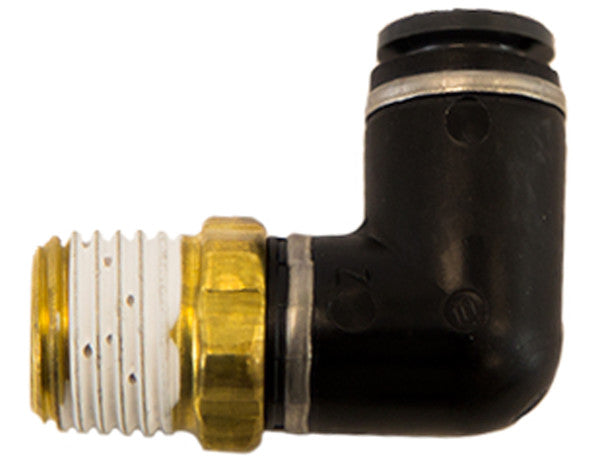
Buyers Products Swivel Male Elbows are made of long lasting corrosion-resistant brass and poly. They are designed to meet DOT FMVSS 571.106 air brake performance specifications.
Specifications
| Color | Black |
|---|---|
| Finish | Multiple |
| Fitting Shape | 90?? Elbow |
| Male/Female/Union | Male |
| Material | Multiple |
| Meets D.O.T. FMVSS 571.106 Air Brake Performance Regulations (y/n) | Yes |
| Pipe Thread Size | 1/4 NPT |
| Swivel (y/n) | Yes |
| Works with Tube Outer Diameter | 1/4 |
Advanced Technical Overview: Brass/Poly DOT Push-In Swivel Male Elbow 1/4 Inch Tube OD x 1/4 Inch Pipe Thread
This comprehensive technical description details the Brass/Poly DOT Push-In Swivel Male Elbow, a critical component engineered for robust and reliable performance within demanding pneumatic systems, particularly those subject to Department of Transportation (DOT) regulations for air brake systems. Designed with a precise 1/4 inch tube outer diameter (OD) push-in connection and a 1/4 inch National Pipe Taper (NPT) male pipe thread, this fitting exemplifies advanced fluid power connectivity solutions. Its compliance with DOT FMVSS 571.106 air brake performance specifications underscores its suitability for safety-critical applications, delivering both performance and regulatory adherence.
Material Science: The Synergy of Brass and Advanced Polymers
The selection of materials for this fitting, a strategic combination of brass and high-performance polymers, is fundamental to its superior characteristics. Each material contributes distinct properties that collectively enhance the fitting's functionality, durability, and resistance to environmental stressors.
Brass Composition and Advantages
The brass components of this elbow fitting are typically alloys predominantly comprising copper and zinc, often with trace elements like lead (for machinability in older specifications, though modern brass is often lead-free or low-lead to meet environmental standards) or tin. Brass is renowned for its exceptional balance of properties:
- Corrosion Resistance: Brass exhibits inherent resistance to corrosion, particularly from water, air, and many common industrial fluids. This attribute is crucial for maintaining system integrity over prolonged periods, especially in environments exposed to moisture or corrosive agents. The stable oxide layer formed on brass surfaces provides a barrier against further degradation, contributing to its longevity in harsh operating conditions.
- High Strength and Durability: With tensile strengths comparable to mild steel, brass offers excellent mechanical strength, enabling the fitting to withstand significant internal pressures and external mechanical stresses without deformation or failure. This robustness is paramount in air brake systems where high pressures are routine.
- Temperature Performance: Brass maintains its mechanical properties across a wide temperature range, ensuring reliable operation from sub-zero conditions to elevated temperatures common in engine compartments or industrial processes.
- Machinability: The inherent machinability of brass allows for the production of intricate geometries with high precision, essential for creating the precise threads and internal mechanisms required for a reliable fitting. This precision directly impacts sealing effectiveness and ease of installation.
- Vibration Resistance: The mass and metallurgical structure of brass contribute to its superior vibration dampening characteristics compared to lighter materials. This property is vital in vehicular applications where constant vibration could otherwise compromise the integrity of connections.
Advanced Polymer Integration
The polymer components, identified as "poly" in the description, typically consist of engineered thermoplastics such as Nylon 6/6, Acetal (POM), or similar high-performance engineering plastics. These materials are chosen for their specific attributes that complement brass:
- Lightweight: Polymers significantly reduce the overall weight of the fitting compared to an all-metal counterpart, a benefit in weight-sensitive applications like commercial vehicles where every gram contributes to fuel efficiency.
- Chemical Resistance: Specific polymers offer excellent resistance to a broad spectrum of chemicals, including oils, greases, fuels, and common cleaning agents, preventing degradation of the fitting's sealing and gripping mechanisms.
- Dielectric Properties: Polymers are electrical insulators, which can be advantageous in preventing galvanic corrosion when connected to dissimilar metals or in applications where electrical isolation is desired.
- Flexibility and Impact Resistance: While brass provides rigidity, certain polymer sections can absorb minor impacts and flex without permanent deformation, enhancing the fitting's resilience in dynamic environments.
- Sealing Performance: Polymers are extensively used for seals (O-rings, internal grippers) within push-in fittings due to their elastic properties, low friction, and ability to form tight seals against tubing surfaces.
Synergistic Advantages of Brass/Poly Construction
The combination of brass and advanced polymers in this fitting yields a component that leverages the best of both worlds. Brass provides structural integrity, robust thread connections, and high-pressure capability, while the polymer elements facilitate the push-in connection mechanism, offer chemical resistance, and contribute to overall weight reduction and sealing efficiency. This hybrid design ensures optimal performance under the stringent conditions mandated by DOT regulations.
Fitting Mechanics: Push-In, Swivel, and Elbow Configuration
The design features of this fitting—push-in, swivel, and male elbow—are specifically engineered to provide ease of installation, operational flexibility, and reliable directional changes within pneumatic systems.
Push-In (Push-to-Connect) Technology
The push-in, or push-to-connect, mechanism represents a significant advancement in pneumatic system assembly. It allows for rapid, tool-free connection of tubing, dramatically reducing installation time and labor costs. The fundamental operation involves:
- Tube Insertion: The prepared (cleanly cut and deburred) tube end is simply pushed into the fitting.
- Gripping Mechanism: Inside the fitting, a collet (often made of engineered polymer or plated metal) with sharp, angled teeth or a gripping ring securely holds the tube in place. These teeth bite into the outer surface of the tubing, preventing accidental disconnection even under pressure.
- Sealing Element: Simultaneously, an O-ring or similar elastomeric seal within the fitting compresses around the tube's outer diameter, creating a leak-tight seal against the internal pressure. This seal is often made of NBR (Nitrile Butadiene Rubber) or EPDM, selected for its compatibility with air and specific temperature ranges.
Advantages of push-in technology include:
- Speed and Simplicity: No special tools or crimping are required, making installation and disconnection quick and straightforward.
- Reliability: When properly installed, push-in fittings provide a secure and leak-free connection that can withstand operational pressures and vibrations.
- Reduced Risk of Error: The intuitive nature of the connection minimizes the chance of installation mistakes common with threaded or compression fittings.
- Reusability: Many push-in fittings are designed for multiple disconnections and reconnections, offering flexibility during system modifications or maintenance.
Swivel Functionality
The "swivel" attribute denotes that one part of the fitting can rotate relative to another while maintaining a sealed connection. In this male elbow fitting, the swivel mechanism typically allows the push-in port to rotate 360 degrees around the axis of the pipe thread. This feature offers several critical benefits:
- Enhanced Installation Flexibility: The ability to orient the tube connection after the pipe thread has been tightened simplifies installation in confined spaces. Technicians can thread the male NPT end into a port and then adjust the angle of the connected tube without having to loosen or re-tighten the pipe thread, which prevents potential leaks from over- or under-tightening.
- Stress Reduction: Swivel fittings help prevent torsional stress on the tubing. If a system experiences movement or vibration, a swivel connection allows for slight angular adjustments without transferring damaging torque to the tubing, thereby extending the lifespan of both the tubing and the fitting.
- Optimized Hose Routing: It facilitates cleaner and more efficient hose routing, minimizing bends and kinks in the air line, which can improve airflow and reduce the risk of premature tubing wear.
Male Elbow Configuration (90-degree)
The "male elbow" configuration specifies a 90-degree bend in the fitting, with a male threaded connection on one end and the push-in tube connection on the other. The 90-degree angle is a standard and highly versatile shape in pneumatic and hydraulic systems:
- Directional Change: The primary function is to change the direction of fluid flow by 90 degrees, which is indispensable for routing tubing around obstacles, within compact enclosures, or to transition between different planes.
- Space Efficiency: Elbows are inherently space-saving compared to bending rigid tubing, and they ensure consistent flow paths without the stress points that tight tube bends can create.
- Male Threaded End: The male NPT (National Pipe Taper) thread is designed to connect directly into a female threaded port on a manifold, valve, cylinder, or other pneumatic component. The tapered design of NPT threads, when properly sealed with thread sealant (e.g., PTFE tape or liquid sealant), forms a mechanical lock and a leak-tight connection as the threads deform and compress against each other during tightening.
Dimensional Precision: 1/4 Inch Tube OD x 1/4 Inch Pipe Thread
The precise dimensional specifications of this fitting—1/4 inch Tube OD and 1/4 inch Pipe Thread—are critical for ensuring compatibility, proper sealing, and overall system integrity.
1/4 Inch Tube Outer Diameter (OD)
The specification "1/4 Inch Tube OD" refers to the outer diameter of the tubing that this push-in fitting is designed to accept. This is a standard size in pneumatic and air brake applications. The precision of this dimension is paramount for the push-in mechanism:
- Secure Grip: The internal collet and gripping ring are engineered to precisely engage with a 1/4 inch OD tube, providing a secure, vibration-resistant connection. Deviations in tube OD can lead to either an unreliable grip or difficulty in insertion.
- Leak-Tight Seal: The internal O-ring seal relies on the exact 1/4 inch OD of the tube to form an effective, leak-free seal. Any under-sizing can result in leaks, while over-sizing can prevent proper insertion or damage the seal.
- Material Compatibility: This fitting is typically designed for use with semi-rigid thermoplastic tubing materials such as Nylon 11, Nylon 12, or Polyethylene (PE) that meet the dimensional and hardness requirements for air brake systems. The specific material choice for the tubing must be compatible with the working fluid (air), temperature range, and pressure.
1/4 Inch Pipe Thread (NPT)
The "1/4 Inch Pipe Thread" refers to a 1/4-inch nominal size National Pipe Taper (NPT) thread. NPT is a widely adopted standard for tapered pipe threads in North America, designed to create a pressure-tight seal without the need for additional gaskets or O-rings when properly installed with thread sealant.
- Tapered Design: Both the male and female NPT threads are tapered, meaning their diameter gradually increases or decreases along their length. When engaged, the flanks of the threads wedge against each other, creating a mechanical seal.
- Nominal Size: "1/4 inch" is a nominal pipe size and does not directly correspond to the actual diameter of the threads. The actual major diameter of a 1/4 NPT male thread is approximately 0.540 inches (13.7 mm).
- Sealing Importance: Due to the inherent helix of threads, a sealant (e.g., PTFE tape, anaerobic thread sealant) is essential to fill the inevitable helical leak path created by the thread engagement, ensuring a truly pressure-tight connection.
- System Integration: This 1/4 NPT male thread ensures compatibility with a vast array of pneumatic components that feature corresponding 1/4 NPT female ports, facilitating seamless integration into existing or new air brake and industrial pneumatic systems.
Compliance with DOT FMVSS 571.106 Air Brake Performance Regulations
A cornerstone feature of this product is its compliance with DOT FMVSS 571.106, a critical regulation for automotive safety in the United States. This federal standard dictates the performance requirements for air brake hoses, tubing, and their associated fittings used in motor vehicles. Compliance is not merely a label but a testament to rigorous design, manufacturing, and testing protocols.
Overview of FMVSS 571.106
FMVSS 106, "Brake Hoses," specifically covers hydraulic, vacuum, and air brake hoses, tubing, and fittings designed for use in brake systems of motor vehicles. For air brake fittings, the standard ensures that components can withstand the harsh operating conditions of commercial vehicles and maintain the integrity of the air brake system, which is crucial for vehicle safety. The standard sets minimum performance criteria to prevent failures that could lead to loss of braking capability.
Key Performance Requirements and Testing Protocols
Compliance with FMVSS 571.106 for air brake fittings typically involves meeting a series of stringent tests, often conducted on complete hose assemblies (hose and fittings) but with requirements directly impacting fitting design and material selection:
- High-Pressure Resistance/Burst Strength: Fittings must withstand pressures significantly higher than typical operating pressures without bursting or leaking. This ensures a substantial safety margin against pressure surges or system malfunctions.
- Proof Pressure Test: The fitting must hold a specified high pressure for a duration without leakage or permanent deformation.
- Tensile Strength (Pull-Out Force): For push-in fittings, the connection to the tubing must withstand a specified axial pull-out force without releasing the tube or leaking. This tests the gripping mechanism's ability to hold the tube securely under mechanical stress.
- Vibration Resistance: The assembly must endure prolonged periods of vibration while pressurized, simulating real-world vehicle operation. This ensures connections remain secure and leak-free in dynamic environments.
- Flexibility/Endurance: The fitting, particularly its swivel mechanism and the tube connection, must withstand repeated flexing or bending cycles while pressurized without leakage or structural failure.
- Temperature Cycling and Resistance: Fittings must maintain their performance across extreme temperature variations, including both very high and very low temperatures. This involves tests where assemblies are subjected to cycles of freezing and heating while under pressure. The materials (brass, polymer, seals) must not degrade or lose sealing effectiveness.
- Corrosion Resistance: Components are often subjected to salt spray tests to ensure they resist corrosion that could compromise structural integrity or sealing performance over time.
- Ozone Resistance: Elastomeric components (like O-rings) must resist degradation from ozone, which is present in the atmosphere and can cause cracking and material breakdown.
- Fluid Compatibility: While primarily for hydraulic hoses, for air systems, the materials must be compatible with compressed air, including any trace lubricants or moisture that may be present.
The "Yes" entry for "Meets D.O.T. FMVSS 571.106 Air Brake Performance Regulations (y/n)" is a definitive assurance that this Brass/Poly Push-In Swivel Male Elbow has undergone and passed these rigorous tests, confirming its suitability and safety for use in critical air brake systems on commercial vehicles.
Performance Characteristics and Operational Advantages
Beyond regulatory compliance, the design and material choices of this fitting contribute to a range of operational advantages:
- Long-Term Durability and Reliability: The robust construction, combining corrosion-resistant brass and durable polymers, ensures extended service life even in challenging operating conditions. This minimizes the need for frequent replacements and reduces overall maintenance costs.
- Optimized Flow Efficiency: The 90-degree elbow is designed to provide a smooth internal bore, minimizing pressure drop and turbulence, thus ensuring efficient airflow through the pneumatic system.
- Excellent Sealing Integrity: The push-in mechanism, featuring precision-engineered gripping and sealing elements, provides an instantaneous and secure seal that maintains pressure even under vibration and thermal cycling. The NPT thread, when correctly installed with sealant, further guarantees a leak-free connection to the port.
- Reduced Installation Time and Labor: The push-in design significantly cuts down installation time compared to traditional compression or threaded fittings, leading to cost savings in labor and faster assembly of pneumatic systems.
- Versatility in Application: While primarily designed for DOT air brake systems, its robust construction and compliance make it suitable for a broader range of industrial pneumatic applications requiring high reliability and performance, such as factory automation, material handling, and process control systems.
- Environmental Resistance: The "Multiple" finishes and materials specified in the basic description often imply protective coatings on brass components (e.g., nickel plating) or specific blends of polymers chosen for enhanced resistance to UV radiation, chemicals, or extreme temperatures, further extending the fitting's operational envelope.
Applications
Given its technical specifications and DOT compliance, this Brass/Poly Push-In Swivel Male Elbow is ideally suited for:
- Commercial Vehicle Air Brake Systems: Essential for heavy-duty trucks, buses, trailers, and other commercial vehicles requiring FMVSS 106 compliant components for safe and reliable braking.
- Heavy Equipment: Construction machinery, agricultural vehicles, and mining equipment that utilize air-actuated systems for brakes, auxiliary functions, or pneumatic controls.
- Industrial Pneumatic Control Systems: Any industrial setting where robust, reliable, and easily installed fittings are needed for air lines, such as robotic cells, assembly lines, and power tools.
- Transportation Infrastructure: Applications in rail or marine systems where air braking or pneumatic control is vital, provided the specific environmental conditions are compatible with the material properties.
Quality Assurance and Manufacturing Excellence
The manufacturing process for such a critical component involves precision engineering at every stage. High-quality brass components are typically machined to tight tolerances, ensuring accurate thread forms and precise dimensions for the push-in interface. Polymer components are precision injection-molded, often with advanced tooling, to achieve the required dimensional accuracy, surface finish, and material consistency. Throughout production, strict quality control measures are implemented, including:
- Dimensional Inspections: Verifying critical dimensions with calibrated gauges.
- Leak Testing: Each fitting or batch may undergo pressure testing to ensure hermetic seals.
- Material Analysis: Confirmation of material composition to specified standards.
- Functional Testing: Verifying the push-in and swivel mechanisms operate correctly and securely.
This commitment to manufacturing excellence ensures that each Brass/Poly DOT Push-In Swivel Male Elbow consistently meets the demanding performance requirements, providing users with a dependable and safe component for their pneumatic systems.
Conclusion
The Brass/Poly DOT Push-In Swivel Male Elbow with 1/4 Inch Tube OD and 1/4 Inch Pipe Thread represents a sophisticated blend of material science and precision engineering. Its hybrid brass and polymer construction delivers superior corrosion resistance, mechanical strength, and lightweight properties. The innovative push-in technology, coupled with 90-degree elbow and swivel functionalities, offers unmatched ease of installation and operational flexibility. Crucially, its rigorous compliance with DOT FMVSS 571.106 air brake performance specifications affirms its unwavering commitment to safety and reliability in the most demanding vehicular and industrial pneumatic applications. This fitting is not merely a connection point; it is a meticulously engineered component designed to ensure the integrity, efficiency, and safety of critical air systems.