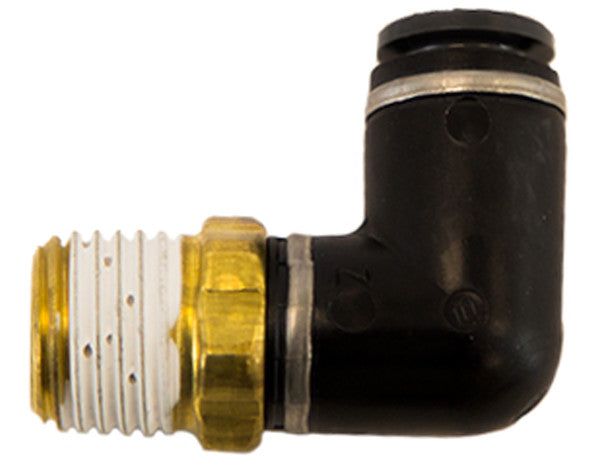
Buyers Products Swivel Male Elbows are made of long lasting corrosion-resistant brass and poly. They are designed to meet DOT FMVSS 571.106 air brake performance specifications.
Specifications
| Color | Black |
|---|---|
| Finish | Multiple |
| Fitting Shape | 90° Elbow |
| Male/Female/Union | Male |
| Material | Multiple |
| Meets D.O.T. FMVSS 571.106 Air Brake Performance Regulations (y/n) | Yes |
| Pipe Thread Size | 3/8 NPT |
| Swivel (y/n) | Yes |
| Works with Tube Outer Diameter | 3/8 |
Advanced Technical Overview: Brass/Poly DOT Push-In Swivel Male Elbow 3/8 Inch Tube OD x 3/8 Inch Pipe Thread
This comprehensive technical description provides an in-depth analysis of the Brass/Poly DOT Push-In Swivel Male Elbow, a critical component engineered for the demanding environments of commercial vehicle air brake systems and other high-performance pneumatic applications. Combining robust material science with precision engineering, this fitting is designed to deliver superior reliability, ease of installation, and steadfast compliance with stringent regulatory standards, particularly DOT FMVSS 571.106. Its specific configuration—a 90-degree swivel male elbow accommodating a 3/8 inch outer diameter tube and connecting to a 3/8 inch NPT pipe thread—positions it as an indispensable element for professional pneumatic system architects and maintenance personnel.
Material Science and Hybrid Construction: Brass and High-Performance Polymer
The selection of materials for this fitting represents a deliberate engineering choice to leverage the synergistic benefits of distinct material classes: brass and a specialized high-performance polymer. This hybrid construction is fundamental to the fitting's exceptional performance characteristics.
Brass Components: Structural Integrity and Corrosion Resistance
The brass elements of this fitting, typically comprising the threaded body and potentially internal structural components, are chosen for their well-established metallurgical properties. Brass, an alloy primarily of copper and zinc, offers a superior combination of strength, machinability, and corrosion resistance. Its inherent resistance to oxidation and degradation from various environmental factors, including moisture, road salts, and common automotive fluids, is paramount for components operating in external or semi-exposed vehicle chassis environments. The high density and non-porous nature of brass contribute to its excellent pressure retention capabilities, ensuring a leak-free connection under high pneumatic pressures. Furthermore, brass exhibits good thermal conductivity and dimensional stability across a broad temperature range, which is vital for maintaining seal integrity during temperature fluctuations characteristic of automotive operation. The material's durability ensures a long service life, reducing the total cost of ownership through minimized replacement frequencies. For the threaded portion, brass provides robust mechanical engagement with mating pipe threads, preventing stripping or deformation even under repeated assembly and disassembly cycles.
Polymer Components: Lightweight, Flexibility, and Advanced Sealing
The polymer components, typically forming the push-in mechanism and external housing, are engineered from high-performance thermoplastics. While the specific polymer type might vary, common choices for DOT-compliant air brake fittings include Nylon 11 or Nylon 12, or advanced acetal resins. These polymers are selected for their exceptional balance of mechanical strength, chemical resistance, and fatigue life. The use of polymer significantly reduces the overall weight of the fitting compared to an all-metal alternative, contributing to vehicle weight reduction and improved fuel efficiency. Moreover, these polymers exhibit excellent impact resistance and vibration damping characteristics, crucial for components in dynamic vehicle environments. The polymer's inherent elasticity and resilience are integral to the effectiveness of the push-in connection technology, allowing for secure tube retention without damaging the tubing material. The black color specified often indicates UV stabilization and carbon black fillers, further enhancing durability and resistance to environmental degradation. The polymer's ability to resist common chemicals, oils, and greases found in automotive applications ensures long-term integrity of the push-in mechanism and external body.
Precision Engineering: Push-In, Swivel, and Elbow Design
The design of this fitting incorporates several key engineering features that collectively enhance its functionality, ease of use, and reliability.
Push-In Connection Technology: Efficiency and Reliability
The push-in (or push-to-connect) mechanism represents a significant advancement in pneumatic connection technology. This design eliminates the need for specialized tools, soldering, crimping, or flaring, drastically simplifying and accelerating installation procedures. The mechanism typically consists of a collet (gripper), an O-ring or similar elastomeric seal, and a release collar, all housed within the polymer body. When a properly prepared tube (e.g., Nylon tubing with a clean, square cut) is inserted, the collet's teeth automatically grip the tube's outer diameter, providing robust axial retention. Simultaneously, the O-ring creates a hermetic seal against the tube's outer surface, preventing air leakage. This design ensures a secure, leak-proof connection that resists vibration and pressure fluctuations. The quick-release feature, often actuated by pressing the collar, allows for swift disconnection without damaging the tubing, facilitating maintenance and system modifications. The reliability of this connection type is critical for air brake systems where unintended disconnections could lead to catastrophic failure.
Swivel Functionality: Dynamic Positioning and Stress Reduction
The integrated swivel feature is a pivotal design element, especially in complex pneumatic routing scenarios. A swivel fitting allows one part of the fitting (typically the tube connection end) to rotate freely relative to the other part (the threaded pipe connection end) after installation. This capability provides several key advantages: it simplifies tube alignment, prevents kinking or unnecessary tension in the tubing, and allows for precise directional adjustment of the tube path. In applications where components are subject to movement or vibration, the swivel function helps to dissipate mechanical stresses that would otherwise be concentrated at the fitting-tube interface, thereby extending the life of both the tubing and the fitting. The ability to orient the elbow optimally post-installation also significantly reduces installation time and effort, enhancing overall system aesthetics and maintainability.
90-Degree Male Elbow Configuration: Directional Control and System Integration
The 90-degree elbow shape serves the fundamental purpose of changing the direction of fluid flow by ninety degrees. This is indispensable for routing air lines around obstacles, through bulkheads, or within confined spaces common in vehicle chassis. The "male" designation indicates that the threaded end features external threads, designed to screw into a female-threaded port on a valve, manifold, air tank, or other system component. The 3/8 inch NPT (National Pipe Taper) pipe thread ensures a robust, tapered seal when properly torqued into a corresponding female port. The tapered design of NPT threads means that the threads compress upon tightening, creating a mechanical interference fit that provides an effective seal, often augmented with thread sealant for enhanced leak prevention. This standard threading ensures broad compatibility with existing pneumatic infrastructure.
Compliance and Certification: DOT FMVSS 571.106 Air Brake Performance Regulations
A cornerstone feature of this product is its explicit compliance with DOT FMVSS 571.106, the Federal Motor Vehicle Safety Standard No. 106. This certification is not merely a label but a testament to rigorous engineering, testing, and quality control processes. FMVSS 106 specifically governs air brake hoses, tubing, and their associated fittings used in commercial motor vehicles. The standard mandates a series of stringent performance tests to ensure the integrity and safety of these critical components under various operational and environmental conditions. These tests include, but are not limited to:
- Burst Pressure Test: Verifies the fitting's ability to withstand pressures significantly higher than normal operating pressures without rupture.
- Vacuum Test: Ensures the fitting maintains integrity under negative pressure, preventing air ingress that could compromise brake system performance.
- High and Low Temperature Cycling: Assesses the fitting's resistance to extreme temperature variations, simulating diverse climatic conditions and operational thermal cycles. This ensures seals remain effective and materials do not degrade.
- Vibration Test: Evaluates the fitting's ability to maintain structural and sealing integrity when subjected to prolonged mechanical vibrations, mimicking real-world vehicle operation.
- Tensile/Pull-Out Resistance Test: Measures the force required to pull the tubing out of the push-in fitting, ensuring the connection remains secure under axial loads and pressures.
- Impulse Test: Simulates rapid pressure changes and pulses, checking the fitting's fatigue resistance over its service life.
- Corrosion Resistance: Confirms the fitting's ability to resist degradation from environmental corrosives.
Meeting FMVSS 106 is critical for any component intended for air brake systems in the United States, signifying that the fitting is engineered to prevent failures that could lead to brake system malfunction, loss of control, and accidents. For fleet operators, vehicle manufacturers, and maintenance professionals, this compliance provides an unequivocal assurance of safety, reliability, and legality, mitigating risks and ensuring adherence to regulatory mandates. Beyond FMVSS 106, the fitting's design and materials are often consistent with other relevant industry standards such as SAE J844 (for air brake tubing) and various ISO or ASTM specifications for material properties and test methods, further underscoring its robust engineering.
Operational Specifications and Performance Envelope
The design and material composition of this Brass/Poly DOT Push-In Swivel Male Elbow enable it to perform reliably across a defined operational envelope:
- Pressure Rating: Engineered to operate effectively within typical air brake system pressures, usually up to 150 psi (approximately 10.3 bar), with a significant safety margin provided by its burst pressure rating to accommodate transient pressure spikes.
- Temperature Range: Designed to maintain integrity and sealing capability over a wide operational temperature range, typically from -40°F to +200°F (-40°C to +93°C), as required by FMVSS 106 for pneumatic components. This ensures performance in diverse climates.
- Flow Characteristics: The 90-degree elbow geometry is optimized to minimize pressure drop and turbulence, ensuring efficient air flow and rapid response within the brake system.
- Seal Integrity: The combination of robust O-ring seals, precision-machined brass, and resilient polymer components ensures long-term, leak-proof performance, critical for maintaining air system pressure and brake effectiveness.
- Vibration and Shock Resistance: The composite construction and secure push-in mechanism provide superior resistance to the constant vibrations and occasional shock loads encountered in heavy-duty vehicle operation.
Applications and System Integration
While primarily designed for air brake systems in commercial vehicles, the robust nature and superior performance of this fitting extend its applicability to other demanding pneumatic environments:
- Commercial Truck and Bus Air Brakes: This is the quintessential application, where the fitting provides reliable connections for air lines controlling braking, suspension, and auxiliary systems.
- Trailer Air Brake Systems: Essential for connecting air lines between tractors and trailers, ensuring seamless brake operation across the entire vehicle combination.
- Industrial Pneumatic Control Systems: Suitable for heavy-duty industrial machinery requiring reliable and quick-connect pneumatic circuits, particularly where space is constrained or vibration is present.
- Specialty Vehicle Applications: Used in construction equipment, agricultural machinery, and other off-highway vehicles where robust and DOT-compliant pneumatic connections are required.
The standard 3/8 inch tube OD and 3/8 inch NPT pipe thread dimensions ensure broad compatibility with industry-standard Nylon air brake tubing and threaded ports, simplifying inventory management and system design.
Installation and Maintenance Best Practices
To maximize the performance and longevity of the Brass/Poly DOT Push-In Swivel Male Elbow, adherence to proper installation and maintenance procedures is crucial:
- Tubing Preparation: Use only DOT-approved Nylon tubing. Ensure the tube is cut squarely and cleanly, free from burrs or nicks that could compromise the O-ring seal. Chamfering the tube end slightly can aid insertion.
- Insertion: Firmly push the tube into the fitting until it bottoms out. A slight tug back on the tube will confirm proper engagement of the collet and seal.
- Threaded Connection: Apply an appropriate thread sealant (e.g., PTFE tape or liquid sealant compatible with air brake systems) to the male NPT threads before tightening into the female port. Torque the fitting to the manufacturer's specified value; overtightening can damage threads or distort the fitting.
- Swivel Utilization: Position the swivel end to achieve the desired tube routing without inducing strain on the tubing.
- Inspection: Periodically inspect all air brake connections for signs of leaks (using leak detection fluid), physical damage, or wear. Replace any damaged fittings or tubing immediately.
- Disconnection: To disconnect, ensure the system is depressurized, then firmly press the release collar against the fitting body while simultaneously pulling the tube out. Avoid using tools to pry the tube, which can damage the fitting or tube.
Conclusion: Uncompromising Quality and Performance
The Brass/Poly DOT Push-In Swivel Male Elbow (3/8 Inch Tube OD x 3/8 Inch Pipe Thread) represents a pinnacle of pneumatic fitting technology, meticulously engineered to meet and exceed the rigorous demands of commercial air brake systems. Its intelligent hybrid material construction, integrating the strength and corrosion resistance of brass with the lightweight and sealing advantages of advanced polymers, ensures unparalleled durability and performance. The sophisticated push-in and swivel mechanisms simplify installation while providing secure, leak-proof connections that adapt to complex routing challenges. Crucially, its unwavering compliance with DOT FMVSS 571.106 underscores its commitment to safety and regulatory adherence, making it the preferred choice for applications where reliability is non-negotiable. For professionals seeking a robust, efficient, and compliant solution for pneumatic systems, this fitting delivers exceptional value and peace of mind.