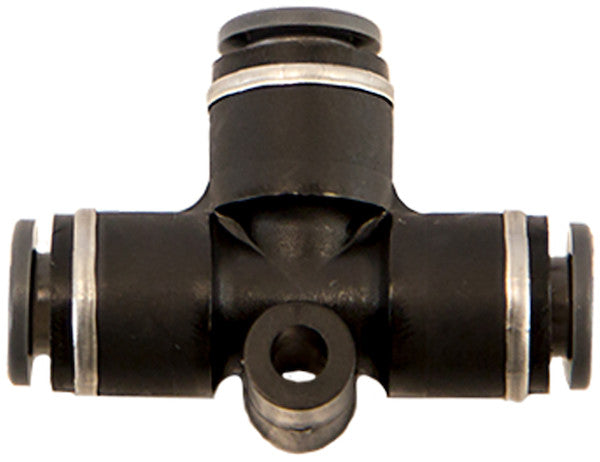
Buyers Products Union Tees are made of long lasting corrosion- resistant brass and poly. They are designed to meet DOT FMVSS 571.106 air brake performance specifications.
Specifications
| Color | Black |
|---|---|
| Finish | Multiple |
| Fitting Shape | Union Tee |
| Male/Female/Union | Union |
| Material | Multiple |
| Meets D.O.T. FMVSS 571.106 Air Brake Performance Regulations (y/n) | Yes |
| Pipe Thread Size | - |
| Swivel (y/n) | No |
| Works with Tube Outer Diameter | 3/8 |
The Brass/Poly DOT Push-In Union Tee, specifically engineered for 3/8 Inch Tube O.D. applications, represents a critical component in advanced pneumatic systems, particularly within the demanding realm of commercial vehicle air brake systems. This highly specialized fitting is meticulously designed to facilitate secure, leak-proof connections and efficient air distribution, adhering to the stringent safety and performance standards mandated by the Department of Transportation (DOT).
At its core, this union tee combines the best attributes of two distinct material families: robust brass and resilient polymers. This material synergy is not merely an arbitrary choice but a calculated engineering decision aimed at maximizing longevity, corrosion resistance, and operational reliability under diverse environmental and mechanical stresses. The "push-in" design signifies a modern approach to fluid connection technology, offering unparalleled ease of installation without compromising integrity, while its "union tee" configuration enables precise branching or merging of pneumatic lines.
Advanced Material Science: Brass and Polymer Integration
The selection of "multiple materials," specifically brass and specialized polymers, is fundamental to the superior performance characteristics of this DOT-compliant union tee. Each material contributes unique properties essential for the arduous operational conditions of air brake systems.
Brass Components
Brass, primarily an alloy of copper and zinc, is chosen for its exceptional mechanical strength, durability, and inherent corrosion resistance. Within the structure of this union tee, brass typically forms the main body or critical structural elements that bear significant mechanical loads and are exposed to various environmental factors. Its key advantages include:
- Corrosion Resistance: Brass exhibits excellent resistance to oxidation, moisture, and common automotive fluids, preventing degradation over time and ensuring the integrity of the air brake system. This is crucial for components exposed to road salts, humidity, and temperature fluctuations.
- Mechanical Strength: It provides the necessary rigidity and robustness to withstand the high pressures and vibrations inherent in air brake systems, ensuring a secure connection that resists deformation or fatigue.
- Temperature Stability: Brass maintains its structural integrity and sealing properties across a wide operating temperature range, from extreme cold to intense heat, which is vital for vehicles operating in diverse climates.
- Machinability: Its excellent machinability allows for precise manufacturing tolerances, ensuring the intricate internal geometry required for effective push-in functionality and sealing.
- Sealing Surface Quality: Brass offers a smooth, stable surface for O-rings and other sealing elements, contributing to a reliable, leak-free connection.
Polymer Components
Specialized engineering polymers are strategically incorporated, often for the collet mechanism, O-rings, and potentially certain housing sections. These polymers are selected for their specific attributes that complement brass:
- Chemical Resistance: Modern engineering polymers offer excellent resistance to oils, greases, and other chemicals commonly found in pneumatic systems, preventing material degradation and ensuring long-term sealing performance.
- Flexibility and Resilience: Polymers provide the necessary flexibility for the push-in collet to securely grip the tubing while allowing for easy insertion and removal. Their elastic properties ensure consistent sealing under dynamic conditions.
- Weight Reduction: Utilizing polymers where appropriate contributes to overall weight reduction of the fitting, which can offer minor fuel efficiency benefits for commercial vehicles.
- Insulating Properties: Polymers can provide some level of electrical and thermal insulation, although their primary role here is mechanical and sealing.
- Friction Reduction: Low-friction polymer surfaces aid in smooth tube insertion and minimize potential damage to the tube's outer diameter during installation.
The "Multiple" finish specification indicates that different surface treatments might be applied to various components—for instance, natural brass finish on some parts, while others might receive a protective coating or be left in their natural polymer state, as evidenced by the "Black" color of certain polymer elements. This integrated material approach results in a fitting that is simultaneously strong, lightweight, corrosion-resistant, and highly effective for its intended application.
Push-In Technology: Engineering for Rapid, Reliable Connections
The "Push-In" designation highlights the innovative connection mechanism of this union tee. This technology has revolutionized pneumatic system assembly by significantly reducing installation time and complexity compared to traditional threaded or compression fittings. The push-in system operates on a simple yet highly effective principle:
- Tube Insertion: The prepared (clean-cut, deburred) tube is simply pushed into the fitting.
- Collet Engagement: An internal collet, typically made of a durable polymer, features a series of teeth or gripping elements that automatically engage and securely grip the outer diameter of the inserted tube. This creates a strong mechanical hold that resists pull-out forces.
- O-Ring Seal: Simultaneously, an internal O-ring, usually made of a resilient elastomeric material, compresses against the outer surface of the tube, forming a hermetic seal against air leakage.
- Release Mechanism: Most push-in fittings incorporate a release collar or button that, when depressed, disengages the collet, allowing for quick and non-damaging tube removal.
The advantages of this push-in system for air brake applications are profound:
- Speed and Efficiency: Installation is dramatically faster, requiring no special tools, adhesives, or sealants. This reduces labor costs and vehicle downtime.
- Reliability: When properly installed, push-in fittings provide a secure, vibration-resistant, and leak-free connection crucial for air brake system safety.
- Reduced Skill Requirement: The simplicity of the installation process reduces the potential for installation errors that could compromise system integrity.
- Reusability (Limited): While primarily designed for single-use tube connections, the fitting itself can often be reused by simply replacing the tube, assuming the collet and O-ring remain in good condition.
- Space Saving: The compact design of push-in fittings often allows for more efficient routing of tubing in confined spaces.
The "Swivel (y/n) - No" specification indicates that this particular union tee is a fixed connection, meaning the branches do not rotate independently. This ensures a stable and predictable tube routing once installed, which is often preferred in air brake systems where movement could lead to wear or fatigue.
DOT FMVSS 571.106 Compliance: The Cornerstone of Air Brake Safety
The unequivocal statement that this Brass/Poly DOT Push-In Union Tee "Meets D.O.T. FMVSS 571.106 Air Brake Performance Regulations" is arguably its most critical attribute. FMVSS 571.106, or Federal Motor Vehicle Safety Standard No. 106, specifies the performance and labeling requirements for hydraulic, air, and vacuum brake hoses, and their respective fittings, used in motor vehicles. For air brake systems, this standard is paramount as it directly addresses components critical to a vehicle's ability to safely stop.
Key Aspects of FMVSS 106 Compliance for Fittings:
- Pressure Resistance: Fittings must withstand specified burst pressures significantly higher than typical operating pressures to ensure a substantial safety margin. This includes resistance to both static and dynamic pressure cycles.
- Temperature Cycling: Components must maintain their integrity and sealing capability through extreme temperature variations, simulating real-world operating conditions across different climates.
- Vibration Resistance: Commercial vehicles are subject to constant vibration. Fittings must remain secure and leak-free even under prolonged exposure to high-frequency and high-amplitude vibrations.
- Pull-Out Resistance: For push-in fittings, the ability to resist pull-out forces is critical. FMVSS 106 specifies minimum pull-out resistance values that the fitting must achieve without releasing the tube or leaking.
- Leakage Performance: Under various conditions (pressure, temperature, vibration), the fitting must not exhibit any discernible leakage, ensuring that air pressure is consistently maintained within the brake system.
- Corrosion Resistance: Prolonged exposure to corrosive elements must not degrade the fitting's structural or sealing capabilities.
- Material Compatibility: The materials used must be compatible with the air and lubricants typically found in air brake systems, preventing chemical degradation.
Compliance with FMVSS 106 signifies that this union tee has undergone rigorous testing and validation processes, assuring engineers, installers, and vehicle operators that it meets the highest standards for safety, reliability, and performance. Using non-compliant fittings in air brake systems can lead to catastrophic failures, severe penalties, and poses significant safety risks. The "Yes" affirmation for D.O.T. FMVSS 571.106 compliance underscores the product's suitability for mission-critical air brake applications.
Union Tee Configuration and 3/8 Inch Tube O.D.
The "Union Tee" fitting shape is designed for specific pneumatic circuit configurations. A union tee serves to split a single air line into two separate lines, or conversely, to combine two air lines into a single output. All three ports on a union tee are designed for the same outer diameter tubing, making it ideal for creating branches of equal size or merging symmetrical lines. In air brake systems, this configuration is commonly used for:
- Air Distribution: Distributing compressed air from a main supply line to multiple brake chambers or ancillary pneumatic components (e.g., air suspension, air horns).
- Manifolding: Creating compact manifolds for air supply, reducing the need for complex piping.
- System Redundancy: In some designs, tees can be used to create redundant air paths, though this is less common for critical primary brake lines.
The "Works with Tube Outer Diameter: 3/8 Inch" specification is a crucial dimension. 3/8 inch (approximately 9.525 mm) is a standard and widely used tube size in automotive and heavy-duty vehicle air brake systems. This specific size balances adequate airflow capacity for brake actuation with practical space requirements and flexibility for routing. The precision in manufacturing to accommodate a 3/8 inch O.D. tube is vital for the push-in mechanism to function correctly, ensuring a tight grip and a reliable seal. Incompatibility in tube O.D. would lead to immediate leaks or an inability to properly install the tubing.
Installation Best Practices and Maintenance Considerations
While push-in fittings are lauded for their ease of installation, adhering to best practices is crucial to ensure their long-term performance and compliance with DOT regulations. Proper installation involves:
- Tube Preparation: The tubing (typically nylon or similar DOT-approved polymer) must be cut squarely and cleanly, free from burrs, nicks, or ovality. A specialized tube cutter is recommended to achieve the ideal cut, as jagged edges can damage the internal O-ring or prevent proper collet engagement.
- Cleanliness: Ensure the tube and fitting ports are clean and free of dirt, debris, or contaminants that could compromise the seal or mechanism.
- Full Insertion: The tube must be pushed firmly into the fitting until it bottoms out. A visual or tactile check should confirm that the tube is fully seated and securely held by the collet. A slight tug on the tube can confirm proper engagement.
- Routing: Tubes should be routed to avoid sharp bends, chafing against other components, or areas of extreme heat. Adequate slack should be provided to account for vehicle chassis movement.
Maintenance for these fittings is minimal due to their robust design and materials. Regular visual inspections during routine vehicle maintenance should look for:
- Leakage: Listen for hissing sounds or use a soapy water solution to detect air leaks around the fitting.
- Physical Damage: Check for cracks, severe abrasion, or deformation of the fitting body or tubing.
- Tube Integrity: Inspect the exposed sections of tubing leading into and out of the fitting for wear, cuts, or kinks.
If any issues are detected, the fitting or tubing should be replaced immediately with DOT-compliant components to maintain air brake system safety and functionality.
Applications and Broader Significance
This Brass/Poly DOT Push-In Union Tee is an indispensable component across various heavy-duty and industrial sectors where reliable pneumatic connections are critical. Its primary application is in the air brake systems of:
- Commercial Trucks: Tractor-trailers, dump trucks, delivery vehicles.
- Buses: City buses, school buses, motor coaches.
- Heavy Equipment: Construction machinery, agricultural vehicles, mining equipment.
- Specialty Vehicles: Fire apparatus, utility vehicles, recreational vehicles with air brakes.
Beyond air brakes, its DOT compliance and robust construction make it suitable for other regulated pneumatic systems in these vehicles, such as air suspension systems, auxiliary air supply for tools, or complex pneumatic control circuits, provided they operate within the fitting's specified pressure and temperature parameters. Its "Black" color and "Multiple" finish, while aesthetic, also indicate potential UV stabilization for the polymer components and appropriate surface treatments for brass to ensure long-term durability in outdoor, exposed environments.
Quality Assurance and Manufacturing Excellence
The production of DOT-compliant fittings like this union tee involves stringent quality assurance protocols. Manufacturers must employ precise machining for brass components and advanced molding techniques for polymer parts to meet exact dimensional tolerances. Each batch of fittings typically undergoes rigorous testing, including:
- Dimensional Verification: Ensuring all critical dimensions meet design specifications, particularly for tube O.D. and internal sealing surfaces.
- Material Verification: Confirming the chemical composition of brass and the properties of polymers.
- Performance Testing: Batch testing for burst pressure, pull-out force, leakage, and vibration resistance, often exceeding the minimum requirements of FMVSS 106 to provide an additional margin of safety.
- Visual Inspection: Checking for defects, burrs, or inconsistencies that could compromise performance.
This commitment to manufacturing excellence ensures that every Brass/Poly DOT Push-In Union Tee delivers consistent, reliable performance throughout its operational lifespan, contributing to the overall safety and efficiency of the vehicle's air brake system.
Conclusion
The Brass/Poly DOT Push-In Union Tee for 3/8 Inch Tube O.D. stands as a testament to intelligent engineering and material science, purpose-built for the most demanding pneumatic applications. Its hybrid material construction, integrating corrosion-resistant brass with resilient polymers, provides a robust and durable solution. The intuitive push-in design dramatically simplifies installation, while its "Union Tee" configuration offers versatile air line branching capabilities. Most crucially, its full compliance with DOT FMVSS 571.106 air brake performance specifications guarantees uncompromising safety and reliability. For professionals seeking a high-performance, compliant, and easy-to-install fitting for critical air brake and pneumatic systems, this product represents an optimal choice, delivering peace of mind through proven quality and adherence to federal safety standards.