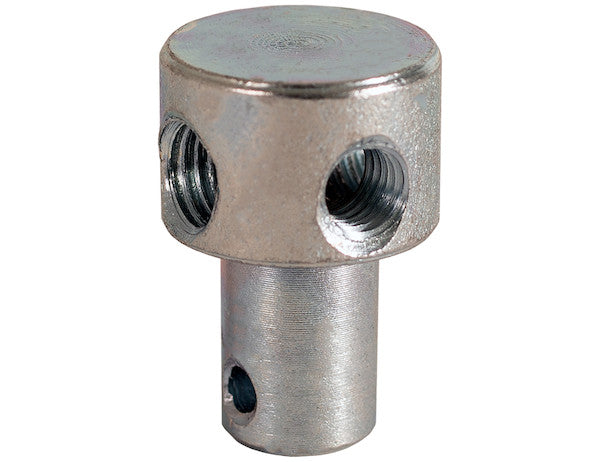
Buyers Products Universal Pivot Pin is made from steel and designed to connect a push-pull, rod-end cable to a plate up to 1/4 in. thick with a 7/16 in. diameter hole. It can fit both 1/4 in.-28 thread and 5/16 in.-24 thread.
Specifications
| FInish | Zinc Plated |
| Use WIth | .25 in. Levers with .438 in. hole |
| Material | Carbon Steel |
Technical Deep Dive: The Universal Pivot Pin by Buyers Products
The Buyers Products Universal Pivot Pin represents a crucial component in mechanical linkage systems, particularly those employing push-pull, rod-end cables. Engineered for versatility and durability, this pivot pin facilitates the secure and efficient connection between a control cable and various mechanical interfaces, such as levers or plates. This extended technical description will delve into the design principles, material science, functional mechanics, application spectrum, installation considerations, and the rigorous quality standards that underpin the reliability of this essential industrial component.
Design and Engineering Principles
At its core, the Universal Pivot Pin is a testament to minimalist yet highly effective engineering. The primary design objective is to create a robust pivot point that allows for angular movement while maintaining a secure attachment. The pin's cylindrical body, precisely machined, serves as the central axis for rotation. Its ability to accommodate both 1/4 in.-28 thread and 5/16 in.-24 thread rod ends is a key design feature, significantly enhancing its "universal" designation. This dual-thread compatibility eliminates the need for multiple specialized pins, streamlining inventory and simplifying procurement processes for various cable types.
The specified compatibility with plates up to 1/4 inch thick and a 7/16 inch diameter hole (.438 in.) is critical. This dimension ensures proper clearance and a snug fit, minimizing play and maximizing the mechanical efficiency of the connection. Excessive play can lead to inaccurate control, increased wear, and potential system failure. The design accounts for these factors by specifying precise tolerances for the mating components.
Material Science: Carbon Steel and Zinc Plating
The choice of material for the Universal Pivot Pin is fundamental to its performance and longevity. Constructed from carbon steel, the pin benefits from the inherent mechanical properties of this alloy. Carbon steel is renowned for its excellent tensile strength, hardness, and ductility, making it highly resistant to the stresses encountered in mechanical linkages, including shear forces, bending moments, and compressive loads. Its ability to withstand repeated cyclic loading without fatigue failure is paramount for applications where consistent operation is expected over extended periods.
To further enhance its durability and resistance to environmental degradation, the pivot pin undergoes a zinc plating process. Zinc plating, a common surface treatment for steel components, provides a sacrificial barrier against corrosion. In the presence of moisture and oxygen, zinc corrodes preferentially to steel, protecting the underlying carbon steel substrate. This significantly extends the service life of the pin, especially in outdoor, humid, or otherwise challenging industrial environments where exposure to elements is common. The zinc plating also provides a visually appealing finish, which, while secondary to functionality, contributes to the overall perceived quality of the product.
Functional Mechanics and Operational Principles
The operational principle of the Universal Pivot Pin is straightforward: it creates a stable axis of rotation for a push-pull cable's rod end to connect to a lever or plate. When the cable is actuated, whether pushed or pulled, the rod end rotates around the pivot pin, translating the linear motion of the cable into angular motion of the connected lever or plate. This mechanism is fundamental to numerous control systems, from throttle controls and clutch linkages to valve actuation and gear shifting mechanisms.
The precision of the connection is vital. A properly installed pivot pin ensures that the force transmitted through the cable is efficiently transferred to the lever, minimizing energy loss due to friction or binding. The smooth surface finish of the zinc-plated pin, combined with appropriate lubrication where necessary, facilitates low-friction rotation, contributing to responsive and precise control. The dual-thread compatibility means that regardless of whether a 1/4 in.-28 or 5/16 in.-24 threaded rod end is used, the pivot pin provides the necessary interface for a secure and functional connection, maintaining the integrity of the linkage system.
Application Spectrum
The "universal" nature of this pivot pin makes it suitable for an extensive range of applications across various industries. Its primary use case is in conjunction with push-pull control cables, which are ubiquitous in:
- Automotive and Heavy-Duty Vehicles: Used in throttle controls, transmission linkages, clutch mechanisms, hood and trunk releases, heating, ventilation, and air conditioning (HVAC) system controls, and various auxiliary equipment operations.
- Marine Applications: Integral to engine throttle and shift controls, rudder linkages, and other deck machinery controls where robust and corrosion-resistant components are critical.
- Agricultural Machinery: Found in tractor controls, implement adjustments, and other hydraulic or mechanical linkages requiring precise actuation in demanding outdoor environments.
- Construction Equipment: Essential for operating various levers and pedals on excavators, loaders, bulldozers, and other heavy machinery.
- Industrial Machinery: Utilized in factory automation, conveying systems, material handling equipment, and other industrial apparatus where remote or mechanical control is necessary.
- Recreational Vehicles (RVs) and Powersports: Employed in throttle, brake, and gear shift linkages for ATVs, UTVs, snowmobiles, and motorcycles.
The common thread across these diverse applications is the need for a reliable, durable, and versatile pivot point that can withstand operational stresses and environmental exposure. The Buyers Products Universal Pivot Pin meets these requirements, making it a preferred choice for OEMs and aftermarket repairs.
Installation and Maintenance Considerations
Proper installation of the Universal Pivot Pin is crucial for optimal performance and longevity. The pin is designed for straightforward integration into a system:
- Hole Preparation: Ensure the mounting plate or lever has a clean, accurately sized 7/16 inch diameter hole, free from burrs or obstructions. The plate thickness must not exceed 1/4 inch to ensure the pin's design parameters are met.
- Rod End Attachment: The push-pull cable's rod end (either 1/4 in.-28 or 5/16 in.-24 thread) is threaded onto the appropriate end of the pivot pin. It is essential to ensure adequate thread engagement for a secure connection.
- Securing the Pin: While the product description focuses on the pin itself, in a typical installation, the pin is often secured within the lever or plate using a retaining clip, cotter pin, or other fastening methods (not included with the pin but implied by its function) to prevent axial displacement. The design of the pin often includes a groove or cross-drilled hole for such retention devices.
- Torque Specification: If the rod end is secured with a nut (again, implied), adherence to manufacturer-recommended torque specifications is critical to prevent loosening under vibration or over-tightening, which can damage threads or distort components.
- Lubrication: Depending on the application and environmental conditions, periodic lubrication of the pivot point may be beneficial to reduce friction and wear, extending the life of the pin and associated components. High-quality grease or lubricant suitable for the operating environment should be used.
Routine inspection for wear, corrosion, or signs of looseness is also recommended as part of a comprehensive maintenance schedule. Timely replacement of worn components, including the pivot pin, is essential to prevent more significant system failures.
Quality Assurance and Compliance
Buyers Products is known for its commitment to manufacturing high-quality components. The Universal Pivot Pin undergoes rigorous quality control processes to ensure it meets design specifications and performance standards. This typically includes:
- Material Verification: Incoming carbon steel is inspected to confirm compliance with metallurgical specifications.
- Dimensional Inspection: Precision measurements are taken at various stages of manufacturing to ensure the pin's diameter, length, thread specifications, and other critical dimensions adhere to tight tolerances.
- Finish Inspection: The zinc plating is inspected for thickness, adhesion, and uniformity to guarantee effective corrosion protection.
- Functional Testing: While not explicitly stated for individual pins, in broader product development, components like these may be subjected to fatigue testing or load testing to simulate real-world operating conditions and verify their structural integrity and durability.
Adherence to industry standards and best practices in manufacturing ensures that the Universal Pivot Pin consistently delivers reliable performance, minimizing downtime and maximizing operational efficiency for end-users.
Technical Specifications in Detail
Revisiting the provided specifications with a technical lens:
- Finish: Zinc Plated - As discussed, this electrochemical process applies a thin coating of zinc to the carbon steel substrate, providing galvanic corrosion protection. The thickness and type of zinc plating (e.g., clear chromate, yellow chromate) are critical factors determining the level and duration of corrosion resistance, as well as the aesthetic appearance.
- Use With: .25 in. Levers with .438 in. hole - This specification is precise. The ".25 in." likely refers to the thickness of the lever or plate the pin is designed to connect to, reinforcing the "up to 1/4 in. thick" mentioned in the description. The ".438 in. hole" translates to 7/16 inch, which is the exact diameter required for the pivot point. This ensures a proper fit, preventing excessive play that could compromise the control system's accuracy and longevity.
- Material: Carbon Steel - This general classification indicates a steel alloy with carbon as the primary alloying element (typically up to 2.1% by weight). The specific grade of carbon steel (e.g., 1018, 1045) would define its precise mechanical properties like yield strength, ultimate tensile strength, and hardness, which are critical for an engineer designing a robust linkage system. The general specification of "carbon steel" signifies a material selected for its balance of strength, machinability, and cost-effectiveness suitable for such an application.
Conclusion
The Buyers Products Universal Pivot Pin, though seemingly a small component, plays a pivotal role in the functionality and reliability of countless mechanical control systems. Its judicious design, leveraging durable carbon steel with effective zinc plating, ensures longevity and consistent performance across a broad spectrum of demanding applications. The dual-thread compatibility underscores its versatility, making it an indispensable component for engineers and technicians involved in the design, assembly, and maintenance of push-pull cable actuated systems. By understanding the detailed technical attributes and operational principles of this pivot pin, users can appreciate its critical contribution to the seamless and efficient operation of their machinery and vehicles.