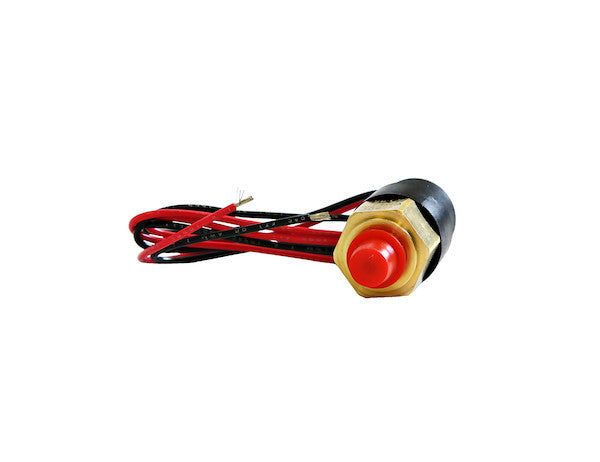
Pressure Switches from Buyers Products monitor your hydraulic system and trigger a signal to let you know when oil pressure is too high or too low. They install in any 1/8 in. NPT port. Choose from switches preset at either 15 PSI or 25 PSI.
Specifications
| Adjustable | No |
|---|---|
| Pressure Setting | 15 |
| Proof Pressure | 300 |
| Style | N.O. (SPST) |
| Thread | 1/8 NPT |
Advanced Technical Overview: Pressure Switch Preset At 15 PSI Normally Open
This technical exposition details the operational principles, critical specifications, and broad applications of the Buyers Products Pressure Switch, specifically configured with a preset actuation point of 15 PSI and a Normally Open (N.O.) Single Pole, Single Throw (SPST) contact style. Designed for robust performance in demanding hydraulic environments, this device serves as a pivotal component for system monitoring, safety interlocks, and automated control sequences.
Fundamentals of Pressure Switching Technology
Pressure switches are electromechanical devices engineered to respond to a specific pressure threshold within a fluid system, converting a hydraulic or pneumatic pressure input into an electrical output signal. This signal is typically used to initiate, stop, or modify an electrical circuit, thereby controlling system operations, providing diagnostic feedback, or activating safety mechanisms. The core principle involves a sensing element (e.g., diaphragm, piston, or Bourdon tube) that deforms in proportion to the applied fluid pressure. This deformation is mechanically linked to an electrical contact mechanism. When the pressure reaches a predetermined set point, the mechanism actuates, changing the state of the electrical contacts.
The Buyers Products Pressure Switch is purpose-built for hydraulic systems, where accurate and reliable pressure monitoring is paramount. Its design ensures precise detection of critical pressure deviations, safeguarding machinery and optimizing operational efficiency. The integrated nature of the sensing and switching elements within a compact, durable housing makes it an ideal solution for a wide array of industrial and mobile applications.
The Significance of a 15 PSI Preset Actuation Point
The explicit specification of a 15 PSI (pounds per square inch) preset pressure setting is a critical design feature that defines the switch's intended application and operational reliability. Unlike adjustable pressure switches, which offer flexibility in setting the actuation point, a factory-preset switch provides several distinct advantages:
- Consistency and Reliability: Each unit is calibrated to activate precisely at 15 PSI, ensuring uniform performance across multiple installations and eliminating potential human error associated with field adjustments. This consistency is crucial in applications where precise and repeatable pressure thresholds are required.
- Tamper-Proof Design: The non-adjustable nature prevents unauthorized or accidental alteration of the critical pressure setting, thereby maintaining the integrity of the designed control or safety logic. This is particularly important in safety-critical systems or those requiring regulatory compliance.
- Simplified Installation: With no need for field calibration, installation becomes a straightforward process of connecting the switch to the hydraulic system and the electrical circuit. This reduces installation time and complexity, contributing to overall project efficiency.
- Specific Application Targeting: A 15 PSI set point is often chosen for specific control or warning applications within hydraulic circuits. For instance, it can serve as a minimum lubrication pressure sensor in ancillary systems, a low-pressure warning for certain pilot circuits, or an indicator for a partially clogged filter where a differential pressure of 15 PSI across the filter element signifies a maintenance requirement. It can also be used to confirm the presence of a low but essential pressure, signaling that a component like an accumulator has sufficient pre-charge or that a return line is not completely blocked.
Monitoring for pressure drops below or rises above this 15 PSI threshold is vital. A drop below 15 PSI might indicate insufficient fluid supply, pump cavitation, significant leaks, or component malfunction, leading to potential equipment damage if not addressed promptly. Conversely, while this specific switch is focused on the rising pressure above 15 PSI to close its contacts, an overpressure scenario, though typically monitored by higher-setpoint switches or relief valves, highlights the general importance of understanding system pressure envelopes.
Detailed Analysis of Normally Open (N.O.) SPST Contact Style
The electrical configuration of this pressure switch is defined as Normally Open (N.O.) Single Pole, Single Throw (SPST). Understanding this contact style is fundamental to integrating the switch effectively into control circuits:
- Normally Open (N.O.): In its default, de-energized, or "normal" state (i.e., when the hydraulic pressure applied to the switch is below the 15 PSI set point), the electrical contacts are open, meaning no current can flow through the switch.
- Actuation Behavior: When the hydraulic pressure rises to or exceeds 15 PSI, the internal mechanism of the switch actuates, causing the N.O. contacts to close. This completes the electrical circuit, allowing current to flow.
- Single Pole, Single Throw (SPST): This describes a simple switch with one input terminal and one output terminal. It controls a single circuit and has only two states: open or closed. There are no other alternate paths for current.
Operational Implications of N.O. SPST:
Consider a typical control scenario: a lamp or indicator light is wired in series with the N.O. pressure switch and a power source. When the hydraulic system pressure is below 15 PSI, the switch contacts are open, and the lamp remains off. As the system pressure builds up and reaches 15 PSI, the switch contacts close, illuminating the lamp. This configuration is commonly used for:
- Confirmation of Minimum Pressure: Activating a green indicator light when a minimum operating pressure (15 PSI) is achieved, signaling that a system is ready for operation or that a specific function has enough pressure to proceed.
- Enabling System Functions: As an interlock, the switch can enable a secondary circuit or component (e.g., another pump, a hydraulic cylinder sequence) only when the primary circuit pressure has reached 15 PSI.
- Low-Pressure Alarm Deactivation: In some inverse logic setups, an N.O. switch closing at 15 PSI could deactivate a "low pressure" alarm that was initially active when pressure was below this threshold.
The N.O. configuration provides a clear and unambiguous signal for the attainment of a specific pressure level, making it highly versatile for systems that require verification of minimum pressure conditions before proceeding with subsequent operations or indicating a ready state.
Robustness and Durability: Proof Pressure of 300 PSI
The specified proof pressure of 300 PSI is a critical technical parameter that attests to the mechanical integrity and safety margin of the Buyers Products Pressure Switch. Proof pressure is defined as the maximum pressure that can be applied to the sensing element of a pressure switch without causing permanent deformation, damage, or a shift in the calibrated set point. It represents a safety buffer beyond the nominal operating pressure.
For a switch with a 15 PSI actuation point, a proof pressure of 300 PSI signifies a substantial overpressure capability. This ratio (300 PSI proof / 15 PSI actuation = 20x) indicates that the switch is engineered to withstand significant transient pressure spikes or system anomalies without compromising its long-term reliability or accuracy. In hydraulic systems, pressure fluctuations, surges due to valve actuation, or start-up transients are common. A robust proof pressure ensures that these events do not damage the switch, thereby preventing costly downtime and maintaining system control integrity.
It is important to distinguish proof pressure from burst pressure, which is the absolute maximum pressure the device can withstand before structural failure (e.g., rupture of the housing or sensing element). While burst pressure is higher, proof pressure is the more relevant metric for indicating the practical operational robustness and resilience of the switch under foreseeable, albeit extreme, operating conditions.
Seamless Integration: 1/8 NPT Thread
The 1/8 NPT (National Pipe Taper) thread specification for installation ensures universal compatibility and ease of integration into a vast array of hydraulic systems. NPT threads are a widely adopted standard for tapered pipe threads in North America and globally for fluid power connections:
- Tapered Design: The tapered nature of NPT threads allows for a mechanical interference fit, creating a seal when tightened. This design relies on the flanks of the threads compressing against each other, often supplemented with a thread sealant (like PTFE tape or pipe dope) to ensure a leak-free connection.
- Standardization: 1/8 NPT is a common size for pressure taps, gauge ports, and small instrumentation connections in hydraulic manifolds, pumps, valves, and cylinders. This standardization significantly simplifies design, installation, and maintenance, as appropriate female ports are readily available in most hydraulic components.
- Ease of Installation: The compact size and standard threading allow for quick and secure mounting without requiring specialized tools or adapters, facilitating both new installations and retrofitting into existing systems.
The choice of 1/8 NPT underscores the product's design for practical, reliable application in typical industrial and mobile hydraulic setups where space might be at a premium and robust, leak-proof connections are essential.
Role in Hydraulic System Monitoring and Control
Pressure switches are indispensable components in modern hydraulic systems, providing critical data for system diagnostics, safety, and automation. This 15 PSI N.O. pressure switch can be employed in various sophisticated roles:
- Preventive Maintenance: By monitoring low-end pressure thresholds, the switch can signal impending filter blockage (via a differential pressure switch, where this switch acts as one component), low fluid levels, or pump wear long before catastrophic failure occurs. Early detection allows for scheduled maintenance, reducing unplanned downtime and repair costs.
- Safety Interlocks: In applications where a minimum hydraulic pressure is required for safe operation (e.g., ensuring clamp pressure before machining begins, or confirming brake accumulator charge before vehicle movement), the N.O. switch can serve as a critical safety interlock. If pressure is below 15 PSI, the contacts remain open, preventing dangerous machine operation.
- Automation and Sequence Control: The switch can act as a condition sensor in automated sequences. For example, it can signal a Programmable Logic Controller (PLC) that a specific part of a hydraulic cycle has reached sufficient pressure to proceed to the next step, ensuring proper sequencing and preventing operational errors.
- Alarm Generation: Directly or indirectly, the switch can activate visual (lights) or audible (buzzers, horns) alarms when the system pressure reaches 15 PSI. This is particularly useful as a "system ready" indicator or as a confirmation of a process step.
- Pump Control: In some systems, a pressure switch might be used to cycle a smaller auxiliary pump or a specific section of a multi-stage pump, activating it once a certain pressure threshold is met or exceeded to maintain pressure.
Buyers Products Commitment to Quality and Performance
Buyers Products is renowned for its commitment to engineering high-quality, durable, and reliable components for the truck and trailer equipment industry, which extends to their hydraulic system accessories. Their pressure switches are manufactured to rigorous standards, utilizing robust materials and precision assembly techniques to ensure long-term performance in harsh operating environments. The focus on reliable pressure monitoring helps customers maintain optimal system health, extend equipment lifespan, and ensure operational safety.
The choice of a non-adjustable, factory-calibrated switch at 15 PSI reflects an understanding of specific industry needs where consistency and tamper-proof operation are paramount. This precision engineering minimizes variations and maximizes confidence in the switch's functionality.
Typical Applications Scenarios
Given its specific 15 PSI N.O. configuration, this pressure switch finds application in numerous scenarios:
- Mobile Hydraulics: Ensuring minimum pilot pressure in valve control systems before main functions engage. Monitoring lubrication pressure in auxiliary drives or gearboxes integrated with hydraulic systems.
- Industrial Machinery: Activating warning indicators when minimum system pressure is achieved for presses, lifts, or clamping mechanisms. Detecting filter bypass conditions where a pressure drop of 15 PSI across a filter might indicate clogging (in conjunction with another switch).
- Off-Highway Equipment: Signalling operational readiness in hydraulic braking systems or steering assist systems once adequate pressure is established.
- Material Handling: Confirming sufficient pressure for hydraulic clamping or lifting mechanisms before movement sequences are initiated.
- Lubrication Systems: Monitoring oil pressure in low-pressure lubrication circuits, signaling that lubricant flow has reached the required minimal operational pressure to prevent wear.
The versatility of this specific switch, designed for low-pressure sensing with a clear Normally Open signal, makes it an invaluable asset for engineers and system integrators seeking precise control and reliable feedback in their hydraulic designs.
Conclusion
The Buyers Products Pressure Switch, preset at 15 PSI with a Normally Open (SPST) contact configuration, represents a precisely engineered solution for critical hydraulic system monitoring. Its non-adjustable nature ensures consistent and reliable performance, eliminating calibration complexities and enhancing system integrity. The robust 300 PSI proof pressure provides significant protection against transient pressure events, while the standard 1/8 NPT thread simplifies integration.
By providing a clear electrical signal upon reaching or exceeding the 15 PSI threshold, this switch enables sophisticated control strategies, enhances safety interlocks, and contributes significantly to proactive maintenance regimes. For applications demanding accurate low-pressure sensing and a reliable N.O. output, this pressure switch from Buyers Products stands as a testament to quality, durability, and precise engineering, ultimately contributing to the longevity, efficiency, and safety of hydraulic machinery.