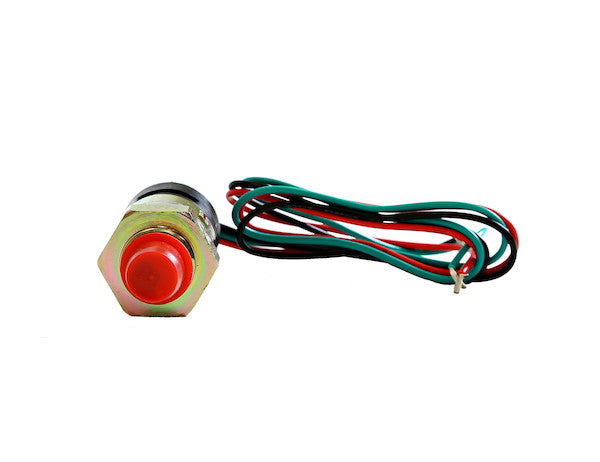
Pressure Switches from Buyers Products monitor your hydraulic system and trigger a signal to let you know when oil pressure is too high or too low. They install in any 1/8 in. NPT port. Choose from switches preset at either 15 PSI or 25 PSI.
Specifications
| Adjustable | Yes |
|---|---|
| Pressure Setting | 25 |
| Proof Pressure | 300 |
| Style | N.O. (SPST) |
| Thread | 1/8 NPT |
The Buyers Products Pressure Switch, meticulously engineered and factory-preset at 25 PSI with a Normally Open (N.O.) Single Pole Single Throw (SPST) contact configuration, represents a critical component in the precise monitoring and control of hydraulic and pneumatic systems. This device is designed to provide instantaneous and reliable electrical signals based on the detection of a specific pressure threshold, acting as an indispensable safeguard and operational facilitator within a myriad of industrial and mobile applications. Its robust construction and adherence to exacting performance standards ensure optimal functionality and longevity, even in the most demanding operational environments. The integration of such a high-quality pressure switch contributes significantly to system efficiency, safety, and the prevention of costly downtime associated with unsupervised pressure anomalies.
At its core, a pressure switch operates on the principle of converting mechanical pressure into an electrical signal. This particular model, preset to 25 PSI, utilizes a highly sensitive internal sensing element, typically a diaphragm or piston, which deflects or moves in response to changes in system pressure. This mechanical movement is precisely calibrated to actuate a snap-action electrical switch when the hydraulic or pneumatic pressure reaches or exceeds 25 PSI. The "Normally Open" (N.O.) configuration means that under conditions where the pressure is below 25 PSI, the electrical contacts within the switch remain open, effectively breaking the circuit. Once the pressure reaches or surpasses the 25 PSI set point, the internal mechanism closes the contacts, thereby completing the circuit and allowing electrical current to flow. This behavior is fundamental for applications requiring an indication or activation when a minimum pressure has been achieved, or when a specific operational pressure threshold has been crossed from a lower state.
The specification of a "Preset At 25 PSI" indicates that this pressure switch is factory-calibrated to trip precisely at this pressure point, ensuring consistent and accurate performance without the need for field adjustment. While the product specifications table mentions "Adjustable: Yes," for this specific SKU, the primary characteristic is its fixed 25 PSI activation point, optimized for immediate deployment in applications where this exact threshold is critical. This factory pre-calibration eliminates potential human error during setup, guarantees repeatability, and simplifies installation by making the unit plug-and-play for its intended pressure-sensing task. This precision is vital in scenarios where maintaining a minimum operational pressure is crucial for equipment function or safety, such as confirming pump output, ensuring proper lubrication flow, or signaling the adequate pressurization of an accumulator or hydraulic line.
The "Normally Open (N.O.) SPST" contact style is a deliberate design choice that caters to specific control philosophies. SPST, or Single Pole Single Throw, describes a switch with one input terminal (pole) and one output terminal (throw), meaning it simply makes or breaks a single circuit path. With an N.O. configuration, the switch contacts are open when the system pressure is below the 25 PSI set point. They close only when the pressure reaches or exceeds 25 PSI. This is invaluable for triggering alarms, indicator lights, relays, or solenoids upon reaching a specific pressure. For example, it could activate a "System Pressure OK" light, initiate the next phase in an automated process once a hydraulic cylinder has built sufficient pressure, or confirm the satisfactory operation of a pump. Its straightforward operation makes it easy to integrate into existing electrical control circuits, minimizing complexity and maximizing reliability.
Another critical specification is the "Proof Pressure" of 300 PSI. This rating signifies the maximum pressure that the switch can withstand without suffering permanent damage or a detrimental shift in its calibration accuracy. It is distinct from the operational set point (25 PSI) and the maximum working pressure, indicating the structural integrity and resilience of the switch's sensing element and housing under transient pressure spikes or occasional over-pressurization conditions. A proof pressure significantly higher than the set point provides a substantial safety margin, ensuring the device remains functional and reliable even when subjected to temporary pressures well above its activation threshold. This robustness is essential for longevity and preventing catastrophic failures in dynamic hydraulic or pneumatic environments where pressure fluctuations are common.
The "1/8 NPT" thread type specifies the standard connection interface for this pressure switch. NPT, or National Pipe Taper, is a widely adopted standard for sealing threaded pipe connections in North America. The 1/8-inch size denotes a compact and versatile connection suitable for a broad range of hydraulic and pneumatic lines where direct, secure mounting into an existing port is required. This universal threading ensures compatibility with numerous fittings, manifolds, and system components, facilitating straightforward installation and reducing the need for specialized adapters. Proper installation with appropriate thread sealant is crucial to ensure a leak-free connection, thereby maintaining system integrity and the accurate functioning of the pressure switch itself.
The design and construction of this Buyers Products pressure switch prioritize durability and performance. Key materials are selected for their resilience against common hydraulic fluids, environmental factors, and mechanical stresses. The housing is typically constructed from robust metals such such as brass or stainless steel, offering excellent corrosion resistance and mechanical strength. Internal components, including the sensing element and electrical contacts, are chosen for their precision and ability to withstand repeated actuation cycles. The diaphragm or piston material, often made from high-grade elastomers or metallic alloys, is crucial for accurate pressure sensing and resistance to chemical degradation from hydraulic oils or pneumatic gases. The snap-action mechanism is engineered for crisp, consistent switching, minimizing contact bounce and maximizing electrical contact life. This meticulous attention to material selection and construction details contributes directly to the switch's long-term reliability and accuracy in demanding industrial settings.
Applications for a 25 PSI Normally Open pressure switch are extensive and span across numerous industries. In hydraulic power units, it can be used to monitor the minimum pressure in a return line or low-pressure auxiliary circuit, indicating proper fluid circulation. It's invaluable in lubrication systems to confirm that oil pressure has reached an adequate level before machinery is allowed to operate, preventing costly damage due to insufficient lubrication. Within mobile equipment, such as construction vehicles, agricultural machinery, or refuse trucks, it can confirm the engagement of specific hydraulic functions or provide an early warning of low system pressure. It can also be integrated into pneumatic systems, though 25 PSI is a relatively low threshold for typical air systems, it can still serve to monitor very low pressure zones or vacuum break points if configured appropriately. Furthermore, it plays a role in safety interlock systems, ensuring that certain operations cannot proceed until a specified pressure condition has been met, thereby protecting personnel and equipment.
Proper installation and maintenance are paramount to maximizing the operational life and accuracy of any pressure switch. When installing the 1/8 NPT thread, it is essential to use a suitable thread sealant, such as PTFE tape or liquid pipe thread sealant, to ensure a hermetic seal and prevent leaks. Care should be taken not to overtighten the switch, as this can damage the threads or deform the switch housing, affecting its calibration or structural integrity. Electrical connections should adhere to applicable standards, ensuring proper wire gauge for the current load and adequate insulation. The switch should be mounted in a location that minimizes exposure to excessive vibration, extreme temperatures outside its specified operating range, and direct impact, all of which can degrade performance over time. While this specific model is factory-preset and generally not field-adjustable, periodic checks of system pressure against the switch's activation point can confirm its continued accuracy. In the event of suspected malfunction, troubleshooting typically involves verifying system pressure independently and checking the electrical continuity of the switch contacts.
Advantages of opting for a factory-preset pressure switch like this 25 PSI N.O. model are significant. The most prominent benefit is the elimination of field calibration, which saves time during installation and reduces the potential for human error. Operators can be confident that the switch will activate consistently at the specified pressure point, ensuring uniform performance across multiple units and installations. This consistency is crucial for critical applications where deviations from the set point could lead to operational inefficiencies or safety hazards. Furthermore, the robust design and the high proof pressure rating contribute to an extended service life and reduced maintenance requirements. Buyers Products is known for delivering components that meet rigorous performance criteria, and this pressure switch is no exception, offering a reliable, cost-effective solution for precision pressure monitoring.
Delving deeper into technical aspects, characteristics like hysteresis, repeatability, and response time are vital for understanding a pressure switch's behavior. Hysteresis, also known as deadband, refers to the difference between the pressure at which the switch activates (closes) and the pressure at which it deactivates (opens) as pressure is decreased. While the exact hysteresis for this model is not explicitly listed, a well-engineered switch will have a controlled and predictable deadband to prevent rapid cycling around the set point, which can wear out contacts and associated electrical components. Repeatability is the switch's ability to activate at the same pressure point consistently over many cycles, a crucial metric for ensuring long-term reliability and precise control. This Buyers Products switch is designed for high repeatability, providing dependable operation over its lifespan. The response time, or the speed at which the switch reacts to a pressure change, is typically very fast for mechanical snap-action switches, making them suitable for real-time monitoring and control where immediate action upon reaching the threshold is necessary. Consideration of the electrical ratings (voltage and current) for the SPST contacts is also essential to ensure compatibility with the control circuit it is integrated into, preventing overloading of the switch contacts and potential failure.
In summary, the Buyers Products Pressure Switch preset at 25 PSI with a Normally Open (SPST) configuration is a precisely engineered, durable, and reliable instrument designed for critical pressure monitoring in hydraulic and pneumatic systems. Its factory-calibrated 25 PSI set point offers immediate, consistent, and accurate activation, simplifying system integration and enhancing operational safety and efficiency. The Normally Open contact ensures a clear signal upon reaching or exceeding the threshold, making it ideal for activation of indicators, alarms, or control sequences. With a robust 300 PSI proof pressure and a standard 1/8 NPT connection, this switch is built to withstand demanding industrial environments and integrate seamlessly into a wide array of machinery. For engineers, system designers, and maintenance professionals seeking a dependable and precisely set pressure sensing solution to safeguard their equipment and optimize performance, this pressure switch stands as an exemplary choice, reflecting Buyers Products' commitment to quality and functional excellence. Invest in precision, reliability, and peace of mind for your hydraulic and pneumatic applications by choosing this high-performance pressure switch.