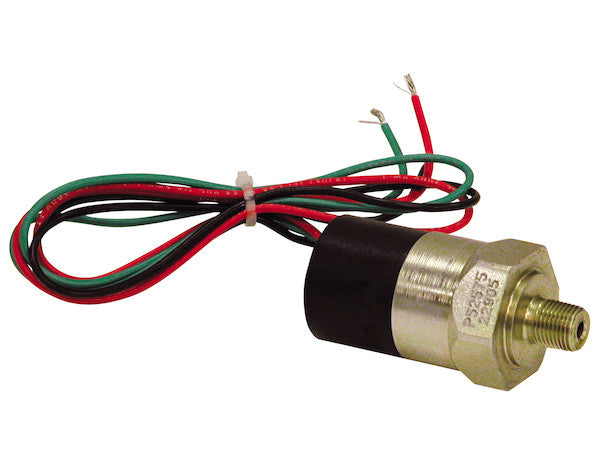
Adjustable Pressure Switches from Buyers Products can be custom set to a specific PSI. They trigger a signal when oil pressure is too low or high. The unit can be wired normally open or normally closed. Two models are available: - PS2575 is adjustable between 25-75 PSI and fits in any 1/8 in. NPT port. - PS2501K is adjustable between 250-1,000 PSI and fits a 1/4 in. NPT port (ideal for high pressure lines).
Specifications
| Adjustable | Yes |
|---|---|
| Pressure Setting | 25-75 |
| Proof Pressure | 1000 |
| Style | N.O./N.C. (SPDT) |
| Thread | 1/8 NPT |
Advanced Technical Overview: The 1/8 Inch NPT Adjustable Pressure Switch (25-75 PSI)
In countless industrial, mobile, and process control applications, the precise monitoring and control of fluid pressure are paramount for operational safety, equipment longevity, and system efficiency. The 1/8 Inch NPT Adjustable Pressure Switch, specifically the PS2575 model from Buyers Products, represents a critical component engineered to provide reliable pressure detection within a sensitive range of 25 to 75 PSI. This device is not merely a switch; it is a meticulously designed instrument offering adaptability and robust performance for demanding environments. Its capacity to be custom set to specific pressure thresholds, combined with its versatile Normally Open (N.O.) or Normally Closed (N.C.) wiring options, makes it an indispensable tool for a wide array of pressure-critical systems.
Core Principles of Operation and Design
At its foundation, the adjustable pressure switch operates on a straightforward electromechanical principle: a change in fluid pressure is converted into a mechanical displacement, which in turn actuates an electrical switch. For the PS2575, designed for the 25-75 PSI range, this typically involves a sensing element such as a diaphragm or a piston. As fluid pressure increases or decreases, it exerts force on this sensing element. This force is then mechanically linked to a precision microswitch. The PS2575 model incorporates an adjustable spring mechanism. This spring applies a counter-force to the sensing element. By adjusting the tension of this spring, the precise pressure point at which the microswitch actuates can be calibrated within the specified 25 to 75 PSI range. This adjustability is crucial, allowing the switch to be finely tuned to the unique operational parameters and safety requirements of diverse systems, ensuring optimal protection and control.
The inherent design often incorporates a robust housing, typically crafted from materials like brass or stainless steel, to withstand the mechanical stresses and environmental conditions encountered in industrial settings. The internal components, including the diaphragm or piston, are selected for their durability, chemical compatibility with the intended fluid (e.g., hydraulic oil, air, water), and resistance to fatigue over prolonged operational cycles. The electrical contacts within the microswitch are engineered for reliability, capable of handling specified electrical loads and resisting arc erosion to ensure a long operational lifespan.
Key Technical Specifications and Their Implications
Adjustable Pressure Setting (25-75 PSI)
The core utility of the PS2575 lies in its adjustability. A pressure range of 25 to 75 PSI is common in many low-to-medium pressure hydraulic and pneumatic systems, as well as lubrication circuits and certain engine oil pressure applications. This adjustability empowers engineers and technicians to precisely define the trip point where an action is required. For instance, in a lubrication system, setting the switch to trigger at 30 PSI could signal critically low oil pressure, prompting a shutdown or alarm. Conversely, setting it at 70 PSI could indicate an overpressure condition in a pneumatic line due to a faulty regulator or blocked exhaust. The ability to fine-tune this set point on-site significantly reduces inventory requirements for fixed-setting switches and provides unparalleled flexibility during system commissioning and optimization.
1/8 Inch NPT Thread
The 1/8 inch National Pipe Taper (NPT) thread connection is a widely recognized standard in North America for joining pipes and fittings. Its tapered design creates a metal-to-metal seal when properly tightened, often augmented with thread sealant (such as PTFE tape or pipe dope) to ensure a leak-proof connection, particularly important in fluid power applications. The 1/8 NPT size indicates compatibility with a vast range of existing ports and adapters, simplifying integration into new or legacy systems without requiring specialized tooling or custom fittings. This standardization reduces installation complexity and cost, making the PS2575 a highly adaptable component for diverse machinery and infrastructure.
Proof Pressure (1000 PSI)
The specified proof pressure of 1000 PSI is a critical safety and reliability parameter. Proof pressure is defined as the maximum pressure that can be applied to the sensing element of the switch without causing permanent damage or a shift in its set point. While the operational range of the PS2575 is 25-75 PSI, its ability to withstand transient pressure spikes up to 1000 PSI provides a substantial safety margin. This is particularly important in hydraulic systems where pressure surges (water hammer effect) can momentarily exceed normal operating pressures. A high proof pressure ensures that the switch remains functional and accurate even after exposure to such events, safeguarding the monitored system and preventing unexpected failures or false readings.
Switch Style: N.O./N.C. (SPDT)
The PS2575 features a Single-Pole, Double-Throw (SPDT) switch configuration, offering both Normally Open (N.O.) and Normally Closed (N.C.) contact options.
- Normally Open (N.O.): In this configuration, the electrical circuit is open (no current flows) when the sensed pressure is below the set point. When the pressure reaches or exceeds the set point (or drops below, depending on switch activation logic and adjustment), the switch closes, completing the circuit.
- Normally Closed (N.C.): Conversely, in the N.C. configuration, the circuit is closed (current flows) when the sensed pressure is below the set point. When the pressure reaches or exceeds the set point, the switch opens, breaking the circuit.
The SPDT functionality is invaluable for system designers, providing unparalleled flexibility for various control strategies. For example, an N.O. contact might be used to activate an alarm light when pressure drops too low, while an N.C. contact could be used to de-energize a pump motor, initiating a system shutdown under the same low-pressure condition. This dual capability allows a single switch model to serve multiple roles, simplifying inventory and standardizing component selection across different applications.
Applications and Industry Relevance
The versatility and robust design of the 1/8 Inch NPT Adjustable Pressure Switch (25-75 PSI) make it suitable for a vast array of applications across numerous industries:
- Mobile Hydraulic Systems: Essential for monitoring hydraulic oil pressure in construction equipment, agricultural machinery, refuse vehicles, and utility trucks. It can signal low pump pressure, indicate a clogged filter, or confirm proper actuation pressure for implements and attachments.
- Engine Lubrication Systems: Critical for ensuring adequate oil pressure to prevent catastrophic engine damage. Set points within the 25-75 PSI range are typical for engine oil pressure warning systems, activating dashboard indicators or initiating engine shutdown sequences.
- Pneumatic Control Systems: Used in industrial automation to verify minimum or maximum air pressure in air lines, ensuring correct operation of pneumatic cylinders, valves, and tools. It can trigger alarms for compressor failures or pressure drops due to leaks.
- Industrial Process Control: Employed in manufacturing plants for monitoring fluid pressure in various processes, such as cooling circuits, solvent lines, or low-pressure chemical injection systems, providing crucial feedback for process stability and safety.
- Pump Protection: Can be integrated into pump control circuits to detect run-dry conditions (low suction pressure) or dead-head conditions (high discharge pressure), protecting pumps from damage and extending their lifespan.
- Filtration Systems: Monitors differential pressure across filters. While directly measuring system pressure, changes in pressure can indirectly indicate filter clogging, signaling a need for maintenance or backwash cycles.
- Specialized OEM Equipment: Its compact size and adjustability make it ideal for integration into original equipment manufacturing designs where precise, customizable pressure sensing is required without significant space allocation.
Installation, Calibration, and Maintenance
Installation
Proper installation is paramount to the reliability and longevity of any pressure switch.
- Port Preparation: Ensure the 1/8 NPT port is clean and free of debris.
- Thread Sealant: Apply an appropriate thread sealant (e.g., PTFE tape or liquid pipe sealant rated for the system fluid and pressure) to the male threads of the switch. Ensure sealant does not enter the pressure port opening, as it could contaminate the system or foul the sensing element.
- Torque: Carefully thread the switch into the port. Hand-tighten until snug, then use a wrench to tighten an additional 1 to 2 turns, or according to manufacturer specifications, to achieve a leak-tight seal. Avoid over-tightening, which can damage the threads or the switch body.
- Orientation: Consider the physical orientation, especially in environments with high vibration or where specific drainage is required for condensation or contaminants.
- Electrical Wiring: Connect the electrical terminals according to the system's wiring diagram. Ensure proper grounding where required. The SPDT contacts typically offer three terminals: Common, Normally Open, and Normally Closed. Verify the correct connection for the desired N.O. or N.C. operation.
Calibration and Adjustment
The adjustability of the PS2575 is a key feature, requiring careful calibration.
- System Isolation: Isolate the pressure line where the switch is installed and relieve any residual pressure.
- Pressure Reference: Connect a calibrated pressure gauge (a master gauge) to the same pressure line or a test port adjacent to the switch. This gauge will serve as the reference for accurate setting.
- Adjustment Mechanism: The adjustment mechanism is typically an external screw or knob, often located under a protective cover.
- Iterative Adjustment: Gradually increase or decrease the system pressure (depending on whether you’re setting a rising or falling pressure trip point) while observing the reference gauge and the electrical response of the switch (e.g., using a multimeter on the contacts, or observing the system reaction like an alarm). Adjust the setting screw incrementally until the switch actuates at the desired pressure threshold.
- Verification: Cycle the pressure multiple times to verify the repeatability and accuracy of the set point. Note any hysteresis (the difference between the trip point on rising pressure and falling pressure), which is inherent in mechanical switches but should be within acceptable limits for the application.
Maintenance
Pressure switches like the PS2575 are generally low-maintenance devices.
- Periodic Inspection: Visually inspect the switch and its wiring for signs of physical damage, corrosion, or loose connections during routine system maintenance.
- Functionality Test: Periodically verify the switch’s trip point against a calibrated gauge to ensure its accuracy has not drifted over time due to wear or environmental factors.
- Environmental Protection: Ensure any protective covers are secure to prevent ingress of dust, moisture, or chemicals, especially in harsh environments.
Comparison with Higher Pressure Models (PS2501K)
While this detailed overview focuses on the PS2575 model (25-75 PSI, 1/8 NPT), it’s important to acknowledge the availability of complementary models like the PS2501K (250-1,000 PSI, 1/4 NPT). This higher-range model is engineered for significantly more demanding applications, such as high-pressure hydraulic main lines, industrial presses, or heavy-duty power units. The difference in pressure range, proof pressure, and thread size (1/4 NPT being more common for higher flow and pressure lines) highlights Buyers Products’ commitment to offering a comprehensive suite of pressure monitoring solutions tailored to specific performance requirements. The fundamental principles of adjustability and SPDT functionality remain consistent, providing a familiar and reliable operational experience across the product line.
Conclusion
The 1/8 Inch NPT Adjustable Pressure Switch, with its 25-75 PSI range, stands as a testament to precision engineering in critical pressure monitoring. Its robust construction, field-adjustable set point, and versatile SPDT contact configuration make it an indispensable component for ensuring safety, optimizing performance, and preventing costly downtime across a broad spectrum of industrial and mobile applications. From safeguarding intricate hydraulic circuits to providing vital feedback in engine lubrication systems, this switch offers a reliable and adaptable solution for maintaining operational integrity. Investing in such a high-quality, adjustable pressure switch from Buyers Products ensures that your systems are equipped with a dependable mechanism for critical pressure detection and control, enhancing both efficiency and longevity.