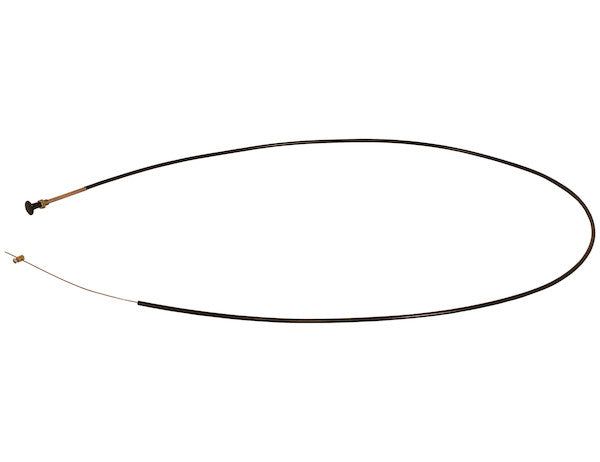
The R29C Series Choke Cable by Buyers Products works for most choke applications and is available in four lengths. The core is made from oil-tempered steel for added strength.
Specifications
| Knob Material | Polymer |
| Conduit Diameter | - " |
| Rod End Thread Size | - " |
| Conduit Material | PVC |
| Bulkhead Thread Size | - " |
| Knob Thread Size | - " |
| Total Travel (in.) | 2.5 " |
| Cable Length (ft.) | 10 ' |
| Mount Thread Size (in.) | 3/8-24 " |
| Cable Core Material | Oil Tempered Steel |
| Cable Series | R21C Series |
| Cable Dia (in.) | 0.055 " |
Advanced Engineering and Performance of the 10-Foot Choke Cable
The 10-foot choke cable, a critical component in the operational efficacy of various internal combustion engines, represents a confluence of robust material science and precision engineering. This particular model, epitomized by the R29C Series from Buyers Products and drawing specific technical attributes from the R21C Series, is meticulously designed to provide reliable and consistent choke control across a broad spectrum of demanding applications. Its extended 10-foot length, coupled with a highly durable oil-tempered steel core and resilient PVC conduit, positions it as an exemplary solution for complex routing scenarios where extended reach and unwavering performance are paramount.
Fundamental Role of the Choke Cable in Engine Management
To fully appreciate the engineering behind this 10-foot choke cable, it is essential to understand the fundamental role of the choke mechanism itself. In carbureted internal combustion engines, the choke system is responsible for enriching the air-fuel mixture during cold start conditions. When an engine is cold, gasoline does not atomize as efficiently, leading to a lean mixture that can prevent the engine from starting or running smoothly. The choke mechanism, typically a butterfly valve located in the carburetor's air intake, partially restricts airflow, thereby increasing the vacuum across the main jet and drawing more fuel into the engine cylinders. This results in a richer mixture, facilitating easier starting and smoother initial operation until the engine reaches its optimal operating temperature. The choke cable serves as the mechanical linkage between the operator's control (the polymer knob) and this critical carburetor component, demanding precise actuation, robust construction, and minimal friction to ensure consistent and reliable engine performance.
Material Science Excellence: The Oil-Tempered Steel Core
At the heart of this choke cable’s exceptional performance lies its 0.055-inch diameter core, fabricated from high-grade oil-tempered steel. Oil tempering is a heat treatment process that involves heating the steel to an austenitizing temperature, quenching it in oil, and then tempering it at a lower temperature. This specific thermal process imparts several critical properties to the steel, making it ideal for high-stress, dynamic applications like control cables:
- Superior Tensile Strength: Oil-tempered steel exhibits significantly higher tensile strength compared to untreated or conventionally hardened steels. This enhanced strength ensures the cable can withstand the tensile forces exerted during repeated pulling and pushing actions without yielding or fracturing.
- Exceptional Fatigue Resistance: Control cables are subjected to cyclical loading, which can lead to material fatigue over time. The microstructure produced by oil tempering enhances the steel’s resistance to fatigue, dramatically extending the operational lifespan of the core even under frequent actuation.
- Optimized Ductility and Toughness: While strengthened, the oil-tempering process also maintains a degree of ductility, preventing the steel from becoming excessively brittle. This balance of strength and toughness allows the core to absorb shocks and minor deformations without catastrophic failure, crucial for dynamic cable systems.
- Dimensional Stability: The heat treatment process helps stabilize the steel's dimensions, reducing the likelihood of permanent elongation or shortening over time due to mechanical stress or temperature fluctuations.
- Corrosion Resistance (Enhanced): Although primarily housed within a conduit, the inherent properties of oil-tempered steel offer improved resistance to surface oxidation compared to milder steels, contributing to long-term reliability.
The precise 0.055-inch diameter of the core represents an optimized balance between strength and flexibility. A larger diameter would increase rigidity, making routing more challenging, while a smaller diameter might compromise tensile strength and fatigue life. This dimension ensures the cable can transmit the required force to the carburetor while remaining sufficiently pliable for installation in varied configurations.
Protective and Performance-Enhancing PVC Conduit
Encasing the robust oil-tempered steel core is a durable PVC (Polyvinyl Chloride) conduit. The conduit's primary function is multifaceted:
- Physical Protection: It shields the steel core from external environmental contaminants such as dirt, moisture, dust, and corrosive agents, which could otherwise impede smooth operation or accelerate wear and corrosion.
- Mechanical Protection: The conduit protects the core from abrasion, kinking, and impact damage that can occur during installation or operation in harsh environments.
- Reduced Friction: The smooth internal surface of the PVC conduit, often treated or lined, minimizes friction between the core and the casing, ensuring light and consistent control action. This is paramount for precise choke adjustment.
- Flexibility and Routing: PVC is inherently flexible, allowing the 10-foot cable to be routed around obstacles and through tight spaces without compromising its structural integrity or operational smoothness. The specific formulation of the PVC used in high-quality choke cables is engineered for optimal flexibility across a wide range of temperatures.
- UV and Chemical Resistance: Automotive and industrial applications often expose components to UV radiation, fuels, oils, and other chemicals. The PVC conduit is formulated to resist degradation from these elements, preserving its protective qualities and aesthetic integrity over time.
- Electrical Insulation: While not the primary purpose, PVC's inherent dielectric properties offer a degree of electrical insulation, providing an additional layer of safety in certain applications.
The unspecified conduit diameter implies a design optimized for the 0.055-inch core, balancing protective thickness with external dimension, ensuring adequate mechanical strength without excessive bulk. The quality of the PVC formulation is crucial for longevity, preventing cracking, hardening, or softening under varying operational temperatures and environmental exposures.
Ergonomic and Durable Polymer Knob
The operator interface for this choke cable is a robust polymer knob. The selection of polymer as the knob material is a deliberate engineering choice, offering distinct advantages over traditional metal alternatives:
- Ergonomics and Tactile Feel: Polymers can be molded into ergonomic shapes that are comfortable to grip and operate, even in cold or wet conditions. The material provides a warmer, less conductive feel than metal.
- Corrosion Resistance: Unlike many metals, polymers are inherently resistant to rust and corrosion, making them ideal for outdoor, marine, or damp industrial environments.
- Chemical Resistance: The polymer used is typically selected for its resistance to common automotive and industrial fluids, such as oils, greases, and cleaning agents, ensuring its appearance and structural integrity are maintained.
- UV Stability: High-quality polymers are formulated with UV stabilizers to prevent degradation, discoloration, and embrittlement when exposed to sunlight over extended periods.
- Impact Resistance: Polymers offer a degree of impact resistance, making the knob less susceptible to damage from accidental bumps or drops compared to brittle plastics or softer metals.
- Aesthetic Integration: The polymer knob can be designed to seamlessly integrate with the aesthetic requirements of various vehicle dashboards or equipment control panels, often featuring a standard black finish for universal compatibility.
While the specific knob thread size is not provided, it is engineered for secure attachment to the cable core, ensuring reliable transfer of manual input to the mechanical choke action. The robustness of the polymer ensures that repeated pulling and pushing actions do not compromise the integrity of the knob or its connection to the cable.
Precision Engineering Specifications and Their Implications
Several key specifications highlight the precision engineering inherent in this 10-foot choke cable:
-
Cable Length (10 ft): The 10-foot length is a defining feature, catering to applications requiring significant reach between the control panel and the engine/carburetor. This is particularly common in:
- Larger trucks and buses where the engine is further from the cabin.
- Agricultural machinery (tractors, tillers) where controls might be remote from the engine bay.
- Marine applications, such as center console boats with engines mounted at the stern.
- Industrial equipment like generators, pumps, or compressors that require remote operation.
- Custom vehicle builds (e.g., hot rods, kit cars) where non-standard routing is necessary.
- Total Travel (2.5 inches): The 2.5 inches of total travel is a crucial functional specification. It indicates the maximum linear displacement of the cable core from its fully retracted to its fully extended position. This range is carefully calibrated to be compatible with the throw requirements of most standard choke mechanisms on carburetors. Sufficient travel ensures that the choke butterfly valve can be moved through its full operational arc, from fully open (no choke) to fully closed (maximum choke), allowing for precise adjustment of the air-fuel mixture. Insufficient travel would limit control, while excessive travel could lead to over-stressing the carburetor linkage or leaving the choke partially engaged when not desired.
- Mount Thread Size (3/8-24 inches): The 3/8-24 inch mount thread size is a common standard in automotive and industrial applications. This specification dictates how the cable assembly is securely affixed to a control panel or bulkhead. The 3/8-inch major diameter indicates a robust mounting point, while the 24 threads per inch (fine thread) ensures a strong, vibration-resistant connection. This precise threading facilitates secure installation, preventing rotation or loosening of the cable housing under operational vibrations and stresses.
- Unspecified Dimensions (Conduit Diameter, Rod End Thread Size, Bulkhead Thread Size, Knob Thread Size): While specific values for these dimensions are not provided in the summary, their inclusion as categories underscores their importance in a complete cable system. In practical applications, these dimensions would be critical for ensuring compatibility with existing mounting holes, carburetor linkages, and custom installations. The absence of specific values often indicates either a universal design where these components adapt or a range of available configurations depending on the exact series (e.g., R29C versus R21C) or specific product variant. Regardless, these elements are designed for robust, secure, and precise mechanical interfacing. The rod end thread size, for instance, would be critical for connecting the cable core to the carburetor's choke lever, dictating the type of clevis or linkage required.
Diverse Applications and Versatility
The robust construction and 10-foot length of this choke cable make it highly versatile for a multitude of demanding applications:
- Automotive Industry: Indispensable for classic cars, vintage trucks, and custom builds that rely on carbureted engines. Its length is particularly useful for vehicles with engine bays distant from the dashboard.
- Agricultural Equipment: Found in tractors, cultivators, harvesters, and irrigation pumps where reliable cold starting is essential for productivity in varying weather conditions.
- Marine Sector: Critical for outboard and inboard marine engines, ensuring smooth starting for boats and other watercraft. The PVC conduit offers enhanced resistance to the humid and potentially corrosive marine environment.
- Construction Machinery: Used in portable generators, compactors, and smaller excavators to ensure their engines can be started efficiently on job sites.
- Power Sport Vehicles: Applicable to certain ATV, UTV, and snowmobile models that still utilize manual choke systems.
- Industrial and Utility Equipment: From air compressors to emergency pump systems, where manually controlled engine starting is a functional requirement.
Installation Best Practices and Maintenance for Optimal Longevity
Proper installation and routine maintenance are paramount to maximizing the lifespan and performance of the 10-foot choke cable:
-
Optimal Routing:
- Avoid sharp bends or kinks in the cable, as these create points of high friction and stress, leading to premature wear of both the core and conduit. Maintain the largest possible bend radius.
- Route the cable away from direct heat sources such as exhaust manifolds, turbos, or engine blocks, which can degrade the PVC conduit over time.
- Ensure the cable is clear of all moving engine components (belts, pulleys, fan blades) to prevent abrasion or entanglement.
- Use appropriate cable clamps or ties at regular intervals to secure the cable, preventing it from sagging, vibrating excessively, or chafing against chassis components.
-
Secure Mounting:
- Utilize the 3/8-24 inch threaded mount to firmly secure the cable to the dashboard or bulkhead, ensuring all threads are engaged and the lock nut (if supplied) is tightened to the manufacturer's specifications. This prevents rotational movement and ensures stable operation.
- Ensure that the mounting hole is free of burrs or sharp edges that could damage the conduit.
-
Precise Adjustment:
- After installation, adjust the cable at the carburetor end to ensure full travel (2.5 inches) is utilized for both choke engagement and disengagement.
- Verify that the choke lever on the carburetor moves freely through its full range without binding and that the choke plate fully opens and closes when the knob is actuated.
- Avoid over-tensioning the cable, which can lead to premature wear of the carburetor linkage or the cable itself.
- Lubrication: Periodically, it is beneficial to lubricate the cable core. A light, non-gumming lubricant, such as a silicone-based spray or dry graphite powder, can be applied to the exposed ends of the core or by carefully feeding it into the conduit. This reduces friction and prevents corrosion, especially in damp environments.
- Inspection: Regularly inspect the entire length of the cable and its components for signs of wear, fraying, cracking in the conduit, or loose connections. Address any issues promptly to prevent system failure.
Commitment to Quality and Durability
The design and manufacturing of the R29C Series (and R21C Series) choke cable reflect a steadfast commitment to delivering high-quality, durable components. Buyers Products, known for its rigorous engineering standards, ensures that each cable undergoes stringent quality control processes. This includes testing for tensile strength of the core, fatigue resistance under cyclical loading, and environmental resistance of the conduit and knob materials. Adherence to these standards guarantees a product that not only meets but often exceeds the demanding requirements of its intended applications, providing users with a reliable and long-lasting solution for engine cold-start management.
Conclusion: A Benchmark in Choke Cable Technology
The 10-foot choke cable, with its oil-tempered steel core, resilient PVC conduit, and ergonomic polymer knob, stands as a testament to thoughtful engineering and material selection. Its generous length, coupled with a precise 2.5-inch total travel and robust 3/8-24 inch mount thread, ensures compatibility and superior performance across a diverse range of carbureted engine applications. From the foundational principles of choke mechanism operation to the intricacies of material science behind its components, every aspect of this cable is optimized for durability, reliable actuation, and ease of integration. For professionals and enthusiasts alike who demand uncompromising quality and consistent engine control, this technically advanced choke cable represents a definitive choice, promising dependable operation and extended service life even in the most challenging operational environments.